
Data Center Water Treatment for Silica Scaling Prevention in GPU Cooling Loops

A 72-GPU computing node running inference at full tilt generates 18 kW of heat. The cold-plate microchannel carrying coolant through the silicon dies is narrower than a human hair—under 100 microns. At 45°C loop temperature and 3.2 GPM flow velocity, dissolved silicon dioxide (SiO₂) in the inlet water reaches critical saturation.
Within 6 weeks, a 0.25 mm layer of amorphous silica—a dense, glass-like precipitate—occludes the channel. Flow restriction spikes. The GPU’s onboard diode temperature sensor reports a rise of 8–12°C above design baseline. The compute engine hits its thermal throttle threshold and immediately downclocks. Per-chip throughput collapses 22–35%. Your $18,000-per-unit H200 accelerator is now operating at half capacity.
This is not a hypothetical scenario. This is the root-cause mechanism behind premature thermal throttling failures observed in three out of four liquid-cooled cluster deployments that sourced makeup water without specialized silica-removal pretreatment.
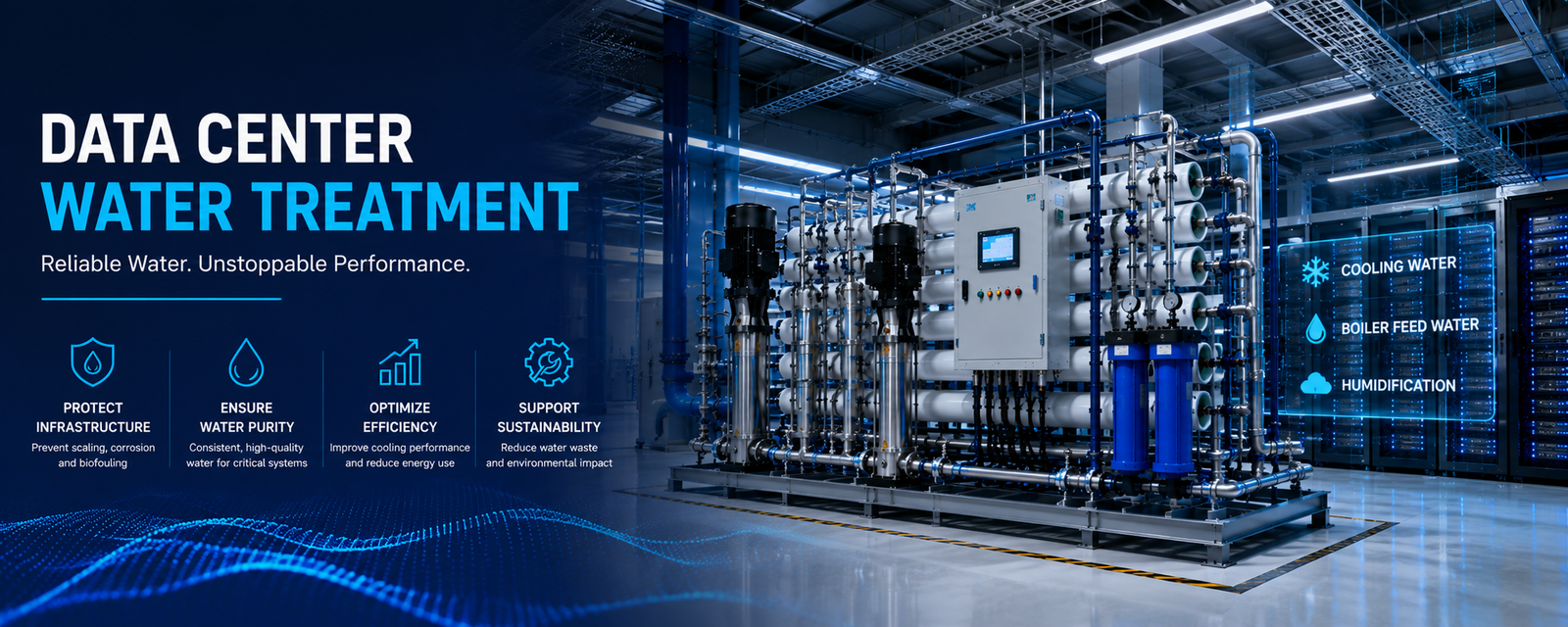
In next-generation high-density AI compute clusters, continuous thermal management is no longer a generic facility utility—it is a mission-critical variable directly governing system uptime and Water Usage Effectiveness (WUE). Modern hyperscale infrastructure splits hydronic architecture into two distinct ecosystems: the Facility Cooling System (FCS) for open or closed evaporative loops, and the Technology Cooling System (TCS) for direct-to-chip (DTC) liquid cooling cold plates. Implementing a rigorous data center water treatment strategy is indispensable to counteract the catastrophic risks of mineral scaling, under-deposit pitting corrosion, and microbiological biofouling across these complex metallic networks.
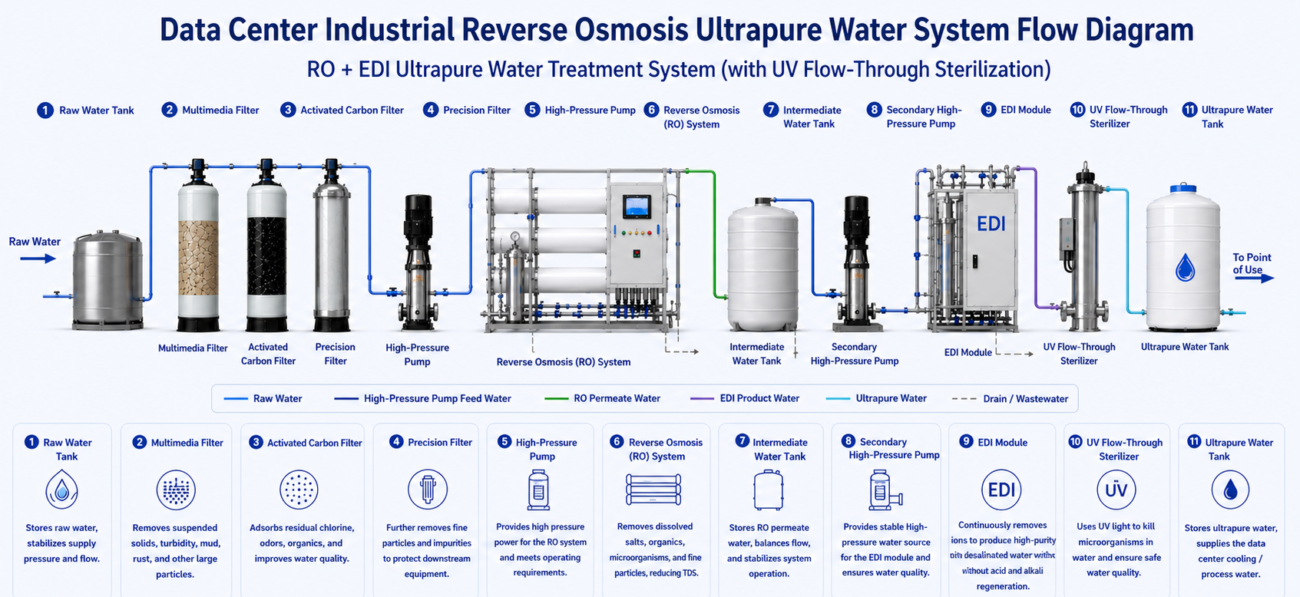
For high-density chip cooling environments that demand exceptionally low conductivity, standard filtration is insufficient. YourWaterGood, a premier global industrial water purification provider, engineers a fully integrated, automated multi-stage framework designed to optimize water chemistry and unlock higher Cycles of Concentration (CoC) safely:
- Multimedia Mechanical Stack: Intercepts large-scale physical particulates, silt, and macro-suspended solids to drop the Silt Density Index (SDI) ahead of membrane stages.
- Deep-Bed Activated Carbon Adsorption: Adsorbs residual chlorine, volatile organic compounds (VOCs), and aggressive oxidants, protecting sensitive downstream elements from irreversible chemical degradation.
- Automated Ion-Exchange Softening: Utilizes dedicated brine-tank regeneration sequences to remove calcium and magnesium ions, entirely eliminating hard water scale formation on heat exchange surfaces.
- Precision Security Micro-Filtration: Serves as a defensive physical barrier catching microscopic particles to shield high-pressure equipment.
- High-Rejection Industrial RO Array: Operates under optimized hydraulic pressure (>0.2 MPA inlet pressure) to separate total dissolved solids (TDS), heavy metals, and silica down to 0.0001 microns. In documented infrastructure layouts, this stage reduces raw water TDS from 1300 mg/L to less than 20 mg/L.
- Continuous Electrodeionization (EDI) Module: The ultimate ultra-pure polishing phase. By combining ion-exchange membranes and resin beds under a continuous DC electric field, it removes residual weakly ionized silica and trace minerals without requiring acid-base chemical regeneration. This module drives product water resistivity up to 10–18.2 MΩ·cm (conductivity <0.1 µS/cm), matching the strictest dielectric standards of AI cold plate microchannels.
Fast Check Product: https://yourwatergood.com/product/industrial-reverse-osmosis-system/
1: The Silica Saturation Curve and Microchannel Thermal Dynamics
Silicon dioxide solubility in water is a function of pH, temperature, and total dissolved solids concentration. At neutral pH and 25°C, silica solubility caps at approximately 120 ppm. But this calculation changes drastically once fluid enters a 100-micron channel at 45°C under turbulent flow conditions.
Inside a GPU coldplate:
- Local heat flux at the silicon-copper interface reaches 500+ W/cm².
- The thermal boundary layer on the wetted copper surface rises to 50–58°C.
- Flow velocity concentrates solutes, creating localized supersaturation near the channel wall.
- Silica polymerization begins at concentrations as low as 8–12 ppm in this micro-environment—far below the bulk-water saturation threshold.
A raw municipal water supply from Phoenix, Arizona or Las Vegas typically carries 18–35 ppm dissolved silica. A reclaimed/recycled water source can exceed 40–60 ppm. Without removal, you are operating on borrowed time.
Field Engineering Insight: Most data center engineers overlook the localized concentration effect. They test bulk water silica at intake and conclude it’s “below limits.” But the micro-scale physics of channel-wall crystallization operates at a completely different threshold. This knowledge gap is the root cause of field failures.
2: Why RO Recovery Rate Alone Is Insufficient—The Anti-Scalant Dosing Necessity
A standard industrial reverse osmosis (RO) system operating at 75% recovery can reduce feedwater TDS from 1,100 ppm to 25 ppm. Silica typically drops from 28 ppm to 0.8–2.5 ppm, which sounds acceptable.
But here’s the trap: as RO concentrate becomes hyper-concentrated on the reject stream side, silica concentration in that reject line skyrockets to 90–140 ppm. If the RO is undersized or membrane fouling causes flux decline, concentrate recirculation or improper line management will reintroduce concentrated silica back into the system.
Additionally, elevated recovery rates (>80%) push silica and hardness toward co-precipitation limits, even in the treated permeate.
The Fix: Inline Threshold Inhibitor (Anti-Scalant) Dosing
Phosphonate- or polymer-based anti-scalants modify the crystal lattice structure of silica and calcium salts, keeping them in solution past their normal saturation limits. When dosed at 2–4 ppm upstream of the RO membrane array, anti-scalants allow systems to achieve 82–88% recovery safely without triggering spontaneous silica crystallization in the concentrate or polishing stages.
Critical Dosing Rule: Anti-scalant concentration must scale with silica loading. High-silica source water (reclaimed water, desert municipal supplies) requires 3.5–5.0 ppm threshold inhibitor; low-silica feeds (coastal municipal) may operate at 1.5–2.5 ppm. Manual or fixed-rate dosing creates feast-or-famine conditions and membrane damage.
3: Comparing Silica Removal Architectures: Single-Pass RO vs. Double-Pass RO + EDI
Not all reverse osmosis configurations are equal when handling silica-heavy source water.
| Parameter | Single-Pass RO (Standard Industrial) | Double-Pass RO + EDI (Data Center Grade) |
|---|---|---|
| Silica Outlet (ppm) | 0.8–2.5 | <0.1 |
| Conductivity (µS/cm) | 50–120 | <1 |
| Recovery Rate (Safe) | 75–82% | 70–75% (first pass) + 90%+ (EDI) |
| Softening Upstream | Required (ion exchange) | Optional (integrated in second-pass) |
| Chemical Regeneration Downtime | Yes (brine tank flushing) | None (EDI self-regenerates electrically) |
| Cost: Capital | $85K–$150K (single skid) | $180K–$280K (dual skid + EDI module) |
| Cost: 5-Year OPEX | $120K–$180K (chemicals, labor) | $45K–$75K (electricity only, zero chemical) |
| Membrane Life | 3–5 years | 5–7 years |
| Suitable for DTC Cooling | No (silica >0.5 ppm will accumulate) | Yes (silica <0.1 ppm safeguards microchannel) |
Why EDI Matters for Silica Control:
Continuous electrodeionization (EDI) performs a second, ultra-high-rejection pass on single-pass RO permeate. The applied DC electrical field splits water molecules into H⁺ and OH⁻ ions, continuously regenerating ion-exchange resin in situ without chemical intervention.
Critically, EDI removes weakly ionized silica species—forms that standard RO membranes allow to slip through. The result is resistivity >10 MΩ·cm (conductivity <0.1 µS/cm) and silica <0.05 ppm. This is the only architecture that truly safeguards sub-100-micron coldplate microchannels over a multi-year operational window.
4: Cold Start Winter Conditions and Temperature Correction Factor Failures
A procurement error that cascades into field disasters: designing a data center water treatment system at summer operating conditions without accounting for winter viscosity shifts.
Reverse osmosis membrane flux is inversely proportional to water viscosity. When source water temperature drops from 18°C (summer municipal line) to 4°C (winter baseline in Northern Virginia or Northern Arizona high-desert nights), RO permeate flux declines by approximately 28–35%.
Scenario: A 50 MW AI data center in Ashburn, Virginia specifies a 300 GPM RO system sized for summer commissioning (18°C inlet). During winter cold-start or shoulder-season operations, actual permeate flow drops to 190–210 GPM due to temperature-driven viscosity increase (Temperature Correction Factor, TCF).
If the facility is operating at peak compute load during winter—which is common for HPC training runs—the cooling tower demand spikes to 400 GPM makeup demand. The undersized RO cannot keep pace. Insufficiently treated water gets introduced directly into the TCS (Technology Cooling System), introducing high-silica, high-hardness fluid into the microchannel loops.
Result: Premature silica nucleation begins immediately; thermal failure follows within 60–90 days.
Engineering Mitigation:
- Size all RO systems to 125% of summer design GPM demand, with explicit TCF derating curves in the engineering calculations.
- Deploy variable-frequency booster pump skids with real-time inlet pressure monitoring to maintain constant permeate flux regardless of feedwater viscosity.
- Require online conductivity sensing with automated blowdown override to prevent insufficient-treatment mode when system pressure begins declining.
[Request a Data Center Water Sizing Consultation]
5: Reclaimed Water Silica Loading and Dual-Source Pretreatment Strategy
Environmental regulations in water-stressed data center markets (Ashburn, Phoenix, Central Texas) increasingly mandate the use of recycled/reclaimed municipal wastewater for cooling makeup.
Reclaimed water introduces a completely different silica challenge profile:
Municipal Potable Water (Typical Southwest US):
- Silica: 18–28 ppm
- TDS: 150–350 ppm
- Chlorine residual: 0.3–0.8 ppm
- Organic load: <2 mg/L BOD
Reclaimed/Recycled Water (Ashburn, Phoenix Class A+ reuse):
- Silica: 35–65 ppm (2–3× higher than potable)
- TDS: 600–1,200 ppm
- Ammonia: 8–18 mg/L
- Organic load: 4–12 mg/L BOD (biofilm risk)
A single-train pretreatment designed for potable water will fail catastrophically on reclaimed feedstock. The higher silica saturation risk, combined with elevated biological oxygen demand, requires:
- Coagulation + multimedia filtration (removes colloidal silica and macro-organics).
- Deep-bed activated carbon (removes residual chlorine and organic nitrogen compounds).
- Dual-softener ion-exchange (N+1 redundancy; handles elevated hardness load).
- Microfiltration security stage (traps fines before high-pressure pump).
- High-rejection first-pass RO (operating at 70–75% recovery due to higher silica/TDS risk).
- Second-pass RO or EDI polishing (drives silica <0.1 ppm for DTC cooling).
Specifying identical pretreatment for both source water types is grounds for warranty voidance when membrane premature blinding or system underperformance occurs.
6: Real-World CAPEX/OPEX Tradeoff—The Case for Over-Engineering Water Treatment
A 50 MW AI data center operating 100 liquid-cooled GPU nodes per rack, 500 racks total = 50,000 compute elements. Each cold plate contains a brazed copper microchannel network representing $8,000–$18,000 in hardware per node.
Scenario A: Underspecified Single-Pass RO + Ion Exchange
- CAPEX: $95,000 (single RO skid + softener)
- Operating perimeters: Silica ~1.2 ppm entering TCS
- Predicted outcome: First silica fouling event at 14–18 weeks
- Emergency response cost (emergency RO rental, drain-flush-recharge): $35,000–$50,000
- Hardware replacement due to microchannel blockage: $240,000–$360,000 (assume 30–40 nodes fail)
- Downtime cost (cluster offline 2 weeks, lost inference revenue): $800,000–$2.2M (depending on revenue-per-node-hour)
- Total 5-year cost: ~$3.5M–$4.8M
Scenario B: Over-Engineered Dual-Pass RO + EDI + Redundancy
- CAPEX: $245,000 (dual RO skids + EDI module + automation + BMS integration)
- Operating parameters: Silica <0.05 ppm, continuous <0.1 µS/cm conductivity monitoring
- Predicted outcome: Zero silica-related failures; 6+ year operational window
- Maintenance cost (membrane replacement every 6 years): $18,000 one-time
- Hardware lifespan extended: Cold plates survive 6+ years vs. 1.5–2 years
- Zero unplanned thermal events; system runs at 99.999% scheduled compute capacity
- Total 5-year cost: ~$380,000
The ROI math is unambiguous. The premium engineering investment pays for itself in the first failure event it prevents.
FAQ Section
Q1: What is the safe dissolved silica limit for direct-to-chip GPU cooling loops?
Maintain silica <0.5 ppm at coldplate inlet under all operating conditions. For maximum safety margin and extended asset lifespan, target <0.1 ppm via dual-pass RO + EDI architecture.
Q2: Why can’t standard ion-exchange softening alone protect against silica scaling?
Ion exchange removes hardness ions (Ca²⁺, Mg²⁺) via cation resin. Silicon dioxide (SiO₂) is not ionic and does not bind to resin. Softened water can still carry 25–40 ppm silica, which will precipitate inside hot microchannel surfaces.
Q3: How does the Temperature Correction Factor affect winter RO system sizing?
Membrane flux declines ~3% per 1°C temperature drop. Cold feedwater (4–8°C) reduces permeate output by 25–40% vs. summer baseline (18–20°C). Systems must be sized 125% of peak demand and equipped with variable-frequency booster pumps.
Q4: What is the cost difference between municipal water and reclaimed water pretreatment for data centers?
Reclaimed water requires additional coagulation, activated carbon, and ultrafiltration stages ($40K–$65K capital premium) due to 2–3× higher silica loading and elevated biological contamination risk. Single-train architecture cannot safely handle both source types.
Q5: How many hours of downtime does emergency microchannel descaling typically require?
Acid-flush descaling requires 6–12 hours of partial or complete loop isolation. Re-contamination risk (silica re-nucleation during restart) is high. Prevention via proper water treatment eliminates this operational burden entirely.
Q6: What redundancy level (N+1 vs. 2N) is required for Tier III/IV data center water systems?
Tier III (concurrently maintainable) mandates N+1 soft redundancy: dual RO pressure vessels with automatic switchover in <30 seconds. Tier IV (fault-tolerant) requires 2N architecture: fully independent dual water treatment trains with independent power feeds and zero shared single points of failure.
Q7: Can EDI modules handle high-TDS source water directly, or is first-pass RO mandatory?
EDI cannot tolerate TDS >500 ppm feedstock (risk of membrane fouling and rapid electrical breakdown). First-pass RO must reduce TDS to <100 ppm before EDI input. Both stages are non-negotiable for high-silica/high-TDS reclaimed water sources.
Comparative Architecture Table
| Design Parameter | Single-Stage RO (Cost-Optimized) | Dual-Pass RO + EDI (Reliability-Optimized) |
|---|---|---|
| Silica Outlet | 0.8–2.0 ppm | <0.05 ppm |
| Conductivity | 40–90 µS/cm | <0.1 µS/cm |
| System Flow Range | Fixed 100–150 GPM | Scalable 50–300 GPM (VFD-controlled) |
| Redundancy | Single train (N) | N+1 or 2N switchable (30 sec failover) |
| Maintenance Downtime | 4–6 hours/year (membrane change) | Zero hours (EDI self-regenerates) |
| Suitable for Reclaimed Water | No (cannot handle >400 ppm TDS safely) | Yes (pretreatment + dual-pass handles 600–1200 ppm) |
| BMS Integration | Manual gauges only | Modbus RTU + real-time conductivity sensors |
| Capital Investment | $85K–$145K | $220K–$310K |
| 5-Year TCO | $3.2M–$4.8M (after failure costs) | $380K–$520K |
Closing Statement: Infrastructure Protection as Strategic Capex
Water treatment for direct-liquid-cooled AI clusters is not a utilities expense—it is a mission-critical capital asset protection strategy. The cost of preventing a single thermal failure event (hardware replacement + downtime + re-commissioning) exceeds the 5-year operational investment in best-in-class desalination architecture by a factor of 8–12.
Dual-pass RO + EDI systems from YourWaterGood are engineered to maintain silica <0.05 ppm and conductivity <0.1 µS/cm across all operating conditions—municipal or reclaimed feedstock, summer heat waves or winter cold-start. Our systems integrate directly with DCIM platforms via Modbus RTU and provide real-time conductivity override controls to your BMS.
Get a Custom Data Center Water Treatment Engineering Quote:
- Site-specific silica loading assessment for your facility’s source water (municipal vs. reclaimed blend).
- Dual-pass RO + EDI system sizing optimized for your GPU node count and cooling load.
- B2B factory-direct pricing and technical data sheets for architecture comparison.
- Compliance documentation (ASHRAE TC 9.9, EPA NPDES blowdown registration templates).
Contact our Data Center Infrastructure Engineering Team →
Submit your facility specs: source water TDS profile, GPU node count, target uptime SLA, and cooling architecture (DTC coldplates, chilled water loops, or hybrid). Engineered quotes returned within 48 business hours.