
Why Deionized Water Alone Can Corrode Your AI Cooling Loop — And How to Engineer Around It

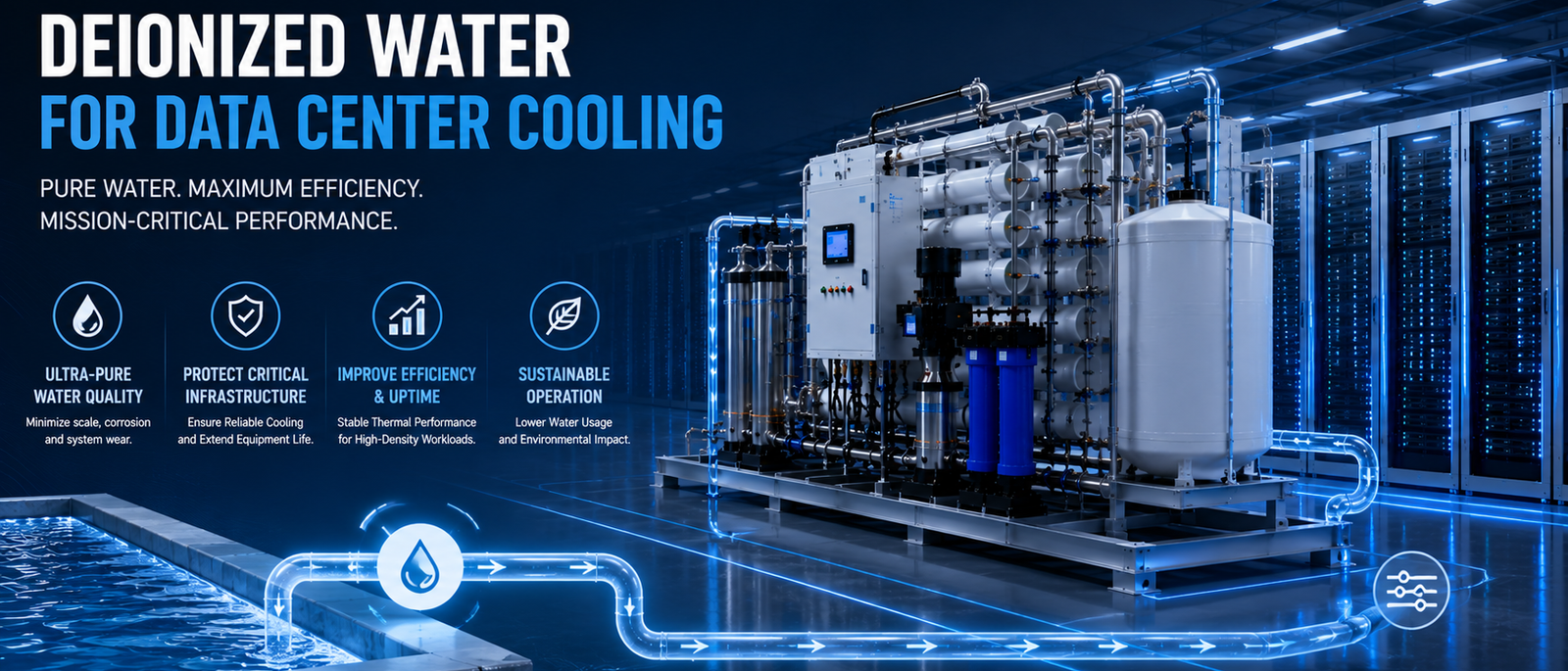
Rack densities north of 60 kW are outrunning what air-cooled CRAH units were ever designed to handle. Direct-to-chip liquid cooling and rear-door heat exchangers have moved the failure point from the air handler to the water itself — and the water in that loop is no longer a passive coolant. It’s a chemistry problem with a service-level agreement attached.
Deionized water for data center cooling is the default answer facility teams reach for once they hear “conductivity” and “corrosion” in the same sentence. It’s also the water chemistry most often specified incorrectly, because “more pure” is treated as “more safe” — and in a closed metallic loop, that assumption fails.
Before you sign off on a vendor for loop fill, top-off, or commissioning water, lock down these five specs:
- Resistivity band, not a single number. Specify a target range (typically 1–5 MΩ·cm for mixed-metal closed loops), not “as pure as possible” — see below for why.
- Batch fill capacity in gallons, not GPM alone. A cooling tower vendor thinks in continuous flow; a DI system for loop fill has to be sized around one-time and top-off volumes.
- Redundant resin or EDI trains (N+1). A single exhausted resin bed should never be the reason a CDU can’t be refilled after maintenance.
- Onsite or mobile exchange capability. Can the vendor deliver a swap tank to a live campus within your maintenance window, or only ship a fixed skid with a 10-week lead time?
- Dissolved oxygen and pH control on fill water — not just conductivity. A loop can pass a resistivity spec and still corrode within days if this is ignored.
Get these wrong and the failure mode isn’t a slow efficiency decline — it’s a leaking cold plate, a shorted board, and an unplanned outage review with your name on it.
Fast Check Product: https://yourwatergood.com/product/industrial-reverse-osmosis-system/
Where Deionized Water Actually Enters an AI Cooling Loop
Continuous makeup water and loop fill water are not the same engineering problem, and vendors that quote them identically are quoting the wrong system.
Cooling towers consume water continuously — evaporation and blowdown mean a steady GPM draw, day and night. Closed liquid cooling loops (direct-to-chip, CDU-fed manifolds, rear-door exchangers) are different: once filled, they recirculate the same water for months or years.
That changes what “deionized water for data center cooling” actually means operationally:
- Initial commissioning fill — a one-time, large-volume charge of an entire building’s loop network, often tens of thousands of gallons across multiple CDUs.
- Scheduled top-off — small-volume additions to offset minor seepage at fittings and quick-disconnects.
- Post-maintenance refill — the highest-risk event, covered below.
A vendor sizing your system purely on GPD (gallons per day) output, the way they would for a cooling tower makeup skid, will oversize your resin train and undersize your batch delivery logistics. Loop fill is a volume and timing problem first, a flow-rate problem second.
The Post-Repair Refill Window: Why Standard DI Water Can Trigger Flash Corrosion at New Joints
Here’s the detail most facility engineers miss until it costs them a cold plate: the moment of highest corrosion risk in a liquid-cooled loop isn’t steady-state operation — it’s the refill immediately after a repair.
When a CDU is swapped, a hose ruptures, or a cold plate is replaced, the loop is drained and opened to atmosphere. That introduces dissolved oxygen into a system where the interior metal surfaces — copper cold plates, brass fittings, aluminum manifolds — have just lost their protective oxide film at the repair joint.
Refill that bare, oxygen-exposed joint with water that’s been over-deionized without dissolved-oxygen control, and you get flash corrosion: localized pitting at the new joint within hours, long before your quarterly water-quality sample would ever catch it.
The fix isn’t “purer water.” It’s controlled-band DI water with dissolved oxygen held below spec (typically under 50 ppb for sensitive mixed-metal loops) at the moment of refill — plus, where the loop metallurgy calls for it, a metered corrosion-inhibitor dose immediately following the fill. This is a detail almost never covered in generic RO/DI literature, because most of that literature is written for continuous industrial process water, not for the specific vulnerability window created by a live maintenance event on an energized rack.
Ion Exchange vs. Mixed-Bed Polishing: Sizing DI Capacity for Batch Fills, Not Continuous Flow
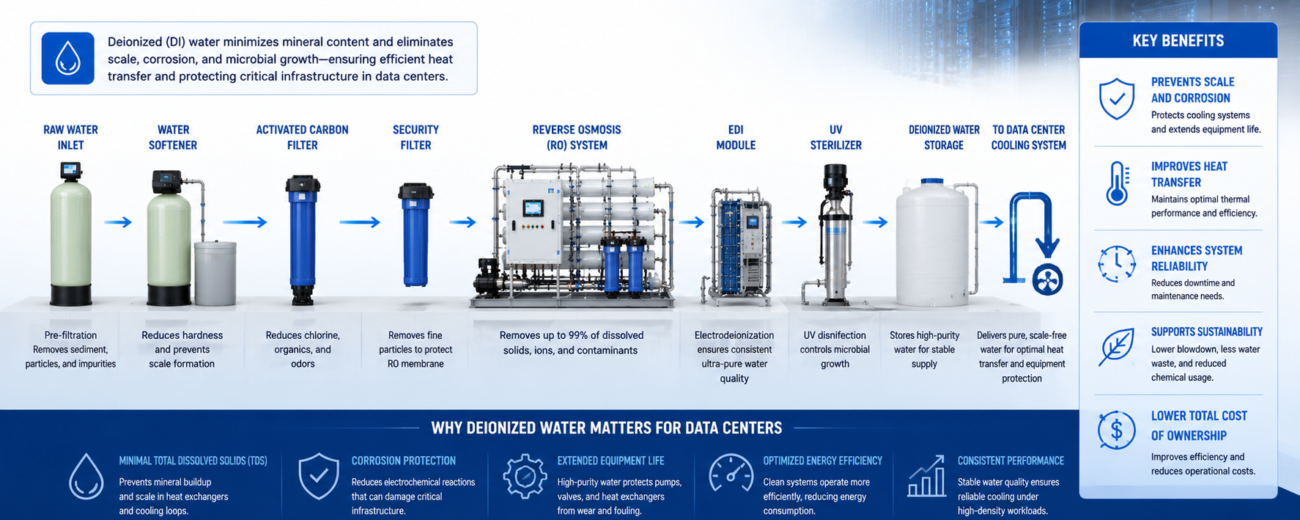
Two-bed ion exchange, mixed-bed polishing, and EDI (continuous electrodeionization) all remove ions — but they’re sized and serviced differently, and picking the wrong one for a batch fill application wastes CAPEX.
- Portable mixed-bed exchange tanks are the right call for periodic top-offs and single-building commissioning fills. They’re swapped, not regenerated onsite, which matters when you don’t have chemical regeneration infrastructure at a colocation facility.
- Fixed two-bed + polisher trains make sense when a campus runs frequent commissioning across multiple phases and the fill volume justifies a permanent skid.
- Continuous EDI is overkill for most loop-fill applications — it’s built for sustained high-volume flow, not for topping off a closed loop twice a quarter.
Match the technology to the usage pattern, not to whichever spec sheet reads the most impressive. A facility engineer who over-specifies continuous EDI for an intermittent top-off application is paying for uptime capability the application will never use.
N+1 Deionization Availability: The Real Cost of an Unplanned Loop Drain
A resin bed reaching exhaustion mid-repair is not a hypothetical — it’s a scheduling failure that turns a two-hour cold plate swap into an overnight outage while a replacement tank is trucked in.
N+1 resin or EDI train redundancy for loop-fill water isn’t the same redundancy conversation as N+1 on your RO makeup system for cooling towers, but the principle holds: your maintenance window shouldn’t be hostage to a single exchange tank’s remaining capacity.
Facilities running Tier III or Tier IV infrastructure with 2N mechanical redundancy routinely overlook this at the water-chemistry layer — the CDUs are 2N, the pumps are 2N, but the DI water available to refill them after a repair is a single mobile tank with no backup on order.
Municipal Feed vs. Reclaimed Makeup Water: Two Different Pretreatment Trains Before Deionization
The water feeding your DI system determines what has to happen before ion exchange, and this is where a generic pretreatment skid falls short.
- Municipal supply typically carries residual chlorine or chloramine, which will destroy standard resin and requires activated carbon or catalytic carbon pretreatment first.
- Recycled/reclaimed water (increasingly mandated for data centers under state water-reuse policy) runs higher TDS and elevated silica, which fouls resin faster and shortens bed life if pretreatment isn’t upsized accordingly.
A skid engineered for municipal feed and dropped onto a reclaimed-water source will exhaust resin on a fraction of the expected cycle — a common and entirely avoidable procurement mistake.
Standard Skid vs. Data Center Grade DI System
| Dimension | Standard Pre-Engineered Skid | Data Center Grade High-Redundancy System |
|---|---|---|
| Flow / Batch Capacity | Fixed single-train GPM rating | Multi-train, sized to fill + top-off volumes independently |
| Redundancy | N (single train, no backup) | N+1 or 2N resin/EDI trains |
| BMS Integration | None — local gauges only | Full BACnet/Modbus tie-in, remote conductivity + DO alarms |
| Delivery / Lead Time | Generic 8–12 week production queue | Engineered-to-order, coordinated to CDU commissioning schedule |
| Filtration / Polish Precision | Nominal 5–25 micron pretreatment only | Sub-micron pretreatment + resin/EDI polish to ASHRAE TC 9.9 bands |
Where Deionized Water Fits Into the Bigger CAPEX and Uptime Picture
Get deionized water for data center cooling right and the payoff isn’t just chemistry — it’s asset protection:
- Lower OPEX on heat exchanger cleaning, reduced cold plate microchannel flushing, and fewer emergency resin swaps billed at premium rates.
- Extended lifespan on cold plates, CDUs, high-pressure pumps, and server-side heat exchange cores that would otherwise degrade under pitting corrosion or scale.
- Protection of 99.999% uptime by removing loop water chemistry as a variable that can cause thermal throttling or a forced shutdown.
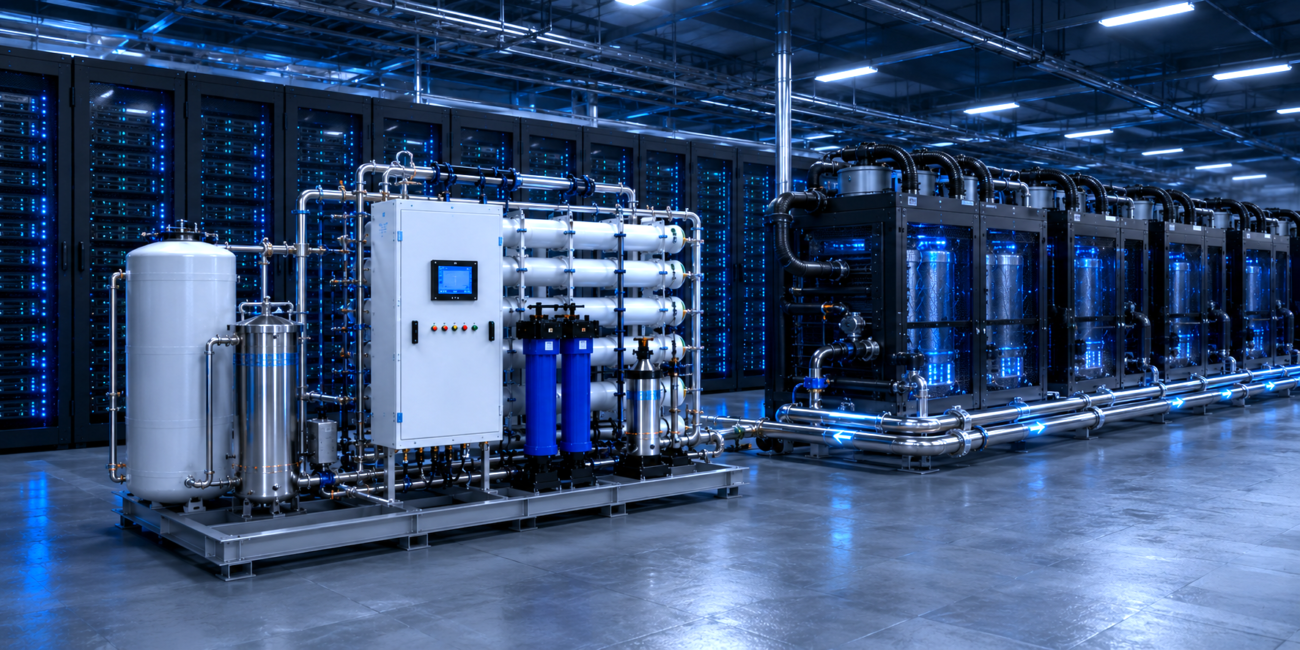
This is why the underlying equipment matters as much as the water spec. YourWaterGood supplies the full chain behind a properly engineered loop: industrial reverse osmosis systems, skid-mounted softening and DI units, EDI ultrapure polishing trains, and automated dosing systems for corrosion inhibitor and biocide control — sized to your fill volumes and redundancy requirements, not a generic industrial catalog spec.
FAQ: Deionized Water for Data Center Cooling
What is deionized water, and why do data centers use it in cooling loops? Deionized (DI) water has had dissolved ions removed via ion exchange resin or EDI, giving it very low electrical conductivity. Data centers use it to limit galvanic corrosion and reduce leakage-current risk in loops that run in close proximity to energized electronics.
What resistivity level is required for deionized water in AI data center cooling? Most closed liquid-cooling loops with mixed metals (copper, aluminum, brass) target a controlled band of roughly 1–5 MΩ·cm, not maximum achievable purity. Going beyond this band without dissolved-oxygen and material controls increases corrosion risk rather than reducing it.
How is deionized water different from reverse osmosis (RO) water for data center cooling? RO removes ions and contaminants by forcing water through a semi-permeable membrane, typically used for high-volume, continuous makeup water such as cooling tower feed. DI water is produced via ion exchange or EDI and is used more for closed-loop fill, top-off, and final polishing where electrical purity, not bulk volume, is the priority.
How much deionized water does a data center cooling loop need per fill or top-off? Initial commissioning fills for a multi-CDU building can run into the tens of thousands of gallons, while routine top-offs are typically a small fraction of that — often under a few hundred gallons per quarter. Sizing should be based on total loop volume, not daily flow rate.
Can municipal tap water be used instead of deionized water for AI cooling loops? Not for direct-to-chip or CDU-fed loops. Municipal water carries dissolved minerals and residual disinfectant that promote scale and metal corrosion in tight microchannel cold plates, and it does not meet the low-conductivity requirements most OEM cold plate warranties specify.
How often should DI resin beds or EDI cartridges be serviced in a data center application? Service intervals depend on feedwater TDS and fill frequency rather than a fixed calendar schedule — inline conductivity monitoring should trigger resin exchange or EDI maintenance before breakthrough, not after.
What happens if deionized water quality isn’t maintained in a liquid cooling loop? Poorly controlled DI water — either under-deionized or improperly refilled after maintenance without dissolved-oxygen control — leads to localized corrosion, cold plate microchannel fouling, and in severe cases pinhole leaks that put energized hardware at risk of a coolant-related short.
Get an Infrastructure Engineering Quote
Specifying deionized water for data center cooling for a new build, a retrofit, or a post-maintenance refill program shouldn’t rely on a generic industrial water skid.
Request Technical Data Sheets, a custom Infrastructure Engineering Quote, or B2B Wholesale / Factory-Direct Pricingon RO, EDI, and skid-mounted DI systems engineered for AI data center liquid cooling — sized to your redundancy tier, your fill logistics, and your maintenance window, not a catalog spec sheet.