
Immersion Cooling Water Treatment: The Water Is on the Secondary Loop, and It Still Needs Treating

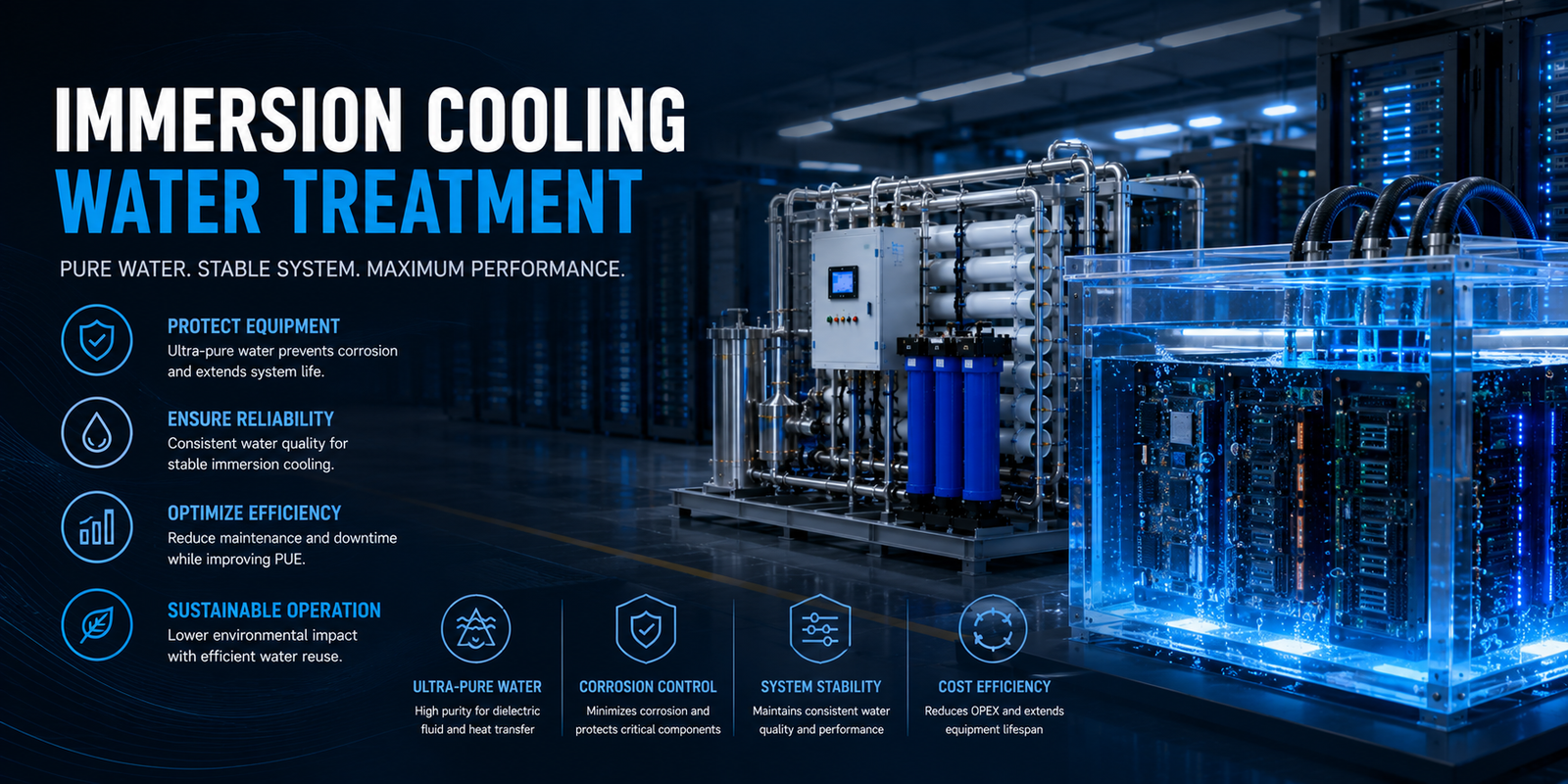
Immersion cooling submerges servers in a dielectric fluid, so the common assumption is that there is no water to treat. There is — it is just one step removed. The dielectric fluid rejects its heat to a water loop through a heat exchanger, and that secondary water loop carries every scale, corrosion, and biofilm risk of any cooling water.
Get that secondary loop wrong and the dielectric fluid runs hot, the chips run hot, and the immersion system loses the thermal headroom it was installed to provide. The water never touches a server, but it governs whether the servers stay cool.
Engineering immersion cooling water treatment correctly means treating the heat-rejection loop for its actual duty — not chasing ultrapure water the chips never see, and not ignoring a loop the operator cannot directly watch.
Before sourcing, lock these immersion-specific points:
- Treat the secondary water loop, not the dielectric fluid — that is where the water is.
- Match treatment to the loop type — closed-loop corrosion control, or evaporative scale and biofilm control.
- Protect the dielectric-to-water heat exchanger from water-side fouling.
- Skip ultrapure grade — immersion water is not near the chips, so 18.2 MΩ·cm is unnecessary.
- Monitor approach temperature, not just dielectric fluid temperature.
The sections below break down where treatment applies and the trap unique to immersion.
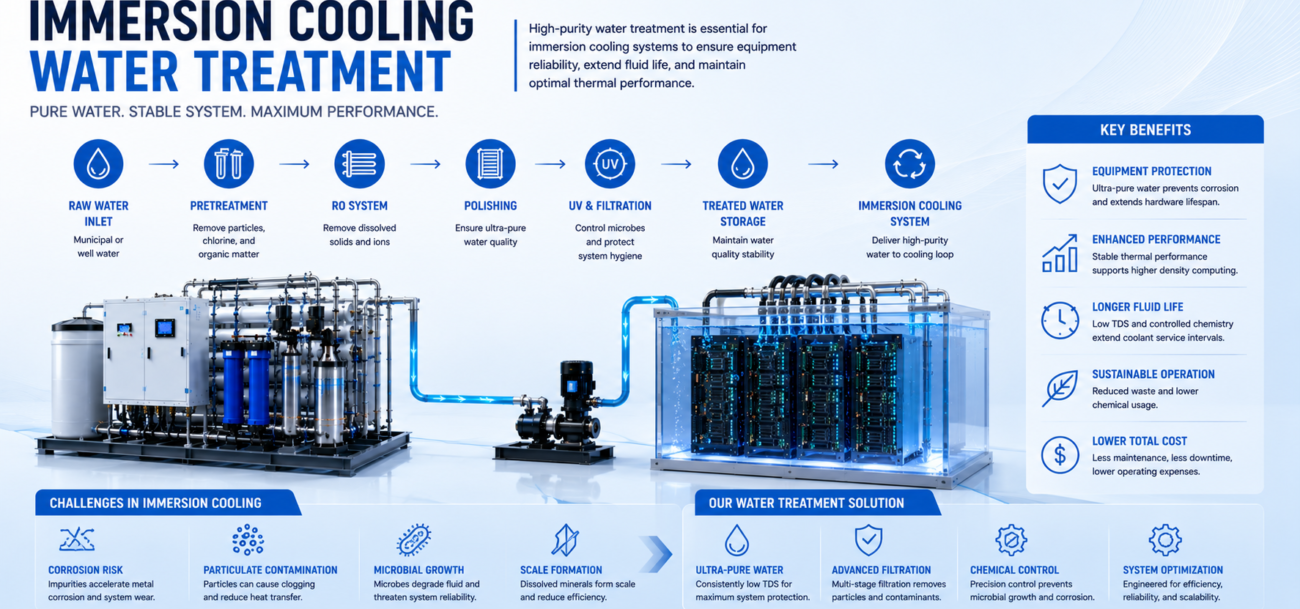
Fast Check Product: https://yourwatergood.com/product/industrial-reverse-osmosis-system/
The Water Is One Step Removed: Where Treatment Actually Applies in Immersion Cooling
The defining clarification for immersion cooling water treatment is that the water and the servers never meet. The treatment target is the secondary heat-rejection loop, not the fluid in the tank.
The heat path in an immersion system runs through distinct stages:
- The immersion tank — servers sit in a non-conductive dielectric fluid that absorbs their heat.
- The CDU / heat exchanger — transfers heat from the dielectric fluid to a water loop.
- The heat-rejection loop — water carries the heat to a cooling tower, dry cooler, or chiller.
Water treatment applies entirely to that third stage. The dielectric fluid is a separate maintenance concern with its own chemistry; the water loop is where scale, corrosion, and biofilm form, exactly as in any cooling system.
Both single-phase and two-phase immersion follow this pattern — two-phase boils the fluid and condenses it against a water-cooled condenser, but the heat still ends up in a water loop. The water treatment problem in immersion cooling is a heat-rejection-loop problem, and that is where the engineering effort belongs.
Why Immersion Water Doesn’t Need to Be Ultrapure
A common over-specification in immersion cooling water treatment is demanding ultrapure water for the heat-rejection loop. It is unnecessary, because the requirement that drives ultrapure water in direct-to-chip cooling does not exist in immersion.
The contrast with direct-to-chip is the key:
- Direct-to-chip circulates water millimeters from energized silicon, so it must be ultrapure (≤ 10 µS/cm, up to 18.2 MΩ·cm) for dielectric safety and microchannel protection.
- Immersion keeps water entirely outside the tank, separated from the electronics by the dielectric fluid and the heat exchanger wall.
Because the water never contacts the chips, the immersion heat-rejection loop needs the treatment of a cooling-tower or closed loop, not a semiconductor-grade UPW system:
- Scale control — softening and antiscalant to protect the heat exchanger.
- Corrosion control — inhibitor chemistry for the loop metallurgy.
- Biological control — biocide where the loop is evaporative.
Specifying RO and EDI to 18.2 MΩ·cm for an immersion heat-rejection loop wastes CAPEX and OPEX on purity the application does not need. Match the water grade to the duty — and the duty is heat rejection, not chip contact.
Treating the Secondary Loop: Closed-Loop vs Evaporative Heat Rejection
The treatment of the immersion secondary loop depends on how it rejects heat. The two common architectures demand different programs.
Closed-loop rejection (dry cooler or chiller):
- A sealed water (or water-glycol) loop carries heat to a dry cooler, with no evaporation.
- The dominant risk is corrosion, not scale — protected by inhibitor chemistry, high-purity fill, and dissolved-oxygen control.
- Uses minimal water but trades it for higher energy at the dry cooler.
Evaporative rejection (cooling tower):
- An open loop rejects heat by evaporation, concentrating dissolved solids.
- The risks are scale, corrosion, and biofilm, managed by softening, antiscalant, corrosion inhibitor, and biocide at controlled Cycles of Concentration.
- Uses more water, with WUE implications, but lowers energy versus a dry cooler.
The choice is a water-versus-energy trade, and it sets the entire treatment program. Identify the rejection method first, because a closed-loop corrosion program and an evaporative scale-and-biofilm program share almost nothing — consistent with ASHRAE TC 9.9 guidance for the equipment served.
Municipal vs Reclaimed Makeup for the Heat-Rejection Loop
Where the immersion loop rejects heat evaporatively, it needs makeup water — and municipal versus reclaimed makeup changes the pre-treatment, exactly as for any cooling tower.
Municipal potable makeup:
- Moderate, stable chemistry with predictable softening and antiscalant needs.
- Carbon for chlorine/chloramine and chloride control to protect 316L.
Reclaimed and recycled makeup — increasingly mandated for WUE targets in Ashburn, VA and Phoenix, AZ:
- High TDS, silica above ~150 ppm, and organics demanding multimedia filtration, heavier softening, and antiscalant.
- Stronger biocide for the elevated nutrient load.
- Often RO treatment of the makeup to restore Cycles-of-Concentration headroom.
A closed-loop dry-cooler immersion design largely sidesteps this by using little makeup, while an evaporative design inherits the full cooling-tower makeup question. The rejection method decides whether makeup-water quality matters at all — consistent with ASHRAE TC 9.9 and EPA frameworks.
Standard Skids vs Data-Center-Grade Immersion Water Systems
A commercial skid and a data-center-grade system differ in how well they protect the heat exchanger and hold the secondary loop, which determines the immersion system’s thermal stability.
| Engineering Parameter | Standard Pre-Engineered Skids | Data Center Grade High-Redundancy Systems |
|---|---|---|
| Loop treatment | Generic | Matched to closed-loop or evaporative duty |
| Heat-exchanger protection | Minimal | Scale, corrosion, biofilm control |
| Flow capacity (GPM) | 10–50 GPM | 100–1,000+ GPM, parallel trains |
| Redundancy | Single train | N+1 / N+2 / 2N |
| Water grade | Mismatched (often over- or under-spec) | Correct grade for heat rejection |
| Monitoring | Fluid temp only | Approach temperature + loop chemistry to BMS |
| BMS integration | Analog (4–20 mA) | Modbus TCP / BACnet IP / SNMP |
| Support | Generic spares | Documented P&ID, standardized spares |
The monitoring row is what separates the two: a system watching only dielectric fluid temperature misses water-side fouling until the fluid alarms, while one tracking approach temperature catches it early. The secondary loop’s treatment and monitoring set the immersion system’s thermal ceiling — the failure mode detailed below.
To pressure-test a vendor, ask how the secondary loop is treated and whether approach temperature is monitored. A vendor proposing ultrapure water for an immersion heat-rejection loop has misread the application.
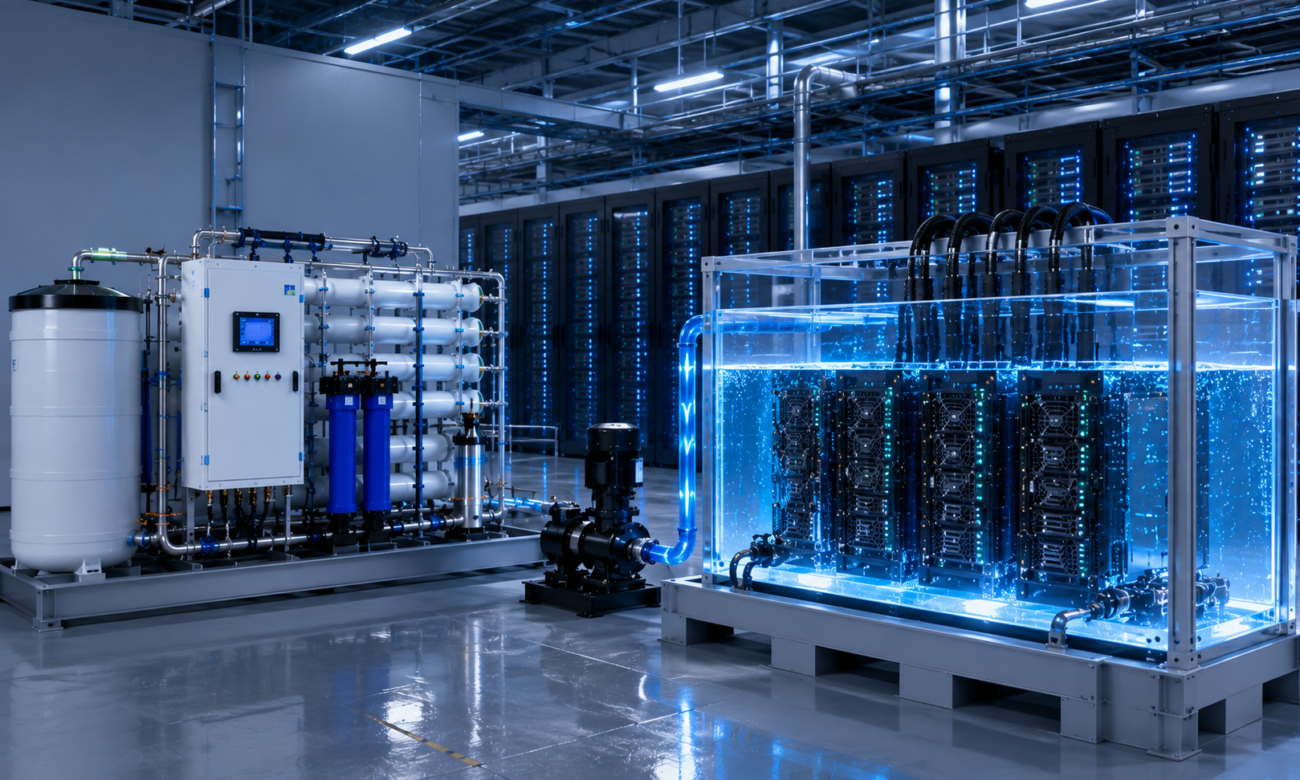
Field Engineering Insight: Water-Side Fouling Hides Behind the Dielectric Fluid
Here is the trap unique to immersion cooling: the water loop is one step removed from the operator’s instruments, so when the water side of the heat exchanger fouls, the symptom shows up as a hot dielectric fluid — and the water cause is never directly seen.
Operators monitor the dielectric fluid temperature as the health metric of an immersion system. The water loop sits behind the CDU heat exchanger, out of that direct line of sight. When scale, biofilm, or corrosion deposits build on the water side of the exchanger, heat transfer from the fluid degrades.
The result is a fluid that runs hotter, and chips that run hotter with it — but the rising fluid temperature gets blamed on the immersion system, the pumps, or the fluid itself. The actual cause, untreated secondary water fouling the exchanger, goes unaddressed because nothing is watching the water side.
The immersion system’s entire thermal headroom is gated by the treatment of a loop the operator is not looking at.
The defense is to treat and monitor the water loop as a first-class system:
- Treat the secondary loop for its duty — scale, corrosion, and biofilm per the rejection method.
- Monitor heat-exchanger approach temperature — the gap between the water and the fluid. A rising approach is the early signal of water-side fouling, well before the fluid temperature alarms.
- Keep the water side clean to preserve the fluid-side performance, since the two are linked through the exchanger.
- Trend loop chemistry — conductivity, inhibitor residual, and microbiological activity — into the BMS.
This is the kind of detail that never appears on an immersion-cooling datasheet but decides whether the system holds its rated thermal performance. It is also where correct secondary-loop treatment pays back: a clean heat exchanger preserves the fluid-side cooling, lowers OPEX, protects the chips from thermal throttling, and holds 99.999% uptime — the performance the immersion system promised.
Immersion Cooling Water Treatment FAQs
Does immersion cooling need water treatment? Yes — not for the dielectric fluid, but for the secondary water loop that rejects the fluid’s heat through a heat exchanger to a cooling tower, dry cooler, or chiller. That loop carries the usual scale, corrosion, and biofilm risks.
Is the dielectric fluid the same as water? No. Immersion submerges servers in a non-conductive dielectric fluid, not water. The water is on a separate heat-rejection loop, isolated from the electronics by the fluid and the heat exchanger.
Does immersion cooling water need to be ultrapure? No. Unlike direct-to-chip cooling, the water is not near the chips, so it needs scale, corrosion, and biofilm control — not ultrapure 18.2 MΩ·cm grade. Specifying UPW for an immersion loop wastes CAPEX and OPEX.
What is the main water risk in immersion cooling? Fouling on the water side of the dielectric-to-water heat exchanger. Scale, biofilm, or corrosion there degrades heat transfer, raising the dielectric fluid and chip temperatures while the water cause stays hidden.
How is the immersion secondary loop treated? By rejection method. A closed loop (dry cooler) needs corrosion control — inhibitor and low dissolved oxygen. An evaporative loop (cooling tower) needs scale, CoC, and biofilm control with treated makeup.
Does immersion cooling use less water? The server side uses no water, but evaporative heat rejection still consumes makeup. Dry-cooler designs use little water in exchange for higher energy — a water-versus-energy trade.
How do I detect water-side fouling in an immersion system? Monitor the heat-exchanger approach temperature — the water-to-fluid gap. A rising approach signals water-side fouling early, before the dielectric fluid temperature alarms, consistent with ASHRAE TC 9.9 monitoring practice.
Treat the Loop That Governs the Fluid
Immersion cooling water treatment is a secondary-loop discipline. The water never touches a server, but its treatment decides whether the dielectric fluid — and the chips — stay cool. The systems that hold their thermal performance are the ones that treat the heat-rejection loop for its duty and watch the approach temperature, not the ones that chase ultrapure water the application never needed.
Whether you are equipping a single immersion tank or a larger deployment, YourWaterGood sources the right system through our manufacturing partner and a network of vetted factories — immersion cooling water treatment configurations cover RO, softening, corrosion and scale dosing, and closed-loop treatment, with quality inspection, logistics, and English-language support handled for you.
- Get an Infrastructure Engineering Quote: send your immersion heat load and rejection method for a configured secondary-loop proposal.
- Request Technical Data Sheets: loop treatment, dosing, and monitoring detail for your engineering review.
- Get Competitive B2B Pricing: sourced through our supplier network, with QC and shipping managed end to end.