
Restaurant Water Treatment: City Water vs. Well Water for Commercial Kitchens

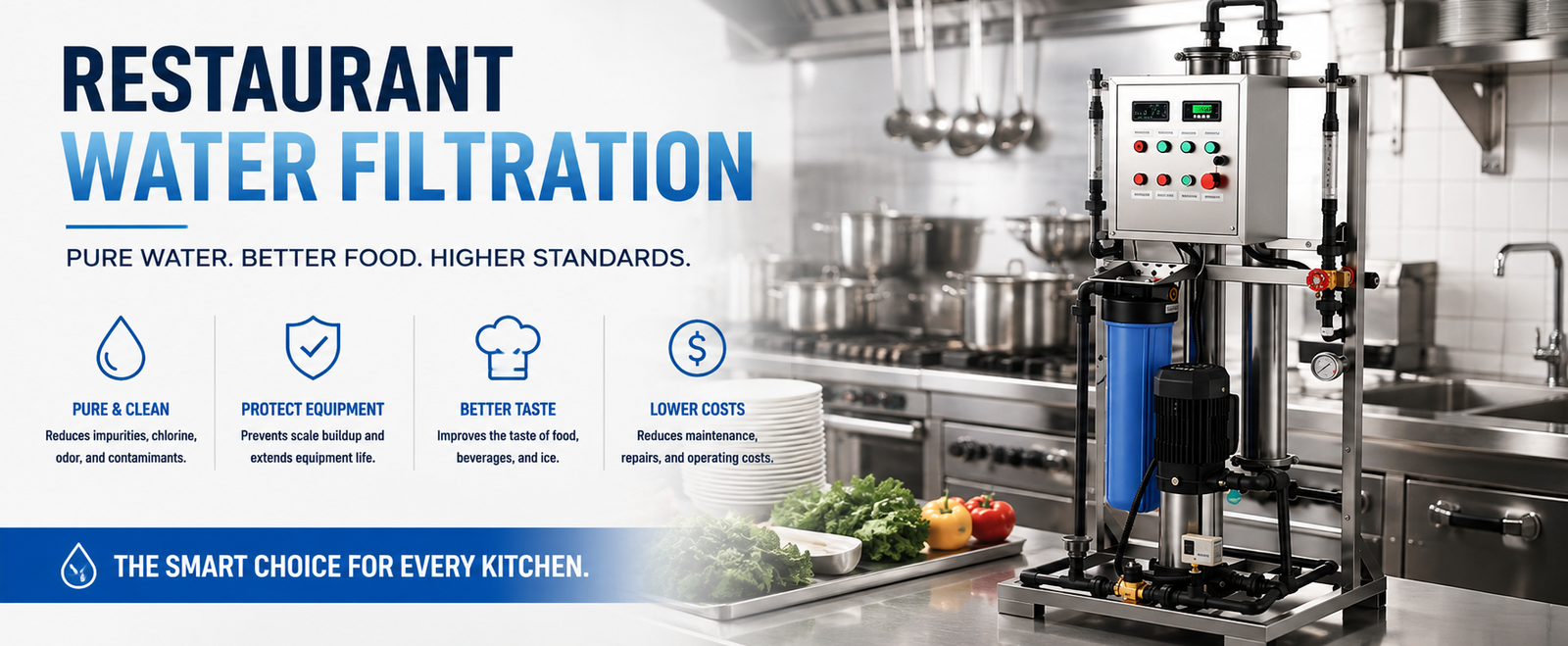
City water and well water break commercial filtration systems in almost opposite ways, and specifying one filter package for both is the most common reason a restaurant’s water treatment underperforms or fails early. Municipal supply carries chlorine, disinfection byproducts, and metals picked up from aging distribution pipes — all of which degrade membranes and flatten flavor over time. Well water carries hardness, dissolved iron and manganese, and pressure swings from the pump cycle — all of which scale and starve the same equipment through a completely different mechanism. Before anyone specs a commercial water filter for restaurant package, the first question is which failure mode the location is actually up against.
Four things determine that answer, and none of them show up on a generic spec sheet:
- Feed water conductivity (μS/cm) relative to what the RO system is rated to accept
- Inlet pressure range — and whether the source holds it steady or cycles
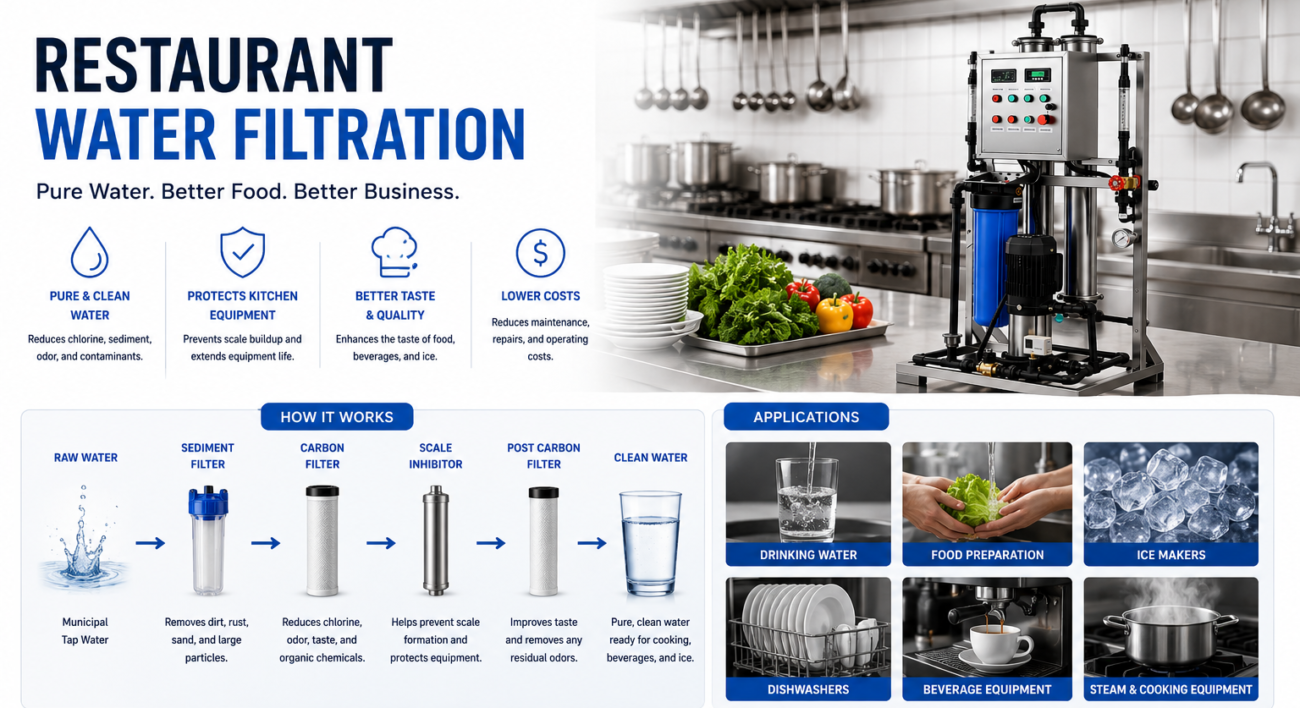
- Pretreatment stage required ahead of the membrane — softening, iron filtration, sediment, or none
- Real-world pre-filter and membrane life under your actual source water, not the catalog number
- Whether disinfection or oxidation is needed before water ever reaches the RO stage
Get these four wrong and no amount of downstream filtration fixes it — you’re just replacing cartridges faster and running the membrane past its useful life quietly.
Fast Check Product: https://yourwatergood.com/product/commercial-reverse-osmosis-system/
City Water: What’s Actually Coming Through the Meter
Municipal supply is treated for public health, not for espresso machines or ice production. Chlorine or chloramine — added to control bacteria in the distribution system — is the first problem: it oxidizes and shortens the life of standard thin-film composite RO membranes if it reaches the element unfiltered.
Disinfection byproducts (DBPs), formed when chlorine reacts with organic matter in the pipe network, are the second. They’re invisible on a basic hardness test and don’t show up until a lab runs for them specifically.
Aging infrastructure adds a third layer: lead, copper, and iron picked up from decades-old service lines — more common in older commercial districts than newer suburban buildouts.
None of this requires a full pretreatment train the way well water usually does. In most cases, a properly staged sediment and carbon step ahead of the RO membrane handles it — but skipping that step is exactly how a membrane rated for a one-year service life gets replaced at month five.
Well Water: The Contaminants a “Clean” Water Report Misses
Groundwater doesn’t carry chlorine — but it carries almost everything else. Hardness (calcium and magnesium) scales heating elements, steamers, and combi ovens long before it touches an RO membrane, and it fouls the membrane itself if it isn’t softened out first.
Dissolved iron and manganese are the two contaminants that catch new well-water buyers off guard. They don’t always show up as color or odor at the tap, but they oxidize inside pre-filter housings and pump components, turning a clear feed into a rust-tinted one that clogs sediment cartridges fast.
Hydrogen sulfide odor, bacteria, and seasonal turbidity round out the list — and unlike municipal supply, none of it is regulated or pre-treated before it reaches your property line. Every gallon that hits your equipment is exactly what came out of the ground that day.
City vs. Well Water: What Each Source Actually Requires Before RO
| Factor | City (Municipal) Water | Well / Groundwater |
|---|---|---|
| Primary contaminants | Chlorine/chloramine, DBPs, trace pipe metals | Hardness, dissolved iron & manganese, sulfur odor, bacteria |
| Pretreatment typically needed before RO | Sediment + carbon stage | Water softener or iron filter; UV if bacteria present |
| Feed pressure behavior | Stable — municipal mains typically hold 40–80 PSI | Cycles with the pump’s pressure switch — often 30/50 PSI, can dip low |
| Source consistency | Stable year-round | Shifts seasonally (runoff, drought, water table changes) |
| Added pretreatment CAPEX | Lower | Higher (softener or iron filter, sometimes UV) |
| Added pretreatment OPEX | Carbon media replacement | Brine/salt, iron filter media regeneration, UV lamp replacement |
Request a Free Site Water Report Review — send your city’s annual water quality report or a well water test, and get a pretreatment recommendation before you spec any equipment.
Feed Water Conductivity: The Number That Actually Sets Your Pretreatment Budget
This is the spec that decides everything else, and it’s usually skipped: every commercial RO system has a maximum feed water conductivity it’s rated to handle without pretreatment. On the compact commercial RO platform we build, that ceiling is 800 μS/cm — roughly 400–550 ppm TDS depending on the mineral mix — for tap water or groundwater feed.
Field insight: A well water lab report that reads “moderate hardness” can still carry enough dissolved iron and manganese to push effective conductivity past a system’s rating, even when the TDS number on the printout looks unremarkable. Iron and manganese oxidize on contact with air inside the pre-filter housing — what enters as invisible dissolved metal exits as a rust-colored film that can clog a standard sediment cartridge in under a month, well ahead of its normal 2–4 month interval, and push scale onto the membrane long before its rated one-year service life. The fix isn’t a bigger RO system — it’s an iron filter or softener staged correctly ahead of it, sized to the source, not the kitchen.
Production capacity on this platform is configurable from roughly 250 to 1,000 liters per hour (about 1,500 to 6,300 GPD), which matters here because a location running higher-conductivity well water often needs to run at a lower recovery rate to protect the membrane — worth confirming before committing to a flow rate on paper.
Request a Commercial Kitchen Water Layout Design — we’ll map where softening, sediment, and RO stages go based on your actual feed water, not a generic diagram.
Feed Pressure Stability: Municipal Mains vs. Well Pump Cycling
RO systems need a minimum, sustained inlet pressure to push water through the membrane — on this platform, that’s 29–58 PSI (0.2–0.4 MPa). Municipal water usually holds within range without issue.
Well systems are different. A pressure switch cycles the pump on and off between a cut-in and cut-out point — often 30/50 PSI — and if the pump loses prime, the tank pressure drops, or the well runs low during peak draw, feed pressure can fall out of the system’s operating range without warning.
That’s why a properly built commercial RO unit runs a high/low pressure switch ahead of the pump stage — it shuts the system down before an out-of-range feed pressure damages the high-pressure pump, rather than letting it run dry or cavitate. It’s a small component on a parts list, and it’s the difference between a nuisance shutdown and a pump replacement.
Getting this right also means matching the unit to your kitchen’s actual peak demand — worth working through when you size the system to your GPM and GPD needs rather than guessing at a flow rate.
Frequently Asked Questions
Does my restaurant need different water treatment for city water vs. well water? Yes. City water mainly needs protection from chlorine and disinfection byproducts; well water mainly needs protection from hardness, iron, and manganese. The same filtration package rarely handles both well.
What’s the maximum feed water conductivity a commercial RO system can handle without pretreatment? It depends on the system, but many commercial units — including ours — are rated up to around 800 μS/cm (roughly 400–550 ppm TDS) on tap or groundwater feed. Above that, pretreatment is required before the RO stage.
Do I need a water softener before a commercial RO system? If you’re on well water with moderate-to-high hardness or iron content, almost always. Skipping it shortens membrane life and increases cleaning frequency significantly.
Can well water pressure swings damage a commercial RO system? Yes, if the system isn’t built to handle it. A high/low pressure switch ahead of the pump stage protects against pressure drops that would otherwise stress or damage the pump.
How often do pre-filters and RO membranes need replacing on well water vs. city water? Pre-filter cartridges typically last 2–4 months on clean feed water, but iron or high sediment content on well water can cut that significantly. RO membranes are rated around one year, also feed-quality dependent.
Does chlorinated city water need pretreatment before RO? Yes. Chlorine and chloramine degrade standard thin-film RO membranes if they reach the element unfiltered — a sediment and carbon pretreatment stage handles this in most municipal supply situations.
How do I know if my restaurant’s water source needs iron or manganese removal? A water test is the only reliable way — visible staining or odor isn’t always present even when levels are high enough to foul equipment. This is exactly what a site water report review is for.
Get Your Water Source Assessed Before You Buy Equipment
Every restaurant’s water problem starts at the source, not at the filter. Whether you’re on a municipal line dealing with chlorine and DBPs, or a well dealing with hardness and iron, the right pretreatment train — sized to your actual feed water and your kitchen’s peak GPM demand — is what protects the equipment behind it.
Get a Custom Commercial Quote, a full Technical Parameter Sheet, or B2B wholesale pricing on our compact commercial reverse osmosis system, built with configurable output and feed-water tolerances suited to both city and well water applications.