
Compact Industrial Reverse Osmosis System: Full Industrial Engineering in a Smaller Footprint

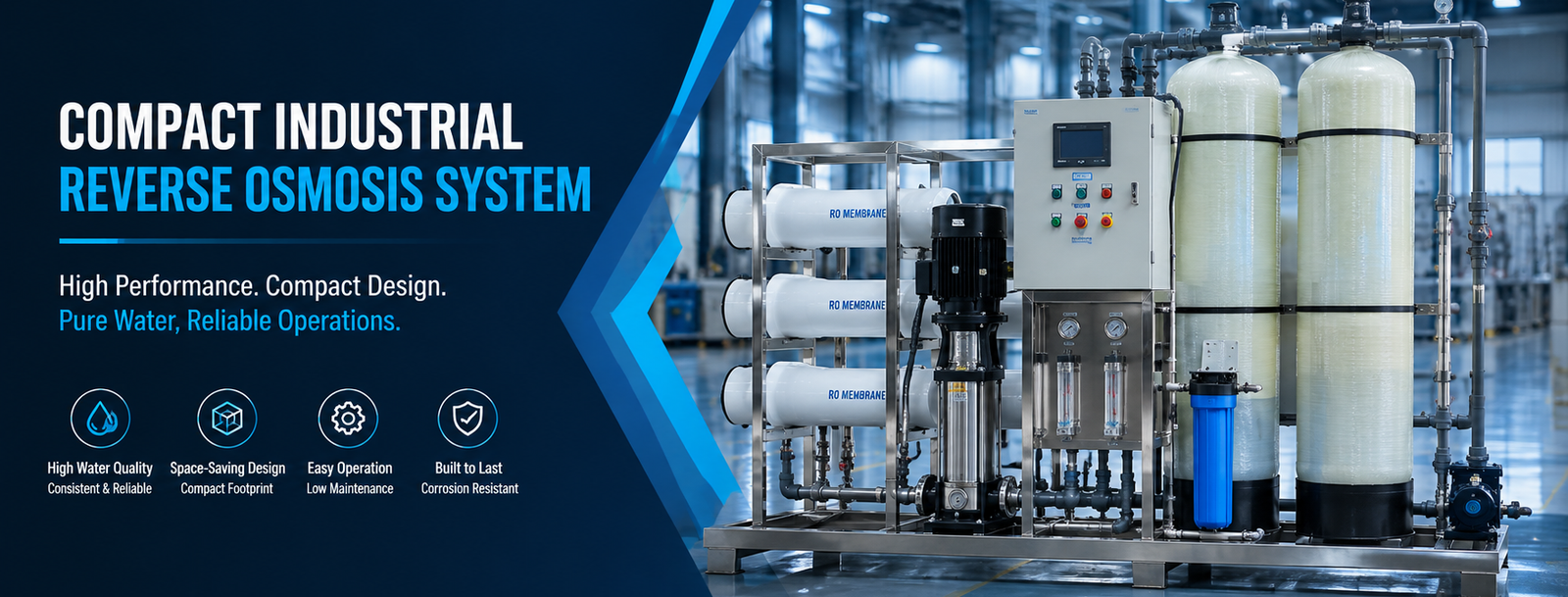
A retrofit line squeezed into an existing mechanical room doesn’t get a pass on water-quality risk just because the skid is smaller. A TDS spike from a municipal main or a heavy-metal exceedance from a well feed still stops a shift — the footprint of the treatment skid has nothing to do with it.
Before sizing a compact skid, lock these specs:
- Continuous duty-cycle rating matched to real peak GPM demand — a compact footprint is not an excuse to undersize the array.
- Full five-stage pretreatment compressed, not shortened — no skipped stages just to save skid length.
- Auto CIP (clean-in-place) that services in place, without pulling the skid out of a tight mechanical room.
- Temperature-correction margin built into the membrane count, which matters more, not less, when there’s less spare area to begin with.
- 316L stainless steel or high-grade UPVC wetted materials and PLC-based control — full industrial engineering, no light-duty substitutions.
A properly engineered compact industrial reverse osmosis system delivers the same duty-cycle reliability as a full-scale train — it’s the packaging that changes, not the engineering standard.
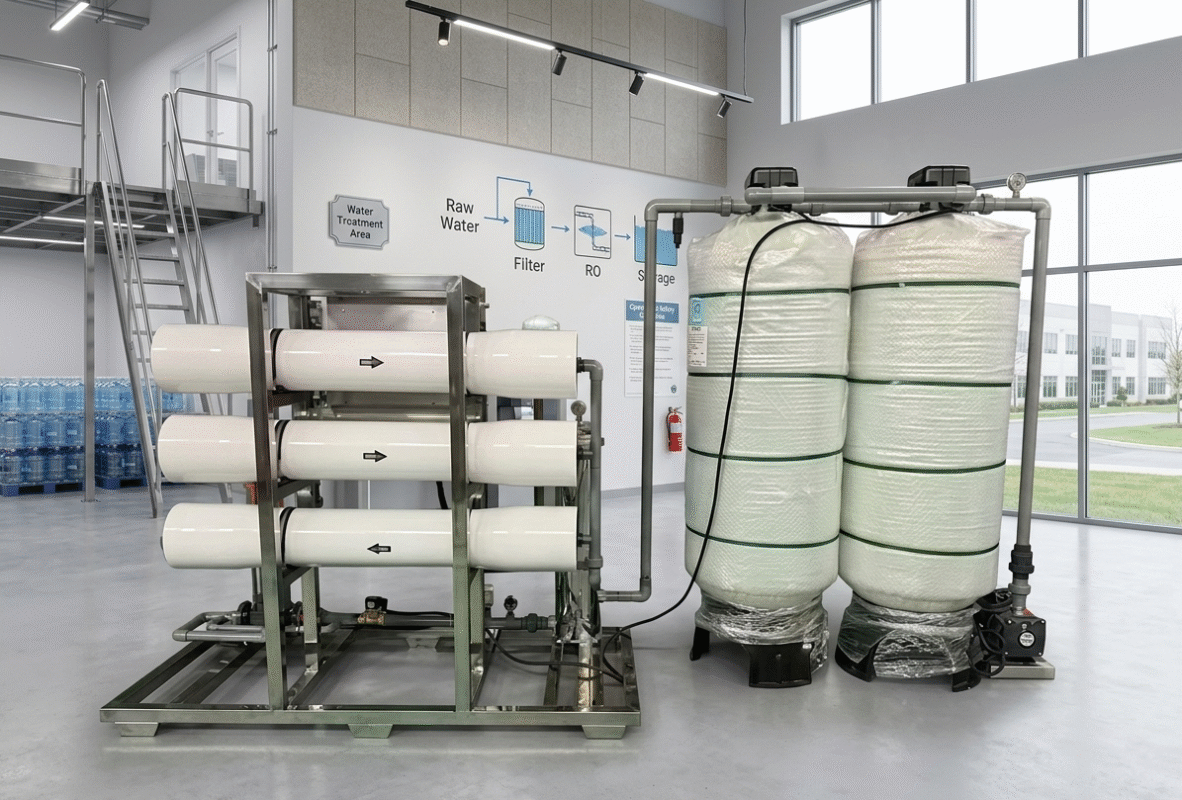
Fast Check Product: https://yourwatergood.com/product/industrial-reverse-osmosis-system/
Why “Compact” Doesn’t Mean Light-Duty
The mistake buyers make with a compact skid is assuming a smaller footprint means a scaled-down duty rating. It shouldn’t.
- Same pretreatment logic, smaller envelope. Multimedia filtration, activated carbon, ion-exchange softening, a precision security filter, and the RO membrane array — all five stages still run, just arranged in a tighter, pre-piped skid layout.
- Same materials standard. A compact skid built with lower-grade fittings to save space is a false economy — 316L stainless steel and high-grade UPVC piping are non-negotiable regardless of footprint.
- Same automation expectation. A compact control panel still needs full PLC logic, not a stripped-down relay board, to hold flux and pressure within spec.
Buyers evaluating a compact industrial reverse osmosis system for a satellite plant, pilot line, or space-constrained mechanical room should treat it as an engineering decision, not a real-estate decision.
Sizing a Compact Skid: Flow Capacity, TDS Rejection, and Space Constraints
Compact deployments typically sit at the lower end of a scalable capacity range, sized for boutique labs, smaller production lines, and retrofit projects rather than full plant-wide demand.
- Flow capacity: The compact tier generally runs roughly 4–13 GPM (approximately 6,300–19,000 GPD), scaling up within the same modular architecture as demand grows — no re-engineering required to expand later.
- TDS rejection: In documented field cases, this architecture has reduced raw feed TDS from 1,300 ppm to under 20 ppm in a single pass, and under 10 ppm in a two-pass configuration, independent of skid size.
- Inlet pressure: The booster pump still requires a minimum inlet pressure of roughly 0.2 MPa (~29 PSI). A compact footprint doesn’t reduce this requirement — undersized site pressure still needs a pre-boost stage.
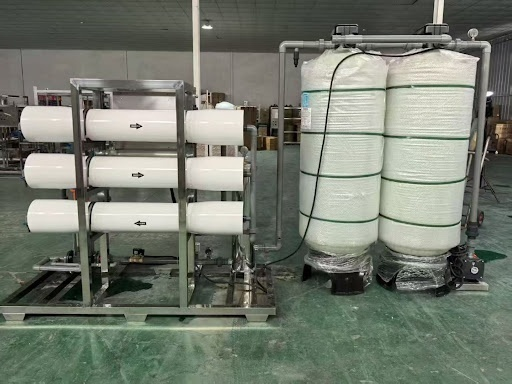
- Pre-piped skid design: Because a compact system is factory-assembled and pre-piped as one unit, field installation time and connection points are reduced compared to a field-erected, component-by-component build.
Request a Custom CAD Skid Diagram or Water Analysis Review to confirm your mechanical room clearance and rigging path before the skid is fabricated — not after it arrives.
Municipal vs. Deep Well Feed in a Compact Pretreatment Train
Feed water source still dictates pretreatment design, even at a compact scale.
Municipal potable feed:
- Chlorine and chloramine removal via carbon filtration protects the membrane; soluble inorganic salts set the RO sizing baseline.
- Generally the simpler compact configuration, since chemistry is more predictable.
Deep well feed:
- Hardness, dissolved iron and manganese, and silica each need a dedicated pretreatment step — softening, oxidation/filtration, or antiscalant dosing — before the compact RO stage.
- Seasonal well chemistry shifts still apply. A compact skid has to carry the same design margin as a full-size one, just arranged more efficiently.
This pretreatment logic operates inside the broader EPA Water Quality Framework governing process-water handling — a compact footprint doesn’t change the regulatory backdrop it sits inside.
Standard Pre-Engineered Compact Skids vs. Fully Customized Turnkey Systems
Not every compact skid on the market is engineered to the same standard. The table below separates a catalog compact unit from a fully engineered compact turnkey system.
| Engineering Parameter | Standard Pre-Engineered Compact Skid | Fully Customized Compact Turnkey System |
|---|---|---|
| Flow capacity (GPM) | Fixed, single configuration | Custom-sized within the compact tier, expandable |
| CAPEX structure | Lower upfront, catalog pricing | Higher upfront, engineered to site water analysis |
| Lead time | Shorter — stock skid configuration | Longer — sized against your actual feed chemistry |
| PLC integration | Basic HMI, standalone panel | Siemens or Allen-Bradley platform, remote-monitoring ready |
| Redundancy | None — single point of failure | Optional N+1 module, even at compact scale |
A standard compact skid works for stable, well-characterized municipal feed with modest uptime requirements. A compact turnkey system is the right call when the facility can’t afford a fouling event to take the line down, footprint or not.
Packing Full PLC Automation and Auto CIP Into a Smaller Control Footprint
Space constraints change the panel layout, not the automation standard.
- Automatic backwash and flushing still runs on a scheduled cycle, without an operator manually triggering it from a compact HMI.
- Real-time PSI and flow monitoring still feeds the PLC loop — a compact panel just consolidates the same instrumentation into a smaller enclosure.
- Auto CIP is engineered to clean membranes in place, which matters more in a compact installation where there’s no floor space to pull a pressure vessel for offline servicing.
This automation is what protects downstream capital equipment — boilers, heat exchangers, and process tanks — from the maintenance costs of inconsistent feed water, regardless of how small the treatment skid’s own footprint is.
Field Engineering Insight: Why Compact Skids Have Less Margin for Cold-Water Flux Decay
This is the detail that catches compact-skid buyers off guard more often than full-scale ones.
When feed water temperature drops toward 50°F (10°C) — common with well feed in winter — viscosity increases and membrane flux drops. A full-size system typically has more membrane area to absorb that swing. A compact skid, by definition, has less spare membrane area built in, so the temperature correction factor — usually 30%–40% additional membrane area at the design stage — is not optional, it’s the difference between hitting rated GPD output in January and not.
Skip that correction, and the compensation happens the wrong way: the pump pushes to a higher PSI to force the same flow through fewer, less-efficient membrane elements. That raises energy draw and accelerates scaling and fouling — especially without an antiscalant dosing pump calibrated to the feed water’s actual silica and calcium concentration.
On a compact skid, that fouling curve is steeper. With less membrane area to spare, the same design gap can drop output enough to stall a production line within days, not weeks.
Where a Compact System Fits: Retrofit Lines, Pilot Plants, and Satellite Facilities
The compact tier of this architecture is engineered for a specific set of deployment scenarios:
- Retrofit and line-expansion projects — where an existing mechanical room has fixed floor space and no room for a field-erected system.
- Pilot lines and R&D facilities — food & beverage or lab environments validating a process before scaling to full production volume.
- Satellite and regional plants — smaller production sites that still need the same water-quality consistency as the flagship facility.
- Metal processing and precision cleaning cells — space-constrained cells needing corrosion-protective process water without a full plant-wide RO train.
For food, beverage, and lab-adjacent compact deployments, the same architecture can be engineered toward the conductivity and purity targets referenced in FDA and USP Purified Water frameworks, typically by pairing the compact RO stage with downstream EDI or mixed-bed polishing. That’s a design target the engineering team sizes toward — not a claim about any specific facility’s regulatory status, which remains the buyer’s own validation responsibility.
Compact Industrial Reverse Osmosis System FAQs
What flow capacity does a compact industrial reverse osmosis system cover? Typically 4–13 GPM (roughly 6,300–19,000 GPD) per skid, built on the same modular architecture that scales to larger capacity if demand grows.
Is a compact RO skid less durable than a full-size industrial system? No, when engineered correctly. Materials (316L stainless steel, high-grade UPVC), pretreatment stages, and PLC control should be identical in standard — only the physical arrangement changes.
How much floor space does a compact industrial RO skid need? It varies by capacity and configuration, since the skid is pre-piped as a single factory-assembled unit; a mechanical-room clearance and rigging review during design is how the exact footprint gets confirmed before fabrication.
Does a compact system still need full five-stage pretreatment? Yes. Multimedia filtration, carbon filtration, ion-exchange softening, a precision security filter, and the RO membrane array are all still required — a compact skid arranges them more efficiently, it doesn’t remove stages.
What TDS rejection can a compact industrial RO system achieve? Documented field cases show raw feed TDS reduced from 1,300 ppm to under 20 ppm in a single pass, and under 10 ppm in two-pass configurations, independent of skid size.
Why does cold well water matter more for a compact skid? A compact skid has less spare membrane area than a full-size system, so a missing temperature correction factor (typically 30%–40% additional membrane area) causes flux decay to show up faster and more severely.
What inlet pressure does a compact RO skid require? The same minimum as a full-size system: roughly 0.2 MPa (~29 PSI) at the booster pump inlet, with a pre-boost stage specified if site pressure runs lower.
Get an Engineered Quote for Your Compact System
A compact footprint changes the packaging, not the engineering standard a production line depends on.
- Get an Industrial Engineering Quote: send your water analysis and available footprint for a sized proposal.
- Request Technical Data Sheets & P&ID Drawings: get the full engineering submittal package for your project file.
- Get B2B Wholesale / Factory-Direct Pricing: request competitive pricing sourced through our vetted manufacturing network.
For a retrofit line, a pilot plant, or a satellite facility, a properly engineered compact industrial reverse osmosis system holds the same flux, pressure, and uptime standard as its full-scale counterpart — just built to fit the room you actually have.