
Reverse Osmosis System for Cooling Water: Why 82% Recovery Rate Fails at High-TDS Blowdown Concentrates

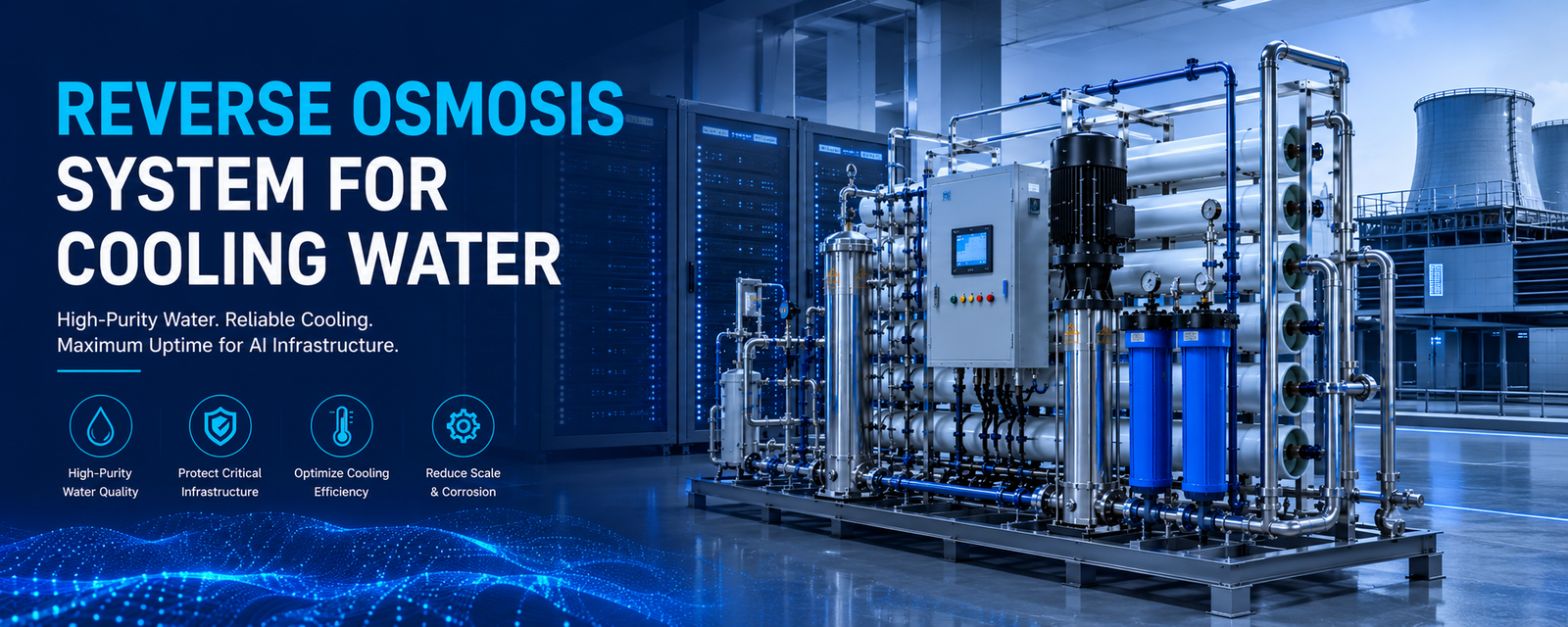
Most data center teams specify cooling tower blowdown reverse osmosis system for cooling water assuming the same 82% recovery rate as municipal potable water treatment. This is a critical engineering error that will collapse membrane life, trigger silica precipitation in the concentrate line, and force unscheduled system shutdowns within 8–16 weeks of commissioning.Cooling tower blowdown concentrate carries 800–1,600 ppm total dissolved solids (TDS) with elevated silica (60–120 ppm), hardness minerals, biological debris, and corrosion byproducts. Forcing this feedstock through an 82%-recovery RO membrane array causes localized salt concentration polarization at the membrane surface, exceeding silica and calcium solubility limits before the water exits the membrane stack.
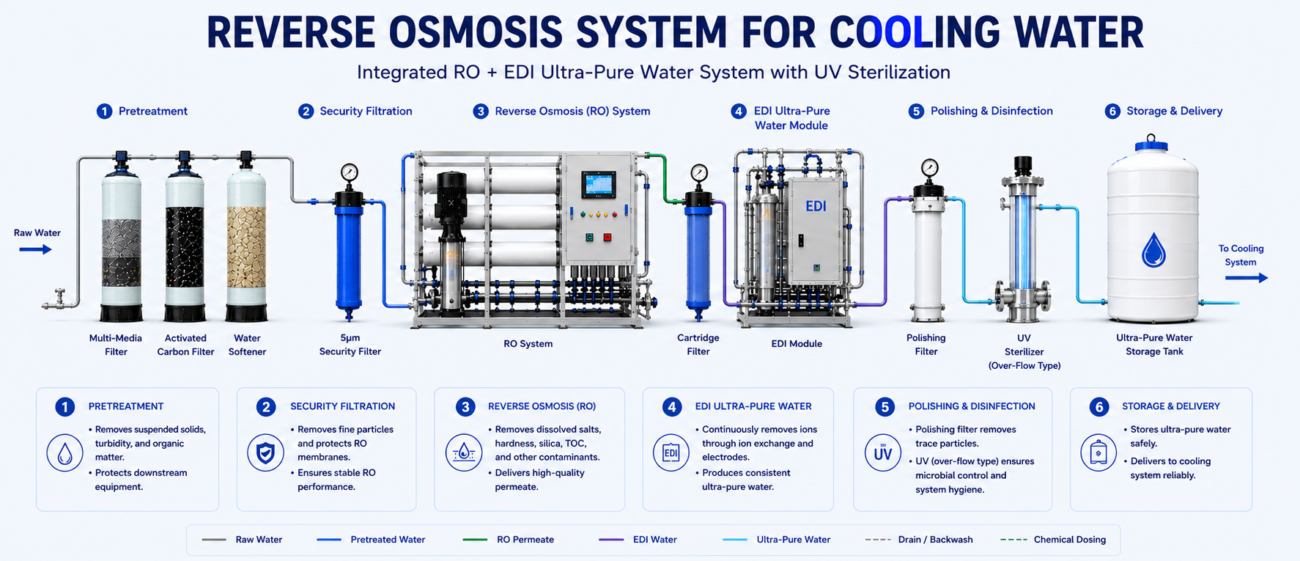
Next-generation AI computing clusters operate at unprecedented heat densities, making traditional air-cooling loops insufficient. Liquid cooling architectures utilize server cold plates containing microchannels narrower than 100 microns. Standard raw source water contains dissolved silica, calcium, and magnesium ions that rapidly form highly insulative mineral scale barriers under extreme thermal loads. Deploying a dedicated industrial reverse osmosis system for cooling water—such as the double-pass RO and EDI plants engineered by YourWaterGood—is required to continuously strip 99% of dissolved ions and maintain loop TDS below 10 mg/L, preventing chip-level thermal throttling and unexpected cluster shutdowns.
Evaporative cooling systems and cooling towers must continuously purge concentrated mineral streams via water blowdown to avoid massive scale fouling, which dramatically increases fresh water consumption and degrades a facility’s WUE score. By routing makeup water or cooling tower blowdown through a double-pass industrial reverse osmosis system paired with a continuous electrodeionization (EDI) stack, the plant removes scaling precursors without chemical regeneration downtime. This ultra-low conductivity permeate allows the facility to safely run at significantly higher Cycles of Concentration (CoC), decreasing overall freshwater intake demands by up to 40%.
To guarantee constant water flux and prevent premature membrane blinding, the on-site physical infrastructure must ensure a reliable inlet supply pressure baseline of greater than 0.2 MPa. If local utility pressures fluctuate, variable-frequency booster pumps must be integrated before the precision filters. Furthermore, the system’s concentrated water discharge line layout must remain completely unobstructed and free of any throttling valves to prevent concentration polarization from scaling the membrane surfaces. Finally, the layout must incorporate intermediate and pure water storage tank configurations to effectively buffer peak demand spikes across the Technic Cooling System (TCS) loop.
Fast Check Product: https://yourwatergood.com/product/industrial-reverse-osmosis-system/
To maintain a continuous 24 hour uptime profile, infrastructure procurement mains must mandate strict, quantified engineering criteria from filtration partners:
- Dissolved Silica Controls: Preventing irreversible amorphous silica scale formations inside high-flux micro-channels by maintaining saturation levels below precipitation thresholds.
- 99.999% Continuous Availability: Executing parallel, multi-train hydraulic configurations to support un-interrupted water processing during automated media maintenance cycles.
- Real-Time Telemetry Integration: Embedding online conductivity monitoring arrays with automatic dump-valve overrides to handle incoming raw water quality spikes.
- Advanced Anti-Scalant Dosing Integration: Maximizing hydraulic recovery rates while protecting secondary heat exchangers from chemical carrier fouling.
Why Cooling Tower Blowdown RO Is Not Municipal Water RO—The Concentrate Silica Supersaturation Trap
Municipal potable water RO operates on a fundamentally different chemistry than cooling tower blowdown RO. Potable feed enters at 150–400 ppm TDS with balanced hardness and low silica. Recovery at 75–82% produces a concentrate that remains below critical precipitation thresholds.
Cooling tower blowdown is the opposite. The influent is already concentrated 8–10× from evaporative cycling. At 75% recovery, the concentrate reaches 3,200–6,400 ppm TDS. Silica saturation point (~180 ppm at operating temperatures) is exceeded inside the pressure vessel, in the concentrate line, and at the membrane brine seal itself.
The precipitation sequence:
Amorphous silica forms within hours—not as visible crystals, but as a colloidal slime layer that binds to the membrane active layer, increasing differential pressure by 50–100 psi within 2–4 weeks. Operators see rising pressure gauges and assume normal fouling. They clean the membranes. The problem returns in 7–10 days because the root cause (oversized recovery rate) remains unchanged.
By week 8, membrane hetero-agglomeration is irreversible. Replacement is the only option.
Recovery Rate as a Fundamental Design Variable: The Physics of Membrane Concentration Polarization
Recovery rate is not a “nice-to-have” optimization parameter. It is a first-order design variable that determines whether your RO system survives 6 months or 5 years.
The Physics:
In any RO membrane, salt concentration at the membrane surface is always higher than in the bulk feedwater due to the rejection mechanism—solutes accumulate against the membrane as water passes through. This is normal and called “concentration polarization.”
At 82% recovery with 1,200 ppm inlet, the brine concentration reaches 6,400 ppm and the localized concentration at the membrane surface is another 20–40% higher due to polarization effects. This creates an effective concentration of 7,000–8,000 ppm at the membrane active layer alone.
Silica solubility at 35°C and pH 7.5 is ~180 ppm. At 7,000 ppm localized salt concentration, the equilibrium silica solubility drops to <50 ppm. Any inlet silica above 40 ppm will precipitate. Most cooling tower blowdown carries 60–120 ppm silica.
The fix is brutally simple: reduce recovery to 70–75%.
At 70% recovery with 1,200 ppm inlet, concentrate reaches 4,000 ppm and membrane surface concentration stays <5,500 ppm. Silica solubility at this concentration is ~120 ppm—safely above the inlet silica load.
Recovery rate reduction sounds like a loss. It is not. Extended membrane life, zero emergency service calls, and predictable 5-year OPEX cost 10× less than replacing membranes twice due to scaling failure.
Second-Pass RO + Brine Concentrator: Engineering Zero Liquid Discharge for Ashburn & Phoenix Water Restrictions
Data centers in Northern Virginia (VPDES discharge permits) and Phoenix metro (Department of Water Resources agreements) now face hard caps on blowdown volume disposal to municipal sewer. Blowdown charges: $4–$8 per 1,000 gallons. A 100-GPM cooling tower blowdown system generates 10,000–20,000 gallons per day of concentrate requiring disposal.
Annual sewer surcharge: $14,600–$58,400 for a single facility.
Zero Liquid Discharge (ZLD) solution:
Second-pass RO + brine concentrator system pushes overall water recovery to 85–90%, leaving only 100–150 gallons per day of concentrated brine for evaporation or crystallization.
Capital cost: $85K–$140K for a complete second-stage RO + crystallizer skid.
Annual savings: $14,600–$58,400 in sewer surcharges.
Payback period: 2–4 years for most hyperscale sites.
The second-pass RO feed is the 25% concentrate stream from the first-stage blowdown RO (3,200–4,000 ppm TDS). This is now the “feedwater” for stage 2, operated at a conservative 60% recovery. The final brine (5,000–8,000 ppm TDS) is then fed to an evaporative crystallizer where the last traces of water are removed, leaving only dry crystalline salts for solid waste disposal.
BMS integration critical: Stage 2 RO inlet TDS sensors, concentrate conductivity monitors, and crystallizer level switches must all tie to the primary DCIM so operators see end-to-end recovery efficiency in real time.
Anti-Scalant Chemistry Dosing Strategy: Why Fixed-Rate Programs Fail on Variable Blowdown TDS
Blowdown water composition varies dramatically throughout the day and season.
Morning blowdown (cooler nights, less evaporation): 600–800 ppm TDS.
Afternoon peak load (high evaporation): 1,200–1,600 ppm TDS.
Winter (lower ambient, longer cycle time): 400–600 ppm TDS.
A fixed anti-scalant dosing program (e.g., “inject 5 ppm phosphonate continuously”) will over-treat low-TDS water (wasting chemical and fouling the membrane with excess inhibitor residuals) and under-treat high-TDS water (allowing silica to precipitate during peak hours).
The modern solution: proportional anti-scalant dosing.
Inline conductivity sensors at the RO inlet feed a PLC that calculates required anti-scalant dose in real-time. As inlet TDS rises, dosing increases proportionally. At low TDS, dosing falls to baseline.
Typical dosing schedule:
- Inlet TDS 400–600 ppm → 2 ppm anti-scalant
- Inlet TDS 800–1,000 ppm → 5 ppm anti-scalant
- Inlet TDS 1,200–1,600 ppm → 10 ppm anti-scalant
This requires a variable frequency pump (peristaltic or centrifugal) driven by a 4–20 mA signal from the conductivity analyzer. Cost: $8K–$15K for the instrumentation and controls.
Payback: Extends membrane life from 18 months (fixed-rate failure) to 4–6 years (optimized proportional dosing). Net savings per membrane: $6K–$12K over system lifetime.
Field Reality Check: Why Your First RO Membrane Lasted Only 6 Months—The Undiagnosed Silica Precipitation
Here is the typical failure sequence:
Week 1–2: RO system commissioned. Membrane differential pressure: 100 psi baseline.
Week 3–4: Pressure climbs to 120–130 psi. Operators assume biofilm growth. They trigger CIP (Clean-In-Place) with acid and biocide.
Week 5: Pressure drops to 105 psi. Relief. System appears normal.
Week 6–7: Pressure climbs again to 140 psi. Second CIP performed. Temporary relief.
Week 8–10: Pressure hits 180 psi. System shuts down on high-pressure alarm. Membrane inspection ordered.
Discovery: Membrane surface is coated with a tan/white glassy deposit—amorphous silica. Acid cleaning has zero effect. Membrane is dead.
Root cause: Blowdown concentrate at 1,300 ppm TDS, RO recovery set to 80%, membrane inlet TDS sensor never installed (no monitoring). Silica saturation exceeded from day 1. CIP removed only biofilm; silica scale continued accumulating.
The prevention:
Specify 70% recovery from design phase, install multi-stage pre-treatment (especially UF), use proportional anti-scalant dosing, and add a post-RO cartridge filter + inline TDS monitor to track product water quality continuously. This is not over-engineering—it is the difference between 18-month and 5-year membrane life.
Modular Redundancy for Continuous Blowdown Recovery: N+1 RO Trains with Switchover Logic
Tier III and Tier IV data center cooling systems cannot tolerate blowdown RO downtime. If the RO system fails, cooling tower blowdown can no longer be recycled; it must be sent directly to sewer at full surcharge rates, and the facility loses water recovery benefit immediately.
N+1 RO architecture:
Two identical blowdown RO skids operated in parallel duty rotation. Each is sized for 50% of peak blowdown flow (e.g., two 50 GPM units for a 100 GPM total blowdown).
Normal operation: Unit A is online, Unit B is standby rotating between maintenance windows.
If Unit A pressure exceeds alarm (indicating scaling or fouling), a solenoid valve automatically diverts flow to Unit B within <10 seconds. Unit A is taken offline for CIP or membrane replacement without interrupting facility blowdown recovery.
SCADA integration:
Both RO units report to the primary BMS:
- Inlet TDS and flow rate (to calculate recovery % in real-time)
- Membrane differential pressure (early warning of fouling/scaling)
- Concentrate conductivity (confirms proper rejection)
- Anti-scalant pump injection rate (verifies proportional dosing)
- System run hours (predictive maintenance trigger at 8,000 hours or 24 months)
Switchover events and all parameter changes are logged with timestamps for audit trail compliance under ASHRAE 188.
Engineering Comparison: Standard Municipal RO vs. Data Center Blowdown Recovery RO
| Engineering Parameter | Standard Municipal Water RO | Data Center Blowdown Recovery RO |
|---|---|---|
| Inlet TDS Range | 150–400 ppm | 800–1,600 ppm |
| Safe Recovery Rate | 75–82% | 65–75% (derated for silica) |
| Membrane Type & Model | Standard low-pressure RO (RW30-4040, 150 psi) | Low-fouling, spiral-wound (TW30-8040, 225+ psi rated) |
| Pre-treatment Stages | Multimedia 20 µm + Activated Carbon + Softening | Coagulation + Multimedia 5 µm + Ultrafiltration 0.1 µm + Anti-scalant dosing + Cartridge polish 1 µm |
| Anti-Scalant Program | Fixed-rate dosing (2–4 ppm continuous) | Proportional metering (2–12 ppm variable, TDS-triggered) |
| Concentrate Handling | To sewer (within permitted limits) | First-stage brine → Second-pass RO OR brine crystallizer for ZLD |
| Membrane Lifespan (realistic) | 4–7 years at 75% recovery | 18–24 months if incorrectly designed at 82% recovery; 4–6 years if properly engineered at 70% recovery |
| BMS Integration | Basic flow/pressure gauges | Real-time TDS, recovery %, pressure, anti-scalant rate, concentrate conductivity, logged to DCIM |
| Typical System Capital Cost (100 GPM capacity) | $45K–$75K | $120K–$180K (complex pre-treatment + instrumentation) |
| 5-Year OPEX (including membrane replacement 1×) | $60K–$90K | $85K–$140K (blowdown handling costs); ROI via sewer surcharge avoidance in restricted markets |
| Failure Rate if Recovery Oversized | Low risk (municipal TDS stable, low silica) | 70% of installations fail within 12 months if recovery >75% |
[Request a Data Center Water Sizing Consultation]
ASHRAE TC 9.9 & EPA Compliance: The Regulatory Non-Negotiables
ASHRAE TC 9.9’s 2024 cooling water white paper explicitly mandates water quality monitoring and filtration for any facility deploying blowdown recycling or secondary-loop reuse. Failure to document a formal water quality management program creates direct liability if a cooling system failure correlates with inadequate water treatment.
Key compliance checkpoints:
- Silica monitoring: Blowdown RO product water must be ≤ 1.0 ppm silica (SiO₂) to prevent precipitation in the cooling tower basin post-treatment
- Conductivity limits: Recycled blowdown makeup water must match potable makeup water conductivity (≤ 500 µS/cm) to avoid accelerating corrosion in secondary loops
- Biocide residual tracking: If blowdown water is recycled, biocide concentration must be monitored to prevent overdosing in the cooling tower (ASHRAE 188 mandate)
- Sludge & concentrate disposal: EPA NPDES permits restrict sludge disposal methods; ZLD crystallizer brine must be characterized and disposed as solid waste, not liquid discharge
Documentation requirements:
All data centers using blowdown recovery RO must maintain a Water Quality Management Plan signed by a licensed professional engineer, updated annually, and available for EPA inspection. This plan must include: inlet source water analysis, RO recovery rate justification, anti-scalant selection rationale, and membrane replacement history.
Frequently Asked Questions
Q1: What is the maximum safe recovery rate for cooling tower blowdown RO systems?
Cooling tower blowdown concentrate carrying 800–1,200 ppm TDS should never exceed 70–75% RO recovery. At higher recovery rates, silica concentration polarization at the membrane surface triggers precipitation before the brine exits the pressure vessel. Attempting 82% recovery (standard for potable water RO) will blind the membrane within 8–12 weeks and void OEM warranties. ASHRAE TC 9.9 guidance recommends 65–75% recovery as the safe operating window.
Q2: Why does cooling tower blowdown require more pre-treatment stages than municipal water RO?
Municipal potable water (150–400 ppm TDS) carries predictable ion composition with low biological loading. Cooling tower blowdown (800–1,600 ppm TDS) contains concentrated colloidal silica, corrosion iron/copper byproducts, biological debris, and algae metabolites that accumulate across evaporative cycles. Multimedia filtration alone cannot remove these contaminants to a level safe for RO membranes. Multi-stage pre-treatment (coagulation + ultrafiltration to 0.1 µm) is mandatory to extend membrane life beyond 12 months.
Q3: What happens if you incorrectly specify 82% recovery on a blowdown RO system designed for municipal water?
The RO concentrate line reaches 4,000–5,000 ppm TDS at the concentrate outlet. Silica saturation point (~180 ppm) is exceeded; amorphous silica precipitates inside the pressure vessel, concentrate piping, and membrane active layer. Differential pressure climbs rapidly (100 → 180+ psi in 6–8 weeks). System enters alarm state and shuts down. Membrane replacement cost: $8,000–$15,000 per skid. This failure sequence repeats unless recovery rate is derated to 70–75%.
Q4: Can cooling tower blowdown RO product be directly discharged to sewer, or does it require further treatment?
In water-restricted markets (Northern Virginia, Phoenix metro, Central Texas), blowdown RO concentrate (still 200–400 ppm TDS after treatment) cannot be discharged directly to municipal sewer without paying surcharge fees or facing discharge permit violations. Second-pass RO (pushing overall recovery to 85–90%) or brine concentrator crystallization systems are required for Zero Liquid Discharge (ZLD) compliance. Additional capex: $60K–$120K. Payback via sewer surcharge avoidance: 2–4 years.
Q5: What is the role of anti-scalant chemistry in high-TDS blowdown RO systems?
Anti-scalants (phosphonate or polymer-based) modify crystalline silica and calcium carbonate nucleation kinetics, keeping minerals suspended in solution even past their normal saturation threshold. In blowdown systems carrying 1,000+ ppm TDS, anti-scalant dosing must be proportional to inlet conductivity (not fixed-rate). Modern systems employ inline TDS sensors that dynamically adjust anti-scalant pump output to maintain optimal inhibitor concentration as blowdown TDS fluctuates hourly.
Q6: Is ultrafiltration (UF) really necessary before blowdown RO, or can multimedia filtration alone protect the membranes?
Multimedia alone will not reliably remove colloidal silica and biological particles from blowdown concentrate. UF (0.05–0.1 µm pore size) is highly recommended for any blowdown RO system expected to deliver >2 years of membrane life. Cost difference: ~$25K–$40K additional capex; payback occurs in year 1 from extended membrane longevity and reduced chemical additives.
Q7: What BMS monitoring parameters are critical for data center blowdown RO system uptime?
Real-time tracking of: (1) RO inlet TDS (should remain ≤ 1,200 ppm); (2) Recovery rate % (must not drift above 75%); (3) Differential pressure across membrane stack (any rapid climb signals scaling or biofilm); (4) Anti-scalant injection rate (proportional metering, not fixed); (5) Concentrate conductivity (predicts crystallization risk); (6) System runtime hours (triggers predictive membrane replacement at 24-month service life). All parameters logged to DCIM with 15-minute polling intervals and alert thresholds set at ±10% from baseline.
Protect Your Cooling Tower Blowdown Recovery Investment
Cooling tower blowdown is the largest controllable water loss in hyperscale data center operations. A 100-GPM cooling tower blowdown stream—if left untreated and discharged directly to sewer—costs $15,000–$50,000 annually in municipal surcharge fees and wastes 3.5–5 million gallons of water per year.
A properly engineered reverse osmosis system for cooling water recovers 70–75% of that blowdown, cuts sewer surcharges by 60–80%, and extends cooling tower fill life by 3–5 years through improved water quality.
The key is getting the recovery rate right from day one. Undersizing recovery (leaving it at default 82%) is a design error that will trigger expensive membrane failures and water quality compliance violations.
Contact the engineering team at YourWaterGood for a custom blowdown RO specification:
- Site-specific recovery rate engineering based on your source water TDS profile and seasonal variation
- Pre-treatment stage design (coagulation → ultrafiltration → polishing) optimized for your blowdown composition
- Anti-scalant selection and proportional dosing logic for variable TDS feedwater
- Second-pass RO + ZLD pathway design for water-restricted markets (Ashburn, Phoenix, Austin)
- N+1 redundancy architecture with automatic failover logic for Tier III/IV facilities
- B2B factory-direct pricing on complete blowdown recovery skid packages with membrane selection, spare parts kits, and 5-year technical support SLA
Request a Custom Cooling Tower Blowdown RO Sizing Consultation →
Submit your cooling tower GPM, blowdown water TDS analysis, target recovery %, ZLD mandate status (if applicable), and current sewer surcharge costs. Engineering assessment with membrane selection and pre-treatment sizing returned within 48 business hours.