
Sales Home Water Purifier PP Cotton — Scaling Your B2B and Retail Channels

Introduction
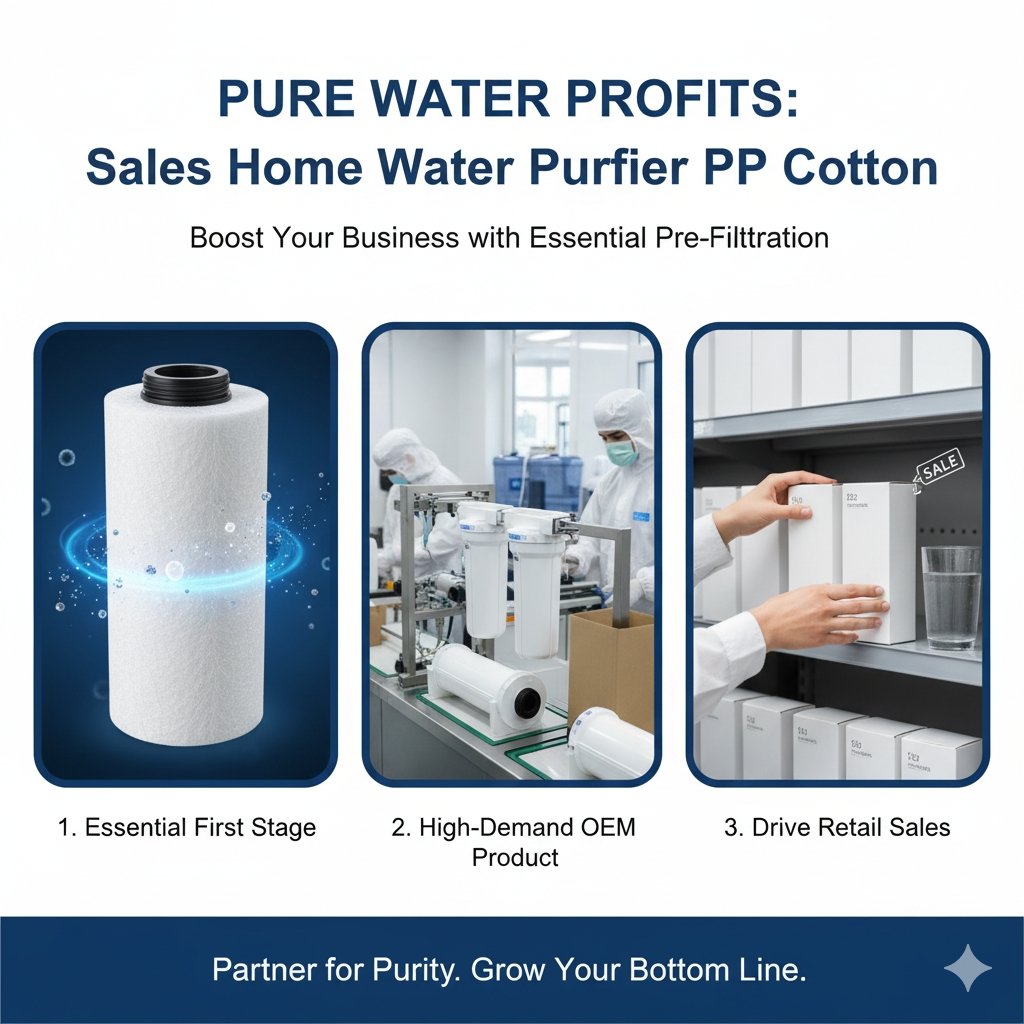
If you’re reading this, you care about two things: selling reliably, and building trust with buyers. The phrase sales home water purifier pp cotton bundles a precise business opportunity — moving polypropylene (PP) melt-blown sediment cartridges and complete home water-purifier packages through wholesale, retail, and installer channels. This article is a practical playbook for manufacturers, distributors, and sales leaders who want to convert engineering strengths into repeatable revenue: product positioning, channel segmentation, pricing and margins, inventory and logistics, marketing that converts, and the operational metrics that predict success.
We’ll assume you sell or plan to sell PP cotton–based sediment cartridges and systems that include them, and that your end markets are homeowners, plumbers/installers, appliance dealers, and e-commerce retailers. Where helpful, review product references and partner info at https://yourwatergood.com/ for typical consumer-facing packaging and technical layout.
Part 1 — Market and customer segmentation
Understand who actually buys.
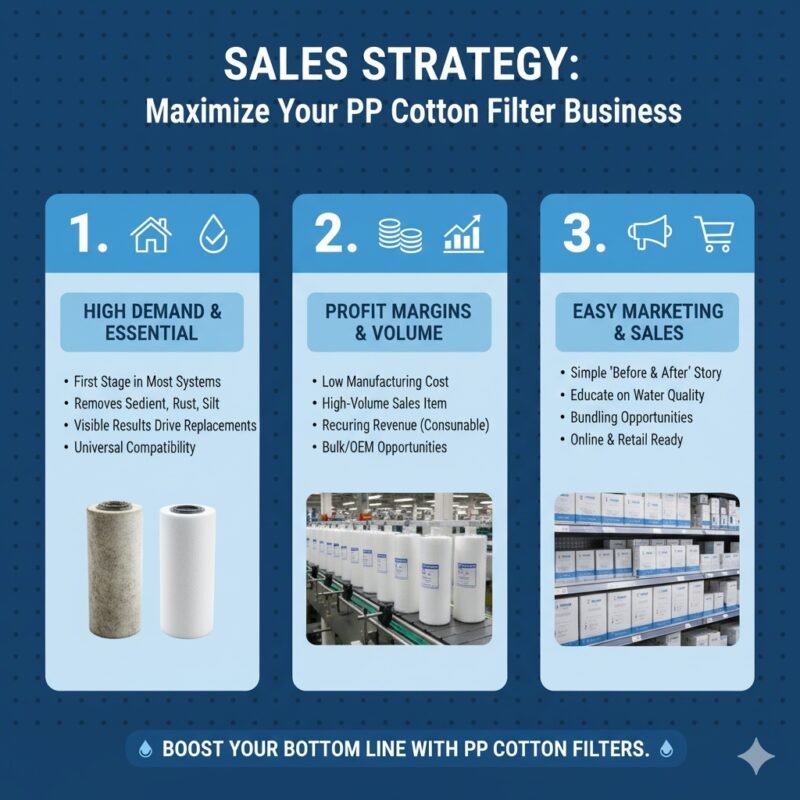
- Homeowners (direct retail / e-commerce). Motivations: clear water at taps, better appliance life, taste/odor improvements when paired with carbon/RO. Purchase drivers: price, convenience, perceived quality, and subscription options for replacement cartridges.
- Installers and plumbing wholesalers. Motivations: reliability, easy installs, compatibility with common housings, margins on parts and service. Purchase drivers: local availability, batch pricing, technical support, and clear installation materials.
- Appliance and fridge dealers. Motivations: inline replacement modules and accessories to up-sell appliances. Purchase drivers: compact modules that fit OEM connections and low return rates.
- Commercial/Light-Commercial buyers (cafes, offices). Motivations: service continuity, water quality for beverages, TCO (total cost of ownership). Purchase drivers: service contracts, spare-part availability, and certifications.
- Private-label and OEM customers. Motivations: predictable supply, white-label packaging, certification support. Purchase drivers: MOQ flexibility, CoAs, audit transparency.
Segmenting your market matters because each channel values different product attributes. Homeowners buy on convenience and reviews; installers buy on reliability and parts availability; OEMs buy on traceability and certification.
Part 2 — Product fundamentals sellers must master
For effective sales home water purifier pp cotton programs, product knowledge differentiates conversations and closes deals.
What PP cotton (melt-blown polypropylene) does:
- Depth-filtration: graded-density structure traps particles across a range of sizes, protecting downstream media (carbon, membranes).
- Low cost and disposability: inexpensive to manufacture, easy to replace, and widely accepted as pre-filtration media.
- Versatility: available in nominal and absolute ratings, pleated or depth form, and multiple lengths (10″, 20″, large pleated cartridges for POE housings).
Key specs buyers ask for:
- Micron rating (nominal vs absolute) and the test method.
- ΔP (differential pressure) vs flow curve — crucial for homeowner experience at taps and for whole-house installations.
- Dirt-holding capacity (grams retained to a service ΔP endpoint).
- Initial-fines and first-flush particulate data — first-use turbidity is a frequent complaint.
- Materials compliance (food-contact/potable water CoA) and lot traceability.
- Mechanical tests: core collapse, end-cap pull strength, and burst pressure for whole-house pleated elements.
If your sales team can recite and document these, you’ll beat competitors who sell on price but can’t answer technical questions.
Part 3 — Positioning and product tiers
Design product tiers for distinct buyer personas:
- Value tier — basic spun/PP depth cartridges, low price, targeted at discount retail and high-volume reseller channels. Minimal testing but basic CoA.
- Trade tier — durable pleated or higher-capacity PP cotton with clear ΔP specs and mechanical testing; targeted at installers and plumbing wholesalers. Often sold in bulk with spare parts.
- Premium tier — conditioned low-fines finish, graded-density optimized for long life, branded packaging, and extended warranty or performance guarantees. Target: appliance dealers, online specialists, and private-label partners.
Offer compatibility charts and SKU cross-references to reduce buyer friction: installers want to match housings and O-ring types quickly.
Part 4 — Sales channels and strategies
A multi-channel approach scales risk and revenue when executed with clear rules.
A. Installer & Trade Channel (plumbing wholesalers)
- Why it works: Installers decide equipment at point-of-install and recommend replacement parts.
- Sales plays: volume packs, technical training, installation-ready kits, priority RMA handling.
- Tools: spec sheets, ΔP charts, physical sample packs for tech review, certification copies.
- Pricing: tiered distributor pricing with higher margins for certified installers and bulk purchases.
- After-sales: provide replacement packs and rapid shipping to reduce downtime for service calls.
B. E-commerce & Direct-to-Consumer
- Why it works: Convenience and subscription monetization.
- Sales plays: starter kit bundles (housing + first-year replacement), subscription discounts, easy-to-understand videos on first-flush and replacement.
- Tools: crisp product pages, comparison tables, customer reviews, and unboxing videos.
- Fulfillment: focus on 2–3 day delivery for cartridges; auto-shipments raise LTV dramatically.
- Pricing: impulse-friendly MSRP with clear savings for subscriptions.
C. Appliance Dealers & Franchise Channels
- Why it works: Cross-sell at point of sale; buyers accept recommended modules for fridges/ice makers.
- Sales plays: certified fit kits, co-branded packaging, training for installers.
- Pricing: margin incentives for dealers and return/refund protections.
D. OEM / Private Label
- Why it works: recurring volume and longer contracts.
- Sales plays: pilot batches, production-run CoAs, audit transparency, packaging variations, and certification support.
- Tools: NDA-protected specs, clear MOQs, and pricing ramps.
E. Commercial / B2B (cafés, offices)
- Why it works: higher price points and service contracts.
- Sales plays: TCO calculators, SLAs for replacements, and on-site training for staff.
- Pricing: contract pricing with periodic review and consumable agreements.
Part 5 — Pricing, margins, and commercial math
To sustain a sales operation, design pricing that balances competitiveness with service and support costs.
Basic unit economics:
- Cost of goods sold (COGS): media, cores, end caps, labor, packaging.
- Fulfillment: warehousing, shipping (especially for cartridges that sell via subscription), returns handling.
- Marketing & sales: channel commissions, digital ads, trade show costs.
- Warranty and RMA reserve: factor in an allowance for returns and replacements.
- Margin targets: aim for gross margin on cartridges at 40–60% in retail channels and 20–35% in installer bulk channels; system margins (whole-house) can be lower on units but recuperate through consumables.
Pricing tactics:
- Bundle pricing: sell systems with first-year consumables at a discount to lock replacement purchases.
- Subscription pricing: 15–30% discount on recurring shipments to increase retention.
- Installer discounts: volume-based tiers to incentivize stocking and recommendation.
- Promotional packs: seasonal promos for capture in retail cycles.
Model example (illustrative):
- Cartridge landed cost: $6.00
- Distributor price: $12.00 (100% markup)
- Retail price: $25–$30 (after further markups)
- Subscription customer sees value and converts; lifetime consumable spend per household over 3 years drives majority of LTV.
Part 6 — Packaging, labeling, and compliance
Packaging is both protection and marketing.
Essentials:
- Individual sealed polybags to prevent dust migration and first-flush complaints.
- Master cartons with printed lot codes and CoA QR links.
- Clear instructions and “first flush” volume prominently displayed to reduce early returns.
- Installation quick-start and warranty card in the box.
- UPC and EAN barcodes for retail channels.
Compliance:
- Provide material CoAs (PP resin, adhesives), FDA/food-contact statements where applicable, and third-party lab reports for any contaminant reduction claims. These documents shorten procurement cycles in trade and OEM channels.
Part VII — Marketing and messaging that converts
Messaging should be channel-specific and evidence-driven.
For homeowners (e-commerce):
- Emphasize benefits: clearer water, longer appliance life, fewer visible particulates.
- Use social proof: reviews, installation photos, and simple before/after visuals.
- Educate: short videos on “what is PP cotton” and why graded-density matters.
- Calls-to-action: starter kit + subscription, or “compare” tables.
For installers:
- Emphasize reliability and serviceability: ΔP curves, dirt-holding, seal robustness.
- Provide quick spec-sheets that installers can read in under a minute.
- Offer technical webinars and certification credentials they can display to customers.
For OEMs and procurement:
- Provide CoAs, retained-sample policies, and audit data.
- Offer pilot order flexibility, quality control checkpoints, and production scheduling transparency.
SEO and content marketing:
- Target long-tail search terms: “pp cotton sediment cartridge 10 inch specs,” “how to reduce first-use turbidity,” and the exact phrase sales home water purifier pp cotton within product pages and blog posts to capture intent-driven traffic.
- Publish data-driven posts with ΔP vs flow charts and dirt-holding test explanations; data builds trust.
Paid channels and trade shows:
- Use targeted Google Shopping for cartridges and Facebook/Instagram for starter kits.
- Attend plumbing and water-tech trade shows to meet installers and distributers; bring test rigs and sample packs.
Part 7 — Sales enablement & training
Equip your reps and partners with the right tools.
Essential enablement:
- One-pagers: specification snapshot, typical applications, part numbers, and cross-reference.
- Training videos: installation, first-flush best practices, and troubleshooting.
- RMA playbook: ask reps to follow a scripted triage (collect lot code, install photos, sample retention).
- Demo kits: include a ΔP bench or easy test demonstration to show product differentiation in trade meetings.
Incentives:
- Certifications or badges for installers who complete training.
- Volume discounts, rebates, and marketing co-op funds for partners who hit targets.
Part 8 — Quality control, testing, and reducing returns
Field reliability drives long-term sales. Implement tight QC.
Must-have processes:
- Lot-level CoA for each shipment stating resin lot, measured ΔP at defined flows, and dirt-holding results.
- Retained-sample policy: keep a production sample per lot for 6–12 months.
- In-line SPC for critical processes (web basis weight, die temps) if producing PP media.
- Factory conditioning or low-fines finishing to reduce first-use turbidity complaints. This step can significantly lower RMA rates and is a strong selling point for premium tiers.
RMA triage flow:
- Capture order and lot code.
- Request installation photos and first-flush confirmation.
- If defect suspected, request return sample (prepaid) and compare to retained sample.
- Provide resolution within SLA (replacement, credit, or technical fix).
Part 9 — Logistics and inventory strategy
Consumables must be available when needed.
Inventory rules:
- Keep regional safety stock for high-turn cartridges — one to two weeks of demand per region at launch, scaling to daily fulfillment capability as subscription revenue grows.
- Forecast using installed base models: installed units × expected replacement cadence = monthly cartridge demand.
- Use small-batch production runs for new SKUs to gauge demand, then scale MOQs as reorder cadence stabilizes.
Fulfillment:
- Optimize for low-cost replenishment options (3–5 day ground shipping) and test sample kits via expedited shipping.
- For subscription customers, automate billing and clearly communicate shipping schedules.
Part 10 — KPIs and dashboards that matter
Track a small set of high-impact metrics:
- Consumable attach rate (replacements sold per installed unit per year).
- RMA rate per 1,000 shipments and first-30-day failure rate.
- Subscription conversion (% of one-time buyers who subscribe within 30 days).
- Fulfillment SLA adherence (% orders shipped within promised window).
- Gross margin by SKU and channel.
Use these to adjust pricing, inventory, and partner incentives quarterly.
Part 11 — Scaling and international considerations
When you expand outside your home market, consider:
- Regulatory differences: materials approvals and potable-water certifications vary.
- Packaging localization: language, units, and QR codes linking to local installation videos.
- Freight & duties: cartridge volumes can be heavy to ship globally; consider regional production or fulfillment partners.
- Service network: installers and spare parts must be available locally to win installer channels.
Part 12 — Real-world launch playbook (90-day plan)
A tactical plan to launch or relaunch a sales home water purifier pp cotton program.
Days 0–30: Prepare
- Finalize SKU definitions (value/trade/premium).
- Produce initial pilot batch and CoAs.
- Create single-page spec-sheets and quick-start videos.
Days 31–60: Pilot
- Release to 10–20 installer partners and a limited e-commerce run.
- Collect data: first-30-day RMA, subscription sign-up, fulfillment timing.
- Adjust packaging and instructions based on feedback.
Days 61–90: Scale
- Ramp production to meet forecasted reorder rates.
- Launch broader e-commerce with subscription marketing.
- Initiate trade-distributor contracts with tiered pricing.
- Run installer training webinars and offer pilot rebates for early adopters.
Part 13 — Common pitfalls and how to avoid them
- Selling on price alone: focus on measurable performance.
- Poor first-use instructions: print first-flush volume and include a short QR video.
- No retained-sample policy: you need samples to resolve disputes fast.
- Understocking consumables: stockouts kill subscriptions and the installer channel’s trust.
- Weak RMA response: slow RMAs cost partners more than product costs.
Conclusion
The sales home water purifier pp cotton opportunity is straightforward: PP cotton cartridges are low-cost, high-velocity consumables that anchor recurring revenue and sustained customer relationships. Success requires combining technical credibility (ΔP curves, dirt-holding data, CoAs) with strong channel playbooks (installer training, subscription commerce, OEM partnerships) and operational discipline (retained samples, regional inventory, fast RMAs). Offer clear differentiation — low-fines finishing, graded-density media, or superior packaging — and support it with data. Convert initial trials into long-term customers by making replacement simple, reliable, and affordable.
If you want to benchmark product packaging, product pages, or starter kit ideas while building your catalog, review typical consumer-facing references and spec layouts at https://yourwatergood.com/ and adapt the best practices here to your channels. Execute the 90-day launch plan, measure the KPIs, and iterate quickly — momentum in consumables and installer trust compounds rapidly when you get the fundamentals right.