How to Verify a Water Filtration System Manufacturer’s Real Capability

Vetting water filtration system manufacturers comes down to four checkpoints: documented production capacity, component traceability, a paid sample run, and turnaround speed on technical drawings. Everything else — brochures, sales calls, generic spec sheets — is marketing. None of it tells you whether a factory can hold tolerances at scale.
Before you request a quote, confirm these five items:
- Real GPD capacity — ask for actual daily output on the product line you need (600 GPD, 800 GPD, or whole-house volume), not a nameplate number pulled from a catalog
- Component traceability — get the source of the RO membrane, activated carbon block, and O-rings documented in writing
- A paid sample unit — a factory that resists shipping a paid sample before a bulk order is hiding something in the production process
- Technical drawing turnaround — request a dimensional drawing for a customized part and time how long it takes to arrive
- QC checkpoints per stage — ask what gets tested during production, not only at final inspection
Fast Check Product: https://yourwatergood.com/shop/
Manufacturer or Trading Company? Read the Signals First
Most sourcing mistakes happen at this step. A trading company can quote fast because it’s reselling capacity it doesn’t control — and it has no leverage when a batch fails QC.
Signals of a real manufacturer:
- They can answer mold and tooling questions without forwarding your message to “the factory”
- They offer a live video walkthrough of the production floor on request
- Their technical contact can discuss membrane specs, not just pricing tiers
- Their quoted lead time changes when you change the customization scope — a trader’s lead time usually doesn’t
Signals of a trading company acting as a manufacturer:
- Vague answers about factory location or floor size
- Inability to confirm who owns the injection molds
- Pricing that barely moves regardless of MOQ or spec changes
Verifying Real GPD Production Capacity
GPD (gallons per day) is the number that separates a real production line from a repackaging operation. Ask for capacity broken down by product — a 5-Stage RO system line runs differently than a whole-house filtration line.
Cross-check the number against two things:
- Floor space and headcount they’ve disclosed — a factory claiming high monthly output from a small assembly area is a red flag
- Existing order references — ask for a recent production run size they’ve completed, not a theoretical maximum
Well water and municipal tap water place different demands on a system’s sustained flow rate. A manufacturer verifying real capacity should be able to explain how their line adjusts GPM (gallons per minute) testing for higher-hardness well water versus standard municipal supply, without treating it as an edge case.
Component Traceability and the QC Checkpoints That Actually Matter
This is where inexperienced buyers get burned months after the order ships — not at inspection, but in the field.
A detail most buyers never ask about: low-grade activated carbon block filters use adhesives that cause an oversized initial PSI drop across the cartridge. That pressure drop shifts load onto the downstream RO membrane and shortens its working life — often showing up as a warranty claim eight to twelve months later, long after the batch has shipped. Ask the manufacturer for pressure-drop test data on the carbon block, not just the finished system’s rated PSI.
A second detail worth checking directly: O-ring quality. Low-grade O-rings develop micro-leaks during repeated hot-to-cold cycling — a failure mode that won’t show up in a single-day inspection but will show up in the field within a year. Ask what O-ring material is specified and how it’s pressure-tested, not just whether the unit “passed inspection.”
Ask for these in writing before sampling:
- RO membrane brand and rejection rate spec
- Activated carbon block adhesive type and PSI drop test data
- O-ring material and thermal-cycling test method
- TDS (ppm) reduction target under stated test conditions
Testing Technical Drawing and Sample Response Time
A manufacturer with real engineering capability responds to a customization request with a dimensional drawing, not a delay.
Time two things during vetting:
- Drawing turnaround — how many business days from your customization request to a usable technical drawing
- Revision cycle speed — how fast they respond after you mark up the first draft
Trading companies typically stall here because the actual engineering team sits somewhere else in the chain, adding days — sometimes weeks — to a step a real factory handles internally.
Off-the-Shelf Components vs. Full OEM/ODM Support
Verification standards shift depending on which path you’re sourcing through. A manufacturer selling off-the-shelf components carries different MOQ, lead time, and support expectations than one offering full OEM/ODM engineering.
| Verification Point | Off-the-Shelf Components | Full-Scale OEM/ODM Support |
|---|---|---|
| MOQ | Often 50–200 units | Typically 500–2,000+ units, part-dependent |
| Lead Time | 15–25 days, stock-dependent | 35–60 days, includes tooling and first-article approval |
| Tooling / Mold Cost | None — shared molds | $3,000–$15,000+, one-time, part-complexity dependent |
| Technical Drawing Support | Existing spec sheet only | Full dimensional drawings, DFM feedback, revision cycles |
| Component Traceability | Harder to confirm — pooled supply | Locked BOM defined at the sampling stage |
If your business model depends on brand differentiation — not just relabeling — full OEM/ODM support is the only path that gives you a locked, traceable bill of materials.
What Verified Manufacturing Support Protects Long-Term
A properly vetted manufacturer changes four numbers on your balance sheet, not just your unboxing experience:
- Fewer warranty claims — traceable components and documented QC catch failure modes before they ship, not after a customer files a claim
- Longer operational stability — systems built on a verified 5-Stage RO architecture hold rated flow and pressure longer under continuous use
- Consistent water quality across batches — verified TDS reduction and membrane specs mean unit #1 and unit #10,000 perform the same
- Protected brand equity — a single bad batch reaching end customers costs more in reputation than the entire vetting process costs in time
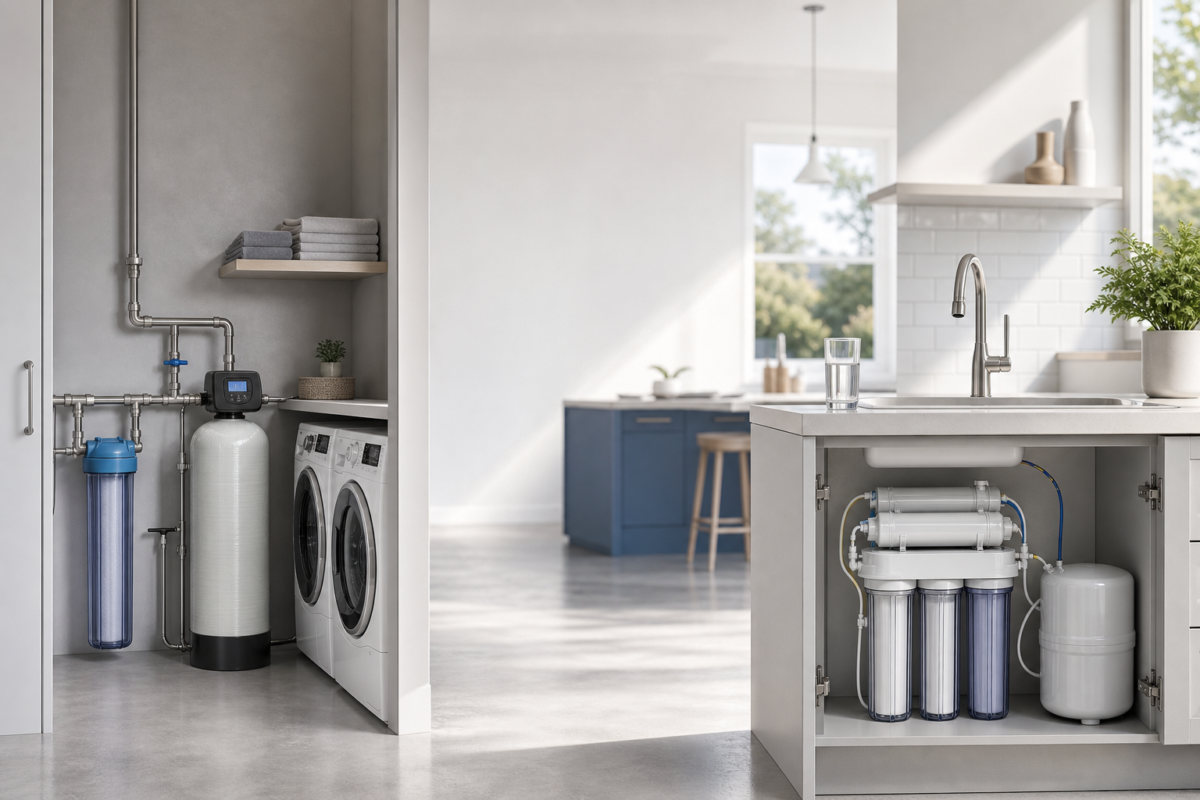
This applies whether you’re sourcing a whole-house system or a compact under-sink RO purifier for a private-label residential line. The verification checklist doesn’t change with unit size — only the tooling cost does.
FAQ
How do I verify a water filtration system manufacturer before ordering? Confirm documented GPD production capacity, request component traceability in writing, order a paid sample, and time their technical drawing turnaround before committing to a bulk order.
What’s the difference between a manufacturer and a trading company? A manufacturer controls tooling, can answer engineering questions directly, and offers live production floor visibility. A trading company resells capacity and typically can’t confirm who owns the molds.
What production capacity should a legitimate factory be able to document? Ask for real daily output in GPD, broken down by the specific product line you’re sourcing — not a general maximum capacity figure from a catalog.
How long should a technical drawing take to receive during vetting? A factory with in-house engineering typically returns a usable dimensional drawing within a few business days. Delays of a week or more usually indicate the drawing work is outsourced.
Should I only work with certified manufacturers? Certification is one data point, not the whole picture. Ask any manufacturer directly whether components have been tested against recognized benchmarks like NSF/ANSI 58 (reverse osmosis systems) or NSF/ANSI 42, and request the lab report as part of your verification file — regardless of what’s printed on their brochure.
What’s the real difference between off-the-shelf components and full OEM/ODM support? Off-the-shelf sourcing has lower MOQ and no tooling cost but limited traceability. Full OEM/ODM support requires higher MOQ and tooling investment but delivers a locked, traceable bill of materials and dedicated technical drawing support.
Does well water versus municipal tap water change how I should vet a manufacturer? Yes. Ask how the manufacturer tests GPM flow rate and TDS reduction under higher-hardness well water conditions specifically, not just standard municipal supply — sustained performance differs between the two.
Get Your Verification Data Before You Commit
A factory that welcomes scrutiny on capacity data, component sourcing, and technical drawings is telling you something. One that deflects is telling you something too.
Before shortlisting your next water filtration system manufacturer, request three things in writing: a custom OEM quote, a full technical parameter sheet, and B2B wholesale pricing tied to your actual order volume — not a generic price list. That paperwork trail is your verification record, and it’s worth more than any brochure claim.