
2 Stage Water Filter Manufacturer: What B2B Buyers Must Verify Before the First Container

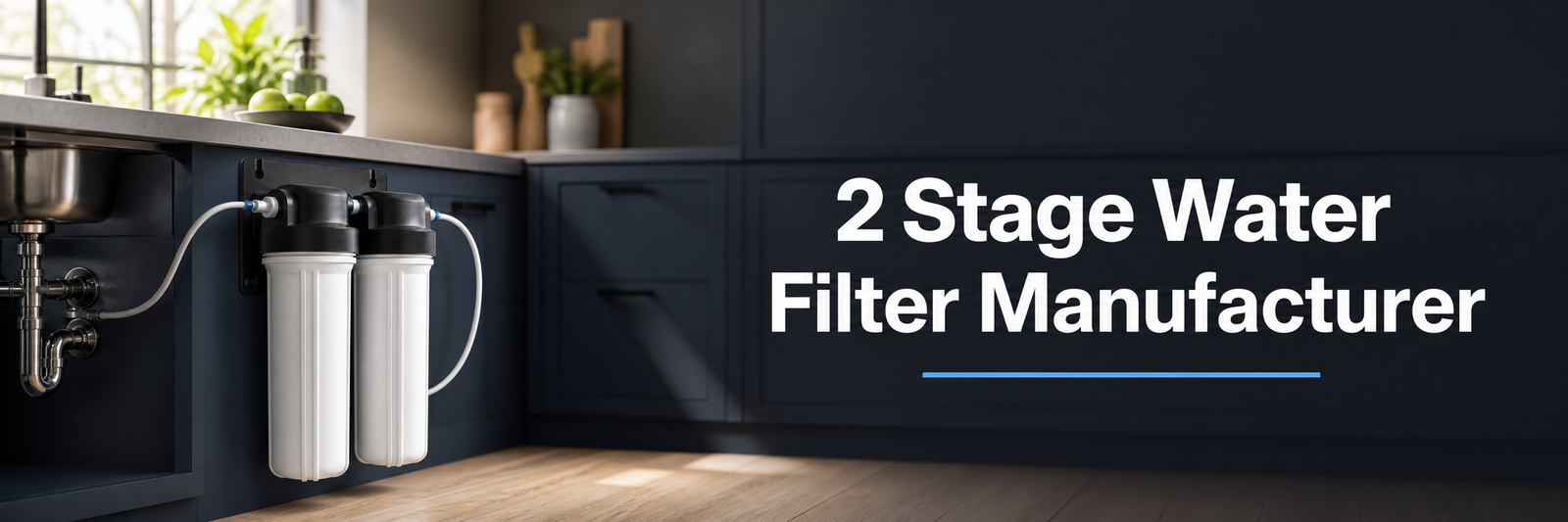
A qualified 2 stage water filter manufacturer is one that can prove component consistency across every production batch — not just quote a low unit price.
Before you send a deposit, confirm the supplier can document:
- Media traceability — lot numbers for PP cotton and carbon block resin, not just a spec sheet
- ΔP (pressure-drop) test data — measured at rated flow, not estimated
- Housing thread and O-ring tolerance records — the #1 source of field leaks
- Sample-to-mass-production consistency — a pre-shipment inspection (PSI) protocol tied to your PO
- Lead time by tooling stage — stock housing vs. custom mold, quoted separately
A supplier that can’t produce this paperwork on request is quoting you a commodity, not an OEM partnership.
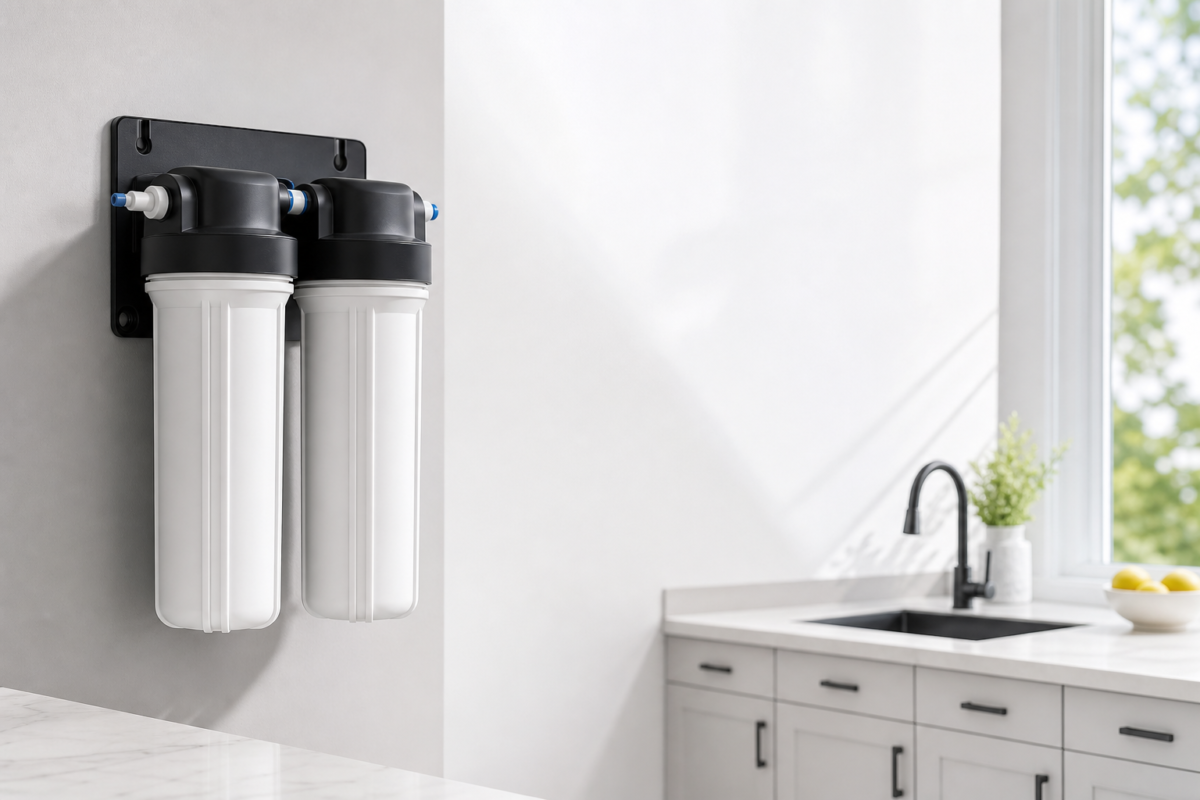
Fast Check Product: https://yourwatergood.com/product/whole-house-water-filtration-system-for-home/
What “OEM Support” Actually Means for a 2-Stage System
A 2-stage water filter — a sediment pre-filter paired with a carbon-based second stage — looks simple on a spec sheet.
It isn’t simple to manufacture at scale.
Real OEM support covers three things buyers routinely skip during vetting:
- Cartridge dimensional lock-in. Housing thread pitch, O-ring groove depth, and cartridge sump length must match across every mold cycle. A 0.2mm drift in the sump can cause bypass leaks that show up only after 60–90 days in the field.
- Media formulation control. Carbon block density and PP cotton wind density directly set the flow-rate-to-micron-rating tradeoff. Buyers who only specify “1-micron” without a flow target at a given PSI often get cartridges that clog within weeks.
- Documentation your compliance team can actually use — drawings, BOM sheets, and test logs, not marketing PDFs.
Off-the-Shelf Components vs. Full-Scale OEM/ODM Support
Most “manufacturers” selling 2-stage systems are actually reselling standard components with a new label. The difference only becomes visible once you ask for engineering support.
| Factor | Off-the-Shelf Wholesale | Full-Scale OEM/ODM Support |
|---|---|---|
| MOQ | Often none — pulled from existing stock | Set per SKU, tied to mold amortization |
| Lead Time | 1–2 weeks (stock housings) | 30–55 days for custom housing tooling |
| Tooling / Mold Fee | None — you inherit the generic mold | One-time fee, typically amortized into unit price after a volume threshold |
| Technical Drawing Support | Rarely provided | Full dimensional drawings, BOM, and ΔP test curves |
| Branding on Housing | Sticker label only | Injection-molded logo, custom color, custom port configuration |
| QC Documentation per Batch | Not standard | Pre-shipment inspection report + retained samples |
Buyers who only compare per-unit price against this table consistently underestimate landed cost — warranty claims and re-labeling both erode the “savings” from a lower quote.
Why Certification Claims Aren’t the Whole Story
Many listings lean hard on certification logos. Here’s the part buyers rarely get told: the EPA does not certify individual point-of-use filters. It regulates water systems and sets contaminant standards — it does not issue a stamp of approval for a specific cartridge or housing.
That means a logo on a product photo tells you almost nothing about the actual batch you’re buying.
What actually protects your brand:
- Independent lab water-quality test reports tied to a specific media lot
- Material safety documentation for anything in direct water contact
- A retained-sample program so you can compare container #1 to container #12
- A named QC contact at the factory, not a general sales inbox
Ask for these documents before you ask about certification logos. A supplier with real testing discipline will have them ready; one that doesn’t will stall.
Municipal Tap Water vs. Well Water: Configuring the Right Build
A 2-stage architecture has to be specified differently depending on the source water your end customer has:
Municipal (city) supply — usually needs the “sediment + carbon” pairing:
- Stage 1: PP cotton, typically 1–5 micron depending on target flow
- Stage 2: Carbon block, sized to reduce free chlorine and taste/odor at the rated GPM
Well water — often needs the “sediment + scale-inhibitor” pairing instead:
- Stage 1: High-density PP cotton pre-filter to protect the second stage
- Stage 2: A polyphosphate or Siliphos scale inhibitor, not carbon
A field detail most spec sheets skip: a 2-stage system does not reduce TDS and does not soften water. If your buyer’s end customer has hard well water above roughly 10–15 grains per gallon, or needs measurable TDS reduction, a 2-stage unit alone will under-deliver — that customer needs an RO system rated in the 300–800 GPD range layered downstream, not a stronger 2-stage cartridge.
Flag this distinction in your own product listings. It prevents the single biggest source of “this didn’t work” support tickets.
The Field Failures That Actually Trigger Warranty Claims
Two failure modes account for most of the RMA volume we see reported back through import channels — and neither shows up in a 30-day quality check.
1. Carbon block binder resin quality. Cheap binders in the carbon block cause a higher initial pressure differential (ΔP) than the spec sheet promises. That elevated ΔP doesn’t just slow flow — it accelerates channeling inside the block, shortens usable cartridge life, and pushes replacement frequency well past what the packaging claims.
2. O-ring compression set under thermal cycling. Housings that see repeated hot-and-cold water exposure (common near water heaters) can develop micro-leaks at the O-ring seat within months, even though the housing passed a static pressure test at the factory. This is the failure mode that generates the highest-cost claims, because it damages surrounding cabinetry, not just the filter.
Ask any supplier directly how they test for both. A vague answer is your answer.
Protecting Brand Equity: From Sample Approval to Container-Load Consistency
Your brand’s reputation lives or dies on whether unit #1 in the first sample box performs the same as unit #4,000 in the fourth container.
That consistency depends on:
- Locked BOM revisions — no silent substitutions of carbon grade or resin supplier between orders
- Retained golden samples at the factory for every SKU, used as the QC benchmark for future runs
- A pre-shipment inspection step before goods leave the dock, not just a final factory walkthrough
- A single technical point of contact who can answer a drawing question in hours, not weeks
Brands that skip this step tend to discover the gap only after warranty claims start arriving from distributors — by which point the damage to reputation is already done.
Frequently Asked Questions
What MOQ should I expect from a 2 stage water filter manufacturer for a private-label order? MOQ is typically tied to the mold used. Stock housings can often ship with no minimum; custom-molded, branded housings usually carry a set MOQ per SKU to amortize tooling.
How long does custom tooling take for a branded housing? Expect roughly 30–55 days for a new mold, separate from production lead time once tooling is approved.
Can a 2-stage system handle both municipal water and well water? Yes, but not with the same cartridge configuration. Municipal supply typically pairs sediment with carbon; well water often pairs sediment with a scale inhibitor instead.
Does a 2-stage filter reduce TDS or soften water? No. TDS reduction requires reverse osmosis, and softening requires ion exchange or a dedicated softener. A 2-stage system addresses sediment and chlorine/taste only.
Is NSF certification required to sell a 2-stage filter in the US? No single federal certification is legally required for this product category. What protects buyers is documented, batch-level lab testing and material safety records — ask for those directly rather than relying on a logo.
What’s the real difference between OEM and ODM support here? OEM typically means your branding on an existing engineered platform; ODM means the factory develops a design, tooling, and BOM specific to your spec sheet from scratch.
What documentation should I request before signing a purchase order? Dimensional drawings, a BOM, ΔP test data at rated flow, O-ring material spec, and a pre-shipment inspection report template.
Get Your Numbers Before You Commit
A per-unit quote tells you almost nothing about landed cost, warranty exposure, or how consistent your containers will be six months from now.
Before you finalize a supplier for your next 2 stage water filter manufacturer program, get three things in writing:
- A Custom OEM Quote scoped to your branding and housing requirements
- A full Technical Parameter Sheet — dimensions, ΔP curves, flow-to-micron ratings, material specs
- B2B Wholesale Pricing broken out by MOQ tier, so you can see where tooling costs actually amortize
Request all three in a single inquiry and compare them against your current supplier’s paperwork — not their sales pitch.