
Whole house filter for city water — practical selection, installation


This topic is covered in full in our main guide: Best whole house water filter for city water — Practical selection, sizing, and long-term care.
If you’re researching whole house filter for city water, you’ve already taken the smart first step: city-supplied water is generally safer than private well water, but it still brings issues (chlorine taste, sediment, occasional discolored water, and trace contaminants) that a properly specified whole-house system can address. This article gives you a practical, decision-focused roadmap — what city water usually contains, which problems a whole-house filter can realistically solve, system configurations that work best for municipal supplies, sizing and flow rules, installation and maintenance guidance, realistic costs, and a buyer’s checklist to help you choose a system that performs reliably for years.
Read straight through or jump to the section you need — by the end you’ll know whether a whole house filter for city water is right for your home and exactly how to specify one so you don’t overpay or undersize it.2-stage whole house water filter for homes.
Quick summary (one-sentence answer)
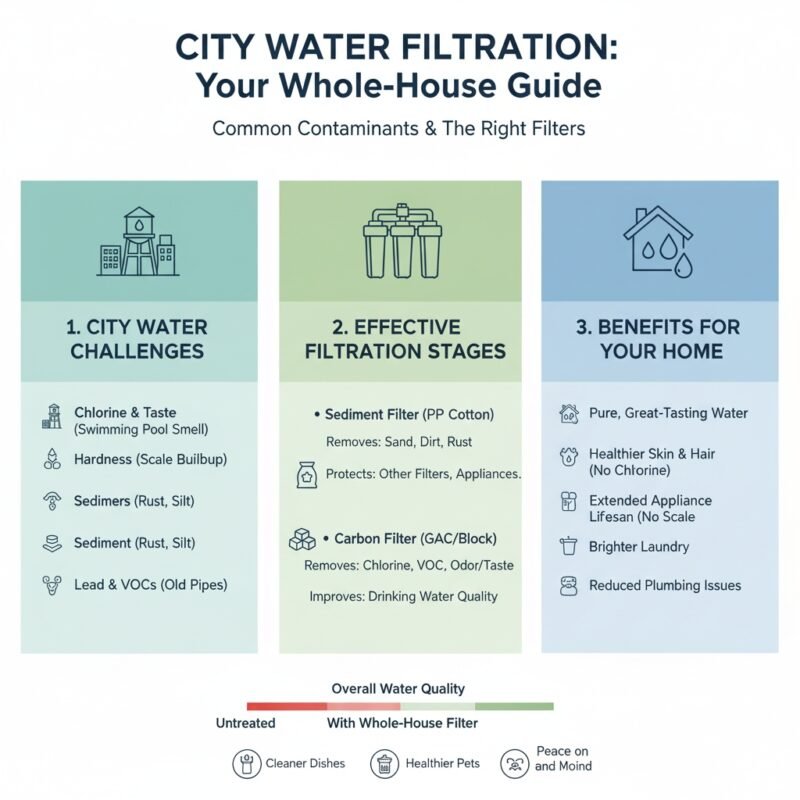
For most homes on municipal supply, a well-specified whole house filter for city water — typically a staged POE stack with sediment prefiltration plus an appropriately sized carbon stage, and optional softening or specialized media if needed — is a cost-effective way to remove particulates, reduce chlorine taste/odor, protect appliances, and extend the life of downstream devices. It’s not a universal fix: dissolved salts (TDS), heavy metals, PFAS, or microbial outbreaks may require additional or point-of-use treatments.
1.What does “city water” usually mean?
“City water” refers to potable water provided by a municipal utility. Typical characteristics:
- Treated and monitored for microbiological safety (coliforms, E. coli) and regulated contaminants.
- Disinfectant residual — usually free chlorine or chloramine — to keep distribution mains safe; that residual can impart taste and odor.
- Low-to-moderate turbidity in general, but distribution mains and home plumbing can generate sediments (rust, scale flakes).
- Variable hardness depending on local geology.
- Trace industrial or agricultural contaminants (PFAS, VOCs, nitrate) may be present in some regions and should be checked via your utility’s Consumer Confidence Report (CCR) or a targeted lab test.
Municipal water is generally good, but it’s not always optimized for taste, appliance longevity, or specialized uses (ice clarity, espresso extraction). That’s where a whole-house filter for city water comes in.
2.Primary reasons homeowners install a whole house filter for city water
- Remove sediment and particulates that clog fixtures, stain laundry, or accelerate wear in appliances.
- Remove disinfectant taste and odor (chlorine) to improve drinking water taste and reduce bleach smell in showers.
- Protect downstream equipment (water heaters, dishwashers, coffee machines, ice makers) from fouling or early failure.
- Address specific local issues revealed by CCR or local advisories (e.g., iron, manganese, elevated organics, or specific contaminants).
- Reduce maintenance (fewer clogged faucet aerators, cleaner ice machines, less scale) and improve guest/household satisfaction.
3.Which contaminants can a whole-house filter for city water address?
A whole-house system can be configured to target several common city-water issues. Typical capabilities:
Likely handled well by standard whole-house stacks:
- Sediment, rust, sand — with PP spun/melt-blown or pleated sediment cartridges (coarse → fine staging).
- Free chlorine (taste & odor) — with granular or carbon block beds sized for contact time.
- Some VOCs and disinfection by-products — carbon helps reduce many organics that affect taste or smell.
Requires special media or complementary systems:
- Chloramine — standard carbon is less effective; use catalytic carbon or larger bed volumes sized for chloramine.
- Hardness (Ca/Mg) — whole-house softener (salt-based or other conditioner) or TAC if scale control is required.
- PFAS, arsenic, nitrate, heavy metals — may need specialty adsorbents, ion exchange, or POU RO, depending on concentrations and regulatory targets.
- Microbial contamination (rare for city water, but possible during distribution events) — use UV or combine with UF/MF for microbial control.
- High TDS — reverse osmosis (RO) is required (usually used POU for drinking/ice rather than whole-house because of waste/recovery factors).
4.Typical whole-house system configurations for municipal supplies
Here are practical, commonly used setups for homes on city water, ordered from simplest to more comprehensive.
A. Basic protection (most common) — Sediment → Carbon
- Stage 1: 20″ or 10″ coarse sediment (20–50 µm) to trap large particles and protect carbon.
- Stage 2: 20″ carbon block or a packed carbon vessel sized by bed volume and contact time.
- Use when: the main issues are taste/odor and sediment. Low maintenance and low cost.
B. Enhanced POE for chloramine areas — Sediment → Catalytic Carbon
- Swap standard carbon for catalytic carbon or use a deeper carbon vessel sized for chloramine breakthrough.
- Use when: your CCR shows chloramine residual or your water utility confirms chloramine use.
C. POE + scale control — Sediment → Carbon → Softener/TAC
- Add a softener if hardness causes scale on boilers, appliances, and fixtures.
- For homes where brine discharge is restricted, consider TAC (Template-Assisted Crystallization) as a salt-free option (performance varies by water chemistry).
D. POE + targeted specialty media — Sediment → Carbon → Media for PFAS/As/Lead
- Specialty media cartridges or packed beds replace or follow carbon if specific contaminant removal is required. Demand manufacturer certification and capacity details.
- Often paired with POU RO for drinking water polishing if household needs demand low TDS or PFAS removal at the tap.
E. Hybrid for high aesthetic or culinary needs — POE Sediment/Carbon + POU RO
- Treat the whole house for sediment and chlorine, then use under-sink RO with remineralizer for kitchen drinking water and ice machines.
- This reduces RO waste while giving top drinking water quality.
5.How to determine what you actually need (the decision workflow)
- Start with data: get your utility CCR and, ideally, a home water test (TDS, hardness, chlorine/chloramine, iron, turbidity, lead, and PFAS if your area is known to have them).
- Define outcomes: list your goals — taste, scale control, appliance protection, low-TDS drinking water, PFAS reduction. Rank them.
- Match tech to goal: use the configurations above as a map. If your top goal is removing chlorine and sediment, a sediment + carbon stack is usually enough. If hardness or PFAS tops your list, plan for additional tech.
- Size for flow: compute peak simultaneous flow (GPM) in your house and choose components rated to handle that flow with acceptable pressure drop.
- Plan maintenance & TCO: consider replacement cadence, costs, and availability of cartridges/media. A higher-capacity carbon vessel may cost more up front but cut long-term consumable costs.
6.Sizing rules — how to match flow and capacity
Sizing is where many DIY or buyer mistakes happen. Two rules are critical: (A) pick components rated for your peak flow with modest pressure drop, and (B) select media volume that gives reasonable time between replacements.
A. Calculate peak flow (GPM)
- Typical simultaneous demands: shower (~2.0–2.5 GPM), dishwasher (~1.5–2.0 GPM), washing machine (~2–4 GPM), kitchen faucet (~1.5–2.5 GPM).
- Example for a medium family: two showers + dishwasher + kitchen faucet ≈ 8–12 GPM peak. Add 25–30% safety margin → design for 10–16 GPM.
- Use this peak figure to choose whole-house housings, carbon vessel flow rating, and softener regen rates.
B. Media capacity and contact time
- For carbon, bed volume and contact time (empty bed contact time — EBCT) determine adsorption performance. Low-capacity inline carbon might be fine for taste but inadequate for larger loads or chloramine.
- Large packed carbon vessels (e.g., 8″–12″ diameter, 40″ height) provide far greater capacity and longer service intervals than small cartridge housings.
- Convert rated gallons to calendar life:
rated gallons ÷ daily gallons treated = days of service. Keep a safety margin (~70–80%) to schedule replacements proactively.
7.Installation considerations and best practices
- Point-of-entry location: install on the incoming cold-water line after the meter and upstream of water heaters if you want the whole house treated (but if your softener is required for hot-water appliances, size accordingly).
- Bypass valve: always install a full bypass so you can service the system without interrupting household water.
- Backflow prevention & code compliance: check local plumbing code; most jurisdictions require backflow assemblies and proper discharge for backwash/regen. Hire a licensed plumber for POE installs.
- Pressure gauges: install inlet/outlet gauges to monitor differential pressure (ΔP). Rising ΔP signals cartridge clogging.
- Access & space: choose a spot with service clearance — 6–12 inches below housings for cartridge removal and enough room for media bag swaps.
- Electrical & UV: if you include UV, ensure dedicated GFCI-protected circuit and accessible lamp replacement access; keep UV before any chlorine removal if you plan to use UV for occasional microbial threats (but note chlorine can impact UV effectiveness discussions — coordinate order per design).
- Drain handling: softeners and backwashing filters need permitted drain connections; plan this with your plumber to avoid discharge violations.
8.Maintenance cadence — realistic schedule for municipal systems
Typical baseline maintenance (adjust for local conditions):
- Sediment cartridge (coarse 20–50 µm): 6–12 months.
- Fine sediment (1–5 µm): 3–6 months if present.
- Carbon cartridge (10″ or 20″): 6–12 months (shorter if heavy chlorine or chloramine).
- Packed carbon vessel media: 1–3 years depending on loading; replace or re-activate per vendor guidance.
- Softener resin: lasts many years (10–15) with proper pretreatment; salt replenishment monthly as needed.
- UV lamp: replace annually (output degrades even if lamp still lights).
- Pressure gauge checks: monthly visual; take action when ΔP reaches manufacturer trigger.
- Annual water test: spot test key parameters to confirm system performance.
Label housings with install dates and set calendar reminders — proactive maintenance prevents taste complaints and protects appliances.
9.Cost expectations — purchase and running costs
Costs vary widely by system choice and local labor. Typical bands:
- Basic sediment + cartridge carbon POE (do-it-yourself style with 20″ housings): $250–$800 equipment; add plumber install $200–$800. Annual consumables $50–$200.
- Packed carbon vessel (professional installation): $1,200–$3,500 installed depending on tank size and brand; annual media amortized cost depends on life (could be modest if media lasts years).
- POE + softener combo: $1,500–$4,500 installed.
- Hybrid POE + POU RO (under-sink for kitchen): $2,000–$5,000 installed (RO depends on capacity and pump requirements).
- Service contracts: $100–$400/year depending on frequency and coverage.
Compute 3–5 year TCO: equipment + install + annual consumables + optional service contract + possible media exchanges. Larger, correctly sized systems often have lower TCO due to longer media life.
10.Common mistakes to avoid
- Undersizing the system (poorly rated GPM or too-small media) — leads to pressure loss and fast exhaustion.
- Skipping a sediment prefilter — carbon beds and membranes clog quickly without proper pretreatment.
- Choosing standard carbon in chloramine areas — requires catalytic carbon or deeper beds. Confirm your utility’s disinfectant.
- Ignoring local codes for drains & backflow — can produce legal headaches and fines.
- Buying solely on upfront price — cheap systems often lead to higher long-term consumable and service costs.
- Neglecting maintenance — exhausted media can create taste/odor problems and harbor biofilms in rare cases.
11.Troubleshooting common POE problems
- Return of chlorine smell: carbon exhausted or insufficient bed volume — replace carbon and consider larger vessel or catalytic carbon if chloramine is present.
- Pressure drop across system: check ΔP; replace clogged sediment and consider larger pleated element or staged prefiltration.
- Cloudy water after a service: flush lines — air and carbon fines can cloud water temporarily.
- Scale despite softener: check softener sizing, regen frequency, and incoming hardness — resin may need servicing.
12.Buying checklist — what to demand from suppliers
- Exact component model numbers and data sheets (flow vs ΔP curves).
- Certifications and test reports for any health-related claims (e.g., NSF/ANSI 42 for aesthetic chlorine removal, NSF/ANSI 53 for specific contaminant reduction).
- Itemized install quote: equipment, labor, valves, bypass, pressure gauges, permits.
- Consumable SKUs and pricing for first 3 years.
- Warranty and maintenance terms; ask if warranty requires professional maintenance and how often.
- Commissioning tests and acceptance criteria (pre/post chlorine/TDS tests if relevant).
- Local references and service network.
13.Sample specification paragraph you can use in an RFQ
Supply and install a whole-house filtration system to treat municipal potable water at point of entry. System shall include: 20″ coarse sediment prefilter, 20″ carbon block or packed carbon vessel sized to achieve manufacturer-reported chlorine reduction at required peak flow (design peak = your calculated GPM), full bypass valve, inlet/outlet pressure gauges, and permitted drain for any backwash/regeneration. Provide itemized quote, consumable SKU pricing for three years, commissioning report with pre/post chlorine and ΔP readings, and warranty documentation. Reference product example: 2-stage whole house water filter for homes.
14.When whole-house isn’t the only or best answer
- If your only concern is drinking water quality (low TDS or PFAS), consider POU RO for the kitchen — more targeted and water-efficient for drinking/ice.
- If you have a single appliance issue (espresso, fridge ice), a dedicated inline or under-sink solution can be cheaper and easier to service.
- If you face complex contaminant problems (high PFAS, nitrates), combine POE media with POU polishing and demand certified removal performance.
15.Final decision roadmap — pick the right whole house filter for city water
- Obtain CCR and a targeted home water test.
- Define primary objectives (taste, scale, PFAS, appliance protection).
- Choose a baseline config: sediment + carbon for taste/particulates; add softener/ specialty media as needed.
- Size for peak GPM and choose carbon media sized by bed volume/contact time for target contaminant.
- Require itemized quotes, certificates for health claims, commissioning tests, and a maintenance plan.
- Schedule proactive maintenance and monitor ΔP.
Conclusion
A whole house filter for city water is often an excellent investment: it improves taste, reduces particulates, protects appliances, and provides a consistent baseline level of water quality across your home. The key to success is matching the system to what your water actually contains, sizing it for real peak flow, and committing to scheduled maintenance. When designed and installed correctly, a whole-house solution brings practical benefits that are noticeable every day — cleaner showers, fewer clogged aerators, better-tasting tap water, and longer appliance life.