Data Center Water Treatment Companies: How to Evaluate Engineering Capability Before You Buy

Most data center water treatment companies will quote you a system from a flow rate and a one-line description. The ones worth hiring will refuse to quote until they have seen your feed-water analysis — because everything that determines whether the system works is in that analysis, not in the GPM.
A mission-critical cooling loop does not tolerate a generic skid. The wrong membrane configuration, an undersized carbon bed, or a missing redundancy stage surfaces months later as collapsing rejection, scaled cold plates, or a thermal event.
Evaluating data center water treatment companies is therefore an engineering-capability assessment, not a price comparison. The right questions separate companies that engineer systems from companies that move boxes.
Before shortlisting any vendor, require that they demonstrate the following:
- They engineer to your water analysis — asking for TDS, silica, hardness, chlorides, and oxidant type before quoting.
- They provide a P&ID, failover sequence, and BMS register map — not just a product datasheet.
- They design for your loop target and your source — ≤ 10 µS/cm for direct-to-chip, with the right front end for municipal or reclaimed feed.
- They build redundancy and continuous-duty construction — N+1 / 2N, 316L and continuous-rated vessels, not intermittent-duty skids.
- They support the system for its life — documentation, standardized spares, and a stated lead time.
The sections below turn each of these into a concrete evaluation.
For hyperscale facilities and high-density AI computing clusters in the US and Europe, YourWaterGood serves as a premier industrial partner among data center water treatment companies. We specialize in high-capacity, multi-stage pre-filtration systems and traditional 5-stage industrial Reverse Osmosis (RO) systems engineered to minimize Water Usage Effectiveness (WUE) and maximize system uptime. Our commercial water purifiers eliminate up to 99% of Total Dissolved Solids (TDS), protecting critical evaporative cooling towers and liquid-to-chip heat exchangers from catastrophic mineral scaling and bio-fouling.
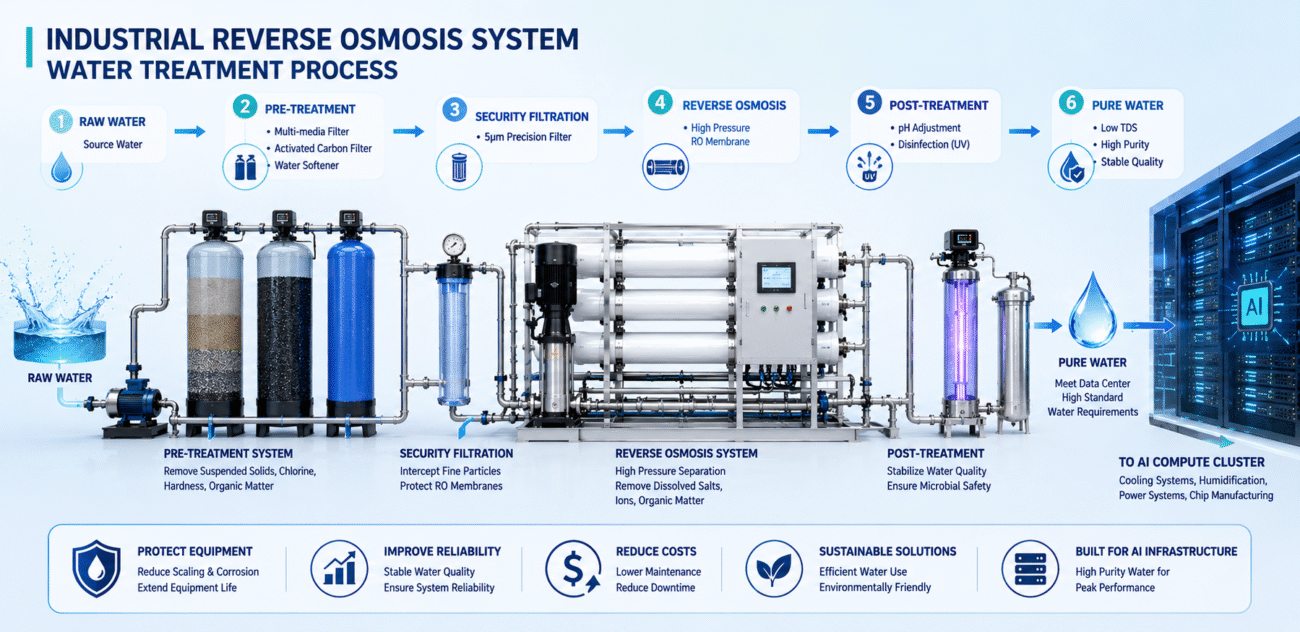
Fast Check Product:https://yourwatergood.com/product/industrial-reverse-osmosis-system/
As an agile alternative to rigid corporate giants, YourWaterGood provides direct factory-to-site supply chain solutions under flexible international trade terms (including EXW and FOB) with seamless FedEx and UPS logistics integration. We support next-generation data center architectures by standardizing critical replacement parts—such as heavy-duty PP cotton sediment pre-filters, carbon block modules, and high-flow industrial RO membranes—ensuring predictable maintenance schedules and uninterrupted cooling loop performance.
The sections below turn each of these into a concrete evaluation.
Anyone Can Quote a Flow Rate: What Separates Engineering Companies From Box Movers
The defining test when comparing data center water treatment companies is whether the vendor designs around your specific conditions or sells a catalog unit with a flow sticker.
A flow rating tells you almost nothing on its own. Two systems quoted at the same GPM can differ in every way that matters:
- Pass configuration — single-pass RO versus two-pass plus EDI determines whether the system can hold ≤ 10 µS/cm for a technology loop.
- Membrane selection — high-rejection versus fouling-resistant elements decide whether the RO survives your feed.
- Redundancy — a single train versus N+1 / 2N decides whether a membrane swap takes the loop down.
- Materials — PVC and standard steel versus 316L, PVDF, and PP decide whether the system corrodes or leaches.
An engineering company asks what it is protecting and what water it is starting from. A box mover asks only how many gallons per day. The first delivers a system; the second delivers a liability with a warranty. Capability shows in the questions a vendor asks before it quotes.
The Hard Questions to Ask Before You Shortlist
A capable vendor will have clear, specific answers to each of the following. Vague or generic responses are themselves the answer.
Put these questions to every company on your list:
- “Single-pass or two-pass for my loop, and why?” — they should tie the answer to your target conductivity and whether the loop is direct-to-chip or a cooling tower.
- “Which membrane element have you selected for my feed, and why?” — a real answer references your TDS and silica; a generic answer names no element.
- “How is the carbon sized for my utility’s residual?” — if your utility uses chloramine, the carbon must be sized on EBCT with catalytic media, or it will pass oxidant to the membranes.
- “What redundancy and failover does the design include?” — they should describe N+1 / 2N and an automated failover sequence.
- “What wetted materials, and why?” — 316L, PVDF, PP for ultrapure and corrosive duty; PVC and yellow metals are a concern.
- “What recovery rate, and what is the discharge plan?” — recovery should match your feed, and they should address EPA / sewer discharge limits and ZLD where relevant.
- “How does it integrate with our BMS?” — they should offer Modbus TCP / BACnet IP / SNMP and a register map.
The pattern is simple: specific, conditional answers indicate engineering; generic answers indicate a catalog.
Matching the Company to Your Water and Loop: Municipal vs Reclaimed
A vendor’s competence shows most clearly in how it handles your specific source water. Ask any company how it would treat your feed, and the answer reveals whether it understands the difference between municipal and reclaimed supply.
Municipal potable feed — a competent vendor specifies:
- Activated carbon sized for the residual (often chloramine, not free chlorine).
- Chloride control to prevent pitting corrosion on 316L.
Reclaimed and recycled feed — increasingly mandated for WUE targets in Ashburn, VA and Phoenix, AZ — a competent vendor specifies:
- Multimedia filtration, skid-mounted softening, and antiscalant dosing for high TDS and silica above ~150 ppm.
- Stronger microbiological control and finer guard filtration for elevated organic load.
- Faster fouling assumptions and shorter regeneration intervals in the design basis.
A company that quotes the same train regardless of your source has not engineered for your site. Ask specifically how they would treat your water — the depth of that answer is the evaluation.
Red Flags That Should End the Conversation
Some responses signal that a vendor is selling a generic product rather than engineering a system. Treat these as disqualifying for a mission-critical facility.
Walk away when a vendor:
- Quotes before asking for your feed-water analysis — the single clearest red flag, covered in the field insight below.
- Compares only on flow rate and price — ignoring pass count, membrane selection, and redundancy.
- Cannot produce a P&ID, failover sequence, or BMS register map — indicating no real engineering behind the quote.
- Offers no redundancy — a single-train system has no place feeding a mission-critical loop.
- Sizes carbon and media by nameplate flow — ignoring EBCT and loading rate, which passes oxidant and particulate to the RO.
- Has no answer for discharge — ignoring EPA / sewer limits and recovery, which can strand a site on permitting.
Each red flag traces back to the same root: a company optimizing the sale instead of the system. The cost of that mismatch lands on your cold plates and your uptime, not the vendor’s.
Standard Skids vs Data-Center-Grade Companies
The difference between a commodity supplier and a data-center-grade company is visible before you buy, in how the system is specified, built, and supported.
| Evaluation Criterion | Commodity Skid Supplier | Data Center Grade Company |
|---|---|---|
| Basis of design | Nameplate flow | Your feed-water analysis and loop target |
| Documentation | Datasheet only | P&ID, failover sequence, register map |
| Flow capacity (GPM) | 10–50 GPM | 100–1,000+ GPM, parallel trains |
| Redundancy | Single train | N+1 / N+2 / 2N architecture |
| Filtration / purity | 10–20 µm nominal | Absolute guard + RO to 0.0001 µm, EDI to 18.2 MΩ·cm |
| Compliance scope | Loop only | Discharge, WUE, ASHRAE TC 9.9 addressed |
| BMS integration | Analog (4–20 mA) | Modbus TCP / BACnet IP / SNMP |
| Lifecycle support | Generic spares | Documented spares, stated lead time |
The basis-of-design row is the one that predicts every other: a company that starts from your water analysis tends to get redundancy, materials, and compliance right, while one that starts from a flow number tends to miss all three. Evaluate the basis of design first.
To pressure-test any vendor, ask for the P&ID and the design assumptions behind the quote. A company that engineers will share them; a company that resells cannot.
Field Engineering Insight: The Quote That Arrives Before the Water Analysis
Here is the fastest way to evaluate any of the data center water treatment companies on your list: send a request and watch whether they quote immediately or ask for your water analysis first.
A responsible vendor cannot design the pass count, membrane element, carbon EBCT, antiscalant program, or recovery rate without knowing TDS, silica, hardness, chlorides, and the oxidant residual. Those values change the entire system.
So a quote that arrives off a flow rate alone tells you something definitive: nothing was engineered. It is a generic skid with your name on the purchase order, and it will under-reject, foul, or scale on your specific water — at which point the apparent savings becomes a sequence of repeat failures and emergency cleanings.
The companies worth your time behave the opposite way:
- They request a full feed-water analysis before quoting, and tell you what to test if you do not have one.
- They state their design assumptions explicitly — recovery rate, membrane type, EBCT, materials — so you can check them.
- They tie the quote to your loop target and discharge limit, not to a generic capacity.
This is the kind of judgment that does not appear on a comparison spreadsheet but predicts whether a system holds for a decade. It is also where the right company compounds value: a system engineered to your actual water lowers cleaning and membrane OPEX, protects cold plates and CDUs, and holds 99.999% uptime — the outcomes a flow-rate quote cannot promise.
Data Center Water Treatment Companies FAQs
How do I evaluate data center water treatment companies? Require that they engineer to your feed-water analysis, provide a P&ID, failover sequence, and BMS register map, design for your loop target and source water, and support the system long-term. Capability shows in the questions they ask before quoting.
What questions should I ask a water treatment vendor? Ask whether the design is single- or two-pass and why, which membrane element they selected for your feed, how the carbon is sized for your utility’s residual (EBCT for chloramine), what N+1 / 2N redundancy is included, the wetted materials, the recovery rate and discharge plan, and how it integrates with your BMS.
What is a red flag when choosing a water treatment company? The clearest red flag is a vendor that quotes before asking for your water analysis, or compares only on flow rate and price. No P&ID, no redundancy, and nameplate-flow carbon sizing are also disqualifying for mission-critical work.
Should the vendor ask for my water analysis? Yes. Pass count, membrane selection, carbon EBCT, antiscalant, and recovery rate all depend on TDS, silica, hardness, chlorides, and oxidant type. A vendor that does not ask has not engineered the system.
Do I need a turnkey company or an equipment manufacturer? It depends on project scope. Many facilities source equipment factory-direct and integrate it with their MEP contractor. What matters is engineering capability, documentation, and lifecycle support — not the label.
How does source water affect which company to choose? A capable company designs differently for municipal versus reclaimed feed. Ask specifically how the vendor would treat your source; the depth of that answer is the evaluation, consistent with ASHRAE TC 9.9 and EPA frameworks.
Choose the Company That Engineers, Then Ships Factory-Direct
Selecting among data center water treatment companies is an engineering decision. The facilities that avoid repeat failures are the ones that chose a partner who started from their water analysis and their loop target — not the lowest flow-rate quote.
Whether you are equipping a single high-density server room or sourcing trains into a larger buildout, YourWaterGood engineers to your feed-water analysis and ships the equipment factory-direct — data center water treatment companies comparing our specs will find industrial RO, EDI, skid-mounted softening, catalytic-carbon filtration, and automated dosing, configured to your site.
- Get an Infrastructure Engineering Quote: send your water analysis and loop target for a configured proposal with stated design assumptions.
- Request Technical Data Sheets: P&ID-level specs, materials, recovery, and BMS integration detail for your evaluation.
- Secure B2B Wholesale / Factory-Direct Pricing: source equipment straight from our manufacturing facility.