
Does a 5-Stage RO Water Filter Actually Remove PFAS and Lead?

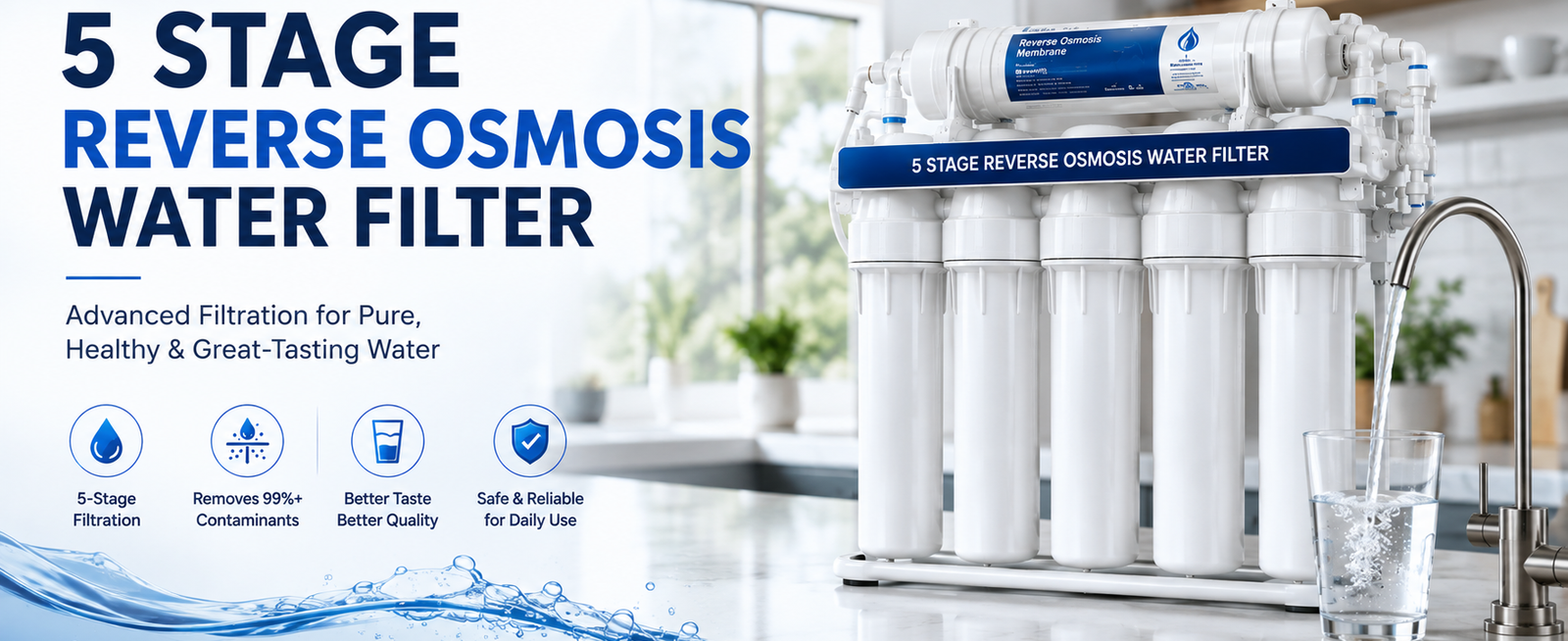
Quick recap before we get into it: a 5-stage RO system filters water through sediment, carbon, and a reverse osmosis membrane before it reaches your tap. If you want the full breakdown of how that works, that’s covered in our intro guide — this page focuses specifically on what it does and doesn’t do for PFAS, lead, and other health-related contaminants, since that’s usually what brings people here.
The short version, before the detail:
- Lead — RO membranes are widely recognized as effective for this, because lead particles are far larger than what the membrane’s pore structure allows through
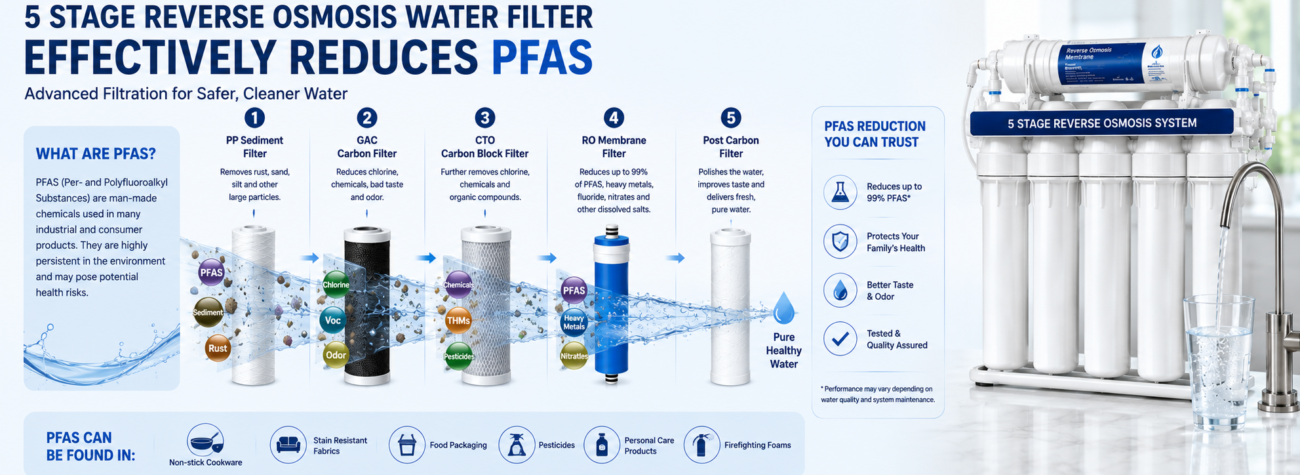
- PFAS — RO is one of the few home filtration technologies with a membrane fine enough to address PFAS at all, though real-world effectiveness varies by the specific compound and the membrane’s condition
- Baby formula water — RO water is a reasonable low-contaminant base, but water source is only one part of safe formula prep
- Bacteria — not guaranteed by filtration alone on every setup; well water households often add a UV stage specifically for this
Does RO Remove Lead?
Yes, and this is one of the more well-established claims in residential water treatment. Lead typically enters tap water from old plumbing and fixtures, not the municipal source itself, and it exists in water as particles and ions well above the size of a water molecule.
An RO membrane’s pore structure — fine enough to reject dissolved solids down to roughly 0.0001 micron — is more than capable of blocking lead at that scale. This is a mechanical filtration outcome, not a chemical treatment, which is part of why it’s considered a reliable approach for lead specifically.
Does RO Remove PFAS?
This one deserves a more careful answer than a flat yes or no.
Why RO is positioned to handle it: PFAS (“forever chemicals”) molecules are generally larger than water molecules, and an RO membrane’s pore size is small enough to reject a meaningful portion of them — which is more than can be said for standard carbon-only filtration, which struggles with certain PFAS types.
Why it’s not a guarantee across the board:
- PFAS is a category of thousands of compounds, not one substance — shorter-chain variants are harder to reject than longer-chain ones.
- Membrane condition matters. A membrane that’s degraded or past its effective life rejects less of everything, PFAS included — which is the same wear pattern that shows up as a rising TDS reading over time.
- Incoming water pressure and system maintenance both affect real-world rejection rates, not just the membrane spec on paper.
If you’re tracking your system’s performance over time, a climbing TDS number is a useful early signal that rejection capability across the board — PFAS included — is starting to decline. That’s covered in more depth on our troubleshooting page if you want to check where your system currently stands.
Is RO Water Safe for Baby Formula?
RO water is commonly used as a low-contaminant base for infant formula, specifically because it reduces lead, nitrates, and other dissolved contaminants that untreated tap or well water can carry.
A few things worth knowing:
- Water source is one part of safe formula prep, not the whole picture. Sterilization and preparation steps matter regardless of which water you start with.
- If you have specific concerns about your water supply, checking with your pediatrician or local health department is worth doing before making decisions based on general information like this.
- Mineral content is a separate question from contaminant removal — see below.
What RO Doesn’t Guarantee on Its Own
Filtration and disinfection are different jobs. An RO membrane’s pore size is small enough to reject most bacteria mechanically, but a standard 5-stage system isn’t marketed or built as a certified disinfection device the way a dedicated UV system is.
If you’re on well water, or bacterial contamination is a specific concern for your household, that’s the situation where adding a UV sterilization stage — available as a build option on our systems — makes the most sense. It’s a distinct layer of protection from the filtration stages, not a replacement for them.
One Myth Worth Correcting
Myth: “RO water isn’t healthy because it removes minerals, and that matters more for a baby.”
Reality: the mineral contribution from any drinking water — filtered or not — is small compared to what infants get from formula itself, which is formulated to provide the nutrition they need. If mineral content in your water specifically matters to you, a remineralization stage is an option to look into, but it’s a preference question, not a safety one.
FAQ
Does a 5-stage RO filter remove PFAS? It’s mechanically positioned to reduce many PFAS compounds due to the membrane’s small pore size, though real-world effectiveness varies by the specific compound and how well-maintained the membrane is.
Does RO water filtration remove lead? Yes — this is one of the more well-documented use cases for RO, since lead particles are well above the size the membrane’s pore structure allows through.
Is reverse osmosis water safe for making baby formula? It’s commonly used as a low-contaminant water source for this purpose. Water quality is one part of safe formula prep; check with your pediatrician if you have specific concerns.
Does RO water lack minerals that babies need? It removes dissolved minerals along with other dissolved solids, but the nutritional contribution from drinking water is small next to what formula itself provides.
Can RO remove bacteria from well water? The membrane’s pore size mechanically blocks most bacteria, but a standard system isn’t built as a certified disinfection device. Well water households often add a UV stage specifically to address this.
How do I know if my water has PFAS or lead in the first place? A certified lab test is the reliable way to confirm this — consumer test strips generally can’t detect PFAS at the sensitivity level required. Many state environmental health departments offer or can point you to testing.
Is RO water safe to drink every day for the whole family? Yes, for the household in general. The considerations on this page are specifically about infant formula prep and specific contaminants, not daily use for adults and older children.
Where to Go From Here
If PFAS or lead are a known concern for your specific water source, a certified lab test is the only way to confirm what’s actually in your water before and after filtration — general information like this can’t substitute for that.
If you’ve confirmed a 5-stage system is the right fit and want to see current specs, including the optional UV add-on for well water households, you can view the 5-stage reverse osmosis water filter product page.