
5 Stage Water Filter System Cost & ROI: What B2B Buyers Actually Pay For

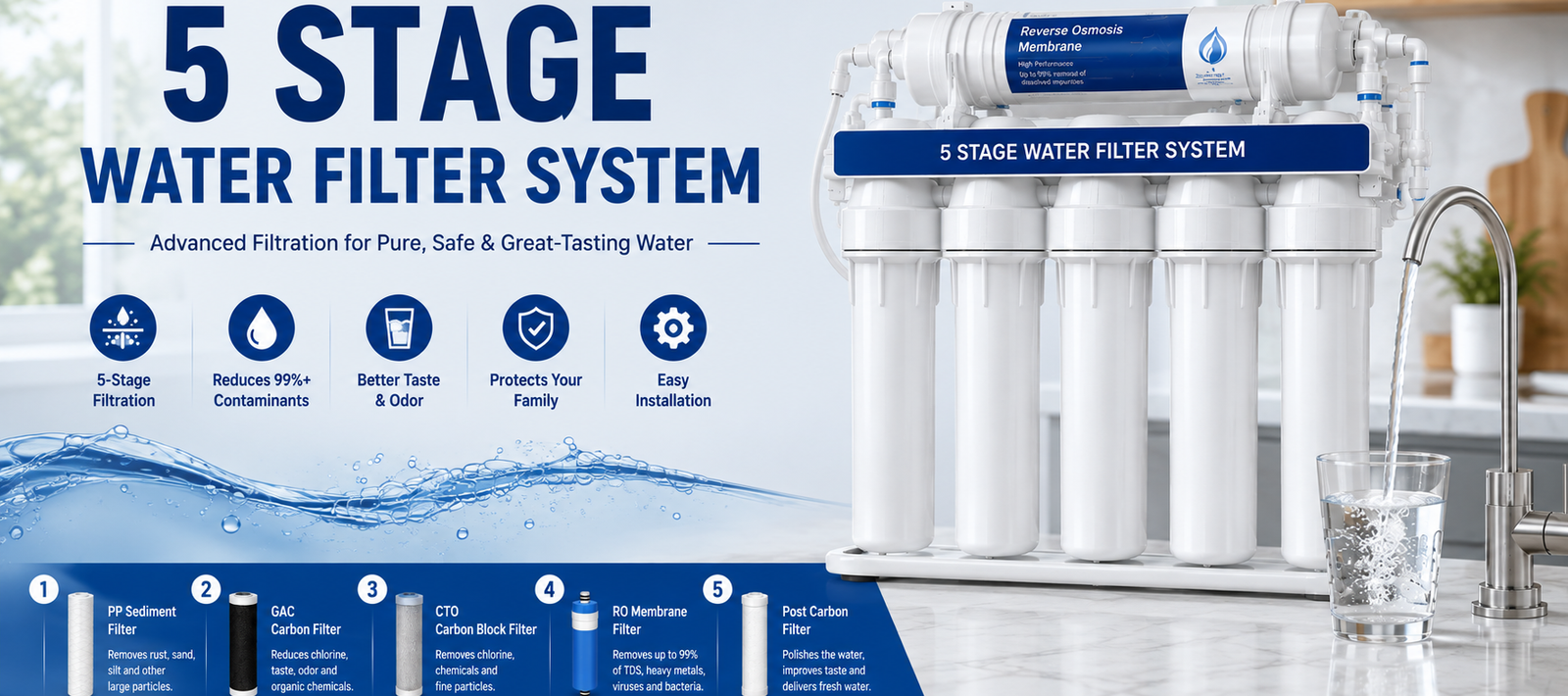
The real cost of a 5 stage water filter system almost never shows up on the quote sheet. It shows up 8 to 14 months later — in warranty claims, field returns, and the margin a brand loses replacing units that failed under real tap water conditions.
Before comparing supplier quotes, benchmark these four cost drivers. They decide whether a system is actually cheap, or just cheap to buy:
- Component traceability — can the factory name the exact carbon block, membrane, and housing batch, or is sourcing “mixed”?
- MOQ flexibility — does the factory lock you into one fixed configuration, or scale tooling to your order size?
- Lead time reliability — is the quoted lead time for a finished, customized unit, or only for stock housings?
- Warranty claim benchmark — what defect/return rate does the factory report on comparable OEM builds, not just their best case?
- Technical drawing support — do you get real spec sheets and GPD/PSI ratings, or a product photo and a price?
Get the cost structure right at the sourcing stage, and everything downstream — warranty cost, retention, brand reputation — gets easier to control.
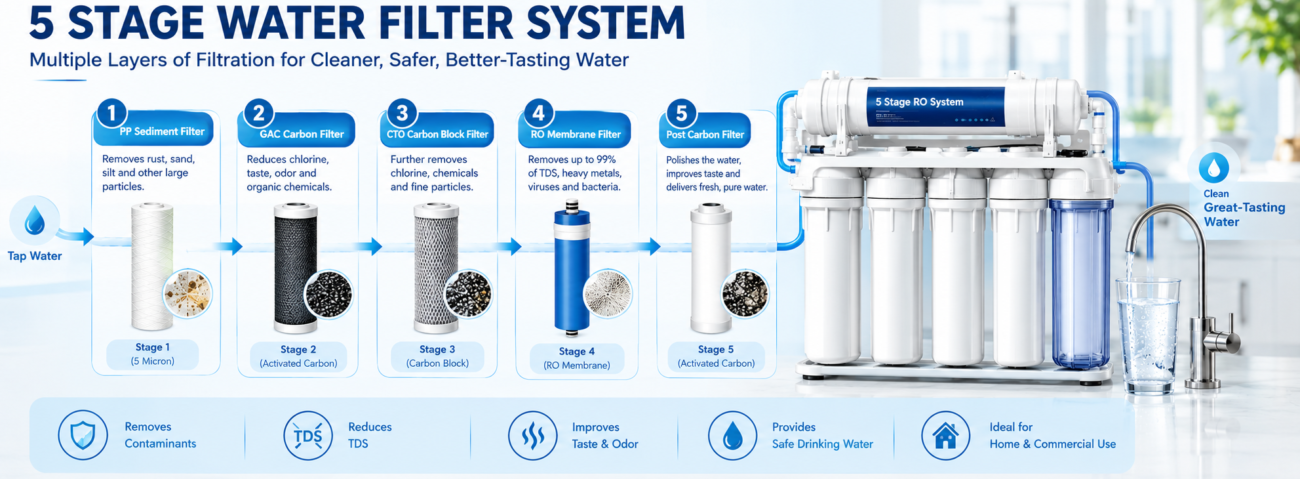
Fast Check Product: https://yourwatergood.com/product/5-stage-ro-water-filter-for-home-busines/
The Hidden Cost Structure Behind a “Cheap” Quote
Unit price is one line on a much longer bill. The rest arrives in stages:
- Freight and duties — often 15–30% on top of unit cost, and it doesn’t shrink when a batch fails inspection.
- Rework and re-inspection — every rejected pallet adds labor and delay cost that never appears on the original PO.
- Warranty claims — a membrane or carbon block that underperforms in the field costs far more to replace under warranty than it ever saved on the unit price.
- Support load — customer service tickets for “milky water” or slow flow rate consume staff hours a low-cost supplier never bills you for.
- Brand damage — a bad review citing product quality is a cost with no line item, and it compounds.
A system rated for 400, 600, or 800 GPD looks identical on a spec sheet whether it’s built from traceable components or whatever was cheapest that quarter. The GPD number tells you throughput. It tells you nothing about how many of those units come back.
Off-the-Shelf Sourcing vs Full OEM/ODM Support: The ROI Comparison
This is the comparison most quote sheets never show side by side:
| Factor | Off-the-Shelf Components | Full-Scale OEM/ODM Support |
|---|---|---|
| MOQ | Fixed, usually high, no configuration flexibility | Scales with order size; smaller pilot runs available for new brands |
| Lead Time | Quoted for stock units only — customization resets the clock | Customization is built into the timeline from day one |
| Tooling / Mold Fee | None, but you inherit someone else’s housing design and branding limits | One-time cost, amortized across the order; you own the design |
| Technical Drawing Support | Rarely provided; buyer reverse-engineers specs after the fact | Full spec sheets, GPD/PSI ratings, and drawings before production starts |
| Housing & Branding | Generic shell, often sold to competitors under a different label | Private-label housing, logo placement, and packaging control |
| UV Add-On | Usually unavailable without re-sourcing the whole system | Can be added as an optional stage without a full redesign |
| Water Output Consistency | Fixed TDS output, no tuning for the end application | Output can be tuned to the application — drinking, food-contact, or process water |
The off-the-shelf column looks cheaper on the PO. The OEM/ODM column is what actually controls your warranty rate, your margin per unit, and how much of your support team’s time gets eaten by preventable complaints.
Where the ROI Actually Shows Up
For brand owners and importers, ROI shows up as fewer warranty claims per thousand units shipped, a more predictable landed cost per container, and a product that doesn’t force a re-source six months into a retail listing.
For commercial and hospitality buyers, ROI shows up differently:
- Fewer service calls on espresso machines, combi ovens, and ice machines damaged by scale.
- Fewer minutes of downtime during peak service, when flow rate (GPM) actually matters.
- Consistent water quality across every outlet in a multi-location chain, not just the flagship store.
Both groups are buying the same underlying system. What changes the ROI math is whether the supplier engineered it to hold up, or just built it to pass a first inspection at the required PSI.
Field Engineering Insight: Where Cheap Components Quietly Eat Your Margin
Three details rarely make it into a spec sheet, but they show up in every warranty claims report:
- Carbon block binder quality. Low-grade binders cause a higher initial PSI drop across the carbon stage. That extra pressure loss shortens the working life of the downstream RO membrane — a failure that gets blamed on “the membrane” months later, when the real cause was a $2 component upstream.
- O-ring compound under thermal cycling. Cheap O-rings develop micro-leaks after repeated hot/cold exposure near a water heater or in a warm back-of-house environment. It’s a slow leak, not a failure — which is exactly why it generates a support ticket instead of an obvious defect.
- Chasing zero TDS in food and beverage applications. For coffee, tea, and ice programs, ultra-pure water strips flavor and is aggressive enough to corrode copper boiler components over time. The systems that hold up in commercial kitchens use a TDS blending or output-tuning setup to land in a target range for the application, rather than treating “lower TDS” as automatically better.
None of these show up in a unit-price comparison. All three show up in a warranty claims report, twelve months later, at a cost that dwarfs the few cents saved per component.
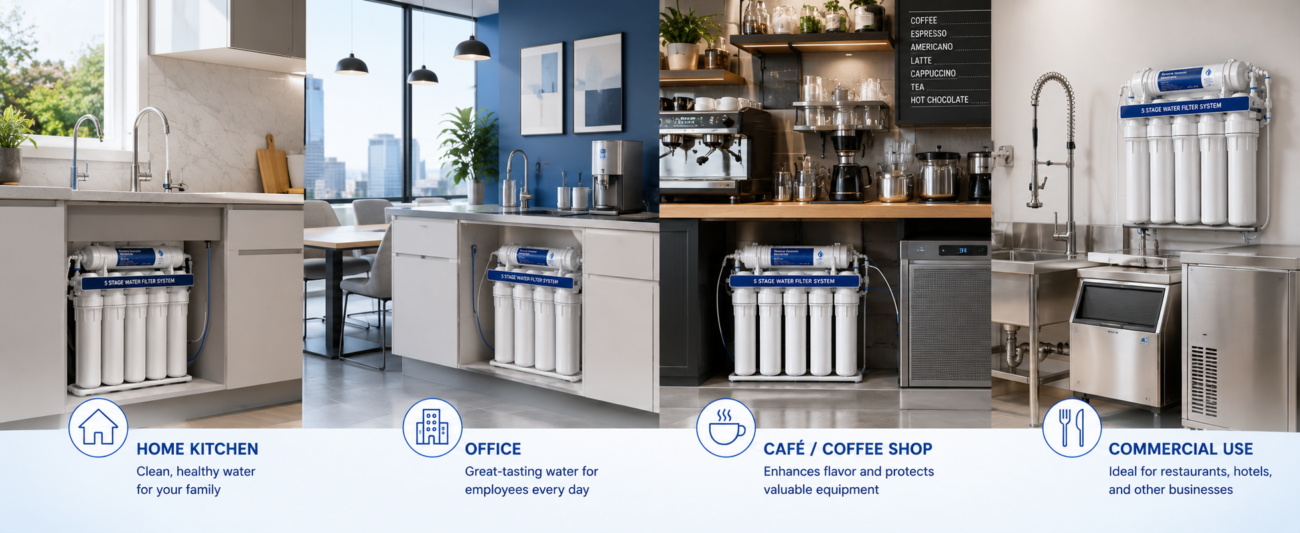
Customization That Changes the ROI Math
The same core platform covers a wider range of use cases than most buyers assume, and each configuration changes the payback timeline:
- GPD sizing. 400 GPD fits a standard under-sink residential install; 600–800 GPD suits higher-draw households or light commercial single-outlet use. Sizing correctly the first time avoids a mid-contract re-order.
- UV sterilization add-on. For well water sources or food-contact applications with microbial risk, a UV stage can be added as an optional sixth stage. It’s a targeted addition, not a full system redesign — which keeps tooling cost and lead time impact small relative to the return-risk it removes.
- Multi-outlet / higher-throughput builds. Chains and hospitality groups sourcing for multiple locations can standardize on one configuration across sites, which simplifies parts inventory and service contracts on the buyer’s end.
- Private-label housing and packaging. For brand owners, this is where the OEM/ODM cost premium converts directly into shelf differentiation instead of competing on price against an identical shell.
Every one of these is a configuration decision made before production, not a retrofit — which is the difference between a system engineered for its actual use case and one that merely fits the use case well enough to ship.
FAQ
What’s the real cost difference between off-the-shelf and OEM 5 stage water filter systems? The unit price gap is often small. The gap that matters is downstream: warranty claim rate, rework cost, and how much your support team spends on preventable complaints over the first year of use.
How fast can a brand see ROI from switching to full OEM/ODM support? Most buyers see the first measurable difference — a drop in warranty tickets and returns — within one to two production cycles, since that’s when component-quality issues from a prior supplier typically surface.
Does a lower MOQ always mean a better deal for wholesale buyers? Not by itself. A low MOQ with no technical drawing support or traceability often costs more in rework and claims than a slightly higher MOQ backed by full OEM documentation.
Can a 5 stage water filter system be customized with UV sterilization? Yes. A UV stage can be added as an optional sixth stage for well-water or food-contact applications without redesigning the base system.
What GPD size should I choose for home versus commercial deployment? Standard residential under-sink use is typically well served at 400 GPD; higher-draw households, light commercial, and single-outlet foodservice applications generally call for 600–800 GPD. Multi-outlet or high-volume commercial use should be sized against actual peak demand.
How does component quality affect warranty claim costs? Carbon block binder quality and O-ring compound are two of the most common root causes of claims that get misattributed to the membrane or the whole unit, well after the components that actually failed have been forgotten.
What lead times should B2B buyers expect for OEM tooling and customization? Lead time depends on how much housing and configuration customization is involved. Off-the-shelf builds ship fastest but offer no branding control; full OEM/ODM timelines are longer but are quoted with customization already factored in, so there’s no reset mid-order.
Get a Custom OEM Quote. Whether you’re sourcing a private-label 5 stage water filter system for retail, outfitting a multi-location foodservice account, or evaluating a switch from an off-the-shelf supplier, the numbers above only matter once they’re run against your actual order volume and application.
Request your Custom OEM Quote, Technical Parameter Sheets, or B2B Wholesale Pricing and get a landed-cost comparison built around your specific configuration — not a generic price list.