
5 Stage RO Filter for Cafés & Small Business: Sizing, ROI, and Equipment Protection

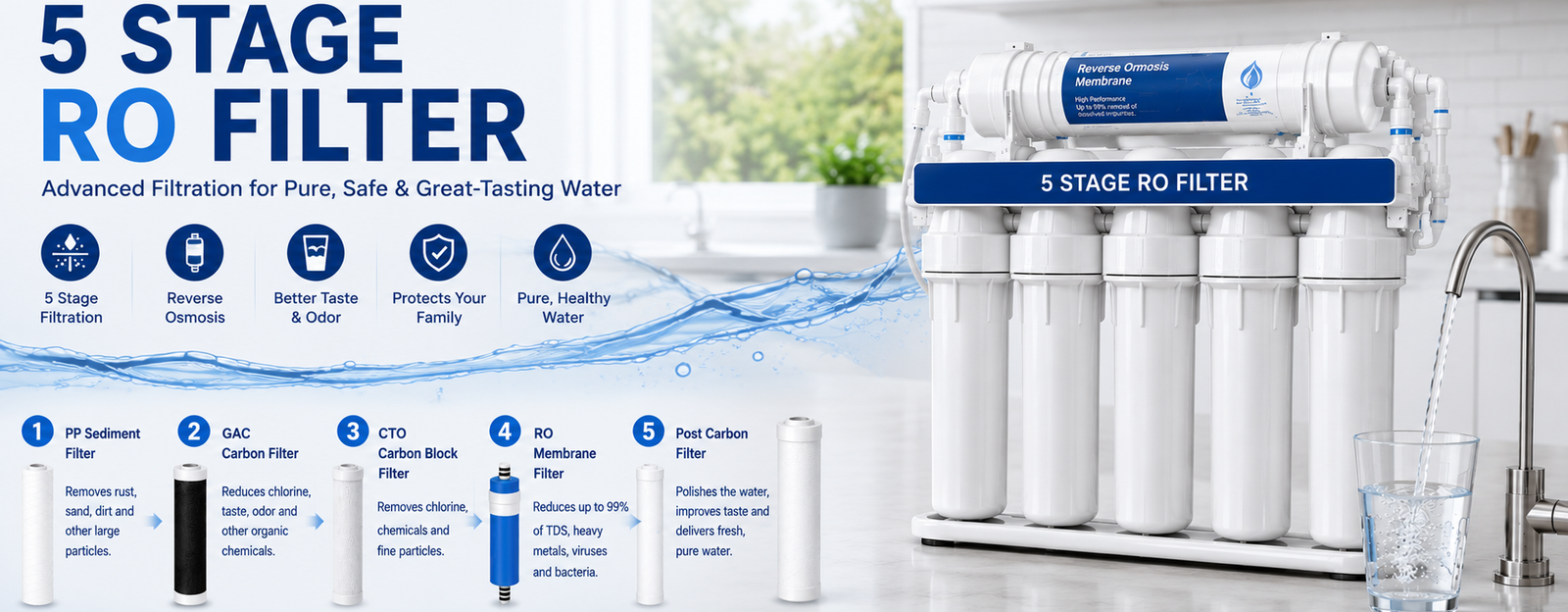
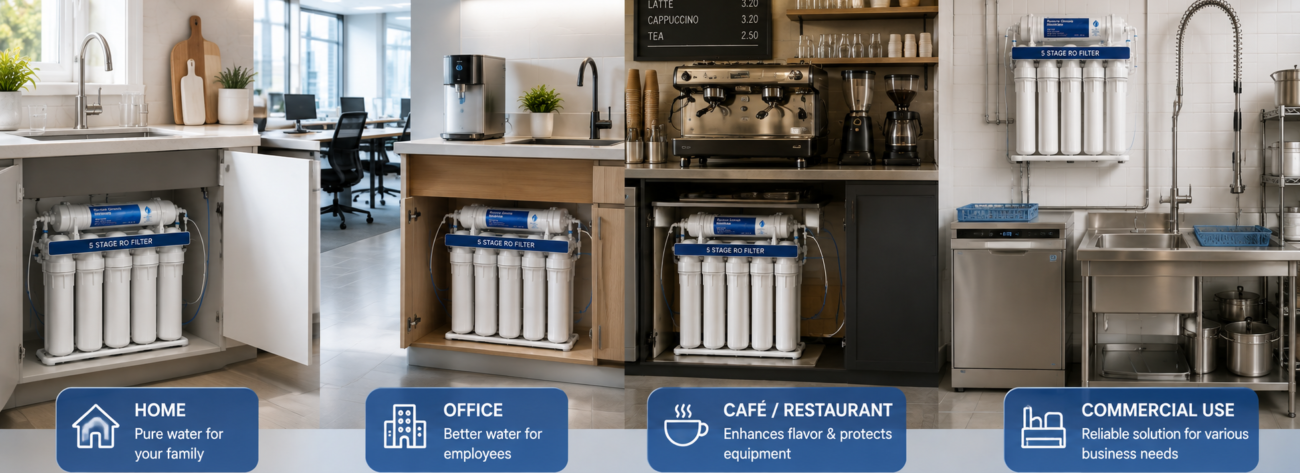
A 5 stage RO filter sized for a home kitchen will run fine in a house. Put it behind a café bar on a Saturday morning rush, and it falls behind before the second ticket prints.
Not because the filtration technology is wrong. Because nobody checked the three numbers that actually decide whether a system survives commercial use:
- Peak GPM, not average GPM — what the system delivers when the espresso machine, ice maker, and prep sink all draw at once.
- Incoming PSI stability — commercial buildings see pressure swings a residential spec sheet never accounts for.
- Daily GPD load across every fixture, not just the one the salesperson quoted.
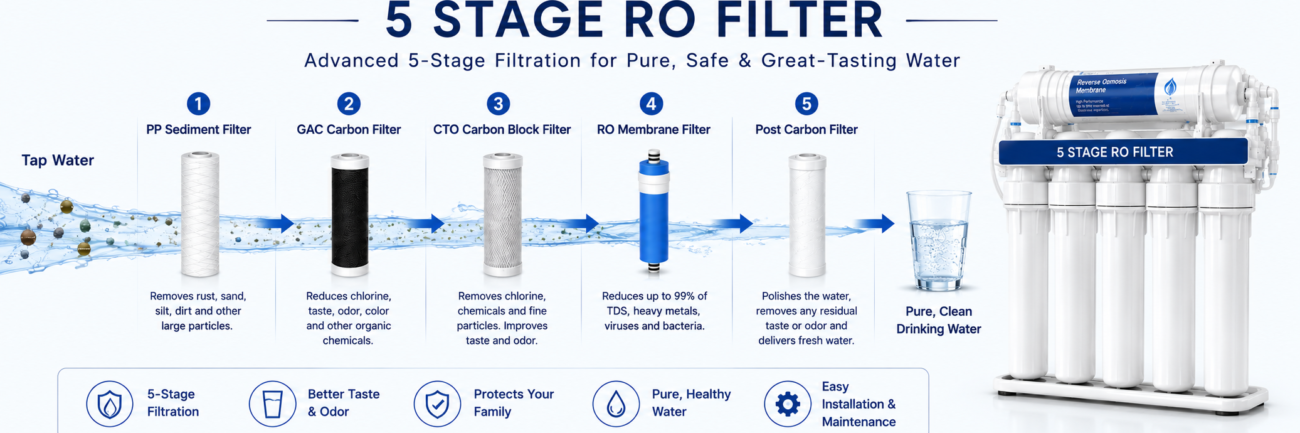
This piece assumes the standard five-stage sequence — sediment, GAC carbon, CTO carbon block, RO membrane, and post-carbon polish — and focuses only on what changes when that system sits behind a commercial bar instead of a kitchen sink. For the full stage-by-stage breakdown, see our pillar guide.
Fast Check Product: https://yourwatergood.com/product/5-stage-ro-water-filter-for-home-busines/
Why a Household-Spec System Fails Behind a Commercial Bar
Residential systems are engineered around one assumption: intermittent, low-volume draw. A café is the opposite.
- Storage tank depletion — a small residential tank recovers between uses at home; it never gets the chance to recover during a rush.
- Membrane fatigue — constant high-demand cycling shortens membrane life faster than the spec sheet’s residential-use rating suggests.
- Flow rate collapse — GPM drops exactly when the bar needs it most, which is what actually generates the customer complaint, not a filtration failure.
A system that’s “5 stage” on the label doesn’t tell you which of those three failure points it was engineered against.
Scale, Chlorine & the Equipment It’s Quietly Destroying
Hard water and chlorine don’t just affect taste. They shorten the working life of the most expensive equipment in the building:
- Espresso machines — scale buildup on boiler elements is the single most common cause of unscheduled service calls in specialty coffee.
- Ice machines — mineral scale reduces ice output and forces more frequent professional descaling cycles.
- Combi ovens and steam equipment — scale on heating elements increases energy draw before it causes a breakdown.
Municipal tap water and commercial well water fail differently. Municipal supply typically needs to address chlorine taste, disinfection byproducts, and legacy pipe metals. Well water more often needs treatment for hardness, iron, manganese, and odor — which changes what pre-filtration stage should be doing the heavy lifting before water ever reaches the membrane.
POE vs POU for Small Commercial Kitchens: The Real Cost Comparison
Whole-store central filtration and single-point end filtration solve different problems, at different costs:
| Factor | POE (Whole-Store Central) | POU (Single-Point End Filtration) |
|---|---|---|
| Initial Cost (CAPEX) | Higher — sized for total building demand | Lower — sized for one fixture or one machine |
| Ongoing Filter Cost (OPEX) | Fewer cartridge changes per gallon treated across the building | More total cartridges as outlets multiply |
| Plumbing Retrofit | Often requires a mainline tie-in and more labor | Minimal — installs at the point of use |
| Footprint | Larger unit, usually a back-of-house mechanical space | Small, fits under a counter or bar |
| Best Fit | Multi-fixture locations, full-scale renovations | Single-machine protection, quick retrofits, pilot locations |
Most small operators don’t need to choose one exclusively. A common pattern is POU protection on the highest-value equipment first, with POE evaluated once the location scales past a single outlet.
Field Engineering Insight: The TDS Mistake That Ruins Coffee
Chasing 0 ppm TDS feels like the “safest” filtration choice. In a commercial coffee application, it’s the wrong target.
Zero-TDS water pulls flat, under-extracted shots — there’s nothing left in the water to carry flavor. It’s also aggressive enough to accelerate corrosion in copper boiler components over time, which is exactly the equipment damage a café is trying to avoid in the first place.
The systems that actually hold up in specialty coffee use a TDS blending valve, tuning finished water to roughly 30–50 ppm. That range protects equipment from scale while keeping enough mineral content for proper extraction. It’s a detail that rarely appears on a spec sheet, and it’s the difference between a system that “filters water” and one that’s engineered for a coffee program.
What ROI Actually Looks Like for a Café or Small Chain
ROI on commercial filtration isn’t one number — it shows up across three places:
- Avoided downtime. Every hour a machine is down for descaling or repair during service hours is lost revenue, not just a repair bill.
- Extended equipment lifespan. Espresso machines, ice makers, and combi ovens protected from scale run longer between capital replacement cycles.
- Consistency across locations. A chain running the same water profile at every site avoids the “this location’s coffee tastes different” complaint that’s expensive to trace back to water quality.
None of this requires a formula to evaluate. It requires comparing your current service-call frequency against a system engineered to reduce the two causes — scale and flow-rate failure — behind most of those calls.
Sizing & Customization: GPD, GPM, and What to Ask Your Supplier
Sizing a commercial system starts with the fixtures it has to support, not a single “commercial-grade” label:
- GPD load — total daily draw across ice machines, dishwashers, and prep sinks combined, not just the bar.
- Peak GPM — the flow rate needed when multiple fixtures draw simultaneously during a rush.
- Incoming PSI — commercial building pressure should be confirmed on-site, not assumed from a residential spec.
- UV sterilization add-on — available as an optional stage for locations on well water or with elevated microbial risk, without redesigning the base system.
For multi-location operators, standardizing on one configuration across sites simplifies parts inventory and service scheduling — a small operational win that compounds as the chain grows.
FAQ
What size 5 stage RO filter does a small café actually need? Size to total daily GPD across every fixture that draws filtered water — not just the espresso machine — and to the peak GPM needed when they run simultaneously during a rush.
How is a commercial 5 stage RO filter different from a residential one? The filtration stages are the same. The difference is engineering for continuous high-demand cycling, storage tank recovery time, and flow rate under peak load — conditions a residential unit isn’t built around.
Should a small restaurant choose POE or POU filtration? Single-location operators protecting one or two high-value machines usually start with POU. Multi-fixture locations or full renovations are where POE’s higher upfront cost starts to pay off in lower per-gallon OPEX.
How much does hard water and scale actually cost a café in equipment repairs? It shows up as more frequent descaling service, shortened boiler and heating-element life, and unscheduled downtime during service hours — costs that compound faster than most operators expect.
Can a 5 stage RO filter be customized with UV for well water? Yes. A UV stage can be added for locations on well water or with elevated microbial risk, without a full system redesign.
How long does it take to see ROI on a commercial water filtration upgrade? Most operators see the first measurable difference — fewer service calls and less scheduled downtime — within the first few maintenance cycles after installation.
Get a Custom Commercial Quote. Whether you’re protecting a single espresso bar or standardizing water quality across a multi-location chain, sizing this correctly the first time is what determines the return.
Request your Custom Commercial Quote, Technical Parameter Sheets, or B2B Wholesale Pricing for a 5 stage RO filter configuration built around your fixture count and daily volume — not a generic commercial listing.