
Central Water Descaler: Salt-Free Scale Control for Businesses and Homes

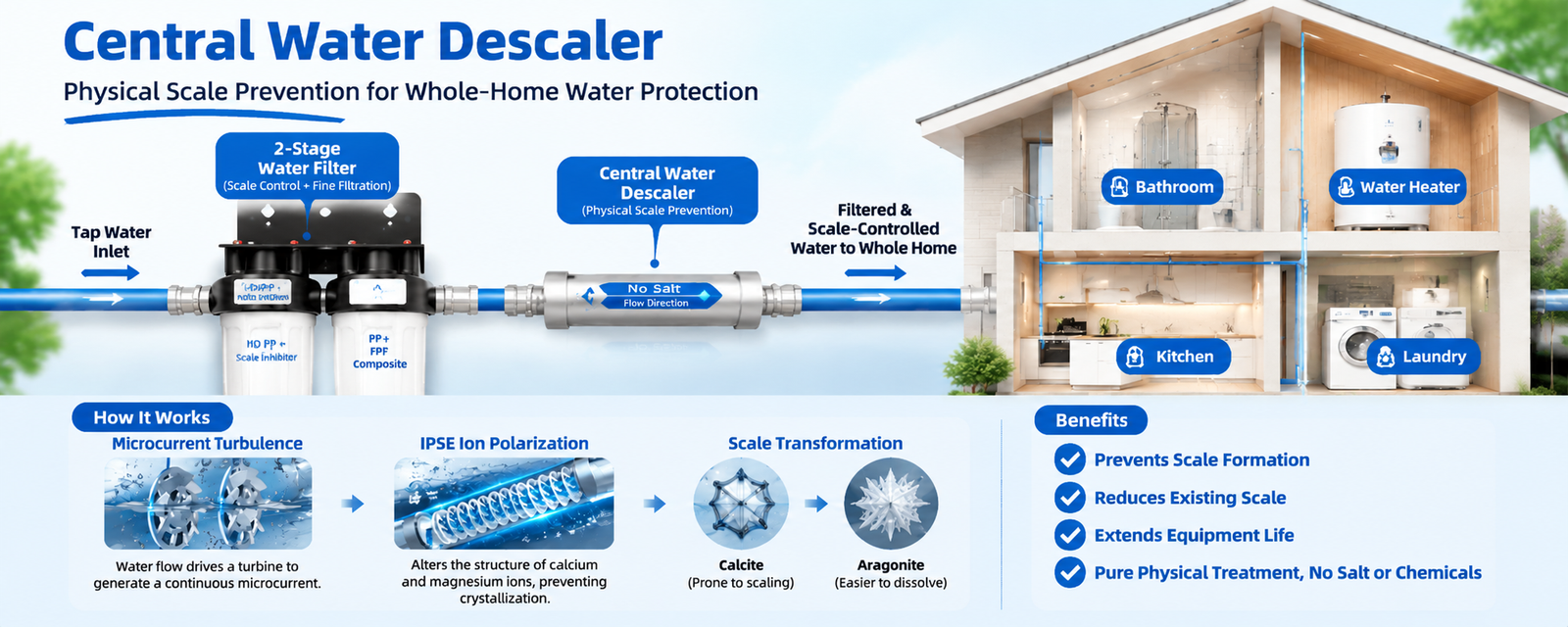
A central water descaler is installed on the main line to reduce scale buildup without salt, chemicals added to the water supply, or a drain line. It does not remove hardness; it changes how calcium and magnesium behave so less scale sticks to pipes, water heaters, and equipment. For businesses and homes on moderately hard water that want scale protection with low upkeep, it is a practical alternative to a softener.
What to know before choosing one:
- It reduces scale; it does not soften. Hardness and TDS stay the same.
- Performance depends on water chemistry and the hardness range the maker specifies.
- Pre-filtration matters: sediment and iron reduce effectiveness.
- Existing scale should be cleaned off; do not count on a descaler to remove it.
- Judge it by scale, not by hardness test strips.
How Salt-Free Descalers Work
Several technologies are sold as central descalers:
- Template-assisted crystallization (TAC): water flows through media that converts dissolved hardness into microscopic crystals. The crystals stay suspended and pass through without attaching to surfaces.
- Polyphosphate dosing: a small amount of food-grade phosphate coats minerals and surfaces to slow scale formation.
- Electronic or electromagnetic conditioners: devices that apply a signal or field to the pipe. Reported results vary widely with water chemistry and installation.
All three leave hardness in the water. Ask any supplier which technology their unit uses, its rated flow, and the hardness range it is designed for.
Descaler vs Softener
| Factor | Central descaler | Ion-exchange softener |
|---|---|---|
| Removes hardness | No | Yes |
| Reduces scale | Yes, within its rated range | Yes |
| Salt | No | Yes |
| Drain | No | Yes |
| Power | Depends on type | Usually |
| Adds sodium | No | Yes |
| Spot-free glass, less soap scum | Partly | Yes |
| Upkeep | Low | Salt and periodic service |
Where brine discharge is restricted, where there is no drain near the main, or where adding sodium is a concern, a descaler is often the preferred route.
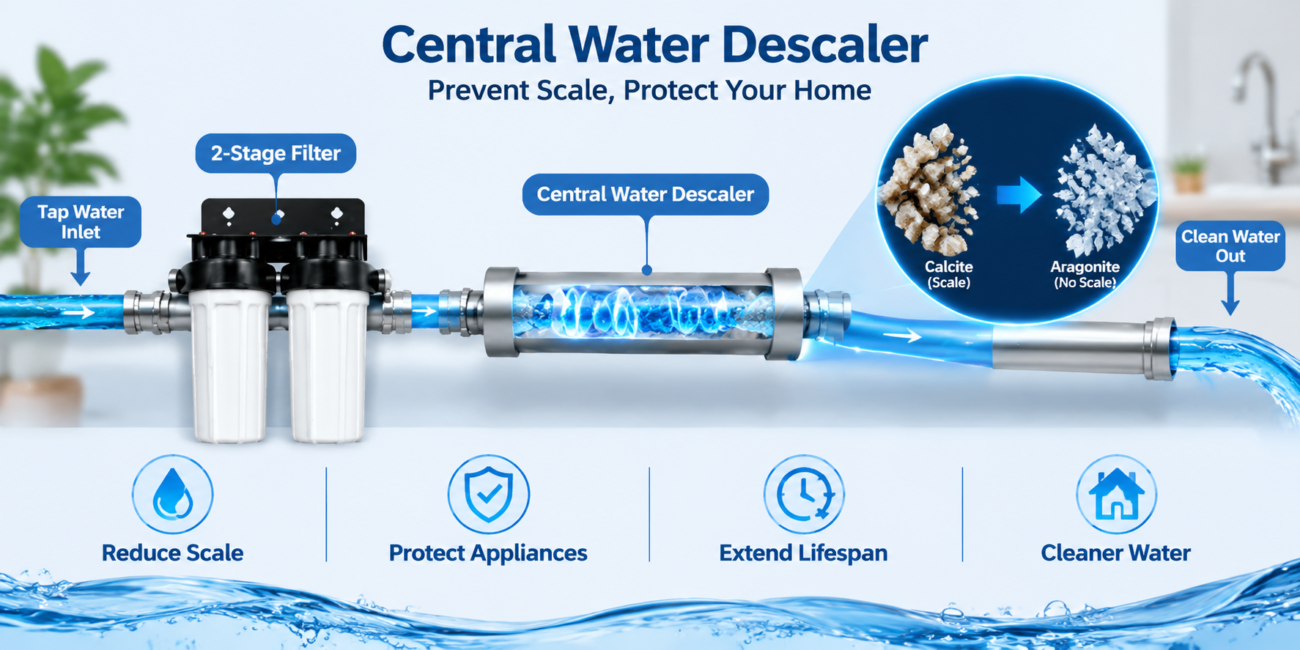
Where It Fits in a Commercial Building
Typical order on the main line:
- Shutoff and pressure-reducing valve
- Sediment filter
- Iron treatment on wells
- Carbon, if chlorine taste matters
- Central descaler
- Water heaters, boilers, kitchen and laundry equipment
Sediment and iron coat descaler media and reduce its effectiveness, so they come first.
Where Descalers Work Well, and Where They Struggle
Good fit:
- Moderately hard city water
- Restaurants and offices protecting water heaters and dishwashers
- Buildings where brine discharge or salt handling is a problem
- Homes that want low-maintenance scale reduction
Struggles:
- Very hard water, where a softener gives more consistent results
- Water with significant iron or manganese, unless treated first
- Applications needing truly soft water, such as some laundry and boiler uses
For an espresso machine or ice maker, add an equipment-level scale inhibitor or RO with blending; see commercial water filter for coffee shop.
Judging Results
Hardness test strips will read the same before and after a descaler, because hardness is not removed. Judge by:
- Showerheads and aerators: clean them, then check after a month
- Water heaters: compare scale and sediment at successive flushes
- Kettles and hot water dispensers: new crust formation
- Dishwasher and steam oven service history
Field engineering insight: many disappointing descaler results come from skipping the cleanup. Old scale keeps flaking off pipes and heating elements after installation, and owners mistake it for new scale. Descale fixtures and flush water heaters when the descaler goes in, so you are measuring new buildup only.
Removing Existing Scale
Treat this as a separate job:
- Descale fixtures and aerators with an acid cleaner suited to the material
- Flush tank water heaters per the maker’s instructions
- Descale commercial equipment on its maker’s schedule
See how to filter limescale from water for practical steps.
Not sure a descaler will cope with your hardness? Send us your water report and equipment list.
Questions to Ask a Descaler Supplier
- Which technology does the unit use: TAC media, polyphosphate, or electronic?
- What flow rate is it rated for, and what pressure drop does it add?
- What hardness range, pH, and iron limits is it designed for?
- Does it need pre-filtration, and at what micron rating?
- Does the media or unit need replacing, and how often?
- Does it need power?
- What evidence supports the scale reduction claim, and under what water conditions was it tested?
A supplier who cannot answer the hardness range and flow questions is not giving you enough to size the job.
Maintenance
- Pre-filter: change sediment cartridges on schedule.
- Descaler media or unit: follow the maker’s replacement interval for the technology used.
- Results check: inspect fixtures and equipment every few months.
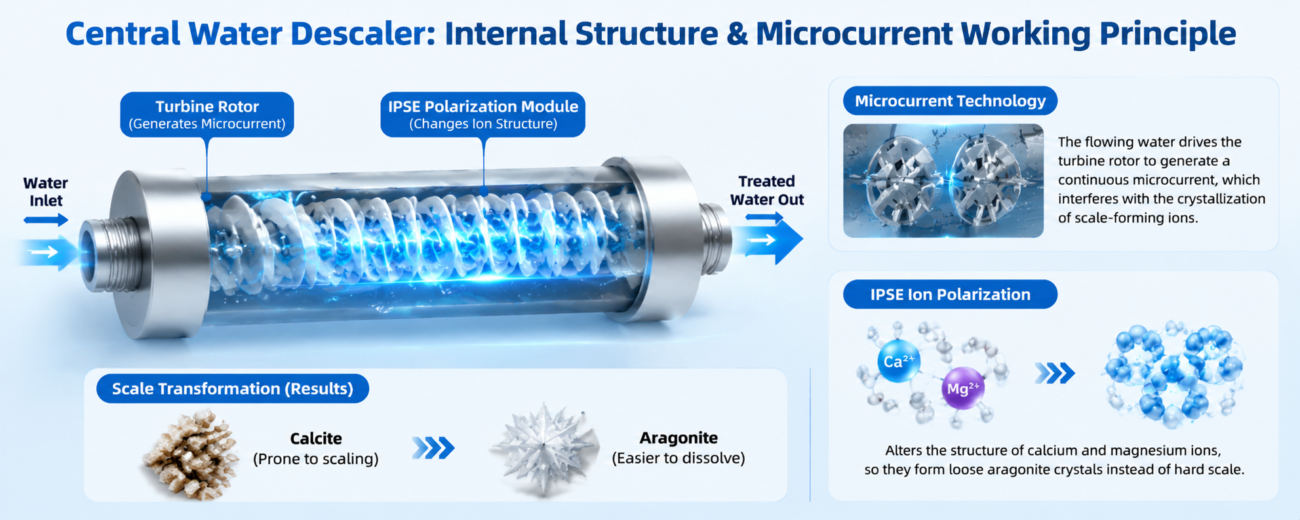
YourWaterGood Central Descaler
Our whole house central water descaler is a salt-free, chemical-free option designed for low maintenance. Flow rating, connection size, and recommended hardness range are on the spec sheet, available on request.
For equipment-level protection, our commercial 2-stage filter in the high-density PP cotton + scale inhibitor configuration protects heating elements and sensors in coffee machines, ice makers, steam ovens, and dishwashers. For a broader comparison of scale options, see water filter for scale reduction.
FAQ
What does a central water descaler do?
It reduces scale buildup without salt by changing how hardness minerals behave. It does not remove hardness.
Will a descaler remove existing scale?
Do not rely on it. Clean existing scale off fixtures and flush water heaters when you install it.
Is a descaler better than a softener?
Not better, different. A descaler suits moderate hardness and no-salt requirements; a softener suits hard water and needs for truly soft water.
Does a descaler change TDS?
No. The minerals stay in the water.
Do I need a filter before a descaler?
Yes. Sediment and iron reduce its effectiveness, so filter first.
Request Specs and Commercial Pricing
Send us your hardness, flow, and pipe size. We will return a custom commercial quote, technical parameter sheets, and B2B wholesale pricing for dealers. Start at YourWaterGood.