
High Flow Water Purification Systems for Commercial Kitchens & Multi-Unit Facilities

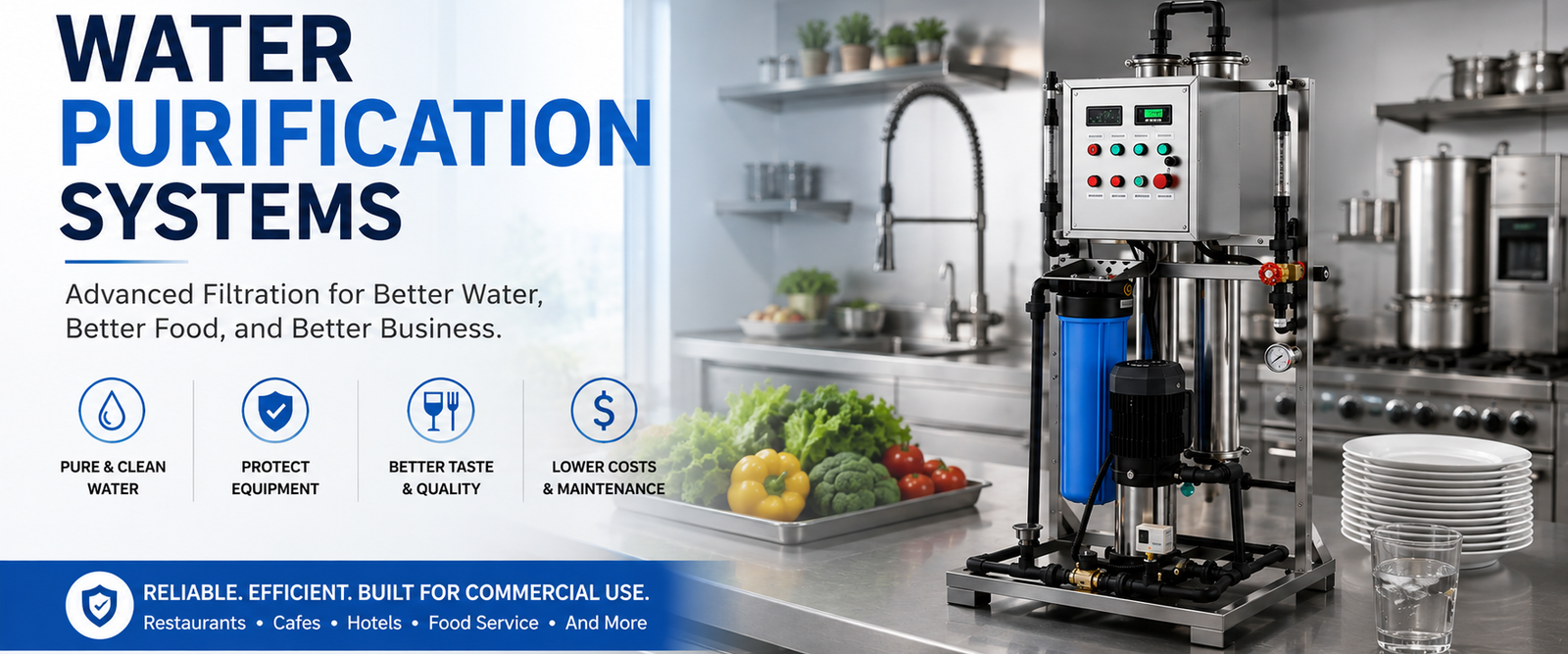
A high flow water purification system built for a commercial kitchen has to hold peak GPM output at open and close rush, protect the equipment sitting behind it, and keep consumable costs predictable enough to model into OPEX. Before you approve a high flow water purification systems proposal, run it against five hard checkpoints:
- Peak flow retention — rated GPM at your busiest hour, not the brochure’s best-case number
- Scale prevention — protection for espresso boilers, combi ovens, and ice machines running hundreds of cycles a week
- Footprint and plumbing path — inlet/outlet pipe sizing that fits your existing utility room
- Consumable change interval — pre-filter and membrane life under real duty cycles, not lab conditions
- Configurable capacity — a build that scales from a single line to a multi-station kitchen without re-engineering the whole system
If you’re sizing water treatment for a single café or one small restaurant rather than a multi-location kitchen, our small business buying tips covers sizing without the industrial-scale detail below.
Fast Check Product: https://yourwatergood.com/product/commercial-reverse-osmosis-system/
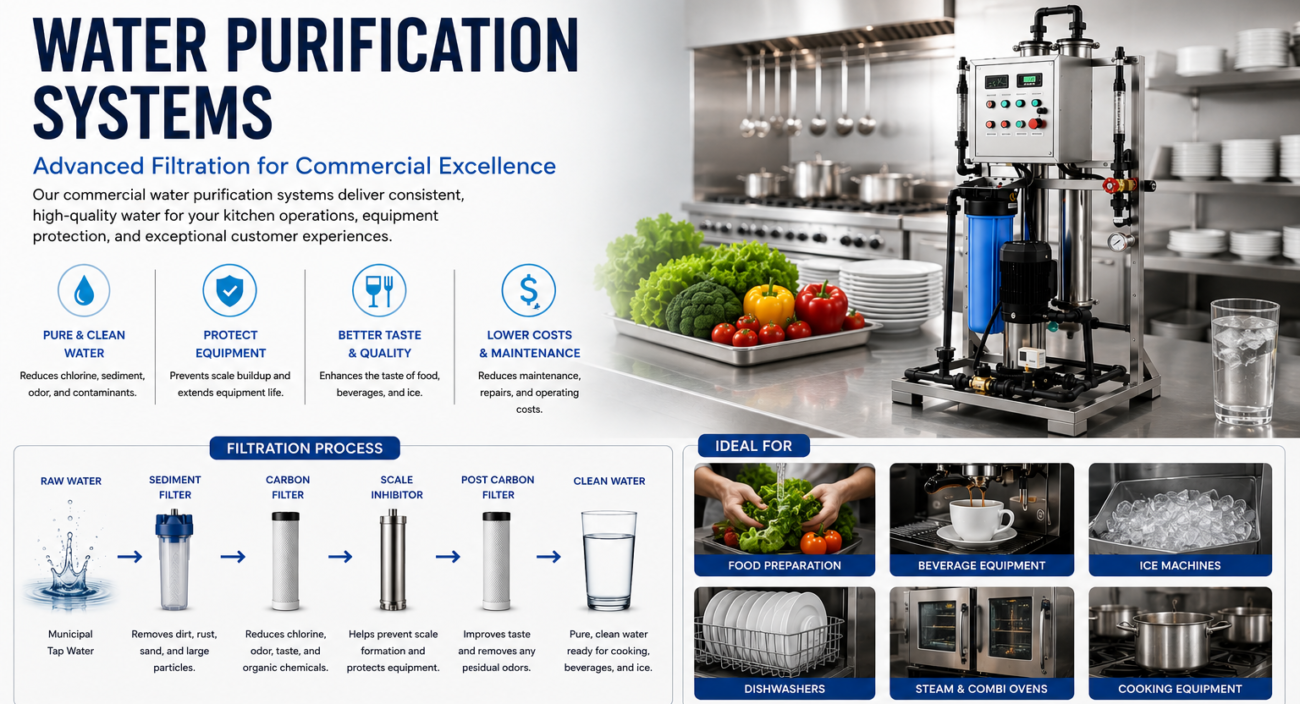
Core Filtration Stages Behind High-Flow Output
Two stages carry the load: a polypropylene (PP) sediment pre-filter ahead of a reverse osmosis (RO) membrane.
The pre-filter strips silt, rust, and particulate before it reaches the membrane. The base configuration uses a 20″ PP cartridge in a plastic pre-filter housing — inexpensive to swap, and the first line of defense against membrane fouling.
Behind it sits a 4040 RO membrane in a stainless steel housing. This is where dissolved solids, chlorine byproducts, and most bacteria and heavy metals come out. A flush solenoid valve clears concentrate from the membrane on a schedule, which is what keeps rejection rates from drifting as the unit racks up run hours.
For flavor-sensitive lines — espresso, cold brew, tea — some operators add a post-carbon polishing stage after the RO membrane. That’s a configuration call worth flagging on your layout request rather than assuming it’s standard.
Municipal Water vs. Well Water: Different Problems, Different Pretreatment
Municipal supply and well water fail commercial equipment in different ways, and a system engineered for one without adjustment underperforms on the other.
City water usually means chlorine or chloramine taste and odor, occasional disinfection byproducts, and — in older buildings — trace metals from aging service lines. RO membranes handle this well with chlorine-tolerant pre-treatment ahead of the membrane.
Well water brings hardness, iron, manganese, and sulfur odor, plus turbidity that swings with rainfall and season. That variability is why the base unit is rated for tap water or groundwater up to roughly 800 μS/cm inlet conductivity — call it 400–550 ppm TDS-equivalent depending on the mineral mix. Above that, plan on a softener or iron filter ahead of the RO stage rather than asking the membrane to do double duty.
POE vs. POU: Where the Real Commercial Cost Sits
| Point-of-Entry (POE) — Central System | Point-of-Use (POU) — Per-Fixture Units | |
|---|---|---|
| CAPEX | Higher upfront — one system sized for the whole kitchen | Lower per unit, cost multiplies with every fixture |
| OPEX (consumables) | One membrane + one pre-filter to budget and track | Multiple cartridges on staggered schedules — easy to lose track of |
| Plumbing retrofit | One main-line tie-in near incoming service | Separate runs to each machine — more labor, more leak points |
| Footprint | Single 60 × 60 cm floor-mounted cabinet | Distributed footprint under every counter and machine |
| Best fit | Multi-machine kitchens, hotels, small chains | Single-fixture, low-volume applications |
For a kitchen running an espresso machine, an ice maker, and a combi oven off the same line, POE consolidates maintenance into one membrane and one pre-filter change instead of three separate schedules on three separate units. That’s the OPEX case, not just the plumbing case.
PP Sediment Media: Why the Material Grade Matters
Not all PP cartridges hold up the same under commercial duty cycles.
Melt-blown polypropylene builds a graded density — coarse fibers outside, tighter fibers inside — which extends dirt-holding capacity and slows the flow-rate decay that comes with a cheaper string-wound cartridge clogging early.
That’s what sets the replacement interval: the pre-filter is rated for 2–4 months under recommended conditions. Push past that window and the pre-filter stops protecting the RO membrane — the membrane starts filtering what the pre-filter should have caught, which shortens membrane life and drags peak flow down before you notice it at the tap.
Equipment Specs: Standard Build to High-Flow Custom
| Spec | Base (Standard) Build | Notes |
|---|---|---|
| Purified water output | 250 L/hr (~1.1 GPM) | Configurable up to 1,000 L/hr (~4.4 GPM, roughly 1 metric ton/hr) for higher-volume kitchens |
| Power | 1.1 kW, 220V | Confirm phase and frequency against your facility’s electrical service before ordering |
| Inlet pressure | 0.2–0.4 MPa (29–58 PSI) | Booster pump needed below this range |
| Inlet water quality | Tap or groundwater, ≤800 μS/cm conductivity | See well-water section above for higher-mineral sources |
| RO membrane | Single 4040 element, stainless housing | Rated ~12 months, water-quality dependent |
| Pre-filter | 20″ PP cartridge, plastic housing | 2–4 month replacement interval |
| Piping | 32mm inlet / 20mm purified-water outlet | ~1-1/4″ inlet / ~3/4″ outlet |
| Frame & cabinet | Stainless steel frame; stainless electrical cabinet | Floor-mounted, 60 × 60 × 140 cm |
The 250 L/hr base build covers a single high-volume line. Scaling to a 1,000 L/hr high-flow configuration for a multi-station kitchen or small chain commissary is a membrane-and-pump staging change on the same frame footprint — not a re-engineering project. Request a Commercial Kitchen Water Layout Design and we’ll size the exact configuration against your peak-hour draw before you commit to a number.
The Floor-Mounted Industrial Advantage
A 60 × 60 × 140 cm stainless steel floor-mounted cabinet does something scattered wall-mounted POU units can’t: it puts pump mass, pressure switches, and the membrane housing on one stable, serviceable frame instead of three or four small units bolted into cramped under-counter space.
That matters at peak hour. The high-pressure pump and high/low pressure switches live in one enclosure a technician can reach without pulling a machine off the line. The electrical control cabinet sits isolated from the wet zone, which cuts the corrosion risk that shows up fast in a steamy kitchen.
It also leaves room to grow. Adding membrane capacity later means expanding within the same frame footprint — not finding new wall space for a second or third POU unit and running new supply lines to reach it.
Maintenance Protocol: Membrane Flush Cycle & Component Life
The flush solenoid valve runs a scheduled concentrate flush on the RO membrane — this is what keeps rejection rate and flow rate from drifting down between service visits, versus units that only flush on manual command.
High/low pressure switches shut the pump down outside safe operating range, protecting it from dry-run damage or supply-side pressure drops. The online water quality monitor gives a live read on output quality between cartridge changes, so you’re not guessing when the pre-filter or membrane needs attention.
Working rhythm: pre-filter every 2–4 months, RO membrane around the 12-month mark — sooner on harder well water, later on clean municipal supply with light duty cycles.
Field Insight: Don’t Over-Purify Water Meant for Espresso
One thing site installers learn the hard way: chasing 0 TDS output on a coffee line is a mistake. Water that pure pulls too hard on coffee solubles, extraction goes flat, and stripped-clean water is aggressive enough to corrode a copper espresso boiler over time.
The fix experienced installers use is a manual blending/bypass valve on the RO output, dialing finished water back to roughly 30–50 ppm TDS — enough mineral content to extract properly and protect the boiler, still low enough to keep scale off the group head. If a coffee program is part of your build, flag it on your layout request so the blend point gets configured before install, not after a barista complains.
Ready to size this for your kitchen? Get your detailed technical parameter sheet and we’ll walk the configuration against your peak-hour numbers.
FAQ
What GPM flow rate do I need for a commercial kitchen? Size to your busiest hour, not your average draw. A single line typically runs fine on the 1.1 GPM (250 L/hr) base build; a multi-station kitchen running an espresso machine, ice maker, and dish station at once usually needs the 4.4 GPM (1,000 L/hr) high-flow configuration.
Can this system be customized for higher flow demand? Yes — RO output on this platform is configurable from 250 L/hr up to 1,000 L/hr, roughly 0.25 to 1 metric ton per hour, by adjusting membrane and pump staging on the same frame.
Is POE or POU better for a restaurant? POE (point-of-entry, whole-facility) wins on OPEX once you’re protecting more than one piece of equipment — one membrane and one pre-filter instead of separate cartridges on every machine. POU makes sense for a single low-volume fixture.
How often does the RO membrane need replacing? Roughly every 12 months under recommended conditions, though harder well water or heavier duty cycles shorten that window. The pre-filter cartridge needs changing more often — every 2–4 months.
Does well water need different treatment than city water? Usually, yes. Well water brings hardness, iron, and manganese that municipal supply typically doesn’t. Above about 800 μS/cm inlet conductivity, plan on a softener or iron filter ahead of the RO stage.
What’s the footprint of a floor-mounted commercial RO system? The standard cabinet is 60 × 60 × 140 cm (about 24 × 24 × 55 in), with 32mm inlet and 20mm purified-water piping.
Will ultra-pure (0 TDS) water hurt my espresso machine or ice flavor? Yes — it flattens extraction and is corrosive to copper boiler components. Installs targeting coffee or ice flavor typically blend finished water to 30–50 ppm TDS instead of running straight 0-TDS output.
Get Priced and Speced
If you’re specifying a high flow water purification system for a kitchen, hotel F&B outlet, or small chain commissary, don’t guess at the config. Request a Custom Commercial Quote, a full technical parameter sheet, or B2B wholesale pricing — high flow water purification systems built on this platform scale from a single line to a multi-station facility without changing frames.