
Best Industrial Reverse Osmosis System for Breweries: Engineering Consistent Brewing Liquor at Scale

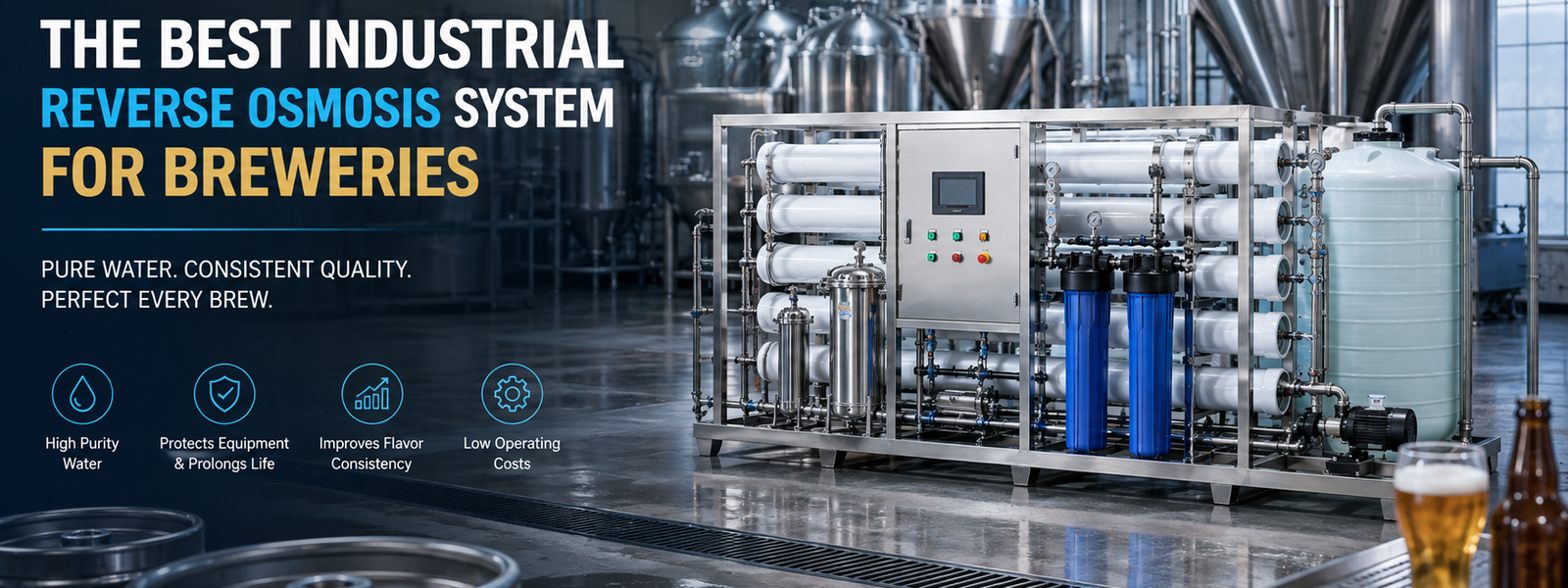
A chlorine spike from a municipal main or a hardness swing from a well feed doesn’t just risk equipment — it changes how the beer tastes, batch to batch. For a production brewery, water-quality variation is a recipe-consistency problem before it’s ever a maintenance ticket.
Before evaluating a supplier, lock these specs into the RFP:
- Peak brew-day duty cycle, sized to mash-in, sparge, and packaging-line demand overlapping with CIP cycles — not just an averaged daily GPM figure.
- Chlorine and chloramine removal validated to non-detect, since even trace residuals react into off-flavor compounds during the boil.
- Automated CIP (clean-in-place) integration that doesn’t compete with the brewhouse’s own sanitation schedule.
- A temperature-correction margin for cold well feed, hedging against flux decay during winter brew cycles.
- 316L stainless steel or high-grade UPVC wetted materials — the same materials standard the rest of the brewhouse is already built to.
Sourcing the right industrial reverse osmosis system for a brewery starts with treating brewing liquor as an engineered input, not a byproduct of whatever the local water utility delivers that week.
Fast Check Product: https://yourwatergood.com/product/industrial-reverse-osmosis-system/
Why Brewing Liquor Chemistry Starts With RO’s Blank Slate
Municipal and well water arrive with a fixed mineral fingerprint — calcium, magnesium, sulfate, chloride, bicarbonate — in whatever ratio the source happens to deliver. That fingerprint dictates mash pH, hop utilization, and final flavor balance, whether or not it matches the beer style being brewed.
Industrial RO systems solve this by resetting the water to near-zero TDS, then letting the brewhouse rebuild the exact mineral profile a recipe calls for — gypsum and calcium chloride for a hop-forward, sulfate-driven profile; a softer, low-mineral build for a delicate lager. Brewing from a blank slate is what makes batch-to-batch consistency achievable at all, regardless of what the raw feed water looks like on a given week.
This is also where food-grade water requirements apply directly: beer is a product regulated under the FDA’s food safety framework, and process water quality is part of that chain of custody — a design consideration for the engineering team, not a certification claim about any specific facility.
Sizing an Industrial RO System to Brew-Day Peak Demand and Your Water-to-Beer Ratio
Brewery water demand isn’t flat — it spikes hard on brew days and again during packaging and CIP cycles, which is where undersized systems get exposed.
- Industry water-to-beer ratios commonly run around 7:1 (gallons of water per gallon of beer produced) across the sector, with best-in-class large breweries operating closer to 3:1–4:1 — and cleaning/CIP alone typically accounts for 3–8 gallons per gallon of beer, the single largest use category in most brewhouses.
- Flow capacity: Modular RO skids commonly scale from roughly 4 GPM to 44 GPM (approximately 6,300–63,400 GPD) per train, with multi-train configurations engineered for production breweries running overlapping brew, packaging, and CIP schedules.
- TDS rejection: In documented field cases, raw feed TDS has been reduced from 1,300 ppm to under 20 ppm in single-pass configurations, and to under 10 ppm in two-pass setups — the blank-slate starting point brewing liquor chemistry depends on.
- Inlet pressure: Booster pumps are engineered against a minimum inlet pressure of roughly 0.2 MPa (~29 PSI); sites below that threshold need a pre-boost stage specified at design time.
Request a Custom CAD Skid Diagram or Water Analysis Review before finalizing GPM targets — sizing to your actual brew schedule and water-to-beer target, not a generic industrial estimate, is what keeps the system from bottlenecking a brew day.
Municipal vs. Well Feed: Why Chlorine Removal Is Non-Negotiable Before the Brewhouse
Feed water source changes the pretreatment train, and for a brewery the stakes are higher than in most industrial applications.
Municipal potable feed:
- Chlorine and chloramine must be stripped to non-detect levels — trace residuals can react with phenolic compounds during the boil to produce chlorophenol off-flavors that are detectable at extremely low concentrations.
- Soluble inorganic salts still set the RO sizing baseline; carbon filtration protects both the membrane and the beer.
Well feed:
- Hardness, dissolved iron and manganese, and silica each need a dedicated pretreatment step — softening, oxidation/filtration, or antiscalant dosing — before the RO stage.
- Seasonal well chemistry shifts still apply, and a brewery running a fixed recipe needs that variability engineered out before it reaches the mash tun, not compensated for after a bad batch.
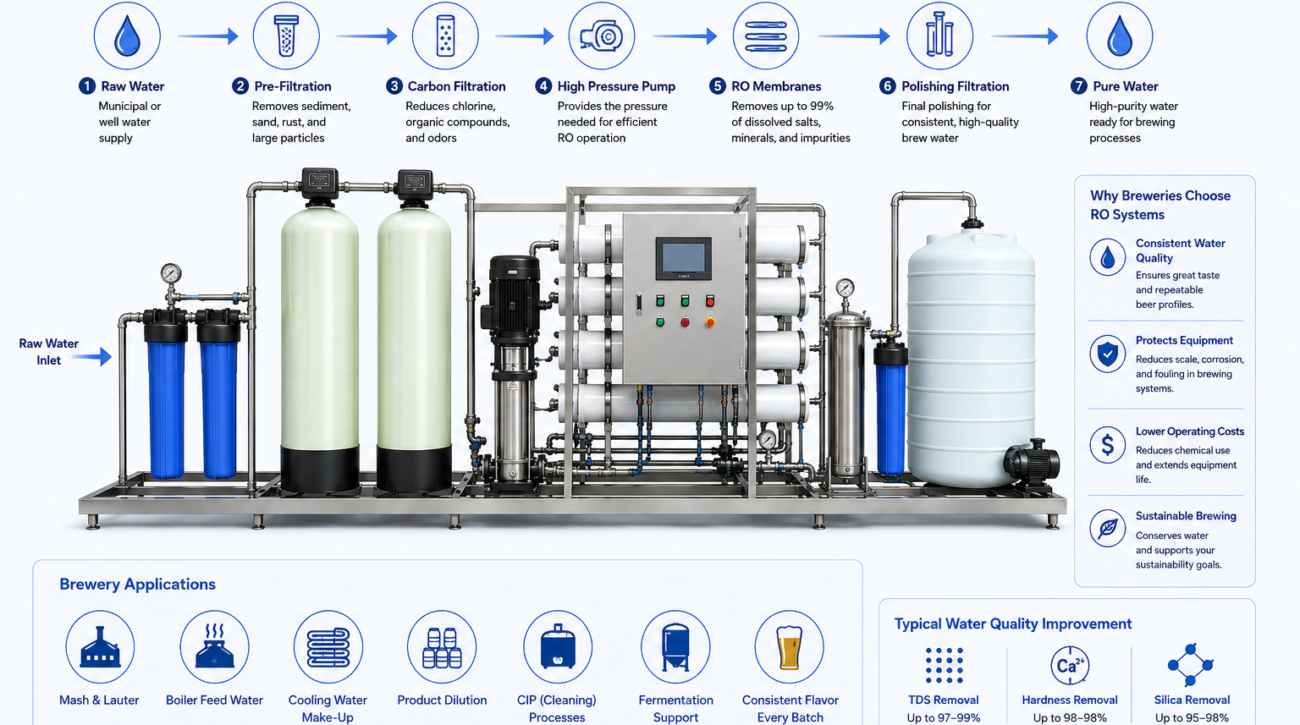
A resilient architecture runs a five-stage sequence: multimedia filtration, activated carbon for chlorine and organics, ion-exchange softening, a precision security filter, and the RO membrane array — each stage protecting the one after it, and ultimately protecting the recipe.
Standard Pre-Engineered Skids vs. Fully Customized Turnkey Systems
Not every packaged RO skid marketed to breweries is engineered to the same standard. The table below is what separates a catalog unit from a system built for continuous brewhouse operation.
| Engineering Parameter | Standard Pre-Engineered Skids | Fully Customized Turnkey Systems |
|---|---|---|
| Flow capacity (GPM) | Fixed, single-train sizing | Custom-sized, multi-train scalable |
| CAPEX structure | Lower upfront, component-based | Higher upfront, single consolidated price |
| Lead time | Shorter — built to stock configurations | Longer — engineered to your water analysis and brew schedule |
| PLC integration | Basic relay logic or standalone HMI | Siemens or Allen-Bradley platform, SCADA-ready |
| Redundancy | Typically none — single point of failure | N+1 or 2N engineered across the train |
A standard skid fits a brewery with stable, well-characterized municipal feed and a predictable brew schedule. A fully customized turnkey system fits a production brewery where a stalled brew day or an inconsistent batch costs more than the CAPEX premium.
PLC Automation and CIP Integration: Protecting the Brew Schedule and the Boiler
The automation layer determines whether the RO system supports the brew schedule or competes with it.
- Automatic backwash and flushing cycles maintain flux without an operator pulling attention away from the brew floor.
- Real-time PSI and flow monitoring feeds a PLC control loop — Siemens or Allen-Bradley platforms are the industrial standard — catching pressure drift before it becomes a fouling event mid-brew.
- Auto CIP lets the RO system clean on its own schedule, independent of the brewhouse’s tank and line CIP cycles, so the two systems aren’t competing for the same water and time window.
This automation is what protects the capital equipment sitting downstream: boilers, heat exchangers, and glycol chilling systems all see fewer emergency descaling events when feed water quality holds steady through every brew day, every season, at true production-brewery duty.
Field Engineering Insight: Cold-Water Flux Decay and Brew-Day Water Temperature Consistency
This is the detail that catches brewery buyers off guard heading into their first winter on a new system.
When well feed temperature drops toward 50°F (10°C), water viscosity increases measurably. If the system wasn’t sized with a temperature correction factor — typically 30%–40% additional membrane area — it can’t hit rated GPD output at that lower temperature, right when winter brewing schedules often run heaviest.
The usual compensation is the wrong one: the high-pressure pump gets pushed to a higher PSI to force the same flow through less-efficient membranes. That drives energy costs up and accelerates scaling and fouling, especially if the antiscalant dosing pump wasn’t calibrated to the feed water’s actual silica and calcium concentration. For a brewery, that fouling curve doesn’t just cut output — it introduces exactly the kind of feed-water variability the RO system was installed to eliminate in the first place, undermining the batch-to-batch consistency the whole investment was meant to protect.
Industrial Reverse Osmosis System for Breweries FAQs
What flow capacity does a brewery need from an industrial RO system? Most modular skids cover 4–44 GPM (roughly 6,300–63,400 GPD) per train. Production breweries running overlapping brew, packaging, and CIP schedules typically move to multi-train configurations.
Why do breweries need RO instead of just carbon filtration? Carbon filtration removes chlorine and organics but doesn’t reduce mineral content. RO resets the water to near-zero TDS, giving the brewhouse full control to rebuild the exact mineral profile a recipe calls for, rather than being locked into the source water’s fixed chemistry.
How much TDS can an industrial RO system remove for brewing water? In documented field cases, raw feed TDS has been reduced from 1,300 ppm to under 20 ppm in a single pass, and under 10 ppm in a two-pass configuration.
What’s a typical water-to-beer ratio for a production brewery? Industry figures commonly run around 7:1, with best-in-class large breweries closer to 3:1–4:1. Cleaning and CIP alone typically account for 3–8 gallons per gallon of beer.
Why is chlorine removal so critical for brewery RO systems? Trace chlorine or chloramine residuals can react with phenolic compounds during the boil to form chlorophenol off-flavors, detectable at very low concentrations — removal needs to be validated to non-detect, not just “reduced.”
Does cold well water affect brewery RO performance? Yes. Below 50°F (10°C), viscosity increases enough to reduce flux. Systems without a temperature correction factor (typically 30%–40% extra membrane area) tend to compensate with higher PSI, accelerating scaling right as winter brew schedules peak.
What inlet pressure does a brewery RO system require? A minimum of roughly 0.2 MPa (~29 PSI) at the booster pump inlet. Sites below that threshold need a pre-boost pump stage specified at design time.
Get an Engineered Quote for Your Brewery
Sizing an industrial RO system against your actual water report and brew schedule — not a generic industrial estimate — is what protects both the membrane warranty and the recipe.
- Get an Industrial Engineering Quote: send your water analysis and brew-day flow requirement for a sized proposal.
- Request Technical Data Sheets & P&ID Drawings: get the full engineering submittal package for your project file.
- Get B2B Wholesale / Factory-Direct Pricing: request competitive pricing sourced through our vetted manufacturing network.
Whether the brewhouse needs a single skid or a multi-train build, the industrial reverse osmosis system architecture above is engineered to hold flux, hold pressure, and hold the same brewing liquor profile — batch after batch, season after season.