Industrial Reverse Osmosis Systems Canada: Engineering CAPEX/OPEX for Continuous Production

A TDS spike from a municipal main, or a heavy-metal exceedance from a well feed, doesn’t wait for a favourable exchange rate or a shipping window. For Canadian manufacturing facilities running continuous duty cycles, water-quality variation is a downtime line item long before it’s a procurement decision.
Before evaluating a supplier, lock these specs into the RFP:
- Continuous duty-cycle rating validated against real peak GPM demand, not a catalog nameplate figure.
- A cold-climate temperature correction margin built into membrane sizing — non-negotiable for well feed through a Canadian winter.
- Automated CIP (clean-in-place) integration so membrane cleaning doesn’t require a production stoppage.
- 316L stainless steel or high-grade UPVC wetted materials rated for continuous high-PSI operation.
- A defined cross-border lead time and landed cost, not just a factory-gate CAPEX number.
Sourcing a properly engineered industrial reverse osmosis system for a Canadian facility means locking these five items into the spec before the RFP goes out — not discovering the gaps after the skid clears customs.
Fast Check Product: https://yourwatergood.com/product/industrial-reverse-osmosis-system/
Feed Water Across Canada: Municipal Supply vs. Well Water Pretreatment Logic
Feed water source still dictates pretreatment architecture, regardless of which province the plant sits in.
Municipal potable feed:
- Chlorine and chloramine need to be stripped upstream to protect the RO membrane from oxidative damage.
- Soluble inorganic salts set the RO sizing baseline; carbon filtration protects the membrane, not the process itself.
Well feed:
- Groundwater sourced from different Canadian aquifers carries variable hardness, dissolved iron and manganese, and silica (SiO₂) loads, each requiring a dedicated pretreatment step — softening, oxidation/filtration, or antiscalant dosing.
- Well chemistry shifts seasonally. A design margin has to account for that swing, not just a single water-analysis sample pulled in summer.
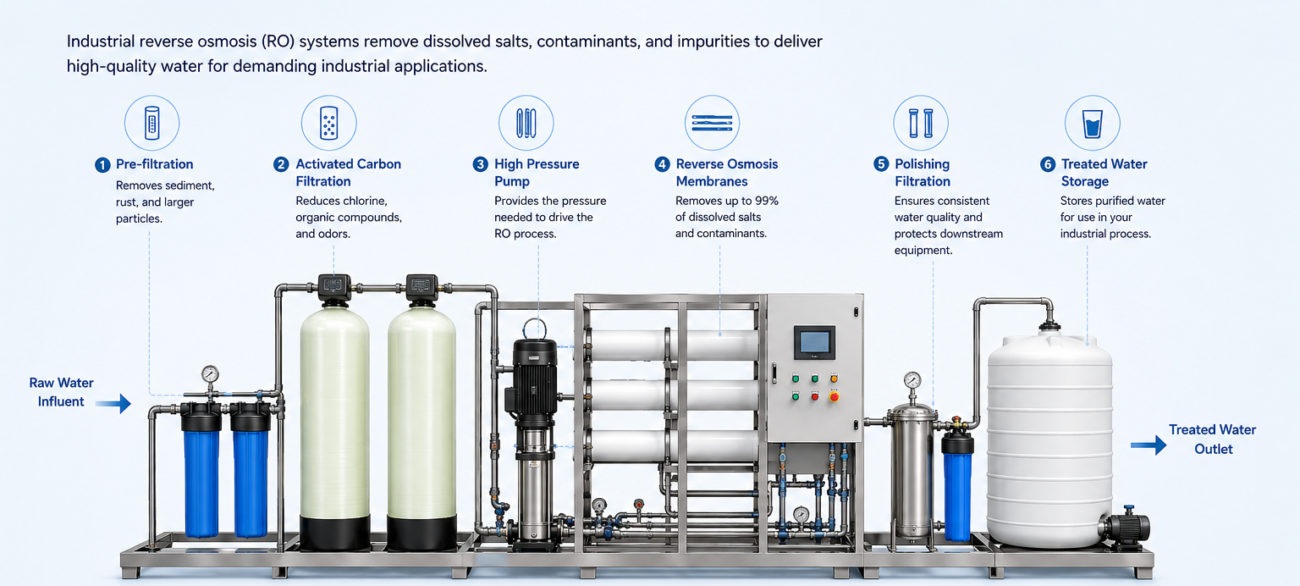
A resilient architecture runs a five-stage sequence: a multimedia filter for suspended solids, an activated carbon filter for chlorine and organics, an ion-exchange softening stage to eliminate hardness scaling, a precision security filter as the final particulate barrier, and the RO membrane array itself. Undersizing any one stage is how the stage after it fails early.
Sizing an Industrial RO System for Canadian Facilities
Capacity planning starts with real production demand, converted into the units your engineering team already works in.
- Flow capacity: Modular skids typically scale from roughly 4 GPM to 44 GPM (approximately 6,300–63,400 GPD) per train, with multi-train configurations engineered for higher-demand facilities — the same GPM/PSI/GPD conventions used across Canadian industrial specs, not a unit conversion headache.
- TDS rejection: In documented field cases, raw feed TDS has been reduced from 1,300 ppm to under 20 ppm in single-pass configurations, and to under 10 ppm in two-pass setups — actual rejection depends on raw water chemistry, which is why a water analysis should precede any spec commitment.
- Inlet pressure: Booster pumps are engineered to operate against a minimum inlet pressure of roughly 0.2 MPa (~29 PSI). Sites below that threshold need a pre-boost pump stage specified up front.
- Wetted materials: Thickened membrane housings paired with 316L stainless steel or high-grade UPVC piping sustain continuous high-pressure operation without the pitting that shortens skid life in chloride-heavy feed water.
Request a Custom CAD Skid Diagram or Water Analysis Review before finalizing GPM targets — sizing against your actual water report is what keeps the membrane warranty valid, wherever the facility sits.
Standard Pre-Engineered Skids vs. Fully Customized Turnkey Systems
Not every packaged RO skid available to Canadian buyers is engineered the same way. The table below is what actually separates a catalog skid from a true turnkey system.
| Engineering Parameter | Standard Pre-Engineered Skids | Fully Customized Turnkey Systems |
|---|---|---|
| Flow capacity (GPM) | Fixed, single-train sizing | Custom-sized, multi-train scalable |
| CAPEX structure | Lower upfront, component-based | Higher upfront, single consolidated price |
| Lead time | Shorter — built to stock configurations | Longer — engineered to site-specific water analysis |
| PLC integration | Basic relay logic or standalone HMI | Siemens or Allen-Bradley platform, SCADA-ready |
| Redundancy | Typically none — single point of failure | N+1 or 2N engineered across the train |
A standard skid fits a facility with stable, well-characterized feed water and modest uptime requirements. A fully customized turnkey system fits a facility where an unplanned outage costs more in a single shift than the CAPEX premium — a calculation that doesn’t change based on which side of the border the plant is on.
Regulatory Backdrop: Health Canada Guidelines, ECCC Effluent Rules, and Provincial Approvals
Canadian industrial water engineering sits inside a different regulatory stack than a US facility, and it’s worth confirming which layers apply before finalizing a system design.
- Health Canada’s Guidelines for Canadian Drinking Water Quality (GCDWQ) set the national health-based reference points that provinces adopt into their own drinking and process water requirements.
- Environment and Climate Change Canada’s Wastewater Systems Effluent Regulations, under the Fisheries Act, set minimum effluent quality standards for systems discharging to fish-bearing waters — relevant to any facility whose RO reject or process wastewater reaches a waterway.
- Provincial environmental compliance approvals — issued by the relevant provincial ministry — typically govern the site-specific permitting for an industrial water system, on top of the federal baseline.
For food, beverage, and pharmaceutical manufacturers, process water is frequently engineered toward the same USP Purified Water compendial targets recognized under Health Canada’s Food and Drug Regulations — a design target the engineering team sizes toward, not a certification claim about any specific facility’s regulatory status.
Field Engineering Insight: Why Canadian Winters Make Temperature Correction Non-Negotiable
This is the detail that separates a system that survives its first Canadian winter from one that doesn’t.
When well water temperature drops toward 50°F (10°C) — a routine winter condition across much of the country — water viscosity increases measurably. If the design didn’t account for this with a temperature correction factor — typically 30%–40% additional membrane area built in at the sizing stage — the system can’t hit its rated GPD output once the feed water cools.
The compensation usually happens the wrong way: the high-pressure pump gets pushed to a higher PSI to force the same flow through membranes that are now less efficient. That drives energy consumption up, and it accelerates scaling and fouling on the membrane surface — especially if the antiscalant dosing pump wasn’t calibrated to the feed water’s actual silica and calcium concentration in the first place.
Left uncorrected, that combination can drop production output enough within a single week that the line goes down — a design gap that shows up every winter, not once.
Cross-Border Sourcing: CAPEX, Lead Time, and Factory-Direct Procurement
Sourcing an industrial RO system for a Canadian facility adds a logistics layer that a domestic US buyer doesn’t have to plan around.
- Landed cost — freight, duties, and brokerage — needs to be quoted alongside the factory-gate CAPEX number, not discovered after the skid ships.
- Lead time should account for cross-border transit and customs clearance in addition to fabrication time, particularly for a fully customized turnkey build.
- Factory-direct sourcing through a vetted manufacturing network keeps CAPEX competitive without adding a domestic distributor’s markup on top of freight — worth confirming directly with the supplier rather than assuming it’s included.
Industrial Reverse Osmosis Systems Canada FAQs
What flow capacity does an industrial RO system need for a Canadian manufacturing facility? Most modular skids cover 4–44 GPM (roughly 6,300–63,400 GPD) per train. Facilities above that range typically move to multi-train, custom-engineered configurations.
Does cold Canadian well water affect RO membrane performance? Yes. Below 50°F (10°C), viscosity increases enough to reduce flux. Systems designed without a temperature correction factor (typically 30%–40% extra membrane area) tend to compensate with higher PSI, which accelerates scaling.
What regulations apply to industrial water systems in Canada? Health Canada’s Guidelines for Canadian Drinking Water Quality set the national reference points; ECCC’s Wastewater Systems Effluent Regulations govern discharge to fish-bearing waters; provincial environmental compliance approvals typically handle site-specific permitting.
How much TDS can an industrial reverse osmosis system remove? In documented cases, raw feed TDS has been reduced from 1,300 ppm to under 20 ppm in a single pass, and under 10 ppm in a two-pass configuration. Actual rejection depends on raw water chemistry.
What inlet water pressure does an industrial RO system require? A minimum of roughly 0.2 MPa (~29 PSI) at the booster pump inlet. Sites below that threshold need a pre-boost pump stage specified at design time.
What’s the difference between a standard skid and a custom turnkey system? A standard skid is fixed-capacity and built to stock; a turnkey system is sized to your actual water analysis, includes PLC/SCADA integration, and is engineered with redundancy (N+1 or 2N) across the train.
Does sourcing an industrial RO system from outside Canada add significant lead time? It adds a cross-border transit and customs step on top of fabrication time — worth confirming as a defined lead time up front rather than an open-ended estimate, especially for a fully customized build.
Get an Engineered Quote for Your Canadian Facility
Sizing an industrial reverse osmosis system against a real water analysis — and a real landed-cost estimate — is what protects both the membrane warranty and the project budget.
- Get an Industrial Engineering Quote: send your water analysis and flow requirement for a sized proposal.
- Request Technical Data Sheets & P&ID Drawings: get the full engineering submittal package for your project file.
- Get B2B Wholesale / Factory-Direct Pricing: request competitive pricing sourced through our vetted manufacturing network.
Whether the requirement is a single skid or a multi-train build, the industrial reverse osmosis system architecture above is engineered to hold flux, hold pressure, and hold uptime — through a Canadian winter, not just a mild one.