
Industrial Seawater Desalination Systems: Engineering Reliable Process Water for Coastal Manufacturing Plants

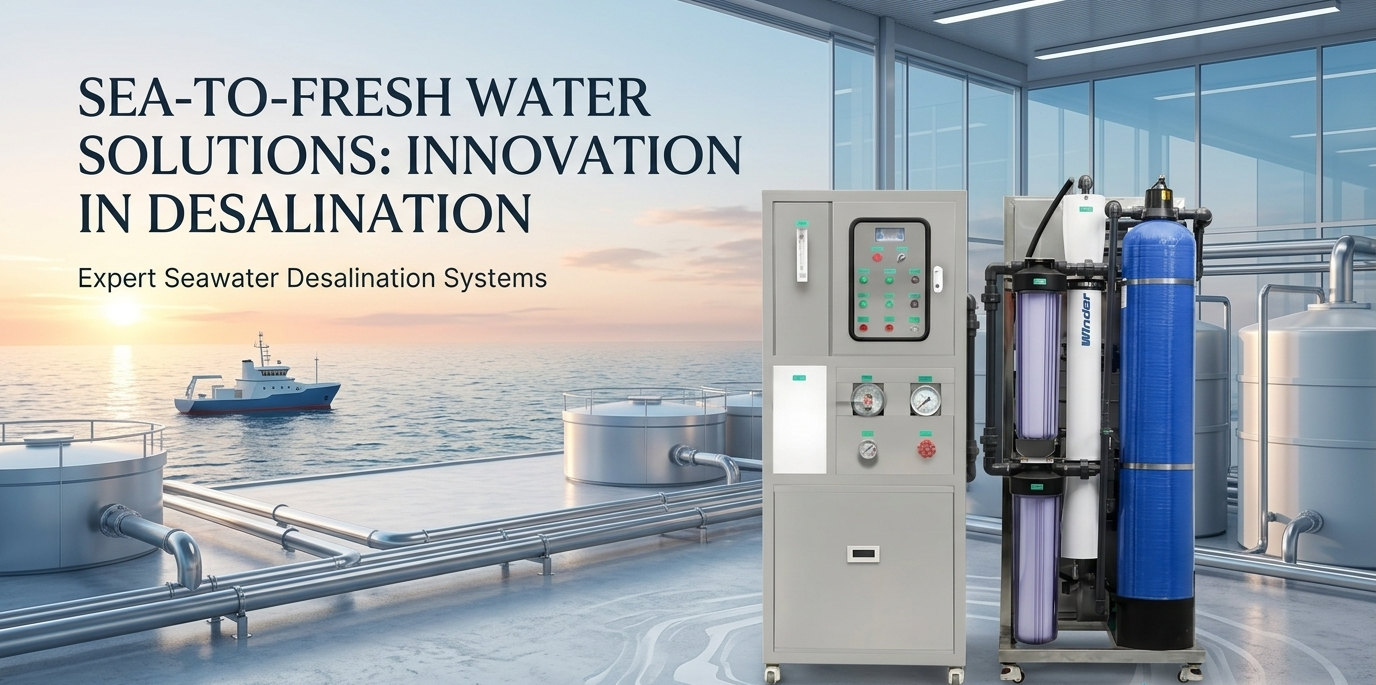
Coastal manufacturing plants face a feedwater risk inland facilities never have to engineer around: raw water TDS that swings from workable to catastrophic overnight. Saltwater intrusion into wellfields, drought-driven municipal allocation cuts, and tidal variation in brackish intakes can push source water past 30,000 ppm TDS without warning. When boiler feed, process rinse, or cooling tower makeup depends on that raw water, a production line is one bad intake reading away from an unplanned shutdown.
Before evaluating any seawater desalination system manufacturer & supplier, lock in these five specifications first:
- Continuous duty-cycle rating at 800–1200 PSI — not a residential or light-commercial pump curve
- Modular pre-treatment (multimedia + UF or PP cotton) fully decoupled from the RO skid, sized to your intake’s actual silt density index
- An Energy Recovery Device (ERD) integrated into the high-pressure train, not sold as a future add-on
- PLC-based automation (Siemens or Allen-Bradley) with remote alarms and scheduled CIP — not manual valve sequencing
- Documented salt rejection ≥99% at the specific TDS and temperature range of your intake, not a marketing-sheet average
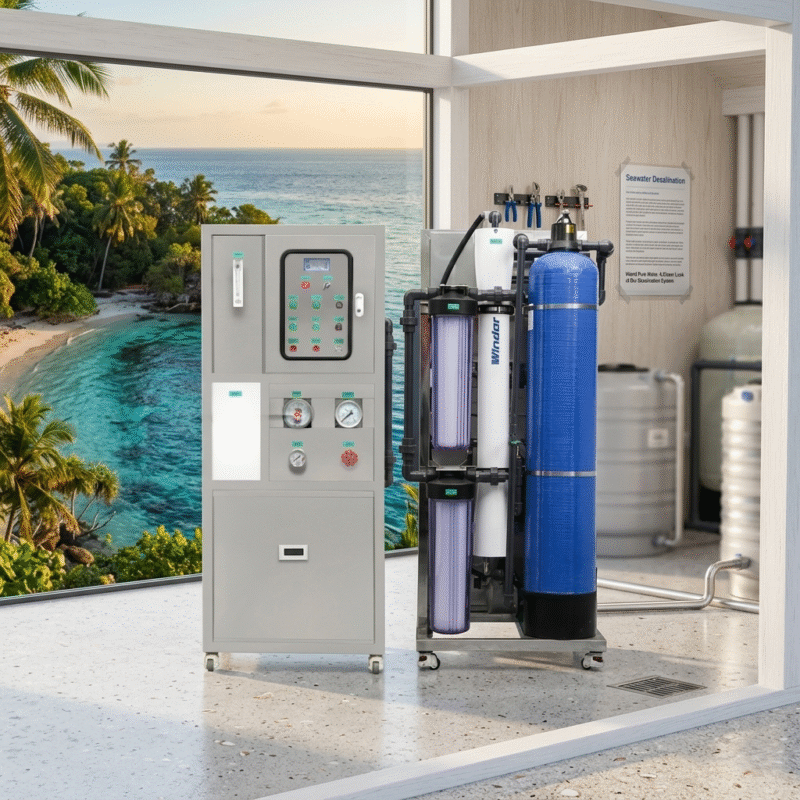
Fast Check Product: https://yourwatergood.com/product/seawater-desalination-system-provider/
Why Coastal Plants Are Adding Seawater to the Feedwater Equation
Municipal supply and well water are engineered problems with well-understood solutions. Municipal tap water is a chlorine/chloramine and soluble-salt problem. Deep well water is a hardness, iron/manganese, and silica-scaling problem.
Seawater is a different category entirely. Chloride loads run 50–100x higher than even the worst municipal or well source, which is why seawater reverse osmosis (SWRO) is engineered as its own discipline — not a scaled-up version of a standard industrial RO train.
Plants are pulled toward seawater as a primary or backup feedwater source for a handful of recurring reasons:
- Municipal allocation caps. Coastal industrial parks in water-stressed regions increasingly cap non-potable industrial draw.
- Wellfield salinity intrusion. Overdrawn coastal aquifers pull seawater into the wellfield faster than they recover.
- Drought curtailment. Municipal contracts get cut first during regional water restrictions; a captive seawater intake does not.
- No groundwater option. Facilities built on reclaimed coastal land, barrier islands, or industrial fill often have no usable aquifer at all.
This applies across verticals: coastal food and beverage bottling lines, petrochemical and refining terminals, power generation makeup water, and electronics manufacturers in water-stressed coastal regions that need a redundant feedwater source ahead of their own ultrapure polishing train.
One clarification that matters for procurement: raw SWRO permeate is a feedwater source, not a finished process-water spec. Semiconductor rinse water, pharmaceutical-grade purified water, and boiler feed all still require downstream polishing — typically a second-pass RO, EDI, or mixed-bed train — after desalination. The seawater system’s job is to convert an unreliable, hyper-saline source into a stable, low-TDS starting point your existing industrial RO or EDI equipment can actually work with.
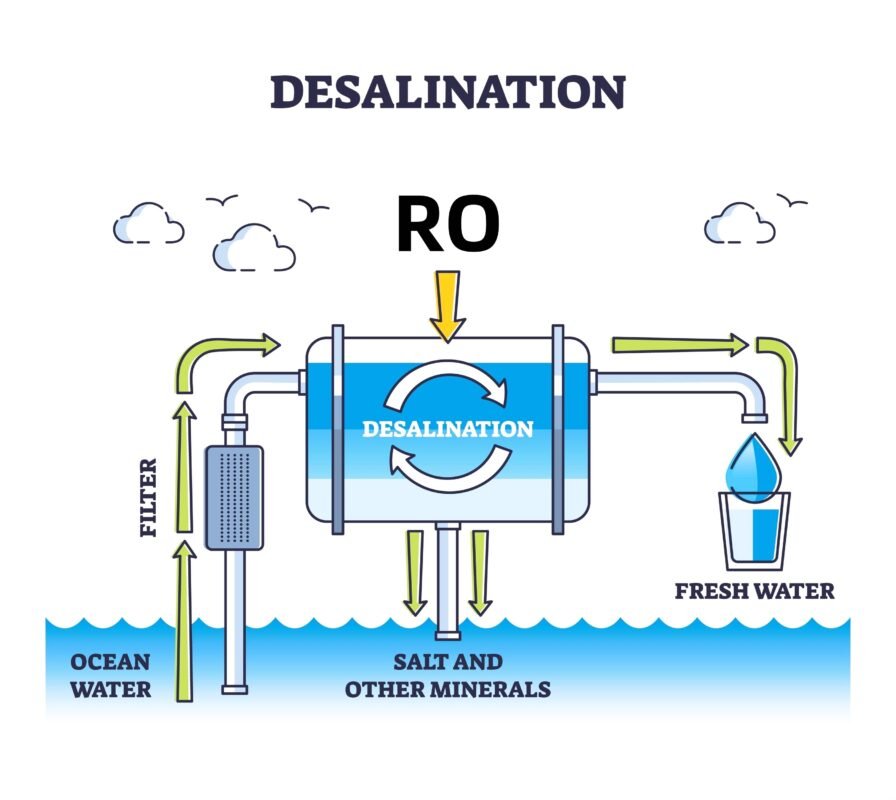
From Ocean Intake to Process-Grade Feedwater: Pre-Treatment and RO Train Design
Seawater carries silt, algae, and organic load that will blind a membrane in days if it isn’t intercepted upstream. The design fix is architectural, not incidental: decouple pre-treatment from the RO core entirely.
Consumer-grade “watermakers” build PP cotton filtration directly into the main skid. In a high-silt marine or industrial coastal intake, those integrated cartridges blind fast, starving the high-pressure pump. Independent, automated multimedia or UF pre-treatment vessels ahead of the SWRO skid keep the membranes fed with consistent, silt-free water — and let distributors and engineers size the pre-treatment stage to the specific intake location instead of a generic default.
Material selection is where a lot of specs quietly go wrong. Seawater at 1000+ PSI is one of the more corrosive service conditions in industrial water treatment. Standard 316 stainless steel, perfectly adequate on the 150–250 PSI balance-of-plant piping of a typical industrial RO system, will pit and fail on a seawater high-pressure train within months. The high-pressure manifolds and membrane housings need Duplex Stainless Steel (SS2205) or Super Duplex (SS2507) — 316L is appropriately used elsewhere in the skid for lower-pressure balance-of-plant lines, but it is not a substitute on the seawater side.
Pre-Engineered Skid vs. Fully Customized Turnkey System
Not every coastal facility needs the same delivery model. The right call depends on capacity, timeline, and how much of your process is already defined.
| Specification | Pre-Engineered Skid | Fully Customized Turnkey System |
|---|---|---|
| Capacity Range | Roughly 10–100 GPM | 100–1,000+ GPM, engineered to peak demand |
| CAPEX / Entry Investment | Lower upfront cost, standardized BOM | Higher upfront investment, optimized lifecycle OPEX |
| Lead Time | Typically 8–12 weeks | Typically 16–24+ weeks depending on scope |
| PLC Integration | Local HMI, standalone control | Full SCADA-integrated PLC (Siemens / Allen-Bradley), remote monitoring |
| Redundancy | Single train, no standby pump | N+1 or N+2 pump and membrane train redundancy |
Request a Custom CAD Skid Diagram or Water Analysis Review before committing to either path — the right column only pencils out once your actual GPM demand and redundancy requirement are on paper.
PLC Automation and 24/7/365 Uptime Assurance
A seawater desalination system that depends on a technician manually adjusting valves is not a 24/7/365 asset — it’s a liability with a schedule. Tier-one systems run on Siemens or Allen-Bradley PLC logic that handles high-pressure pump ramping, automated CIP (Clean-in-Place) cycling, and remote alarm notification without a human in the loop for routine operation.
Redundancy is the other half of uptime. An N+1 pump and membrane train configuration means a single component failure triggers an automated failover, not a shutdown. For a coastal plant where the desalination system is the only feedwater path, that redundancy is what keeps a compressor failure from cascading into a full production stoppage.
The Field Insight Most Engineers Miss: Cold-Water Flux Decay
Here’s the detail that separates a spec sheet from field experience: seawater viscosity increases sharply as temperature drops — whether from a winter cold snap or seasonal upwelling that drops intake temperature below 50°F (10°C).
Unless the system was sized in the design phase with a temperature correction factor — typically adding 30–40% additional membrane area to compensate — the high-pressure pump gets forced to run at abnormally high PSI to hold target output. That does two things, both bad: energy draw spikes, and the membrane surface starts accumulating irreversible scale and fouling.
The second half of that same mistake is antiscalant dosing calculated once and never revisited. Silica and calcium concentrations in raw seawater intake vary by location and season — a dosing pump flow rate set for a summer intake reading will underdose in winter. Left uncorrected, a plant can go from full output to a crippled production line inside a single week.
CAPEX vs. OPEX: The True Lifecycle Cost
A seawater desalination skid is not a sunk capital cost — it’s an operating-cost reduction asset, if it’s specified correctly.
- Lowering plant maintenance costs. Consistent low-TDS feedwater eliminates the scale buildup that drives boiler, cooling tower, and lab equipment maintenance calls.
- Extending capital equipment lifespan. Heat exchangers and high-pressure systems fed with hard or saline water fail on a compressed timeline; stable feedwater chemistry protects that capital investment.
- Operational uptime stability. With N+1 redundancy and automated CIP, a 24/7/365 production schedule is no longer hostage to a single feedwater source going out of spec.
- Water quality consistency. Downstream product quality — bottled beverage formulation, semiconductor rinse water, or process steam — depends on a feed profile that doesn’t drift with the tide.
The Energy Recovery Device on the high-pressure train is the single biggest OPEX lever: capturing kinetic energy from brine discharge and transferring it to incoming feedwater typically cuts overall pumping energy draw by up to 50%. Skipping the ERD to save on upfront CAPEX is the most common way procurement teams accidentally destroy the financial case for the whole system.
Frequently Asked Questions
What operating pressure does an industrial seawater desalination system require? Because seawater TDS typically runs 35,000–45,000 ppm, SWRO systems operate at 800–1200 PSI, depending on the exact salinity and temperature of the intake.
What GPM capacity do industrial seawater desalination systems typically run? Pre-engineered skids generally cover 10–100 GPM. Fully customized turnkey systems scale from 100 GPM to 1,000+ GPM for large coastal manufacturing sites.
Can seawater desalination feedwater meet process-water standards for food, beverage, or electronics manufacturing? Yes, as a feedwater source. SWRO permeate still passes through a facility’s existing industrial RO or EDI polishing train to reach the final process-water or boiler-feed specification.
How does cold seawater temperature affect system output? Cold water is denser and more viscous, which reduces membrane flux. Systems sized without a 30–40% temperature correction factor will see output drop and pump PSI spike during winter or seasonal cold-water intake conditions.
What’s the real difference between a pre-engineered skid and a custom turnkey system? Capacity range, redundancy, and PLC integration depth — see the comparison table above. The deciding factor is usually whether the facility can tolerate a single-train system with no automated failover.
How long does a custom industrial seawater desalination system take to deliver? Pre-engineered skids typically ship in 8–12 weeks. Fully customized turnkey systems with SCADA integration and redundancy run 16–24+ weeks depending on scope.
Why source directly from a manufacturer instead of a broker or distributor? Direct factory sourcing removes markup layers and gives your engineering team direct access to CAD drawings, GPM flow calculations, and OEM replacement parts — without waiting on a third party to relay a technical answer.
Get Your Coastal Facility’s Engineering Package
Water-stressed coastal operations don’t get a second attempt at a feedwater failure. Lock in the engineering specifications above before a supplier locks you into a system sized for someone else’s intake conditions.
Request an Industrial Engineering Quote, full Technical Data Sheets & P&ID Drawings, and B2B Wholesale / Factory-Direct Pricing from our engineering team — built around your actual GPM demand, intake salinity, and temperature profile, not a generic catalog spec — through our seawater desalination system manufacturer & supplier engineering page.