
Commercial Reverse Osmosis System Manufacturers: Sizing, Specs, and Equipment Protection for Foodservice Operators

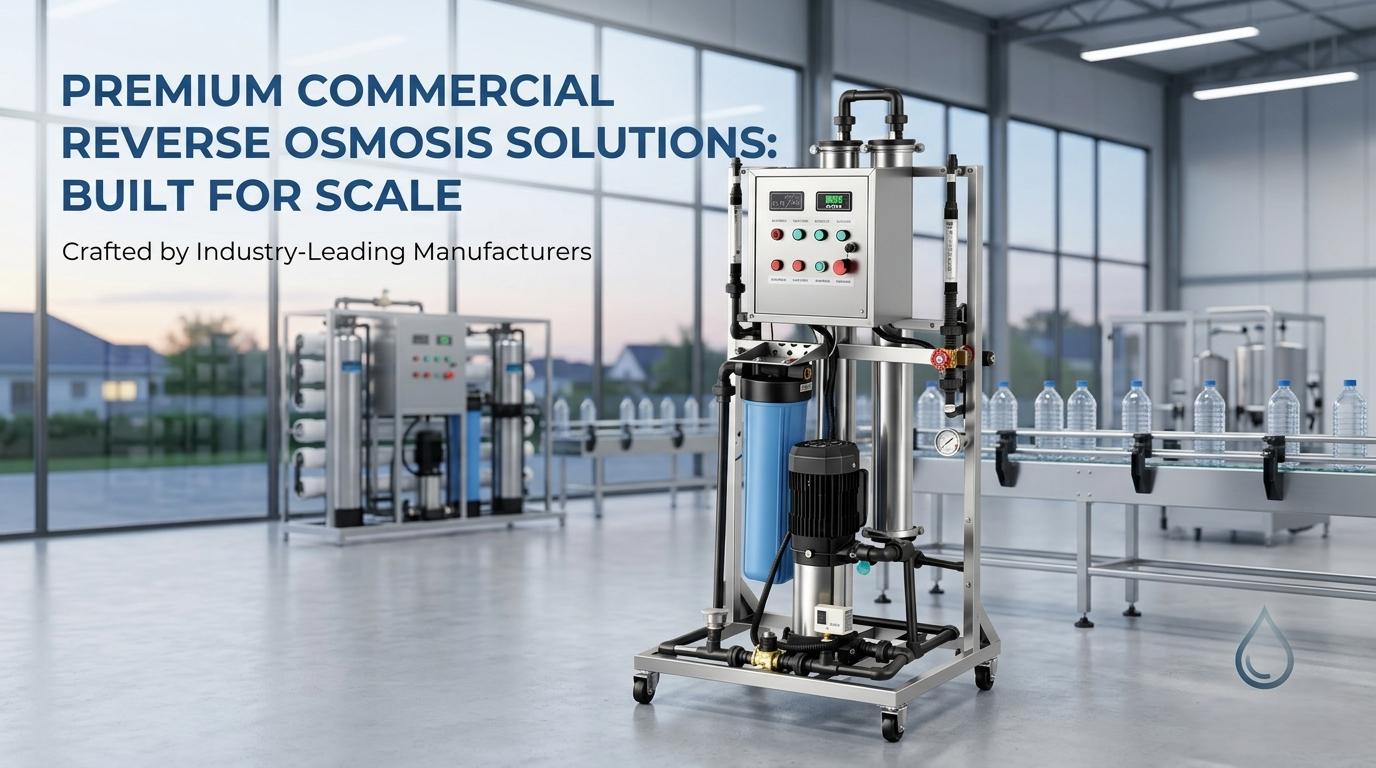
The right commercial reverse osmosis system manufacturers build to a spec sheet, not a sales pitch.
Before comparing quotes, confirm five numbers in writing — not marketing language:
- Continuous output in GPM/GPH, not just a headline GPD number
- Feed pressure window in PSI the pump is rated to hold
- Feed water TDS/conductivity ceiling the membrane can handle
- Footprint in inches, checked against your actual mechanical space
- Material and component documentation — frame, housing, and electrical specs you can verify independently, not just marketing claims
Most spec sheets skip at least two of these. That’s where equipment gets undersized, boilers get corroded, and warranties get voided.
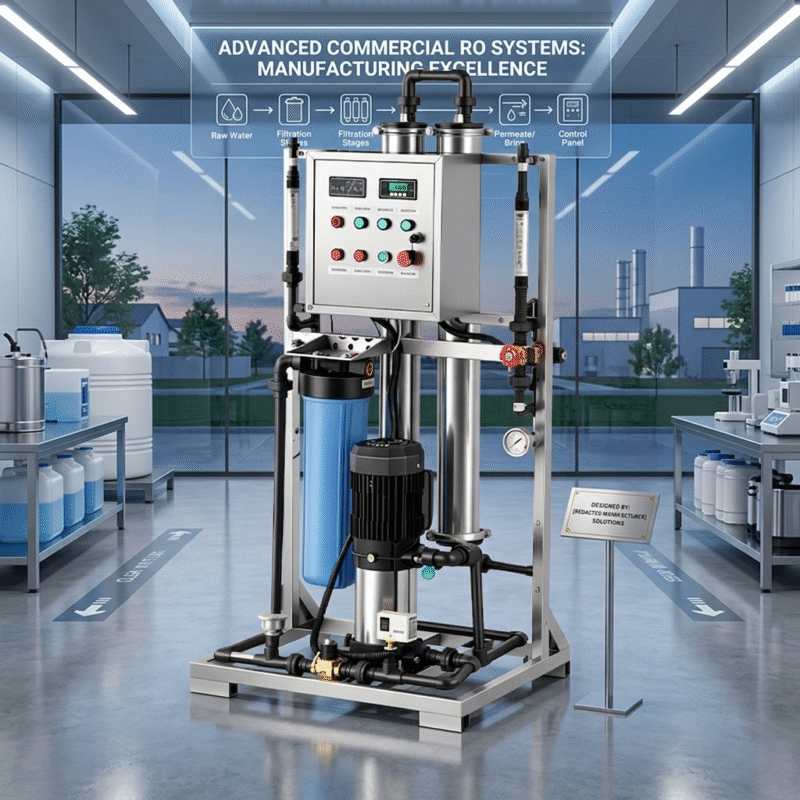
Fast Check Product: https://yourwatergood.com/product/commercial-reverse-osmosis-system/
Peak-Hour GPM: What a Compact Skid Actually Delivers During the Rush
A 0.25 T/H (250 L/H) commercial skid — a common compact configuration — outputs roughly 1.1 GPM, or about 1,057 GPD across a 16-hour operating window.
That number sounds small next to a “GPD” figure on a spec sheet. It is small.
This class of unit is sized for a single-bar café, a small restaurant kitchen, or a food truck — not a multi-line QSR or a 200-room hotel. Larger operations need either a higher-capacity skid or multiple units feeding a shared storage tank.
The mistake buyers make: sizing off the daily GPD number instead of the peak GPM number. A storage tank buffers steady demand. It does not buffer a 20-minute lunch rush pulling faster than the membrane can produce.
Ask your supplier for both numbers, and ask how the storage tank and duty cycle affect usable output during peak draw — not just on paper.
Municipal Chlorine Taste vs. Well Water Hardness: Different Problems, Different Pretreatment
Municipal water is treated to remove chlorine/chloramine taste, disinfection byproducts, and trace metals picked up from aging distribution lines. A single PP sediment stage plus carbon ahead of the RO membrane usually handles it.
Well water is a different fight: hardness, iron, manganese, and sulfur odor. A compact skid’s feed conductivity ceiling — typically around 800 µS/cm, roughly 400–550 ppm TDS depending on the mineral mix — is easy to blow past with untreated well water.
That’s why the pretreatment stage isn’t optional on well-fed sites. Skip it, and you’re not protecting the membrane — you’re pre-scaling it.
Before ordering: get a water test, not an assumption. “City water” and “well water” are not interchangeable inputs on the same skid.
The TDS Blending Valve Nobody Puts on the Spec Sheet
Here’s a detail most equipment sheets never mention: 0 ppm TDS water is a problem, not a win.
Zero-TDS permeate is aggressive. It pulls minerals out of anything it touches — including the copper boiler in a commercial espresso machine. It also strips flavor from extraction, leaving coffee flat and one-dimensional.
The fix on a properly built commercial RO skid is a TDS blending valve: a bypass that blends a small percentage of raw feed back into the permeate stream, dialing the finished water to 30–50 ppm TDS. That range protects copper components and preserves flavor consistency across coffee, ice, and soup stock.
A skid with an integrated inline water quality monitor lets kitchen staff confirm that blend in real time instead of guessing. That’s a maintenance-cost line item most buyers never think to ask about — until a boiler fails early.
Not sure what blend ratio your espresso or ice program needs? Request a Commercial Kitchen Water Layout Design before you finalize a spec.
Footprint, Voltage, and the Utility Hookups That Get Missed at Quote Stage
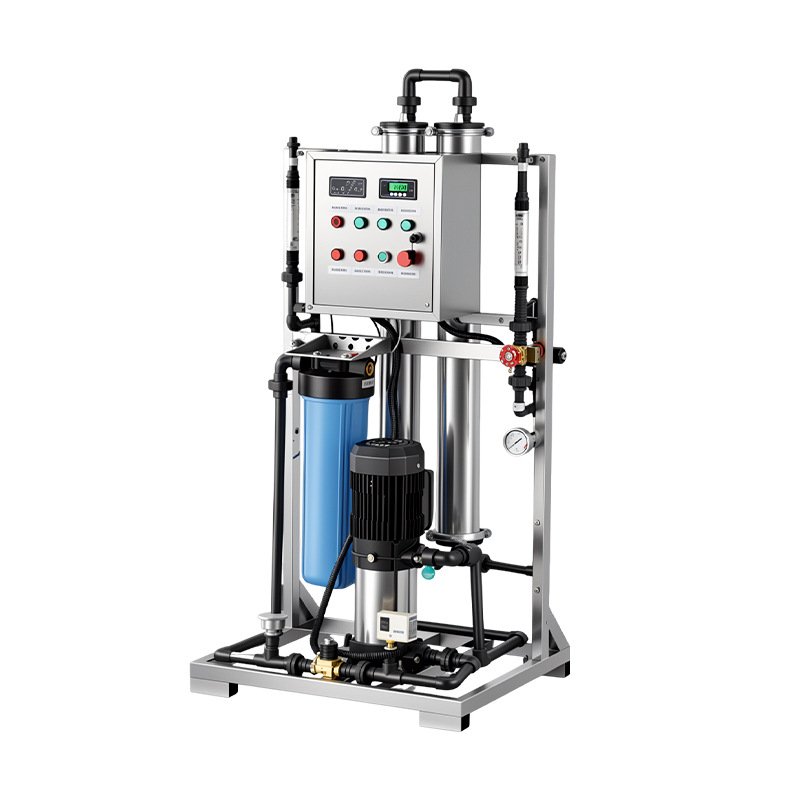
A compact commercial skid runs roughly 23.6″ × 23.6″ of floor footprint and about 55″ tall — small enough for a back-of-house corner, but tight enough that inches matter.
Before signing off, confirm:
- Feed and drain line sizes the skid connects to (commonly 32mm inlet / 20mm permeate line on compact units)
- Stainless vs. painted-steel frame — stainless resists the humidity and wash-down conditions of a working kitchen
- Electrical compatibility — this is the detail that gets missed most often
Many compact skids are built and rated 220V/50Hz, which is standard on export builds but doesn’t match US 60Hz commercial kitchen power. A motor and control transformer rated for 50Hz can run hot, run inefficiently, or trip protection on a 60Hz US circuit.
Confirm frequency compatibility in writing before the skid ships — not after it’s sitting on your loading dock with an electrician standing next to it asking questions nobody can answer.
POE vs. POU: Where the Real Cost Difference Shows Up on the P&L
Whole-facility (POE) and single-station (POU) filtration solve different problems, and they price out very differently over time.
| Factor | POE (Point-of-Entry, Central) | POU (Point-of-Use, Single Station) |
|---|---|---|
| Initial CAPEX | Higher — one system sized for the whole facility | Lower per unit, but multiplies across stations |
| Ongoing OPEX (filters/membranes) | Consolidated — one membrane/filter set to track | Fragmented — separate consumables per station, easy to miss a swap |
| Plumbing retrofit cost | Higher — typically requires a mechanical room tie-in | Lower — installs at the fixture, minimal repiping |
| Footprint | Larger single install, centralized | Smaller per unit, distributed across the kitchen |
| Protection scope | Protects every downstream fixture — ice, espresso, steam | Protects only the connected fixture |
The practical read: a single espresso machine or ice maker often makes sense as POU. A kitchen running an espresso machine, combi oven, and ice maker off the same feed usually comes out ahead on total cost with a central skid, because one membrane replacement beats tracking three.
If you’re weighing a central skid against multiple point-of-use units, request a layout design that models both against your actual fixture count.
What’s Actually Bolted Inside the Cabinet — and Why Component Sourcing Matters
Spec sheets sell capacity. Uptime is decided by what’s inside the cabinet.
On a properly built compact skid, look for:
- Feed solenoid valve — shuts inlet water when the system isn’t drawing, preventing pressure fatigue on the membrane
- Flush solenoid valve — periodically flushes the membrane housing, slowing scale buildup between filter changes
- High/low pressure switches — protect the pump from dry-running or over-pressure conditions that shorten pump life
- Dual rotameters (product and concentrate flow) — give staff a visual read on membrane performance without a technician visit
- Stainless membrane housing, frame, and control cabinet — resists kitchen humidity and wash-down corrosion that eats painted steel
- Industrial-grade low-voltage electricals — the component most likely to be quietly downgraded to hit a lower quote
Every one of these lines maps directly to a line item in your maintenance budget. A missing flush valve doesn’t show up on the spec sheet — it shows up as a shortened membrane life six months in.
FAQ
What size commercial RO system does a small café or restaurant need? A compact 0.25 T/H skid (~1.1 GPM, ~1,057 GPD) fits a single-bar café, small kitchen, or food truck. Multi-line or high-volume operations typically need a larger skid or multiple units on a shared tank.
What’s the difference between GPM and GPD when comparing systems? GPM measures peak continuous output — what the membrane can produce right now. GPD is a daily total. Sizing off GPD alone can leave a kitchen short during a rush, even if the daily total looks sufficient on paper.
Do commercial RO systems need NSF certification? NSF/ANSI 42, 53, and 58 define the industry’s benchmark for sensory, health, and RO-specific performance — but not every manufacturer carries formal certification, and that alone doesn’t disqualify a system. What matters more in practice: material-grade documentation (housing, frame, and membrane specs), component sourcing you can verify line by line, and a supplier willing to send sample water-test results or a full spec sheet before you commit. Ask for those in writing regardless of certification status.
What’s the difference in pretreatment for municipal vs. well water? Municipal water mainly needs chlorine/chloramine and disinfection byproduct removal. Well water needs treatment for hardness, iron, manganese, and sulfur odor, and is more likely to exceed a compact skid’s feed conductivity ceiling without pretreatment.
How often do commercial RO membranes and pre-filters need replacement? RO membranes typically last around a year, depending heavily on feed water quality. Pre-filters need replacement every 2–4 months on average — well water and high-sediment feeds push toward the shorter end.
Why does 0 ppm TDS water hurt coffee flavor and equipment? Zero-TDS water is chemically aggressive: it strips flavor compounds during extraction and corrodes copper boiler components over time. A TDS blending valve set to 30–50 ppm protects both flavor and equipment.
What voltage do commercial RO systems require in US kitchens? Confirm this before ordering. Many compact skids ship rated 220V/50Hz for export markets, which doesn’t match standard US 60Hz commercial power. Get frequency compatibility confirmed in writing, not assumed.
Feed pressure, footprint, and electrical compatibility are the three details that turn a good spec sheet into a bad installation. Get them confirmed before a PO goes out, not after.
Ready to move forward? Request a custom commercial quote, a full technical parameter sheet, or B2B wholesale pricing from a working commercial reverse osmosis system manufacturers team that builds to the spec, not around it.