
Auditing a Whole House Water Filter Manufacturer’s Production Line

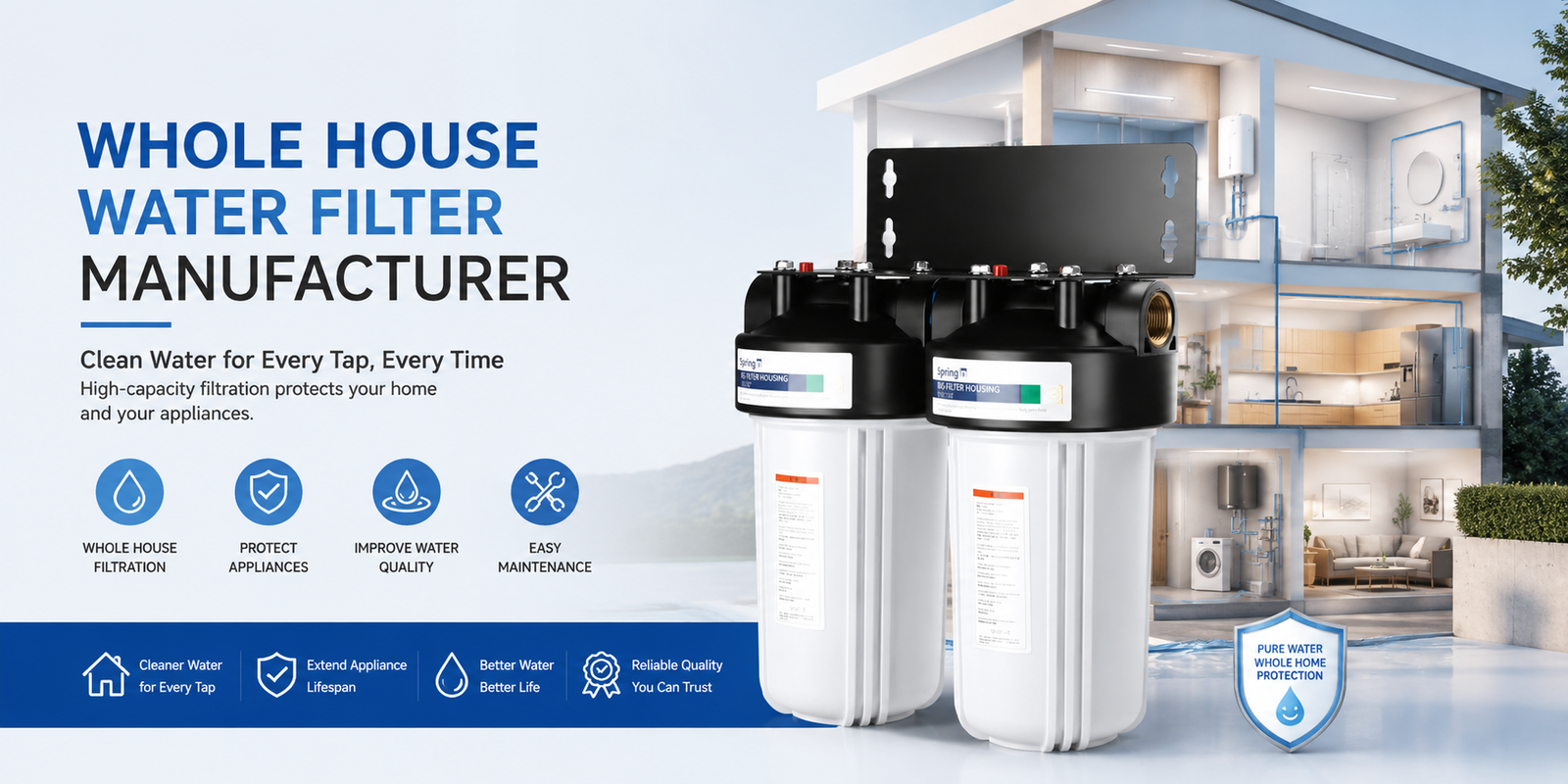
Sourcing from a whole house water filter manufacturer means auditing what happens on the factory floor, not just reading a spec sheet — the line that spins PP cotton and extrudes carbon block is what actually determines whether every unit performs the same. Before you commit to a bulk order, confirm:
- In-house process ownership: Does the factory spin its own PP cotton and extrude its own carbon block, or outsource these to unaudited third parties?
- Point-of-control QC: Is chlorine reduction and sediment capture tested per production lot, or only on a pre-launch sample?
- Tooling capability: Can the factory cut a custom housing mold in-house, or does it subcontract tooling to another shop?
- Documented lead times: Separate commitments for open-mold reorders versus new custom tooling runs.
Fast Check Product:https://yourwatergood.com/product/whole-house-water-filtration-system-for-home/
What Separates a Manufacturer From a Trading Company Reseller
A manufacturer controls the extrusion line, the injection molds, and the QC bench. A reseller controls none of it and simply forwards your PO downstream.
That distinction shows up fast once you ask the right questions:
- Real manufacturers can walk you through their PP cotton spinning process and carbon block extrusion parameters on request.
- Resellers labeled as manufacturers deflect technical questions to “the factory” without naming one.
- Contract manufacturers running multiple client lines should be able to show dedicated tooling for your SKU, not a shared generic mold.
Ask directly for the factory’s production floor plan or a video walkthrough. A manufacturer with nothing to hide will show you the line.
Production Line Detail Most Buyers Never Ask About
Here’s a defect that never shows up on a static bench test: channeling in the PP cotton pre-filter stage.
A filter that passes a pressure test can still let sediment through.
- Graded-density PP cotton is supposed to be looser at the outer surface and tighter at the core, so it captures large particles first and fine sediment last.
- That gradient depends entirely on line speed and fiber tension control during spinning. A factory running inconsistent tension produces micro-channels — small gaps in the fiber mat that let unfiltered water bypass the media.
- A static PSI test won’t catch this. It only shows up as reduced real-world sediment capture over the filter’s service life.
A manufacturer that documents tension-control settings per production run — not just per product design — is the one worth building a long-term order relationship with.
Request a Factory Component Blueprint to review actual extrusion and molding process documentation before you commit to a bulk run.
What Manufacturing Rigor Actually Protects Downstream
A factory floor decision made today shows up in your numbers a year from now, across four places:
- Warranty Claims: Inconsistent extrusion tension or carbon block density means an unpredictable defect rate — and a warranty budget you can’t forecast.
- Operational Stability: Distributors stop reordering from brands whose product performance drifts between shipments. In-house QC at the point of manufacture is what keeps performance flat.
- Water Consistency: Chlorine reduction and sediment capture are only as reliable as the factory’s own lot-testing discipline — not the marketing copy on a spec sheet.
- Brand Equity Protection: A field failure traces back to your brand name, not the factory’s. Manufacturing rigor is the insurance policy your customers never see you paying for.
Confirming Real Specs for a Two-Stage Whole House System
For a standard two-stage whole house configuration, don’t accept vague marketing language — confirm these details on the actual SKU:
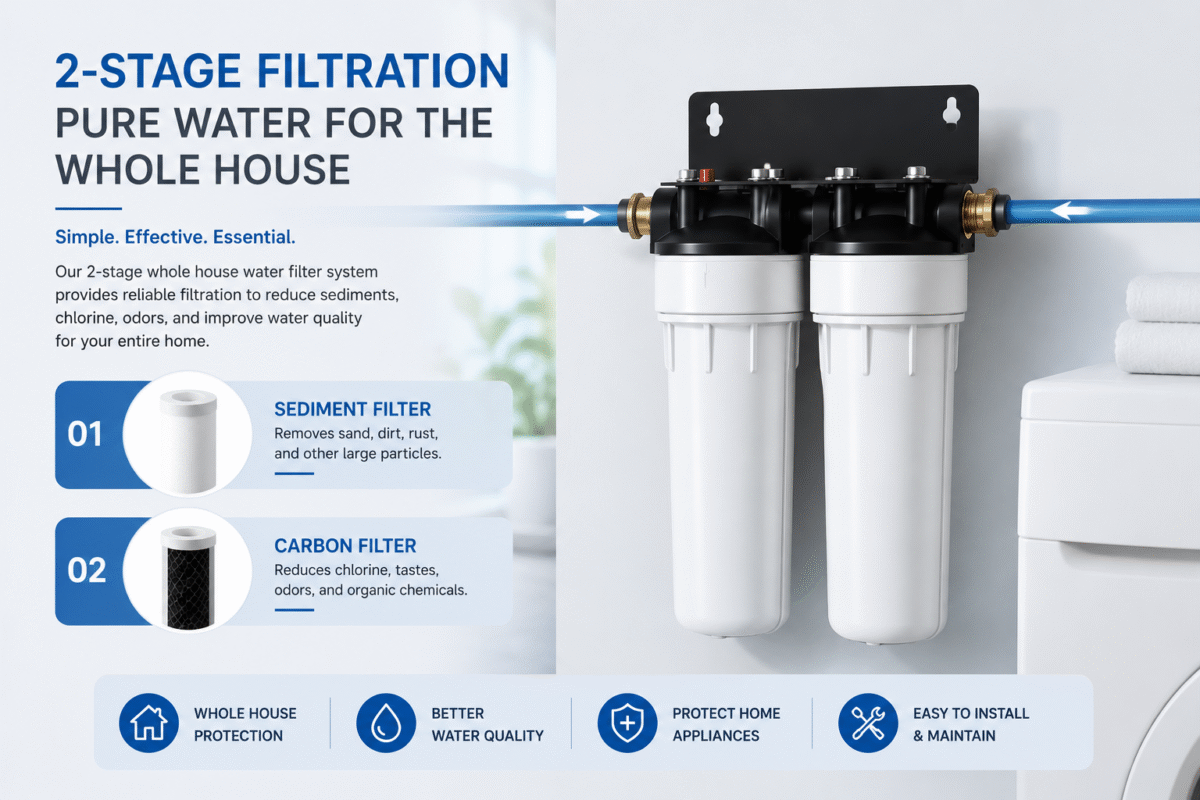
- “Clean & Clear” Configuration (Municipal Water): Stage 1 is a PP cotton pre-filter rated for sediment capture (commonly cited at 5-micron), and Stage 2 is a CTO carbon block rated for 95%+ chlorine reduction along with taste and odor removal.
- “Scale Shield” Configuration (Hard Water): Stage 1 is a high-efficiency PP cotton pre-filter, and Stage 2 is a scale inhibitor (Siliphos/polyphosphate media) that protects water heaters, washing machines, and dishwashers from mineral buildup — without salt.
- Flow and Pressure Data: If GPM or PSI ratings aren’t published for the SKU, request them in writing before finalizing an installation spec sheet.
- Certification Status: Confirm which NSF/ANSI listings, if any, actually apply to this SKU — don’t assume company-wide certifications cover every product line.
These two configurations solve different problems. A manufacturer who can’t clearly explain which one you’re ordering, and why, hasn’t earned your reorder.
Manufacturing Capability Table: Outsourced Components vs. In-House Production
| Capability Factor | Outsourced / Subcontracted | True In-House Manufacturer |
|---|---|---|
| PP cotton spinning control | Sourced from third-party mill, tension unverified | Direct line control, documented per batch |
| Carbon block extrusion | Subcontracted, binder ratio unverified | In-house formulation and QC |
| Custom housing tooling | Outsourced mold shop, added coordination lag | Direct mold-shop scheduling |
| Technical drawing origin | Reseller passes along basic PDF | Factory-issued CAD/SolidWorks files |
| Defect root-cause response | Multiple hand-offs, slow resolution | Direct engineering access |
Open-mold wholesale orders typically run a 100–200 unit MOQ. Custom tooling for a proprietary housing generally requires 500–1,000+ units to justify the mold investment — and the table above is what determines whether that tooling actually performs consistently once it’s built.
Manufacturing Red Flags Before You Place a Bulk Order
- No factory address on the contract — only a sales office or trading company entity.
- Refusal to share extrusion or molding process documentation, even under NDA.
- One “spec sheet” covering every configuration, with no distinction between the municipal and hard-water builds.
- No batch-level testing records, only a single pre-launch qualification report.
- Vague lead-time language (“a few weeks”) instead of a written production schedule for both standard and custom orders.
FAQ
What should I check when auditing a whole house water filter manufacturer’s factory? Confirm whether PP cotton spinning and carbon block extrusion happen in-house, request line-level QC records (not just a final product test), and ask for a factory floor plan or video walkthrough before placing a bulk order.
Does the manufacturer produce PP cotton and carbon block in-house, or outsource it? Ask directly — a true manufacturer can describe its own spinning tension control and extrusion binder ratio. A reseller relabeling outsourced components as “manufactured” usually can’t answer beyond generic marketing language.
What’s the difference between the municipal-water and hard-water configurations? The municipal (Clean & Clear) build pairs PP cotton sediment filtration with a CTO carbon block for chlorine reduction. The hard-water (Scale Shield) build pairs PP cotton with a Siliphos/polyphosphate scale inhibitor to protect appliances — they solve different problems and shouldn’t be quoted interchangeably.
How is chlorine reduction actually verified before a batch ships? Ask for lot-level test data showing chlorine reduction percentage, not just a one-time design certification. A 95%+ reduction claim should be traceable to the specific production batch you’re purchasing.
What tooling investment is required for a custom housing? Custom injection-molded housings typically require $15,000–$50,000 in tooling costs and a 500–1,000+ unit MOQ to justify the investment, versus $0 tooling cost on open-mold configurations.
How long does a custom OEM production run take from mold approval to shipment? Standard open-mold reorders typically ship in 15–25 days. Custom tooling projects, including mold validation cycles, generally require 45–60 days.
What documentation should a manufacturer provide with a bulk order? Factory-issued CAD or structural drawings, lot-level QC test records for chlorine reduction and sediment capture, a written production schedule, and clear confirmation of which NSF/ANSI listings apply to the specific SKU.
Confirm the Factory Before You Confirm the Order
Your brand’s field performance is decided on the production floor, long before a container ships — not in a sales call about a whole house water filter manufacturer‘s catalog.
Contact our engineering team to request a Custom OEM Quote, review our Technical Parameter Sheets, or lock in tier-one B2B Wholesale Pricing for your next production run.