Data Center Cooling Water Treatment Supplier: Factory-Direct Sourcing, Lead Time, and Spares That Protect Uptime

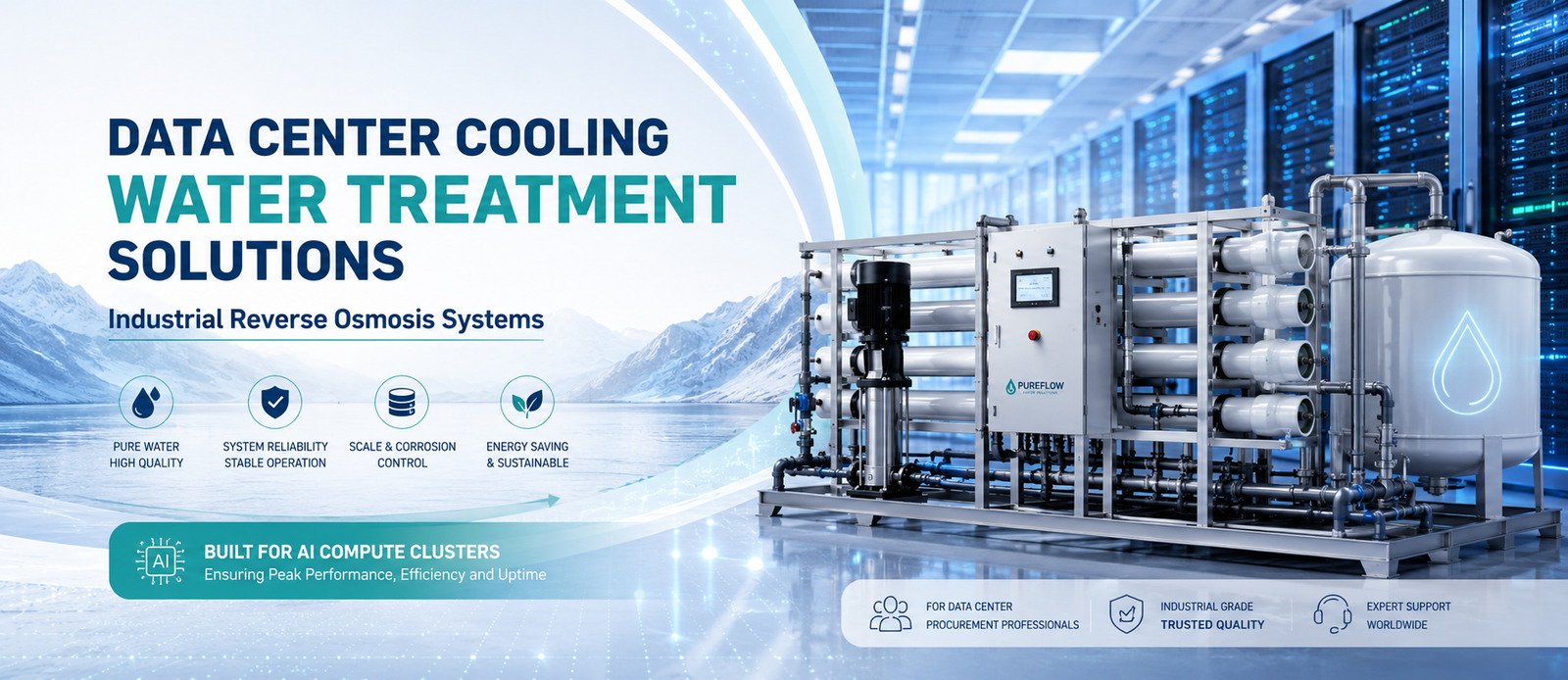
Choosing a data center cooling water treatment supplier on quoted price misreads the decision. For a mission-critical loop, the numbers that govern the outcome are lead time to operational, spare-parts availability, and who actually builds the equipment.
The cheapest quote with a 16-week spare-parts lead time is the most expensive supplier the first time a membrane fails — because the loop cannot run while the replacement is in transit, and idle compute capacity dwarfs any saving on the purchase order.
Selecting a data center cooling water treatment supplier is therefore a supply-chain decision as much as an engineering one. The right partner controls lead time, stocks spares, and builds to your water — the wrong one adds margin and a delay between you and the factory.
Before committing, require that a supplier demonstrate the following:
- Factory-direct manufacturing — not a reseller, so lead time, customization, spares, and price stay under one roof.
- Lead time stated to operational — including factory acceptance testing (FAT) and commissioning, not just a ship date.
- A critical-spares package — membranes, resin, instruments, and dosing parts available with the original order.
- Standardized, industry-available consumables — not proprietary cartridges that lock you to one source.
- Transparent Incoterms and landed cost — so the quoted price reflects what arrives at your site.
The sections below turn each into a sourcing decision.
Fast Check Product:https://yourwatergood.com/product/industrial-reverse-osmosis-system/
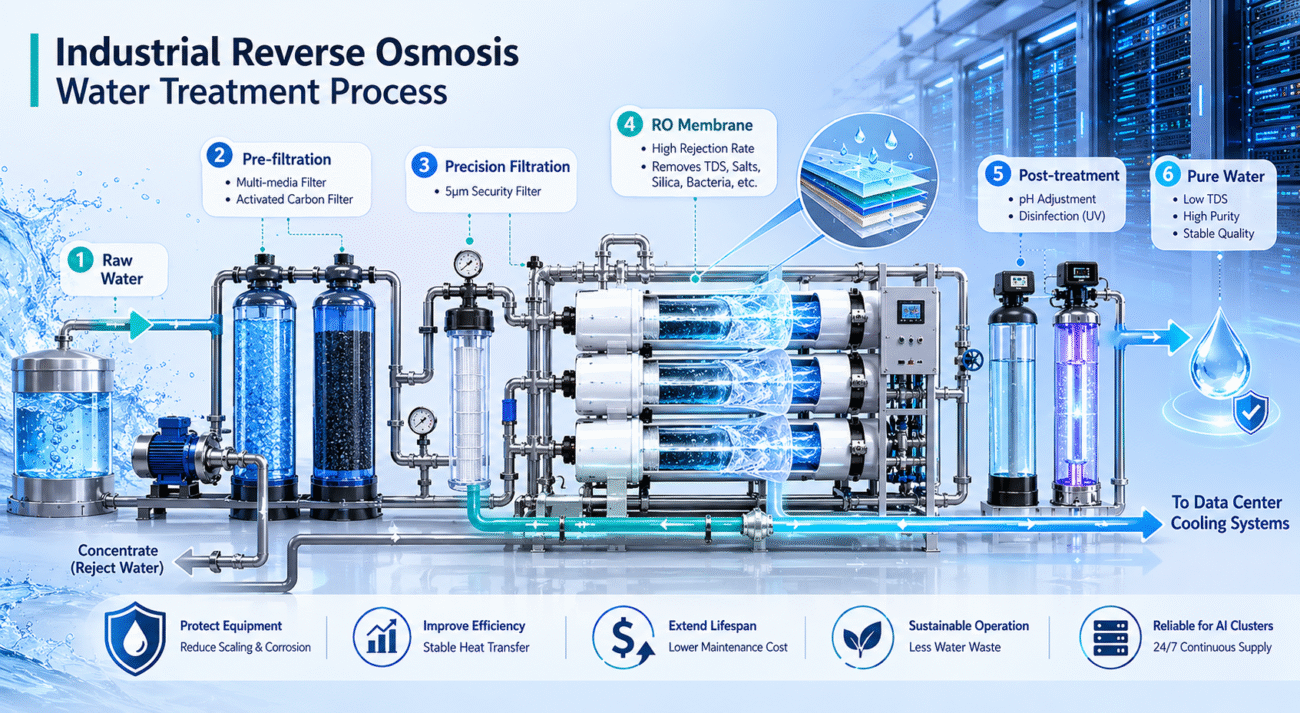
YourWaterGood delivers scalable, high-output commercial and industrial water purification systems engineered specifically to handle the high makeup water demands of modern data center cooling loops.
Instead of unscalable consumer-grade units, our infrastructure solutions focus on robust, multi-stage filtration capable of continuous operation under demanding industrial conditions:
- High-Capacity Multi-Stage Pre-Filtration: Utilizing heavy-duty Pre-Filtration and advanced carbon block modules to remove suspended micro-solids, sediment, and chlorine before water enters primary cooling loops or RO membranes.
- Industrial Reverse Osmosis (RO) Systems: Engineered as heavy-duty 5-stage and 5-stage with UV disinfection configurations, removing up to 99% of Total Dissolved Solids (TDS), silica, and scaling minerals.
- Micro-Channel Protection: High-flow filtration setups designed to safeguard tight-tolerance direct-to-chip cold plates against particulate clogging and bio-fouling.
Selecting an enterprise-grade mission-critical water system requires verifying the following baseline engineering capabilities:
- Continuous Duty Cycle Reliability: Continuous 24/7/365 uptime operation across fluctuating thermal loads with integrated N+1 or 2N mechanical pump and membrane redundancy.
- Precision Conductivity Control: Maintenance of primary and secondary loop fluid electrical conductivity below 0.1 uS/cm using continuous electrodeionization (EDI) polishing.
- Automated Scaling & Bio-Fouling Prevention: Real-time PLC-driven biocide injection and high-recovery scale inhibition capable of managing high cycles of concentration (CoC).
- BMS Integration Protocols: Native Modbus TCP/IP or BACnet IP integration for instantaneous telemetry of differential pressure (PSI), flow rates (GPM), and effluent Total Dissolved Solids (TDS).
Price Is Not the Number That Matters: Sourcing for Uptime, Not the Lowest Quote
The defining error in selecting a data center cooling water treatment supplier is optimizing the purchase price while ignoring the numbers that actually determine cost and risk over the system’s life.
For a mission-critical facility, three figures outrank the quote:
- Lead time to operational — how long until the system is making water in spec, not how long until a crate arrives.
- Spare-parts availability — how fast a failed membrane, resin charge, or dosing pump can be replaced and the loop restored.
- Manufacturing control — whether the supplier can configure the system to your feed water and support it directly.
A supplier who wins on price but trails on all three transfers cost into the operating phase: schedule slips at commissioning, weeks of lost capacity waiting on spares, and a catalog system that under-performs on your specific water. The lowest quote and the lowest total cost are rarely the same supplier — and on a mission-critical loop, uptime is the figure that pays the bills.
Factory-Direct vs Middleman: Who Controls Lead Time, Customization, and Price
Whether a supplier manufactures the equipment or resells it changes everything downstream — lead time, the ability to customize, spare-parts speed, and price all depend on who controls the build.
A factory-direct manufacturer:
- Controls lead time because production scheduling is in-house, not subject to a third party’s queue.
- Configures the system — pass count, membrane selection, materials, and capacity — to your feed-water analysis.
- Supplies spares directly at manufacturer pricing and stock, without a margin layer.
- Prices without a reseller markup, which matters most on large CAPEX builds.
A middleman or reseller:
- Adds margin and a communication layer between the buyer and the engineers who built the system.
- Is limited to catalog configurations, with customization routed back to the actual manufacturer anyway.
- Often cannot stock specialized spares, lengthening time-to-restore on a failure.
For a one-off commodity purchase, the distinction is minor. For a mission-critical, customized water plant that must be supported for a decade, it is decisive. Buy from the factory that builds it, and the layer between you and engineering disappears.
Lead Time to Operational: The Schedule Risk Buyers Miss
Most buyers ask for a delivery date and plan the project around it. The date that actually matters is when the system is operational — making water in spec — and several stages sit between “shipped” and “running” that a ship date hides.
The real lead-time path includes:
- Engineering and configuration to the feed-water analysis, which a factory-direct supplier compresses and a reseller extends.
- Factory acceptance testing (FAT) — witnessed performance verification before shipment, which protects the schedule by catching issues at the factory, not on site.
- Delivery and rigging of heavy skids into the facility, constrained by access and site readiness.
- Commissioning and passivation — flushing, chemistry stabilization, and for new galvanized towers, the passivation window before full operation.
A supplier who quotes only a ship date leaves the buyer to absorb the commissioning time as a schedule surprise. Ask for lead time to operational, with FAT and commissioning included — that is the number the construction schedule actually depends on, and it separates a supplier who plans delivery from one who plans an outcome.
Matching the Supplier to Your Water: Municipal vs Reclaimed Build
A capable supplier builds a different system for different source water, and the ability to do that is a manufacturing-capability question, not a catalog lookup.
Municipal potable feed requires a build centered on:
- Activated carbon sized for the residual disinfectant — often chloramine, not free chlorine.
- Chloride control to protect 316L from pitting corrosion.
Reclaimed and recycled feed — increasingly mandated for WUE targets in Ashburn, VA and Phoenix, AZ — requires a heavier build:
- Multimedia filtration, skid-mounted softening, and antiscalant dosing for high TDS and silica above ~150 ppm.
- Stronger microbiological control and finer guard filtration for elevated organic load.
- Membrane selection and recovery rate matched to the harder feed.
A supplier limited to a single catalog skid cannot build for both. A factory-direct manufacturer configures the pretreatment train to your water analysis — which is why the supplier’s manufacturing flexibility directly determines whether the system fits your site, consistent with ASHRAE TC 9.9 and EPA frameworks.
Standard Skids vs Data-Center-Grade Suppliers
A commodity supplier ships a stock unit and steps back. A data-center-grade supplier manufactures to your water, states lead time to operational, and supports the system for its life.
| Sourcing Criterion | Commodity / Reseller Supplier | Data Center Grade Factory-Direct Supplier |
|---|---|---|
| Manufacturing | Reseller / catalog | Factory-direct, configurable |
| Lead time basis | Ship date only | To operational (FAT + commissioning) |
| Customization | Catalog units | Built to your feed-water analysis |
| Flow capacity (GPM) | 10–50 GPM | 100–1,000+ GPM, parallel trains |
| Redundancy | Single train | N+1 / N+2 / 2N architecture |
| Spare parts | Limited, slow | Critical-spares package, direct stock |
| Consumables | Often proprietary | Industry-standard, multi-source |
| Support | Margin layer | Direct to engineering, documented P&ID |
The manufacturing and spares rows decide outcomes: a reseller cannot compress lead time, customize the build, or restore the loop quickly, while a factory-direct supplier controls all three. The cheaper supplier carries the schedule and downtime risk.
To pressure-test a supplier, ask whether they manufacture the equipment and what their spare-parts lead time is. A supplier who cannot answer both is a layer between you and the factory.
Field Engineering Insight: Spare-Parts Lead Time Is the Real Downtime Driver
Here is the number that catches teams who source on equipment lead time: for a mission-critical loop, the binding figure is time-to-restore, not time-to-deliver — and spare-parts lead time, not the original build, governs it.
Buyers compare ship dates and overlook spares. Then a single component fails — an RO membrane, a specialty resin charge, a dosing pump — and the replacement is on an 8–12+ week reorder. The loop cannot run in spec while that part is in transit, so one failure becomes weeks of lost capacity.
Proprietary, single-source consumables make it worse: the facility is locked to one supplier’s lead time and price for the life of the system, with no second source to call when the part is critical.
The defense is a sourcing decision made at purchase, not at failure:
- Specify a critical-spares package with the original order — membranes, resin, key instruments, and dosing parts held on site.
- Prefer industry-standard consumables — standard membranes, PP and carbon media — that multiple distributors stock.
- Confirm the supplier’s spare-parts lead time and stock policy before buying, and treat a long or single-source answer as a risk.
- Map spares to redundancy — an N+1 train buys time, but only if the spare to rebuild the offline train is on the shelf.
This is the kind of detail that never appears on a flow-rated quote but decides whether a failure costs hours or weeks. It is also where the right supplier compounds value: fast spares and standard consumables lower downtime and OPEX, keep the loop protecting cold plates and CDUs, and hold 99.999% uptime — the outcome a low purchase price alone cannot deliver.
Data Center Cooling Water Treatment Supplier FAQs
How do I choose a data center cooling water treatment supplier? Evaluate factory-direct manufacturing, lead time to operational, spare-parts availability, standardized consumables, and custom build capability — not just purchase price. For a mission-critical loop, uptime and time-to-restore outweigh the quote.
What is factory-direct and why does it matter? Buying from the manufacturer rather than a reseller keeps lead time, customization, spares, and price under one roof. Resellers add margin and a layer between the buyer and the engineers who built the system.
What lead time should I expect from a supplier? It varies with system size and customization. Ask for lead time to operational — including FAT and commissioning — not just a ship date. Configured industrial RO and EDI builds typically run weeks to a few months.
Should I stock spare parts with the order? Yes. Specify a critical-spares package — membranes, resin, instruments, and dosing parts — with the original order. Spare-parts lead time, not equipment lead time, governs downtime on a mission-critical loop.
What Incoterms apply to water treatment equipment? Terms such as EXW, FOB, CIF, and DDP determine who pays freight, customs, and inland delivery of heavy skids. Compare landed cost, not the ex-works price, when evaluating suppliers.
Can a supplier customize a system for my water? A factory-direct manufacturer can configure pass count, membrane selection, materials, and capacity to your feed-water analysis. Resellers are generally limited to catalog units.
Does source water affect the build? Yes. Municipal and reclaimed feeds require different pretreatment trains, so the supplier must build to your water analysis — heavier multimedia, softening, and antiscalant for reclaimed — consistent with ASHRAE TC 9.9 and EPA frameworks.
Source Factory-Direct, and Engineer for Time-to-Restore
A data center cooling water treatment supplier is a supply-chain decision that determines schedule and uptime as much as the equipment itself. The facilities that stay running are the ones that sourced factory-direct, planned lead time to operational, and stocked the spares that govern time-to-restore.
Whether you are equipping a single high-density server room or sourcing trains into a larger buildout, YourWaterGood manufactures and ships the equipment factory-direct — as a data center cooling water treatment supplier building industrial RO, EDI, skid-mounted softening, catalytic-carbon filtration, and automated dosing, configured to your feed water and schedule.
- Get an Infrastructure Engineering Quote: itemized, factory-direct pricing on 1 t/h–10 t/h systems with lead time to operational and a spares package.
- Request Technical Data Sheets: configurations, consumable specs, lead times, and BMS integration detail for your review.
- Secure B2B Wholesale / Factory-Direct Pricing: source equipment and spares straight from our manufacturing facility.