Cost Effective Water Treatments for Data Centers: Total Cost of Ownership Over the Asset Life

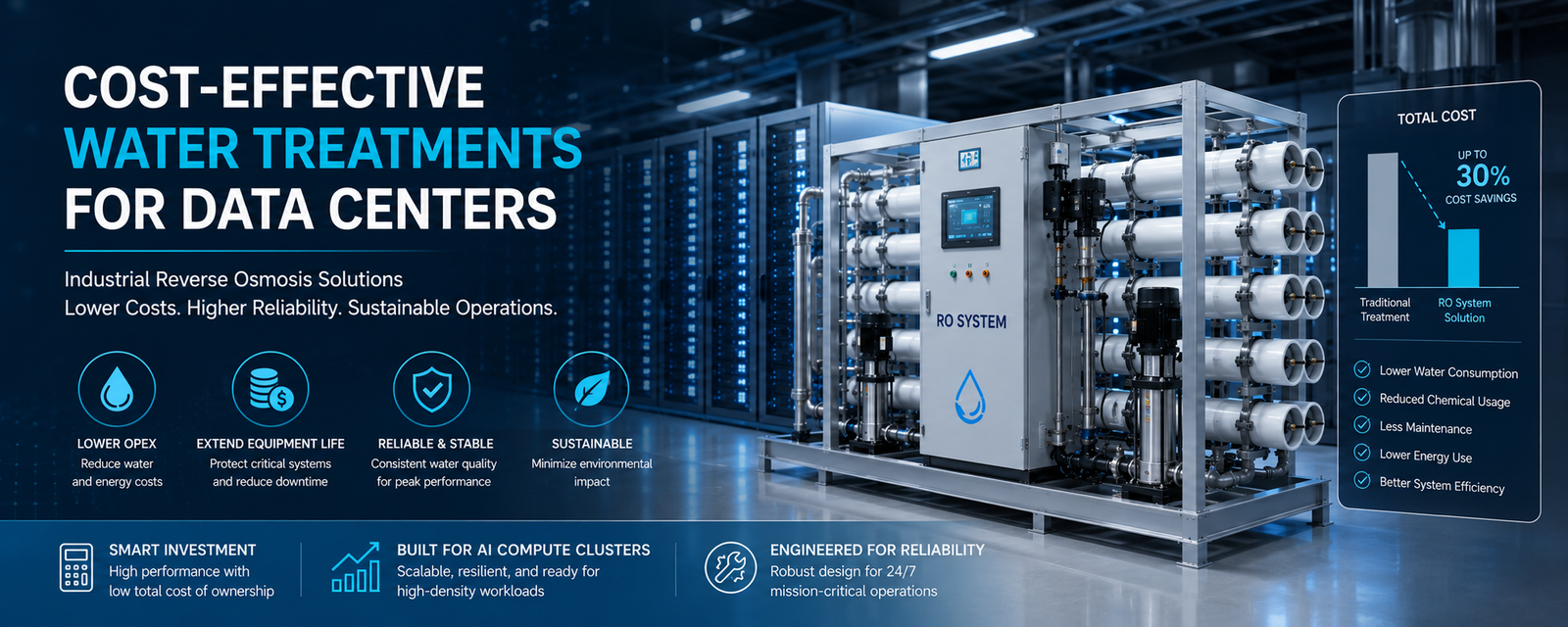
The cheapest water treatment system is almost never the cost-effective one. For a mission-critical data center, “cost-effective” means the lowest total cost of ownership (TCO) across a 10–15 year asset life — and the skid’s purchase price is the smallest line in that total.
The largest line is the cost of what happens when an under-specified system underperforms: scaled cold plates, premature membrane and fill replacement, excess water and sewer fees, an energy penalty from fouled surfaces, and — at the extreme — unplanned downtime.
Sourcing cost effective water treatments for data centers correctly means evaluating the whole cost stack, not the quoted CAPEX. A system that saves money at purchase and loses it every month is not cost-effective; it is expensive on a delay.
Before sourcing, lock these cost-control specifications first:
- Evaluate on TCO, not purchase price — CAPEX is a one-time number; OPEX and downtime risk recur for the entire asset life.
- High Cycles of Concentration (CoC) capability — cuts both makeup water purchased and blowdown discharged, lowering water and sewer cost simultaneously.
- Chemical-free EDI polishing — eliminates acid/caustic purchase, handling, and disposal OPEX.
- Standardized consumables — PP sediment and carbon elements that keep maintenance cost predictable, not proprietary cartridges.
- Automated control and monitoring — lowers labor and prevents the costly excursions that drive emergency cleaning and downtime.
The sections below break down the real cost stack and where cost-effectiveness is actually won.
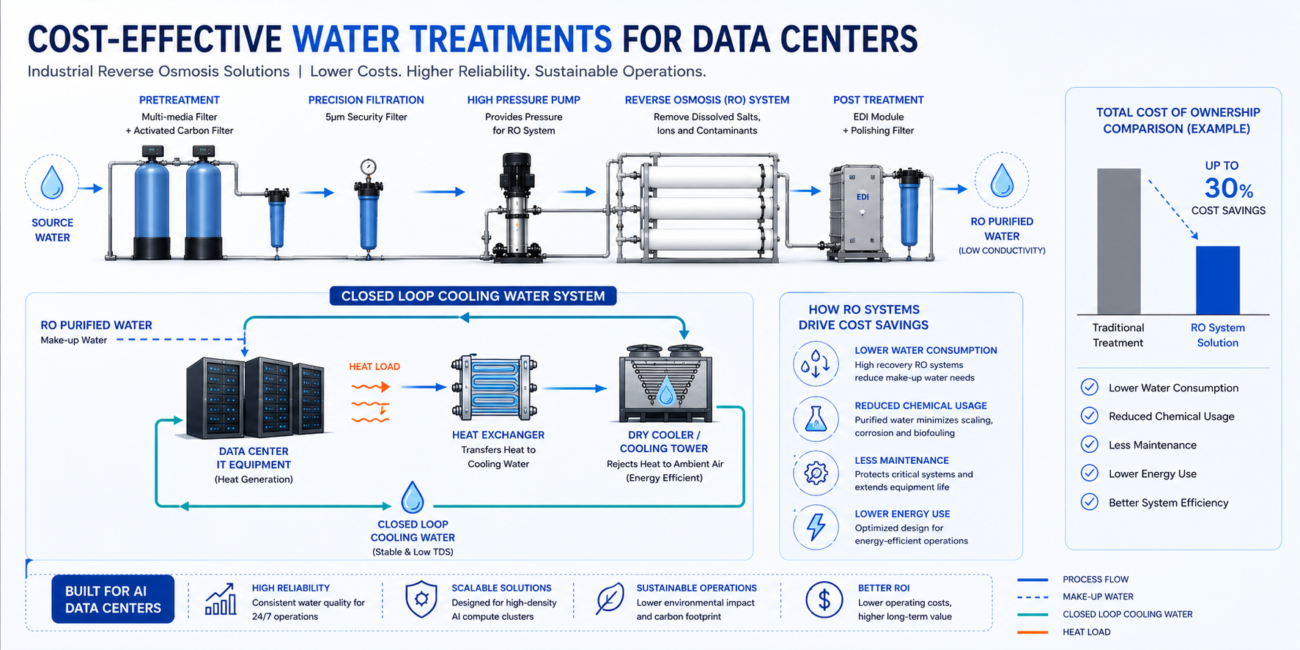
Implementing cost effective water treatments for data centers requires balancing baseline Water Usage Effectiveness (WUE) against ongoing chemical and utility expenses. YourWaterGood delivers high-efficiency commercial and modular 5-stage industrial Reverse Osmosis (RO) systems engineered to trim influent water conductivity. By dropping baseline Total Dissolved Solids (TDS) and mineral content before water reaches the basin, our purification equipment allows facilities supporting high-density AI computing clusters to double their Cycles of Concentration (CoC). This optimization directly reduces freshwater makeup demands by up to 40% and minimizes expensive wastewater blowdown volume.
Fast Check Product:https://yourwatergood.com/product/industrial-reverse-osmosis-system/
The most cost-effective approach is trimming makeup water conductivity using an industrial reverse osmosis (RO) system combined with multi-stage pre-filtration. Suppliers like YourWaterGood provide scalable 5-stage industrial RO plants that remove dissolved calcium, magnesium, and silica from incoming potable or reclaimed greywater. This advanced source treatment allows data center cooling towers to maximize their Cycles of Concentration (CoC), drastically cutting down on freshwater makeup expenses and wastewater disposal fees.
AI data centers running high-density chips use liquid cooling loops with sub-100 micron fluid channels that are highly vulnerable to particulate clogging. Utilizing standardized, high-density PP cotton pre-filtration and carbon block arrays from an experienced supplier like YourWaterGood provides an affordable, heavy-duty barrier against physical contaminants. Standardizing these consumable elements reduces reliance on specialized custom components, simplifies preventative maintenance routines, and extends the operational life of expensive Coolant Distribution Units (CDUs) and copper cold plates.
Purchase Price Is the Smallest Number: What Actually Drives Water-Plant TCO
The most expensive mistake in cost effective water treatments for data centers is comparing vendors on skid price. Over the asset life, the purchase price is a rounding error against the recurring stack behind it.
The real TCO of a data center water plant breaks into layers, roughly in order of magnitude:
- Downtime risk (largest by far) — unplanned outage in a mission-critical hall is measured in dollars per minute, and a single water-induced event can exceed the entire water-plant CAPEX many times over.
- Recurring OPEX — cleaning and CIP cycles, RO membrane and cooling-tower fill replacement, chemical consumption, water and sewer fees, and the energy penalty of fouled heat-transfer surfaces.
- Capital asset erosion — shortened service life of high-value cold plates, CDUs, and high-pressure pumps when water quality is not held.
- CAPEX (smallest) — the one-time skid, membranes, and instrumentation.
The decision discipline: a vendor comparison that stops at CAPEX is optimizing the smallest variable. Cost-effectiveness lives in the recurring layers, where a well-engineered system pays back every month for a decade.
The False Economy: Where Under-Specifying Quietly Raises Total Cost
An under-specified water treatment system always looks cheaper on the quote. The cost it avoids at purchase reappears, larger, in the OPEX and risk layers — usually within the first two to three years.
Where the false economy shows up:
- Skipping pretreatment (softening, antiscalant, adequate filtration) saves CAPEX, then drives faster scaling and fouling — more frequent cleaning, higher chemical use, and shorter membrane life.
- Under-sizing filtration precision lets particulate reach cold-plate microchannels under 100 µm, converting a filter-element saving into a cold-plate replacement.
- Manual instead of automated control saves on instrumentation, then costs in labor and in the excursions a human cannot catch in time.
- Low-CoC operation (the result of weak treatment) forces high blowdown, doubling water and sewer cost for the life of the plant.
The pattern is consistent: the saving is one-time and visible; the cost is recurring and hidden. A system chosen on purchase price alone transfers cost from the CAPEX column nobody scrutinizes later into the OPEX columns that compound for years.
Where Cost-Effectiveness Is Actually Engineered
Genuine cost-effectiveness is not found by buying less equipment. It is engineered into the system through the levers that lower recurring cost across the asset life.
The OPEX levers that move TCO:
- Maximized CoC — proper pretreatment lets cooling towers run higher Cycles of Concentration, cutting makeup water purchased and blowdown discharged. This is typically the single largest recurring saving, reducing freshwater demand by a meaningful share.
- Chemical-free EDI — continuous electrodeionization regenerates electrically, eliminating the acid and caustic that conventional mixed-bed systems consume, store, and dispose of.
- Clean heat-transfer surfaces — scale-free cold plates and exchangers reject heat efficiently, holding pump and chiller energy down and protecting PUE. A thin scale layer is a continuous energy tax.
- Automated control — closed-loop dosing and blowdown reduce labor and chemical waste while preventing the excursions that trigger emergency intervention.
- Standardized consumables — common PP and carbon elements simplify maintenance and avoid proprietary-cartridge premiums.
Each lever lowers a recurring cost while protecting the assets downstream. Cost-effectiveness is the sum of these engineered savings, not the absence of equipment.
Municipal vs Reclaimed Feed: How Source Water Changes the Cost Equation
The cost-effective treatment choice shifts with the source water, because municipal and reclaimed feeds move cost between the water-purchase column and the treatment column.
Municipal potable feed:
- Higher water-purchase cost, but a lighter, lower-cost treatment train.
- The controlling spend is activated carbon for chlorine/chloramine and chloride control to prevent pitting corrosion on 316L.
Reclaimed and recycled feed — increasingly mandated for WUE targets in Ashburn, VA and Phoenix, AZ:
- Much lower water-purchase cost, but a heavier, higher-cost treatment train.
- Requires multimedia filtration, skid-mounted softening, and antiscalant dosing, because silica above ~150 ppm polymerizes into a glassy scale no acid wash removes once set.
- Assumes faster fouling and shorter cleaning intervals in the OPEX projection.
The cost-effective answer is rarely “pick the cheaper water.” It is matching the treatment investment to the source so the combined water-plus-treatment cost is lowest over the asset life. Source water sets the cost structure before any skid is priced.
Standard Skids vs Data-Center-Grade Systems: The TCO Comparison
A commercial skid wins on purchase price and loses on everything that recurs. A data-center-grade system costs more at CAPEX and wins on TCO across the asset life.
| Engineering Parameter | Standard Pre-Engineered Skids | Data Center Grade High-Redundancy Systems |
|---|---|---|
| Purchase price (CAPEX) | Lower | Higher (recovered in OPEX) |
| Recurring OPEX | High (frequent cleaning, chemicals) | Low (high CoC, EDI, automation) |
| Flow capacity (GPM) | 10–50 GPM | 100–1,000+ GPM, parallel trains |
| Redundancy | Single train (downtime risk) | N+1 / N+2 / 2N (downtime avoided) |
| Filtration / purity | 10–20 µm nominal | Absolute guard + RO to 0.0001 µm, EDI to 18.2 MΩ·cm |
| Asset protection | Minimal | Extends cold-plate, CDU, and pump life |
| BMS integration | Analog (4–20 mA) | Modbus TCP / BACnet IP / SNMP |
| Lead time & support | Stock unit, generic spares | Engineered build, documented P&ID, standardized spares |
The redundancy row alone often justifies the CAPEX difference: a single avoided downtime event can exceed the price gap between the two systems. The cheaper skid carries the more expensive risk.
To pressure-test a vendor, ask them to quantify the OPEX, not just the CAPEX. A supplier who can only discuss purchase price has not engineered for cost-effectiveness.
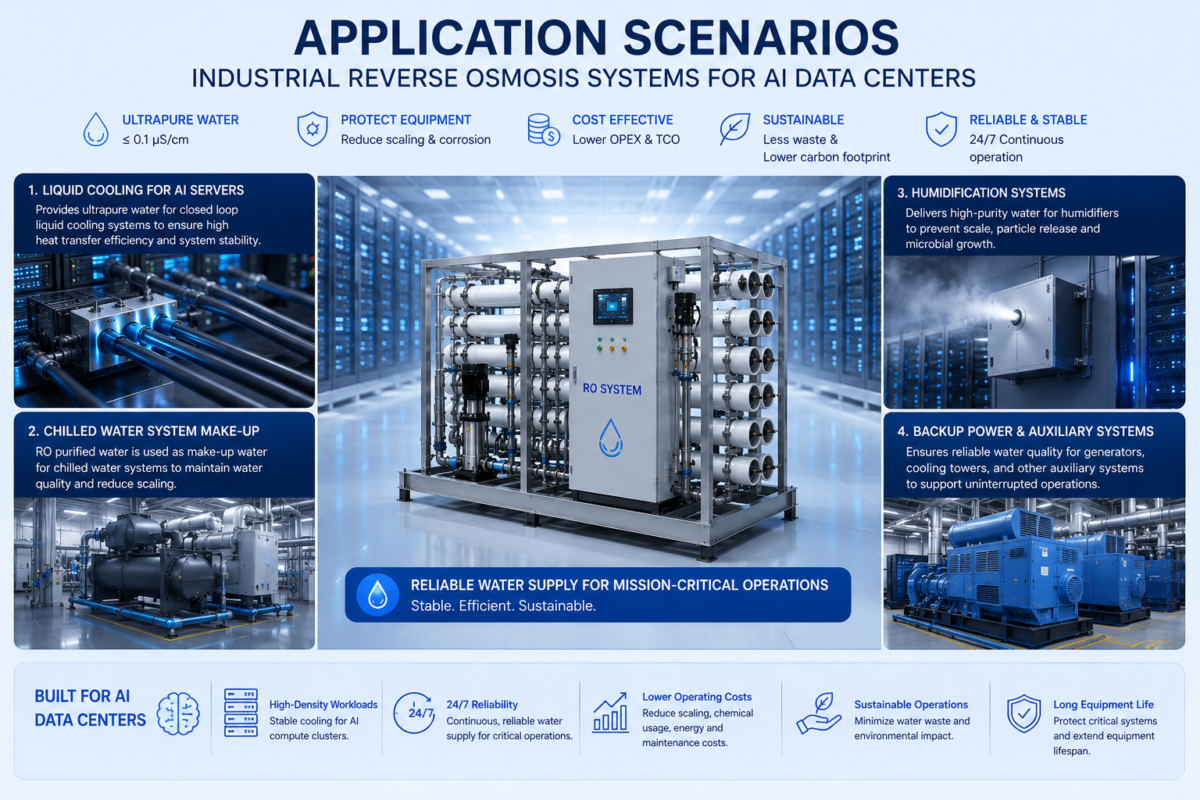
Field Engineering Insight: The Blowdown You Pay For Twice
Here is a cost reality that catches teams budgeting water treatment: cooling-tower blowdown is water you pay for twice — once to buy it, and again to discharge it.
Makeup water is metered and billed on the way in. The same water, blown down to control Cycles of Concentration, is then billed again on the way out — many municipal authorities apply a sewer surcharge based on both discharge volume and discharge strength (TDS or conductivity).
A facility running low CoC because of weak treatment blows down more often, and that high-volume, high-TDS discharge gets hit on both billing metrics. The “savings” from a cheaper treatment system reappears as a doubled water bill for the life of the plant.
The cost-effective lever is to lift CoC safely with proper pretreatment:
- Reduce blowdown volume by running the highest safe CoC, cutting both the intake meter and the discharge surcharge.
- Lower discharge TDS where the surcharge is strength-based, by managing concentration rather than diluting through blowdown.
- Recover where economical — in water-stressed or high-surcharge markets, treating and reusing blowdown can turn a recurring cost into avoided spend.
This is the kind of detail that never appears on a flow-rated quote but decides the largest recurring line in a water plant’s TCO. It is also where good treatment compounds: higher CoC lowers water and sewer OPEX, while clean surfaces protect PUE, extend cold-plate and CDU life, and hold 99.999% uptime — the savings that make a system genuinely cost-effective.
Cost Effective Water Treatments for Data Centers FAQs
What makes a data center water treatment system cost-effective? The lowest total cost of ownership over a 10–15 year life — not the lowest purchase price. Downtime risk and recurring OPEX dwarf the one-time CAPEX, so cost-effectiveness is judged on the whole stack.
What are the largest costs in water-plant TCO? In order: downtime risk, then recurring OPEX (cleaning, membrane and fill replacement, chemicals, water and sewer fees, energy), then capital asset erosion, and finally the CAPEX of the skid itself.
How does higher Cycles of Concentration reduce cost? Running the highest safe CoC cuts both the makeup water purchased and the blowdown discharged, lowering water and sewer fees at the same time — typically the single largest recurring saving.
Why is the cheapest skid often the most expensive choice? Under-specified systems foul faster, driving more cleaning, shorter membrane and fill life, and higher downtime risk. The one-time saving reappears as compounding OPEX and risk, raising TCO.
Does EDI reduce operating cost? Yes. Continuous electrodeionization regenerates electrically, eliminating the acid and caustic that mixed-bed systems must purchase, store, handle, and dispose of — removing a recurring chemical and labor cost.
How does water treatment affect PUE and energy cost? Clean heat-transfer surfaces reject heat efficiently. A thin scale or biofilm layer raises pump and chiller energy continuously, degrading PUE — making fouling a permanent energy tax until removed.
Does reclaimed water lower or raise treatment cost? It lowers water-purchase cost but raises treatment CAPEX and OPEX through heavier softening, antiscalant, and faster fouling. The cost-effective choice balances both columns over the asset life, consistent with ASHRAE TC 9.9 and EPA frameworks.
Engineer the Lowest Total Cost, Not the Lowest Quote
Cost-effective water treatment for a data center is a TCO decision. The facilities that spend the least over a decade are the ones that invested correctly at CAPEX — high CoC, chemical-free polishing, automation, and redundancy — not the ones that bought the cheapest skid and paid for it monthly.
Whether you are equipping a single high-density server room or sourcing trains into a larger buildout, YourWaterGood manufactures and ships the equipment factory-direct — cost effective water treatments for data centers built on industrial RO, EDI, skid-mounted softening, and automated dosing, engineered to lower your recurring cost.
- Get an Infrastructure Engineering Quote: itemized pricing on 1 t/h–10 t/h systems with the OPEX trade-offs modeled, not just a CAPEX number.
- Request Technical Data Sheets: consumption rates, recovery, and lifecycle specs for your TCO analysis.
- Secure B2B Wholesale / Factory-Direct Pricing: source equipment straight from our manufacturing facility to lower delivered cost.