
Closed Loop Cooling Water Treatment Data Center: Why Corrosion, Not Scale, Threatens Sealed Loops

A closed loop has no evaporation, so it cannot concentrate minerals or scale the way a cooling tower does. Operators read that as “needs little treatment” — which is exactly why sealed loops fail, just by a different mechanism: corrosion.
The threat profile inverts when a loop closes. The open-tower enemies — concentration, scaling, and airborne fouling — give way to galvanic corrosion, dissolved oxygen, microbiologically influenced corrosion (MIC), and inhibitor depletion, all of which operate quietly inside a system assumed to be inert.
Specifying closed loop cooling water treatment data center programs correctly means engineering for corrosion control and chemistry stability, not the scaling math that governs an open tower.
A closed loop has no evaporation, so it cannot concentrate minerals or scale the way a cooling tower does. Operators read that as “needs little treatment” — which is exactly why sealed loops fail, just by a different mechanism: corrosion.
The threat profile inverts when a loop closes. The open-tower enemies — concentration, scaling, and airborne fouling — give way to galvanic corrosion, dissolved oxygen, microbiologically influenced corrosion (MIC), and inhibitor depletion, all of which operate quietly inside a system assumed to be inert.
Specifying closed loop cooling water treatment data center programs correctly means engineering for corrosion control and chemistry stability, not the scaling math that governs an open tower.
Fast Check Product:https://yourwatergood.com/product/industrial-reverse-osmosis-system/
Closed Does Not Mean Inert: Why Sealed Loops Fail by Corrosion
The defining error in closed loop cooling water treatment data center design is assuming that a sealed, non-evaporative loop is chemically stable. It is not — it simply fails by corrosion instead of scaling.
A closed technology loop carries a demanding combination:
- Mixed metallurgy — copper cold plates, stainless manifolds, aluminum components, and brazed-plate exchangers share one fluid, setting up galvanic couples that drive corrosion at the junctions.
- Tight geometries — corrosion product (metal oxide particulate) sloughs into the loop and migrates to cold-plate microchannels under 100 µm, where it lodges and stalls flow.
- High-value assets — the components corroding are the cold plates, CDUs, and high-pressure pumps, not a replaceable tower fill.
The consequence of under-treatment is not a gradual efficiency loss. It is under-deposit corrosion perforating a cold plate or a coolant distribution component, and in a direct liquid cooling loop, a leak millimeters from energized silicon is a short-circuit risk, not just a water-loss event.
The discipline: treat a closed loop as a corrosion-control problem from the first fill, because the assets it touches are the most expensive in the facility.
Mixed Metallurgy and the Inhibitor Program: Protecting Copper, Steel, and Aluminum Together
A closed loop’s corrosion inhibitor is not a generic additive — it has to protect every metal in the loop simultaneously, and the wrong program can protect one metal while attacking another.
A defensible inhibitor strategy for a mixed-metallurgy data center loop:
- Ferrous metals (steel) — protected by nitrite or molybdate, dosed to a maintained residual and verified by testing, not assumed.
- Copper and yellow metals (cold plates) — protected by azoles such as tolyltriazole, which form a molecular film on the copper surface.
- Aluminum — sensitive to pH extremes; the program must hold pH in a band (commonly 8.0–10.0) that protects steel without attacking aluminum.
Inhibitor chemistry only works while the residual is maintained:
- Residual depletes as it is consumed protecting metal and as makeup dilutes it.
- Automated dosing paced to loop chemistry holds the residual in band, where manual top-ups drift.
- Glycol complicates it — in glycol-charged loops, thermal degradation produces organic acids that drop pH and consume inhibitor, so pH, reserve alkalinity, and inhibitor residual must be trended together, not just glycol percentage.
A loop dosed once at commissioning and never verified is unprotected within months. Inhibitor is a maintained program, not a fill-day checkbox.
Dissolved Oxygen and MIC: The Two Threats That Survive in a “Sealed” Loop
Two corrosion drivers persist in closed loops precisely because operators assume they cannot — dissolved oxygen and microbiological activity.
Dissolved oxygen is the primary corrosion accelerant for steel. A loop that is truly oxygen-free corrodes slowly; one with continuous oxygen ingress corrodes indefinitely. The ingress paths are non-obvious and are the subject of the field insight below.
Microbiologically influenced corrosion (MIC) thrives in the conditions a closed loop provides:
- Low-flow and dead-leg zones let bacteria colonize and deposits settle.
- Anaerobic species such as sulfate-reducing bacteria (SRB) generate corrosive byproducts under deposits, pitting stainless and steel from within.
- Glycol can act as a nutrient source, feeding biological growth if biocide control lapses.
Controlling both requires active treatment, not a sealed assumption:
- Minimize oxygen ingress through tubing, tank, and makeup specification.
- Maintain biocide and monitor microbiological activity even without evaporation.
- Eliminate dead-legs in design, and flush low-flow branches where they are unavoidable.
A “sealed” loop with stagnant legs and oxygen ingress is a corrosion reactor that happens to also reject heat. Closed-loop treatment is what keeps it from becoming one.
Fill and Makeup Water: Why the Small Volume Still Decides Loop Life
The volume of water a closed loop consumes is small — which leads teams to ignore its quality. That is a mistake, because every gallon of fill and makeup sets the loop’s starting chemistry and reintroduces contaminants.
Initial fill should be high-purity:
- RO or DI water with low TDS, low chloride, and low sulfate — raw municipal water seeds a loop with hardness, chlorides, and oxygen that immediately load the inhibitor.
- For direct-to-chip loops, fill conductivity is driven toward ≤ 10 µS/cm to protect copper and limit galvanic activity.
Makeup water quality depends on the source, and the pre-treatment differs accordingly:
- Municipal makeup needs activated carbon for chlorine/chloramine and chloride control to prevent pitting on 316L.
- Reclaimed or recycled makeup needs multimedia filtration, softening, and antiscalant ahead of RO, because higher TDS, silica above ~150 ppm, and organics otherwise enter the loop.
Even a small, intermittent makeup stream reintroduces dissolved oxygen and hardness on every top-up. High-purity fill and makeup is cheap insurance against a loop-wide corrosion event.
Standard Skids vs Data-Center-Grade Closed-Loop Systems
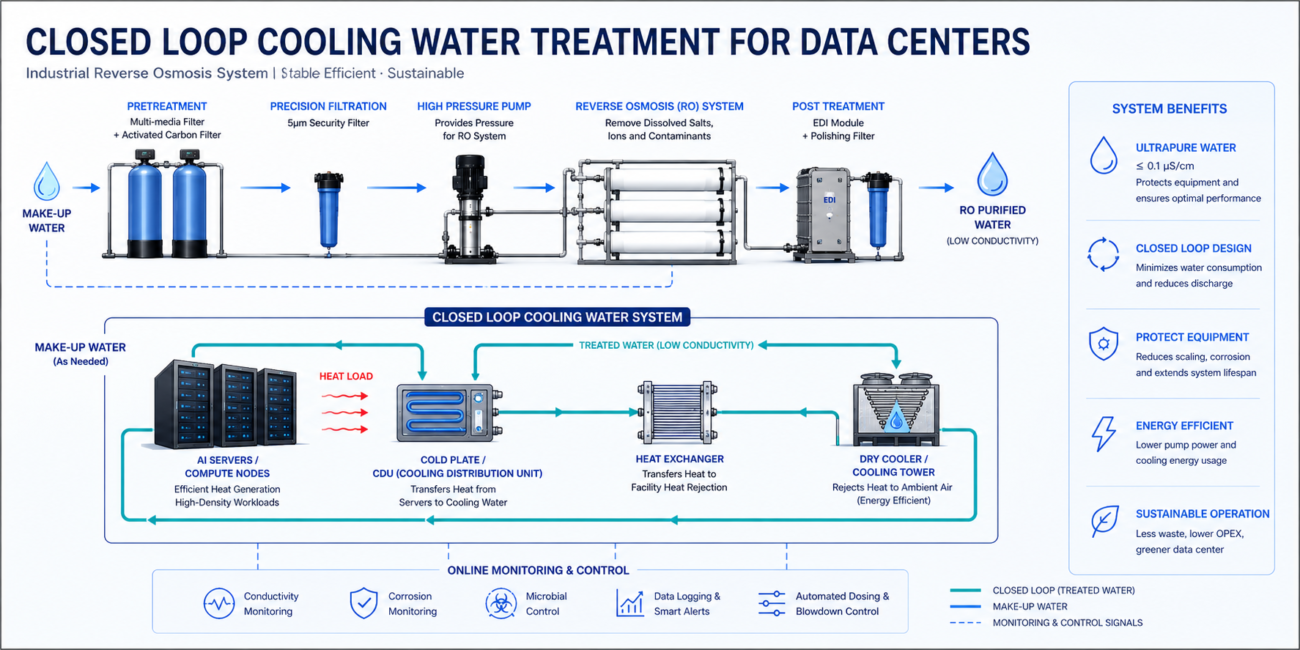
A commercial make-up skid delivers water and stops there. A data-center-grade closed-loop system delivers high-purity fill, maintains the inhibitor program, and monitors the loop continuously to run 24/7/365.
| Engineering Parameter | Standard Pre-Engineered Skids | Data Center Grade High-Redundancy Systems |
|---|---|---|
| Fill / makeup purity | Raw or softened water | RO/DI, low chloride and sulfate |
| Corrosion control | None or manual dose | Automated inhibitor program with maintained residual |
| Flow capacity (GPM) | 10–50 GPM | 100–1,000+ GPM, parallel trains |
| Redundancy | Single train | N+1 / N+2 / 2N parallel architecture |
| Filtration / purity | 10–20 µm nominal | Absolute guard + RO to 0.0001 µm, DI polishing |
| Monitoring | Manual sampling | Online conductivity, pH, inhibitor residual to BMS |
| BMS integration | Analog (4–20 mA) | Modbus TCP / BACnet IP / SNMP |
| Lead time & support | Stock unit, generic spares | Engineered build, documented P&ID, standardized spares |
The corrosion-control row is what separates the two: a loop with a maintained inhibitor program and oxygen control protects cold plates and CDUs for years, while an untreated loop perforates them. The cheaper skid leaves the most expensive assets unprotected.
To pressure-test a vendor, ask how their system maintains and verifies inhibitor residual over time. A supplier who only quotes a fill skid has not engineered for closed-loop corrosion.
Field Engineering Insight: The Oxygen That Gets Into a “Closed” Loop
Here is the detail that explains why sealed loops corrode despite a fill-day inhibitor dose: a “closed” loop is rarely oxygen-tight, and the ingress paths are ones operators never inspect.
Dissolved oxygen enters continuously through several routes:
- Oxygen-permeable elastomer hoses — common EPDM and rubber flexible connections are permeable to oxygen, which diffuses through the hose wall into the fluid even with no leak.
- Open or under-specified expansion tanks — a plain compression tank with a water surface exposed to an air cushion continuously absorbs oxygen; only a sealed bladder or diaphragm tank prevents it.
- Auto air vents and pump seals — points designed to release air can also admit it under the wrong pressure conditions.
The result is a loop that the operator believes is oxygen-free, steadily consuming its inhibitor and pitting steel — and the corrosion gets blamed on “bad fill water” when the real source is atmospheric oxygen diffusing through the rubber and the tank.
The engineering fixes are specification choices, not a bigger skid:
- Specify barrier-grade, oxygen-diffusion-resistant tubing for flexible connections, not bare EPDM.
- Use sealed bladder or diaphragm expansion tanks, never open or plain-steel compression tanks on a treated loop.
- Monitor dissolved oxygen and maintain an oxygen scavenger or film-forming inhibitor residual to neutralize the ingress that remains.
This is the kind of detail that never appears on a flow-rated quote but decides whether a closed loop holds for a decade. It is also where treatment compounds: controlling oxygen and inhibitor lowers cleaning and refill OPEX, prevents corrosion-product fouling of cold-plate microchannels, protects high-pressure pumps and CDUs, and holds 99.999% uptime.
Closed Loop Cooling Water Treatment Data Center FAQs
Does a closed loop cooling water system need treatment? Yes. No evaporation means no scaling, but corrosion, MIC, and dissolved-oxygen attack still degrade the loop. It needs a maintained corrosion inhibitor, high-purity fill, and continuous monitoring.
What is the main threat to a closed data center cooling loop? Corrosion — galvanic corrosion across mixed metallurgy and under-deposit corrosion in low-flow legs — not scale. MIC and oxygen ingress are the accelerants, and the assets at risk are cold plates, CDUs, and pumps.
What water should fill a closed cooling loop? High-purity RO or DI water with low TDS, chloride, and sulfate, charged with a corrosion inhibitor. Direct-to-chip loops are driven toward ≤ 10 µS/cm to protect copper and limit galvanic activity.
How does oxygen get into a “sealed” loop? Through oxygen-permeable EPDM and rubber hoses, open or under-specified expansion tanks, auto air vents, and pump seals. Control it with barrier-grade tubing, sealed bladder tanks, and dissolved-oxygen monitoring.
Which corrosion inhibitors are used in closed loops? Nitrite or molybdate for steel and azoles (such as tolyltriazole) for copper and yellow metals, with pH held in a band (commonly 8.0–10.0) and the residual maintained by automated dosing and verified by testing.
Does glycol need monitoring in a closed loop? Yes. Glycol thermally degrades into organic acids that drop pH and consume inhibitor. Monitor pH, reserve alkalinity, glycol percentage, and inhibitor residual together, not glycol concentration alone.
Is makeup water important if the loop is sealed? Yes. Even small, intermittent makeup reintroduces oxygen and hardness on every top-up. Use high-purity makeup and minimize ingress, consistent with ASHRAE TC 9.9 and EPA frameworks.
Engineer the Loop Chemistry, Not Just the Fill
Closed loop cooling water treatment for a data center is a corrosion-control discipline. The loops that protect their cold plates for a decade are the ones built on high-purity fill, a maintained inhibitor program, and oxygen control — not the ones filled once and assumed inert.
Whether you are commissioning a single high-density server room or sourcing trains into a larger buildout, YourWaterGood manufactures and ships the equipment factory-direct — closed loop cooling water treatment data center packages built on industrial RO and DI for high-purity fill, skid-mounted polishing, automated inhibitor dosing, and BMS-ready monitoring.
- Get an Infrastructure Engineering Quote: itemized pricing on 1 t/h–10 t/h fill and polishing systems with the inhibitor and monitoring program defined.
- Request Technical Data Sheets: purity specs, inhibitor compatibility, and BMS integration detail for your engineering review.
- Secure B2B Wholesale / Factory-Direct Pricing: source equipment straight from our manufacturing facility.