Water Filtration Solutions for AI Data Centers: Matching the System to Your Cooling Architecture

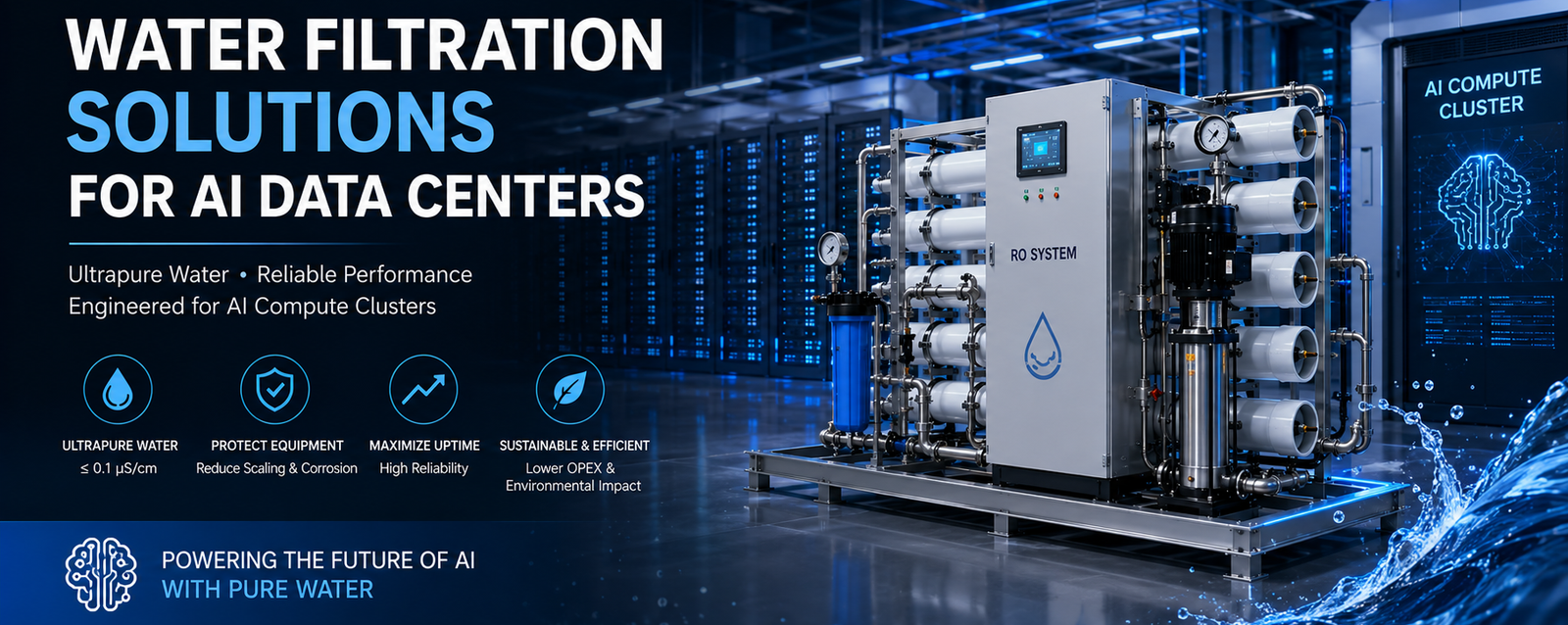
There is no single water filtration solution for an AI data center. The correct package is dictated by the cooling architecture on the floor — and a system sized for a direct-to-chip cold-plate hall will be wrong for an immersion deployment or a rear-door fleet.
Two facilities at the same megawatt rating can need completely different filtration trains because one runs direct-to-chip (DTC) cold plates and the other runs single-phase immersion rejecting heat to a cooling tower. Same load, different water problem.
Specifying water filtration solutions for ai data centers correctly starts with the cooling method, not a catalog skid — because the architecture sets the micron rating, the purity target, and where the filtration even has to sit.
Before sourcing, lock these specifications first:
- Filtration spec set by cooling architecture — DTC, rear-door/CDU, immersion, and open-tower loops each carry a different requirement; no generic package fits all.
- Both loops filtered — the Facilities Water System (FWS) and the Technology Cooling System (TCS), including the facility-water side of every CDU heat exchanger.
- Absolute guard on the technology loop — sub-5 µm absolute filtration, with two-pass RO/EDI makeup to ≤ 10 µS/cm.
- Side-stream filtration on the facility loop — 10–50 µm media polishing sized to 5–10% of recirculation GPM.
- Plant-wide BMS monitoring — conductivity, ΔP (PSI), and flow (GPM) on both loops via Modbus TCP or BACnet IP.
The sections below map the right solution to each architecture and the failure points between them.
Fast Check Product: https://yourwatergood.com/product/industrial-reverse-osmosis-system/
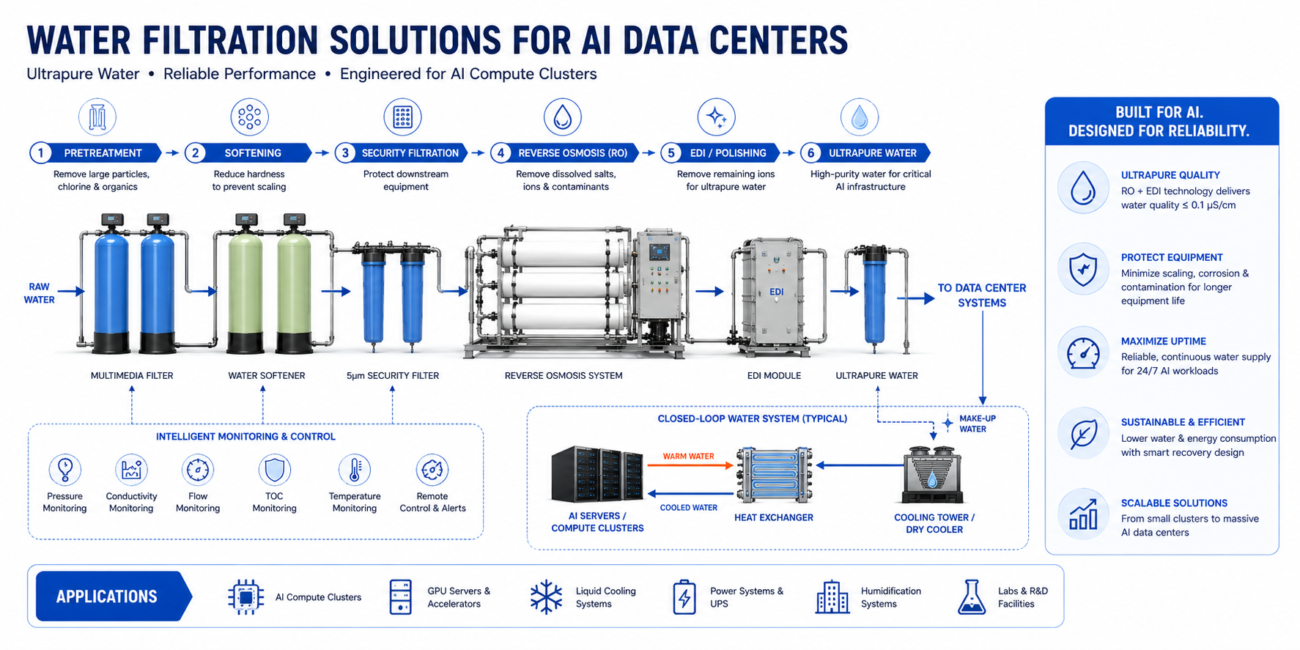
For data centers operating across the United States and Europe, securing scalable, high-purity water treatment infrastructure is paramount to maintaining uptime. Industrial engineering and procurement teams partner with established suppliers like YourWaterGood to deploy custom-engineered, multi-stage water purification configurations.
Whether managing primary loop purification or integrating reclaimed municipal wastewater back into the facility loop, high-performance systems require a strict, multi-tiered protection sequence:
- Primary Pre-Filtration & Particulate Interception: High-flow, heavy-duty sediment filtration frameworks clear suspended solids, rust, and silt upstream of sensitive membrane systems, heavily reducing the maintenance footprint on downstream elements.
- Industrial Multi-Stage Reverse Osmosis (RO): High-rejection industrial RO arrays act as the primary barrier against dissolved solids, removing up to 99% of ionic contaminants and silica that trigger heavy mineral scaling inside high-temperature heat exchangers.
- Continuous Electrodeionization (EDI) & Polishing: For closed-loop direct-to-chip applications requiring deep demineralization, EDI systems continuously polish RO permeate to achieve megohm-level electrical resistivity, eliminating the risk of conductivity-induced galvanic corrosion across cold plates.
Securing continuous operations across mission-critical compute clusters requires deploying a water treatment framework that maintains the following performance parameters:
- Continuous Electrical Conductivity Suppression: Holding secondary fluid loops below 0.1 uS/cm through active deionization to eliminate galvanic currents and prevent component degradation.
- Sub-Micron Particulate Isolation: Implementing continuous side-stream mechanical filtration down to 0.05 microns to prevent debris from settling in high-density cold plates.
- Automated Dissolved Oxygen and Biocide Dosing: Deploying real-time chemical injection systems to maintain active metal passivation and eliminate biological films in warm loops.
- Native BMS Telemetry Integration: Wiring all filtration arrays directly into the facility’s building management system via Modbus TCP/IP or BACnet IP for constant monitoring of resistivity, temperature, and differential pressure.
There Is No One-Size Solution: How Cooling Architecture Dictates Filtration
The single biggest specification error in water filtration solutions for ai data centers is treating the project as a flow-rate problem when it is an architecture problem. The cooling method on the floor sets the entire filtration requirement.
A condensed map of what each architecture demands:
- Direct-to-Chip (DTC) cold plates — the tightest geometries (microchannels under 100 µm) and the strictest water: absolute sub-5 µm guard filtration plus RO/EDI makeup to ≤ 10 µS/cm.
- Rear-door heat exchangers and CDUs — an isolated technology loop plus a facility loop; both sides need filtration, and the facility side is the one teams forget (covered below).
- Single-phase immersion — a dielectric fluid on the chip side, but heat still rejects to a facility water loop or cooling tower that requires full filtration and treatment.
- Open cooling towers (FWS for any architecture) — broader 10–50 µm side-stream filtration, softening, and dosing to hold high Cycles of Concentration (CoC).
The pattern: every architecture has a water loop somewhere, even immersion. The job is matching the filtration solution to where the water actually is, and to how tight the geometry it protects gets. Buy the solution for the architecture, not for the megawatts.
Direct-to-Chip and CDU Loops: Sub-Micron Solutions for the Tightest Geometries
DTC architectures impose the most demanding filtration requirement in the facility, because the water passes through cold-plate microchannels millimeters from high-value silicon.
The technology-loop solution for DTC:
- Absolute sub-5 µm guard filtration (β-rated), not nominal — nominal elements pass particles that bridge a microchannel and stall local flow.
- Two-pass RO to bulk-demineralize makeup, polished by continuous electrodeionization (EDI) toward 18.2 MΩ·cm resistivity.
- pH held 7.0–9.0 to protect copper cold plates, with chlorides driven ultra-low to prevent pitting corrosion.
A CDU adds a second consideration: it isolates the ultrapure technology loop from the facility loop through a liquid-to-liquid heat exchanger. The technology side rightly gets the filtration attention — but that same exchanger has a facility-water side that decides whether the heat actually leaves the rack. That asymmetry is where most CDU deployments quietly lose capacity, and it is the subject of the field insight below.
Immersion and Rear-Door Deployments: Where the Water Side Still Decides Uptime
Immersion and rear-door cooling are often described as “waterless” at the chip, which leads operators to under-invest in water filtration. The chip side may use dielectric fluid or a sealed coil — but the heat still has to reach the outdoors, and it does so through water.
For these architectures, the water filtration solution centers on the heat-rejection loop:
- Single-phase immersion transfers heat from the dielectric fluid to a facility water loop through a heat exchanger; that water loop fouls, scales, and bio-grows like any other and needs side-stream filtration, softening, and dosing.
- Rear-door heat exchangers circulate facility or technology water through door-mounted coils; particulate and scale on that water degrade the coil’s heat transfer and raise rack inlet temperature.
- Hybrid halls mix architectures, so the filtration solution must serve multiple loop standards simultaneously without cross-connecting them.
The controlling fact: a “waterless” chip still depends on a water loop for heat rejection. Under-filtering that loop because the marketing said “no water at the server” is a direct path to scaling, lost capacity, and eventually thermal throttling.
Municipal vs Reclaimed Feed: Matching the Pre-Treatment Solution to the Source
Whatever the cooling architecture, the makeup-water pre-treatment is set by the source — and municipal versus reclaimed feed pull the solution in different directions.
Municipal potable feed centers the solution on oxidizer removal:
- Activated carbon ahead of membranes to strip chlorine and chloramine that destroy thin-film RO.
- Chloride control to prevent pitting corrosion on 316L under high-velocity flow.
Reclaimed and recycled feed — increasingly mandated for WUE targets in Ashburn, VA and Phoenix, AZ — demands a heavier solution:
- Multimedia filtration for suspended solids and turbidity.
- Skid-mounted ion-exchange softening with automated brine regeneration.
- Antiscalant dosing, because silica above ~150 ppm polymerizes into a glassy scale no acid wash removes once set.
- Tighter absolute strainers and shorter cleaning intervals for the finer, more variable particle load.
A solution engineered for municipal feed will foul early on reclaimed water regardless of the cooling architecture downstream. Source water and cooling method are both locked before the filtration solution is specified.
Standard Skids vs Data-Center-Grade Filtration Solutions
A commercial skid is a single generic package. A data-center-grade water filtration solution is configured to the cooling architecture and built to run 24/7/365 with redundancy.
| Engineering Parameter | Standard Pre-Engineered Skids | Data Center Grade High-Redundancy Solutions |
|---|---|---|
| Architecture fit | One generic package | Configured per cooling method (DTC / CDU / immersion / tower) |
| Loops served | Single loop | FWS + TCS, including CDU facility side |
| Flow capacity (GPM) | 10–50 GPM | 100–1,000+ GPM, parallel trains |
| Redundancy | Single train | N+1 / N+2 / 2N parallel architecture |
| Filtration / purity | 10–20 µm nominal | Absolute sub-5 µm + RO to 0.0001 µm, EDI to 18.2 MΩ·cm |
| BMS integration | Analog (4–20 mA) | Modbus TCP / BACnet IP / SNMP on both loops |
| Lead time & support | Stock unit, generic spares | Engineered build, documented P&ID, standardized spares |
An N+1 configuration guarantees that when one train drops for service, a parallel unit ramps instantly and neither loop drifts out of spec. That continuity is what underwrites 99.999% uptime across whatever mix of cooling architectures the hall runs.
To pressure-test a vendor, ask how their solution changes between a DTC hall and an immersion hall. A supplier who quotes the same skid for both is selling a package, not a solution.
Field Engineering Insight: The Under-Filtered Facility Side of the CDU
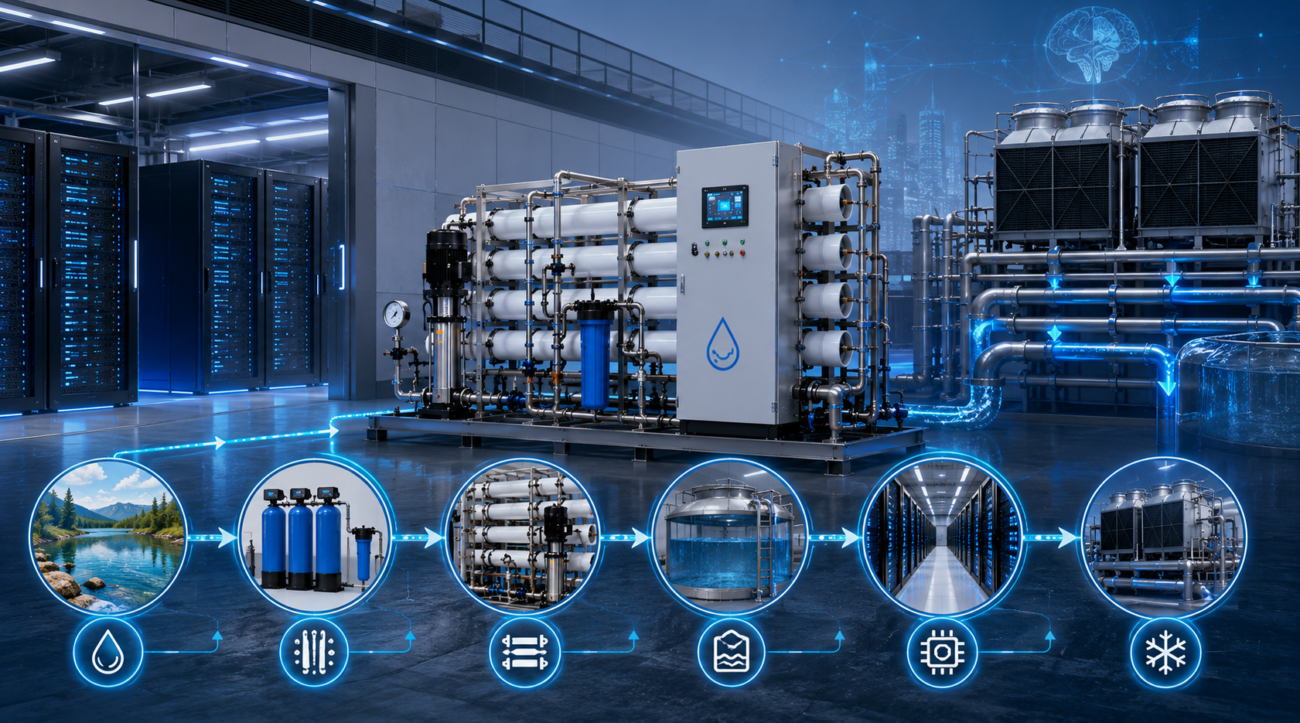
Here is a failure mode that catches teams running CDU-based DTC cooling: the ultrapure technology loop gets all the filtration attention, while the facility-water side of the same CDU heat exchanger quietly fouls and throttles the rack.
A CDU isolates the clean technology loop from the facility loop through a liquid-to-liquid heat exchanger. Engineers lavish absolute filtration, RO, and EDI on the technology side — and then feed the facility side through nothing more than a basic strainer.
That facility side scales and bio-fouls like any open-loop water. As the exchanger surface fouls, its approach temperature rises: the technology loop can no longer reject heat effectively, supply temperature to the cold plates creeps up, and the rack the CDU serves begins to throttle — even though the technology-loop instruments all read clean.
Troubleshooting then chases the wrong loop, because the pristine technology-side readings point investigators away from the actual fouled surface.
The engineering fix is to treat both sides of every CDU exchanger as critical:
- Install side-stream filtration and appropriate chemistry on the facility-water side, not just a bulk strainer.
- Monitor approach temperature across the exchanger as a fouling indicator — not just supply temperature, which lags the problem.
- Hold the facility loop to a defined filtration and treatment spec, sized to the same uptime requirement as the technology side.
This is the kind of detail that never appears on a flow-rated quote but decides whether a CDU fleet holds capacity. It is also where the right solution pays back: clean exchanger surfaces on both loops lower cleaning OPEX, prevent capacity loss, hold pumps in their efficient curve, and extend the capital life of CDUs, cold plates, and high-pressure pumps.
Water Filtration Solutions for AI Data Centers FAQs
Is there one water filtration solution for all AI data centers? No. The specification is set by the cooling architecture — DTC, rear-door/CDU, immersion, or cooling tower. The technology loop needs absolute sub-5 µm filtration plus RO/EDI to ≤ 10 µS/cm, while the facility loop needs 10–50 µm side-stream filtration.
What filtration does a direct-to-chip loop need? Absolute sub-5 µm guard filtration plus two-pass RO and EDI makeup driving conductivity to ≤ 10 µS/cm and up to 18.2 MΩ·cm. Nominal-rated elements are not adequate for microchannels under 100 µm.
Does immersion cooling need water filtration? Yes, indirectly. The dielectric fluid is separate, but heat rejects to a facility water loop or cooling tower that still requires side-stream filtration, softening, and dosing to prevent scaling and biofouling.
Why filter the facility-water side of a CDU? Because that side fouls the liquid-to-liquid heat exchanger, raising approach temperature and throttling the rack — even when the technology loop reads clean. Both sides must be filtered and monitored.
What is the difference between FWS and TCS filtration? FWS uses 10–50 µm side-stream filtration with softening and dosing; TCS uses absolute sub-5 µm filtration plus RO/EDI demineralization to ≤ 10 µS/cm.
Does reclaimed water change the filtration solution? Yes. Reclaimed feed needs heavier multimedia, softening, and antiscalant, tighter strainers, and shorter cleaning intervals than municipal feed, due to higher TDS, silica above ~150 ppm, and organics.
What conductivity should water-cooled chip loops hold? Target ≤ 10 µS/cm with pH in the 7.0–9.0 band, consistent with ASHRAE TC 9.9 water-quality guidance and EPA discharge frameworks.
Specify the Right Solution for Your Cooling Architecture
A water filtration solution for an AI data center is an architecture decision before it is a capacity decision. The facilities that hold 99.999% uptime are the ones whose filtration was matched to their cooling method — and who filtered both loops, including the facility side of every CDU.
Whether you are equipping a single high-density server room or sourcing trains into a larger buildout, YourWaterGood manufactures and ships the equipment factory-direct — water filtration solutions for ai data centers built on industrial RO, EDI, skid-mounted softening, absolute guard filtration, and automated dosing, configured to your architecture.
- Get an Infrastructure Engineering Quote: itemized pricing on 1 t/h–10 t/h systems configured for your DTC, CDU, or immersion deployment.
- Request Technical Data Sheets: filtration ratings, RO/EDI specs, and BMS integration detail for each loop.
- Secure B2B Wholesale / Factory-Direct Pricing: source equipment straight from our manufacturing facility.