
CDU Water Treatment for Liquid Cooling: Engineering the Fill, Flush, and Makeup Water Package

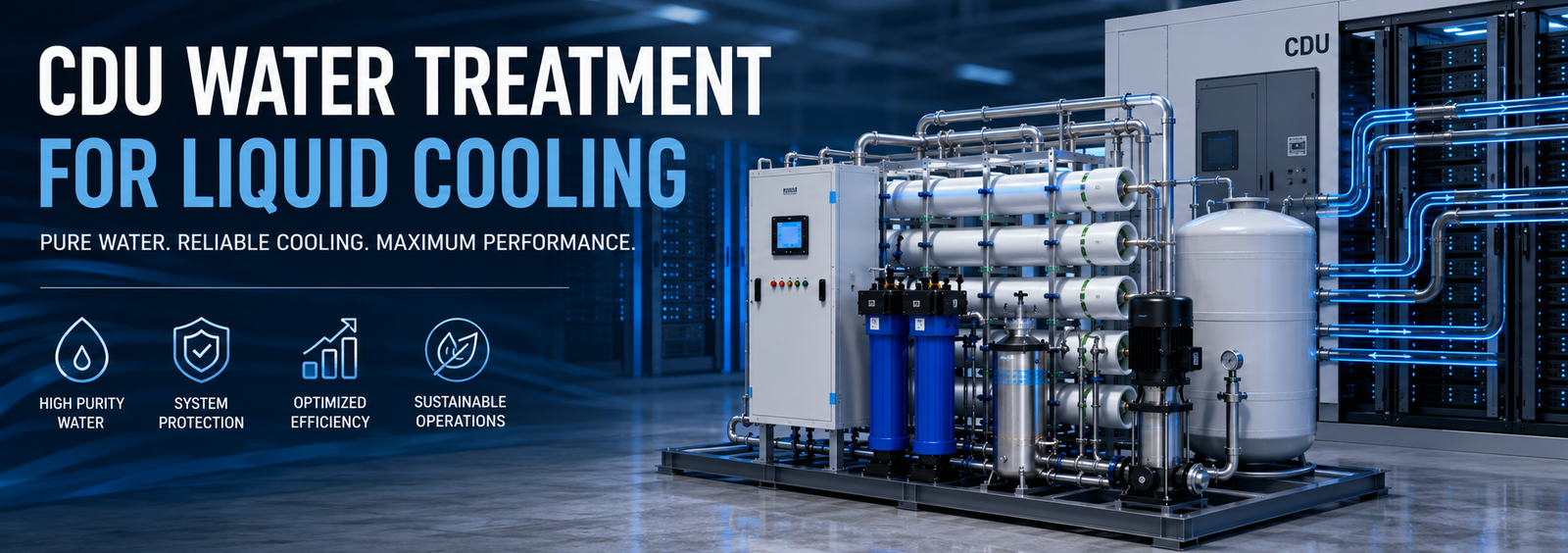
Most CDU water treatment for liquid cooling RFQs stop at a chemistry number — conductivity, resistivity, a TDS target pulled off an ASHRAE TC 9.9 table. The number is real, but it isn’t the engineering problem. Verify these before you sign off on a coolant distribution unit (CDU) support package at yourwatergood.com:
- Fill-water particulate cleanliness rated to an ISO 4406 code, not just a conductivity spec
- A dedicated makeup water train sized for gallons-per-day, not the facility’s full GPM rating
- A documented standby-loop exercise protocol for every idle N+1 or 2N CDU
- Cold-weather fill-volume production time built into the commissioning schedule, not assumed equal to summer
- Passivated 316L wetted surfaces on any skid touching TCS-side polish water
Fast Check Product: https://yourwatergood.com/product/industrial-reverse-osmosis-system/
Why the Chemistry Table Isn’t the Whole CDU Spec
A closed TCS loop can pass every conductivity and hardness number on a spec sheet at commissioning and still ship debris straight into the cold plates on day one.
That’s because the chemistry table describes steady-state water quality. It says nothing about what’s suspended in the water the moment a CDU is filled, flushed, and energized for the first time — which is a construction-site event, not a laboratory one.
New pipe runs shed weld slag, thread sealant, and mill scale. A CDU commissioned on “compliant” makeup water but filled through unrated hose and unflushed piping will read clean on a conductivity meter while carrying particulate load that a conductivity meter cannot see at all.
ISO 4406: The Cleanliness Code Most CDU RFQs Skip Entirely
Microchannel cold plate geometries commonly run under 100 microns. At that width, particulate cleanliness is a pass/fail gate, not a nice-to-have.
ISO 4406 reports fluid cleanliness as three numbers — particle counts per milliliter at 4, 6, and 14 microns. Most CDU and cold plate OEMs publish a target code (commonly in the 16/14/11 to 18/16/13 range) as a fill-water acceptance criterion, separate from the chemistry table.
Hitting that code on a large-volume initial fill requires:
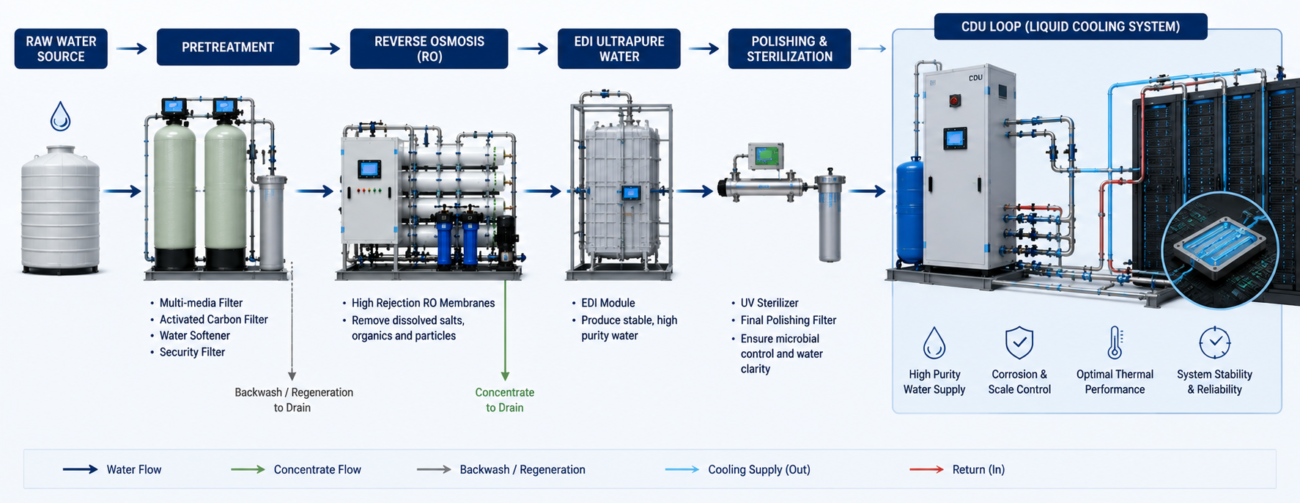
- Final polish filtration at 1 micron absolute or tighter, staged after RO/EDI polishing, not in place of it
- A closed-loop fill cart delivering at a controlled 40–60 PSI, matched to the CDU manifold’s rated inlet pressure — never an open bucket-and-hose fill from a facility hose bib
- Particle counting at the fill point, not just at the treatment skid outlet, since hose and connector debris is introduced downstream of the treatment train
- A documented cleanliness certificate tied to the specific CDU serial number, held alongside the water analysis package for warranty purposes
Skip this step and the failure mode isn’t chemistry — it’s a microchannel restriction discovered during acceptance testing, after the racks are already staged for energization.
Sizing Makeup Water: Why the Big RO Train Is the Wrong Tool for Small Top-Ups
A TCS loop is sealed, but it isn’t static. Service disconnects, hose changes, sensor swaps, and slow seal weep all draw the loop down over time, and every draw-down needs makeup water at the same purity as the original fill.
The mistake we see most often: sizing makeup water off the same industrial RO system built for initial commissioning. That system is rated for GPM; makeup demand is a GPD problem, often under 50 gallons a day per CDU.
Running a 200+ GPM train at 2% duty cycle to chase a trickle of makeup demand does two things badly:
- RO membranes foul faster running short, infrequent cycles than continuous ones, since stagnant permeate between cycles supports microbial growth in the membrane housing
- EDI stacks degrade when cycled on/off far outside their designed duty profile
The fix is a dedicated, small-footprint polishing cart — RO plus mixed-bed or EDI — sized specifically to GPD makeup demand and left in continuous low-flow recirculation rather than on/off cycling. Sizing this correctly is a five-minute conversation once your CDU count and expected weep/service rate are known; it’s the detail most quotes never ask for.
Feed water source changes the pretreatment train on that makeup cart as much as it does on the bulk fill system:
- Municipal supply typically carries residual chlorine or chloramine that will oxidize RO membranes and degrade EDI resin over time — pretreatment needs activated carbon or catalytic media rated for the specific oxidant and dose
- Recycled/reclaimed water, increasingly mandated under EPA and state discharge-permitting frameworks in water-stressed markets like Phoenix, carries elevated TDS and silica risk that a municipal-water pretreatment design won’t catch — undersized pretreatment here shows up as accelerated fouling and shortened membrane life, not an immediate failure
A makeup water package engineered for the wrong source is the single most common reason a system underperforms its own spec sheet within the first year. Target permeate conductivity for TCS-side polish water typically sits well under 1 µS/cm once EDI or mixed-bed polishing is in place — the fill-cart’s job is holding that number through every recirculation cycle, not just at first startup.
N+1 CDU Redundancy: The Standby Loop Nobody Is Watching
Redundant CDU architecture — N+1 or 2N — solves for hardware failover. It does not automatically solve for water quality in the units sitting idle.
A standby CDU loop filled and isolated at commissioning, then left untouched for months, becomes a dead leg. Ultrapure water without a biocide program isn’t sterile indefinitely — given nutrient bleed from gasket materials, elastomers, and O-rings, biological growth can establish in a stagnant polished-water loop even at low TOC.
The failure only shows up at the worst possible moment: the primary CDU trips, the standby unit takes load, and the facilities team discovers a resistivity drop or a filter alarm during an actual failover event rather than during routine maintenance.
Non-negotiable for any N+1/2N architecture:
- Scheduled exercise cycling of every standby loop — periodic low-flow recirculation on a fixed interval, not “only when it fails over”
- Resistivity and TOC monitoring on standby loops, wired into the same BMS points as the active units
- A documented restart procedure that re-verifies water quality before a standby CDU is allowed to assume full load
Cold-Climate Commissioning: When RO Flux Decline Delays Your Energization Date
RO membrane permeate flux drops as feed water temperature drops — a relationship documented in every membrane manufacturer’s Temperature Correction Factor (TCF) tables, and one that project schedules routinely ignore.
A winter commissioning in a market like Ashburn or a mountain-climate build can see feed water in the low 40s°F. At that temperature, a membrane rated for a given GPD output at 77°F can lose 30–40% of that rated flux — meaning the same system takes materially longer to produce the same fill volume.
For a large-volume initial TCS fill, that isn’t a rounding error. It’s the difference between a CDU energizing on schedule and a facilities director explaining a slipped go-live date to hyperscale ops leadership.
Feed water preheating, oversizing the RO train against a winter-worst-case flux rather than a nameplate rating, or scheduling large-volume fills outside peak cold months are all legitimate mitigations — but only if someone modeled the TCF against your actual site conditions before the commissioning date was committed to a customer.
Standard Pre-Engineered Skids vs. Data-Center-Grade CDU Support Systems
| Design Parameter | Standard Pre-Engineered Skid | Data-Center-Grade CDU Support System |
|---|---|---|
| Flow Capacity | Fixed rating, 50–150 GPM | Dual-rated: bulk fill GPM + independent GPD makeup train |
| Redundancy | Single train (N) | N+1 fill skid, dedicated standby-loop exercise loop |
| Fill-Water Cleanliness | Not specified | ISO 4406 code certified per CDU, documented at fill point |
| BMS/PLC Integration | Local gauge readout only | Continuous resistivity, TOC, and particle-count alarms to BMS |
| Wetted Materials | Carbon steel / standard PVC | Passivated 316L stainless, PVDF on TCS-side polish loop |
| Delivery Lead Time | 4–8 weeks, catalog config | Custom-engineered, FAT-tested, commissioning documentation included |
The fill-water cleanliness and standby-loop rows are the ones that get missed on a generic quote — they’re also the ones a Tier III/IV commissioning review or insurance audit will ask for by name.
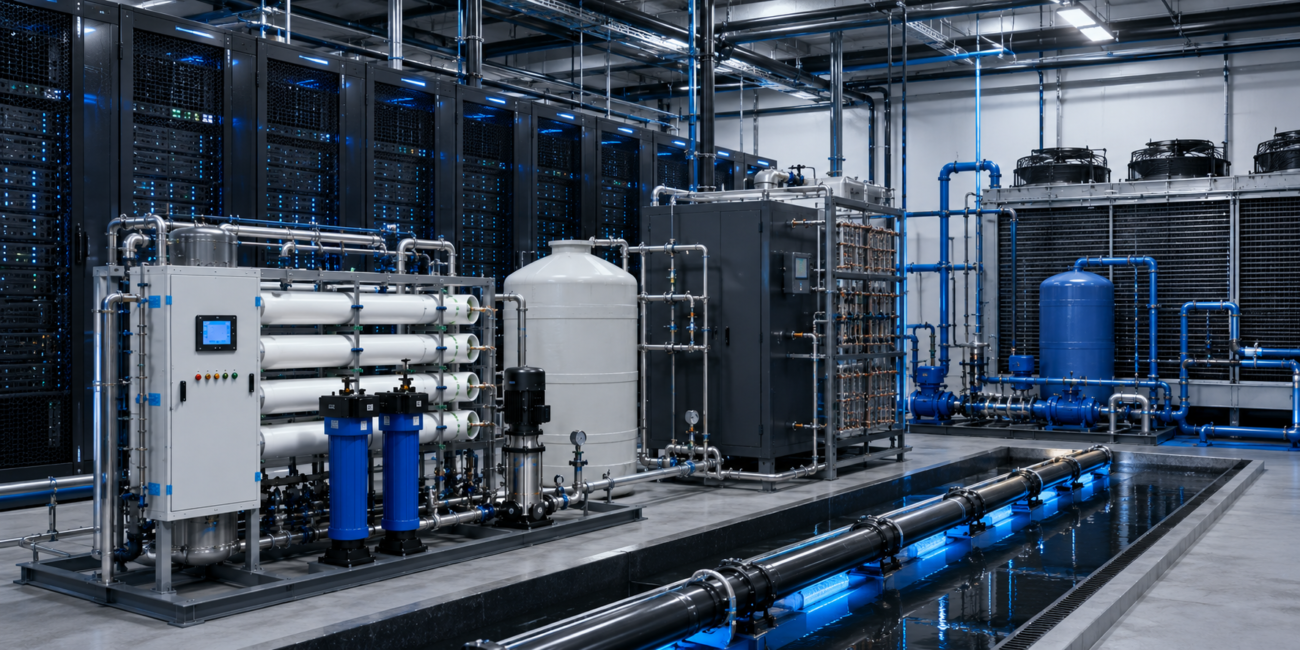
Request a Data Center Water Sizing Consultation if your current CDU quote covers steady-state chemistry but has no line item for fill-water cleanliness certification or standby-loop monitoring — that gap is exactly where warranty disputes start.
Cold plates, CDU heat exchangers, and high-pressure circulation pumps are the most capital-intensive components in a liquid cooling deployment, and none of them fail because a chemistry table was wrong on paper.
- Cold plates and microchannels foul from particulate introduced during fill and service events, not from steady-state chemistry drift alone
- Standby CDUs in N+1/2N architectures fail silently when nobody is monitoring the loop nobody is using
- RO and EDI polishing trains underperform their own nameplate rating when sized without accounting for feed water temperature and source
YWT’s data center product line pairs industrial reverse osmosis systems for bulk fill-water production with right-sized EDI polishing carts for GPD-scale makeup demand — engineered around your actual CDU count, redundancy architecture, and feed water source rather than a single generic skid.
Get an Infrastructure Engineering Quote built around your specific CDU manufacturer’s cleanliness and chemistry spec, not a template.
FAQ: CDU Water Treatment for Liquid Cooling
What water quality does a CDU need before it’s energized? Beyond the steady-state conductivity and hardness targets, the fill water needs a certified ISO 4406 particulate cleanliness code — commonly in the 16/14/11 to 18/16/13 range — verified at the fill point, not just at the treatment skid outlet.
What is ISO 4406 and why does it matter for CDU commissioning? ISO 4406 reports particle counts per milliliter at 4, 6, and 14 microns. It catches construction-site debris — weld slag, thread sealant, mill scale — that a conductivity meter cannot detect, and it’s the standard most cold plate OEMs use to gate fill-water acceptance.
Can I use my facility RO system for CDU makeup water? Not reliably. Makeup demand is typically a GPD-scale trickle, and running a large GPM system at low duty cycle accelerates membrane fouling. A dedicated, continuously recirculating small-footprint polishing cart sized to actual makeup demand performs better and lasts longer.
Do standby CDUs in an N+1 configuration need water treatment too? Yes. A standby loop left stagnant for months can support biological growth even in ultrapure water, given nutrient bleed from gaskets and elastomers. Scheduled exercise cycling and continuous resistivity/TOC monitoring on standby loops are both required, not optional.
Why does cold weather delay CDU commissioning fill water production? RO membrane flux drops as feed water temperature drops. A membrane can lose 30–40% of its rated output in cold feed water versus its 77°F nameplate rating, which materially extends the time needed to produce a large-volume initial fill.
What’s the difference between CDU fill water and TCS chemistry specs? TCS chemistry specs describe steady-state water quality — conductivity, hardness, TOC. Fill-water specs describe a one-time commissioning acceptance criterion for particulate cleanliness, which the chemistry table doesn’t cover at all.
How much makeup water does a typical CDU loop need? Volume varies by loop size and service frequency, but demand is almost always measured in GPD, not GPM — a distinction that should drive the makeup train’s sizing rather than scaling down the bulk fill system.
Get an Infrastructure Engineering Quote, request detailed Technical Data Sheets matched to your CDU manufacturer’s fill-water and makeup-water specification, or ask about B2B wholesale / factory-direct pricing on industrial RO and EDI systems engineered around your fill, flush, and makeup requirements — not a generic single-loop template.