RO Membrane Replacement for Data Center Cooling: Why Calendar-Based Programs Fail High-Density Loops

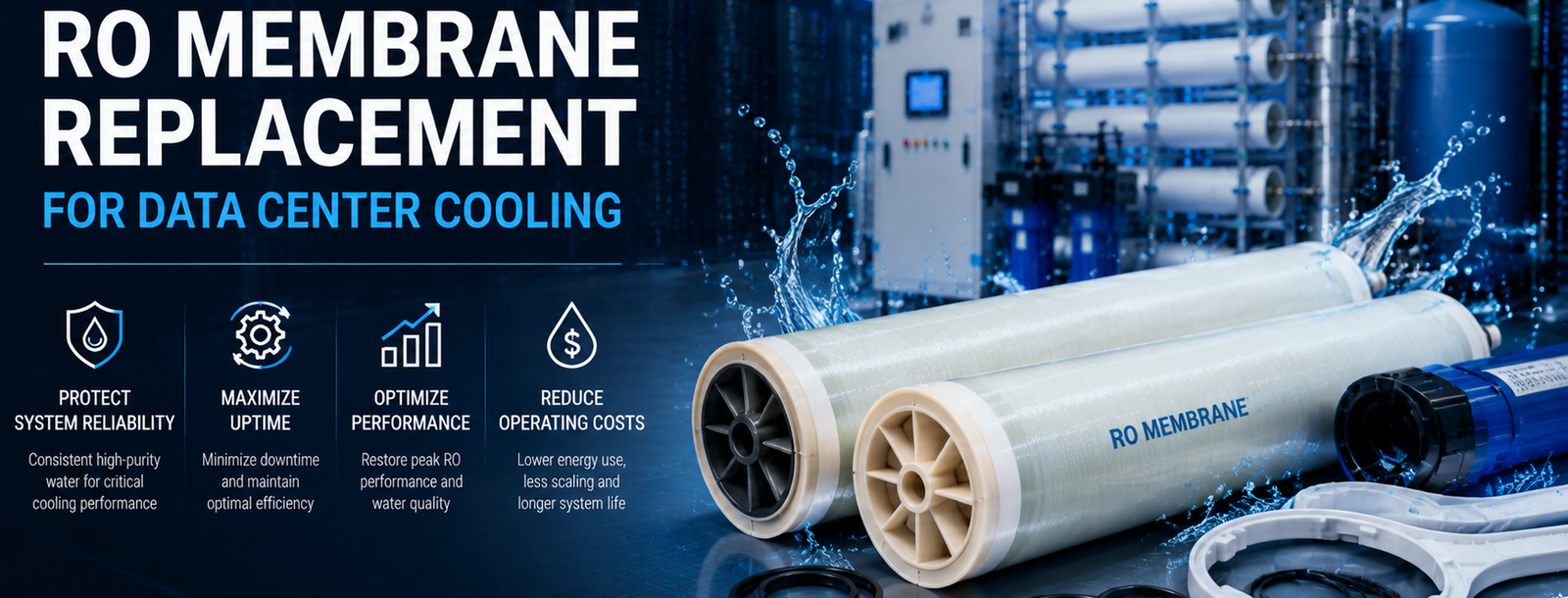
An RO membrane replacement decision made six months too late doesn’t show up as a maintenance line item. It shows up as a cooling capacity shortfall during a summer peak-load event, when the RO train can no longer keep pace with makeup water demand.
The failure mode isn’t a leak. It’s silent flux decline — a slow erosion of permeate output that most facilities don’t catch until the shortfall is already affecting rack inlet temperatures.
Before you sign off on a replacement program or a supplier quote, lock down these five points:
- Normalized performance data, logged from day one — not raw flow and pressure readings
- A written replacement trigger threshold, not a calendar date
- Vessel-level differential pressure monitoring, not just train-level
- Spare element inventory sized to procurement lead time, not to convenience
- A staggered replacement protocol that avoids a full-train shutdown
Most data center water treatment write-ups stop at membrane selection — reverse osmosis system for cooling water design, recovery rates, single-pass vs. two-pass configuration. Almost none of them cover what happens 3 to 7 years later, when those same elements start losing capacity and someone has to decide whether to replace two elements or forty.
The Data That Actually Triggers Replacement — Not the Calendar
Raw permeate flow readings are close to useless on their own. Feed water temperature swings 15–20°F between summer and winter in most US climates, and RO membrane flux tracks temperature almost linearly. A flow drop that looks like fouling in January can be nothing more than cold feed water.
Normalization removes that noise. Every credible replacement decision runs on three normalized metrics, referenced against the array’s commissioning baseline:
- Normalized permeate flow decline of 10–15% from baseline — the standard trigger point before output can no longer meet design capacity
- Normalized salt passage increase of 10–15% — rejection degradation, usually from membrane surface damage or oxidative attack
- Differential pressure rise of 15% across a stage — the clearest signal of particulate or biological fouling building up between elements
Facilities that skip normalization make two opposite mistakes: replacing membranes that still have real service life left because a cold snap looked like fouling, or ignoring genuine degradation because a hot spell masked it as normal seasonal variation.
Send Your Membrane Performance Data for a Free Review — share your logged flow, pressure, and conductivity trends and get a normalized-baseline read before you order replacement elements.
Why Fixed-Interval Contracts Waste CAPEX — Or Fail Silently
Most service contracts default to a fixed interval: replace every 3 years, every 5 years, whatever the original vendor wrote into the O&M manual. It’s easy to budget for. It’s also almost never correct.
Membrane life varies by a factor of three or more depending on feed source, pretreatment quality, and duty cycle. A well-pretreated municipal feed running at moderate recovery can push elements past 7 years. A poorly pretreated deep-well feed at high recovery can foul a lead element in under 18 months.
Fixed-interval replacement fails in both directions:
- Too early — pulling elements that still have 20–30% of usable service life, which is a direct, avoidable CAPEX hit
- Too late — running past the point where normalized flow has already dropped below what the cooling loop needs at peak load, which shows up as reduced heat rejection capacity, not as an alarm
Condition-based replacement, driven by the normalized metrics above, is the only approach that avoids both failure directions at once.
Staggered Replacement: Why Lead-Position Elements Fail First
A pressure vessel loaded with six elements doesn’t foul evenly. The lead element (first in the flow path) absorbs the highest particulate and organic fouling load, since it sees raw feed water before any of it has been filtered by upstream elements. The tail elements see cleaner water but higher osmotic back-pressure as the feed stream concentrates along the vessel.
In practice, this means the lead element in a six-element vessel typically reaches its normalized flow-decline trigger 2–3 times faster than the tail element.
A staggered replacement protocol takes advantage of that:
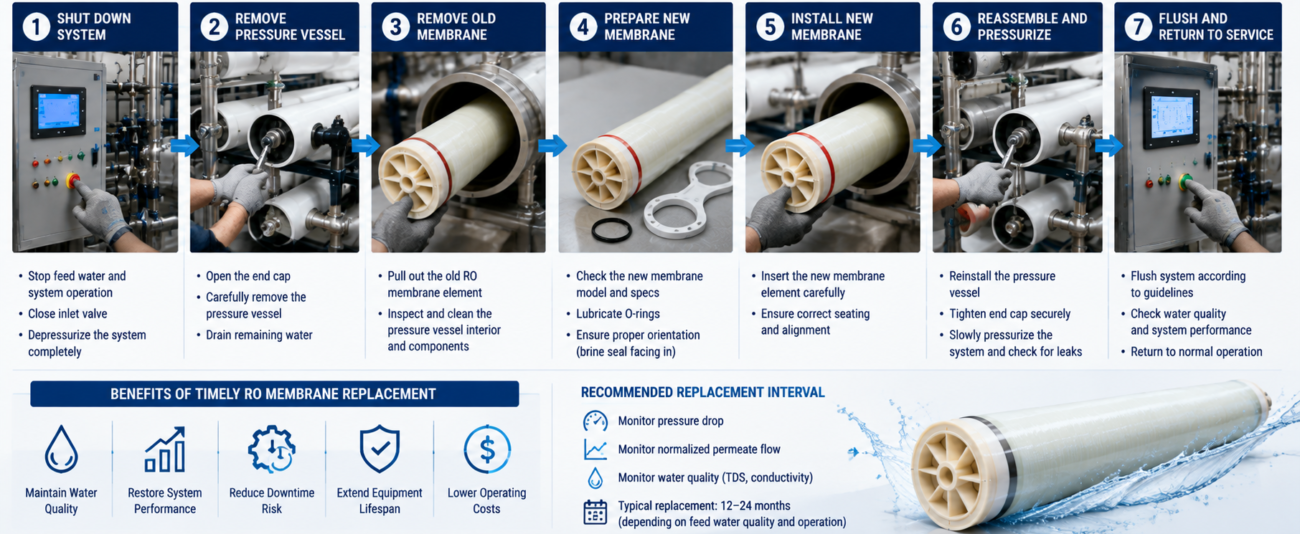
- Replace only the lead-position element (or lead two, in longer vessels) at first trigger
- Physically relocate tail elements one position forward, extending their service before replacement
- Load the new element into the tail position, where fouling load is lowest
This keeps the total element count purchased per cycle lower than a full-array swap, and it means most replacement events don’t require a full-train shutdown — one vessel row goes offline at a time while parallel trains carry load.
Field Insight: Telescoping Damage From Mixed-Brand Array Replacement
Here’s the failure mode that doesn’t show up in any spec sheet: replacing part of an array with a different manufacturer’s element, or a different model-year of the same element, inside an existing pressure vessel.
Different manufacturers — and different generations of the same product line — hold slightly different tolerances on outer diameter, interconnector fit, and permeate-tube seal geometry. Mixed inside one vessel, that tolerance stack-up creates uneven axial thrust distribution across the element pack under normal operating pressure.
The result is telescoping — the outer wraps of the membrane leaf physically shift and deform under the pressure differential, usually surfacing 60–90 days after a “successful” replacement. It’s routinely misdiagnosed as a defective element, when the real cause is array incompatibility.
The fix is procedural, not technical: replace within one brand and one generation per vessel, and confirm interconnector and permeate-tube compatibility against the original element datasheet before an order goes out — not after the new elements arrive on site.
Municipal vs. Deep-Well Feed: Different Fouling Profile, Different Replacement Clock
Data center water treatment sourced from municipal supply and from deep well water don’t foul the same way, and they don’t run the same replacement clock.
Municipal feed carries residual chlorine or chloramine. If upstream activated carbon breaks through — often from chloramine’s longer contact-time requirement — oxidative attack degrades the polyamide active layer directly. That shows up as rising normalized salt passage, not differential pressure. The membrane isn’t fouled; it’s chemically damaged, and no amount of cleaning restores rejection once that damage sets in.
Deep well feed typically carries higher hardness, iron, manganese, and silica (ppm-level, sometimes well above municipal averages). Fouling here is precipitative — mineral scale building on the membrane surface — and it shows up as rising differential pressure and declining normalized flow, well before rejection degrades.
Two different failure signatures mean two different service intervals, even on identical hardware. A replacement program built around one generic trigger set for both feed types will consistently mistime one of them.
Spare Membrane Inventory and Zero-Downtime Replacement Logistics
Standard lead time on a reorder for OEM elements runs 8–12 weeks, longer for less common configurations or brackish-water-specific chemistries. That number doesn’t change because your cooling loop needs 99.999% uptime.
Condition-based replacement only works if the elements are already on the shelf when the trigger fires. Facilities that wait to place a purchase order after the trigger point convert a planned, staggered replacement into an unplanned capacity gap that lasts as long as the reorder lead time.
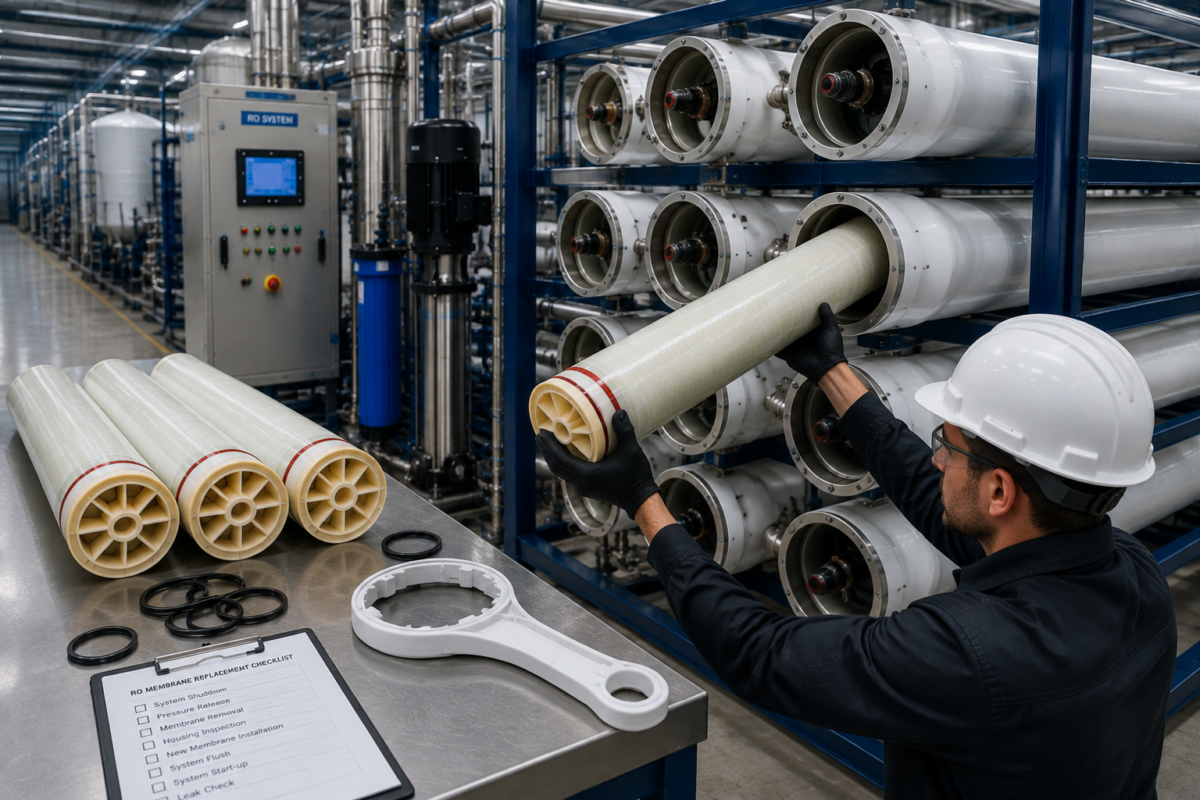
The practical fix: size on-site spare inventory to one full lead-stage vessel row — enough to execute the next staggered replacement cycle without waiting on a PO. Tie the reorder point to the same normalized-flow trend data driving the replacement trigger, so the next spare order goes out before the current spare stock is used.
Reactive vs. Condition-Based Replacement: The Real Difference
| Factor | Reactive (Failure-Driven) | Condition-Based (Predictive) |
|---|---|---|
| Replacement trigger | Visible capacity shortfall or alarm | Normalized flow/salt-passage/dP thresholds |
| Typical element life achieved | Inconsistent — often under 50% of rated life | 85–100% of rated life, per element |
| Downtime risk | High — full-train outage during replacement | Low — staggered, one vessel row at a time |
| CAPEX timing | Unplanned, often emergency freight surcharges | Planned, budgeted against trend data |
| Data logging requirement | Minimal or none | Continuous normalized trending from commissioning |
| Spare inventory need | Reactive, ad hoc ordering | Pre-positioned, tied to reorder-point logic |
Send Your Membrane Performance Data for a Free Review
FAQ
How often should RO membranes be replaced in a data center cooling loop? There’s no single interval. Elements should be replaced when normalized permeate flow drops 10–15% from baseline, normalized salt passage rises 10–15%, or differential pressure across a stage rises 15% — whichever trigger fires first, typically between 3 and 7 years depending on feed water and duty cycle.
What is normalized permeate flow, and why does it matter for replacement timing? It’s the permeate flow rate adjusted for feed temperature and pressure against the commissioning baseline. Without normalization, seasonal temperature swings can look identical to real fouling, leading to replacement decisions based on noise rather than actual membrane condition.
Can I mix RO membrane brands in the same pressure vessel? Not without checking tolerances first. Different manufacturers and even different model years of the same product hold different interconnector and outer-diameter tolerances, which can cause telescoping damage under normal operating pressure within 60–90 days.
What causes RO membrane telescoping? Uneven axial thrust across the element pack, usually from tolerance mismatches between mixed-brand or mixed-generation elements loaded into one vessel. It physically deforms the outer membrane leaf and is frequently misdiagnosed as a defective element.
How long does RO membrane replacement lead time typically take? Standard OEM reorder lead time runs 8–12 weeks for common configurations, longer for brackish-specific or low-volume chemistries. Facilities running condition-based replacement carry spare inventory to bridge this gap.
Do municipal water and deep well water require different replacement schedules? Yes. Municipal feed with chlorine/chloramine breakthrough drives oxidative damage and rising salt passage. Deep well feed with hardness, iron, or silica drives precipitative fouling and rising differential pressure. The two failure signatures run on different clocks.
What differential pressure rise indicates a membrane needs replacement? A 15% rise across a single stage, referenced against the commissioning baseline, is the standard trigger point used in condition-based replacement programs.
A replacement program is only as good as the data behind it. If normalized trending isn’t already part of your current O&M routine, that’s the first gap to close — before the next trigger point arrives unplanned.
Once the trigger data says it’s time, what matters most is getting the right element — cross-referenced to your existing vessel and manufacturer spec, not a redesign. Request a Replacement Element Quote matched to your current array, confirm technical data sheets and lead time on stocked inventory, or ask about B2B Wholesale Pricing on spare elements sized to your reorder point — starting with our RO membrane replacement for data center cooling parts reference.