Turnkey Water Treatment Plant for Data Center Construction: One Vendor, One Train, One Guarantee

A data center under construction usually buys its water plant the way it buys any other line item on the MEP schedule: pretreatment from one supplier, an RO skid from another, a dosing and controls package from a third. Each is sized to a spec sheet. None of them is responsible for how the pieces behave once they are piped together.
That gap is where commissioning slips. A pretreatment system that clears its own factory test on clean feed water can still hand the RO skid influent it was never actually engineered against — and nobody signed up to own that failure.
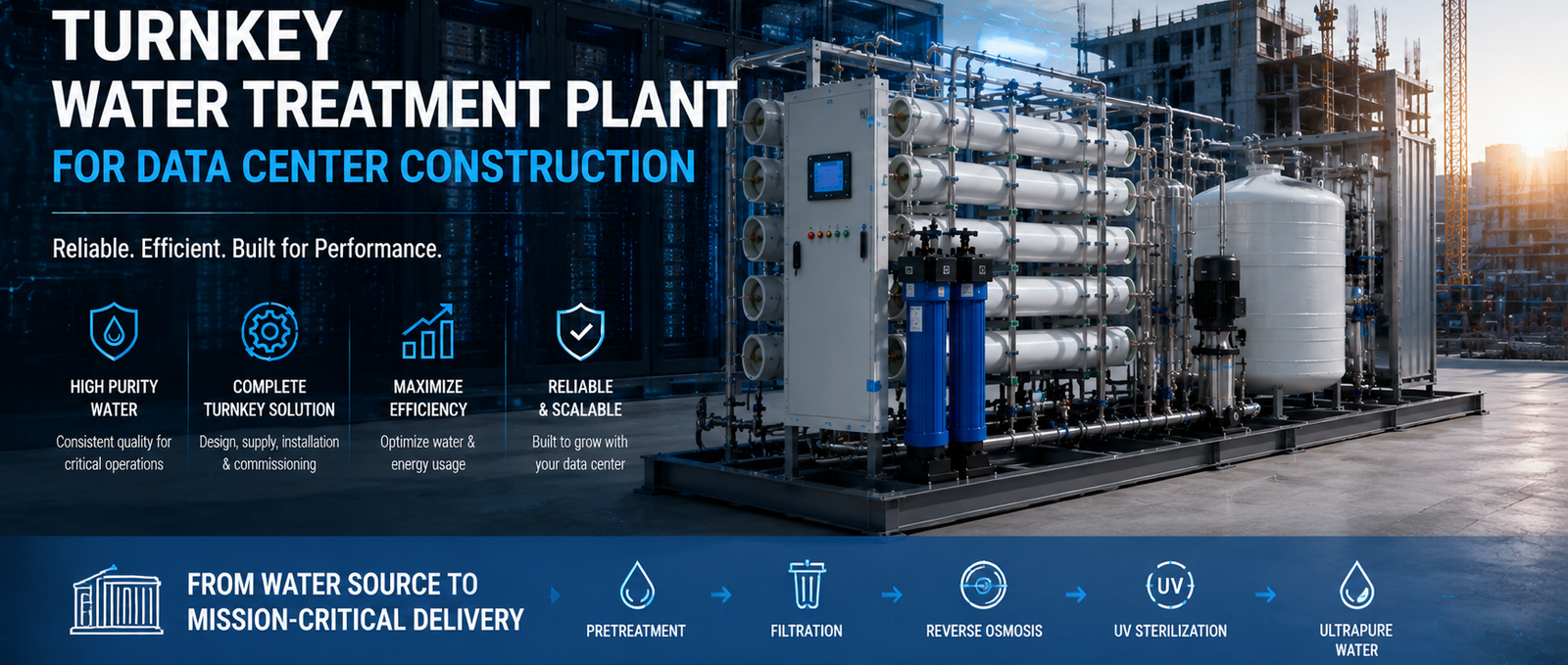
A turnkey water treatment plant for data center construction closes that gap by putting pretreatment, RO, polishing, dosing, and controls under one engineering scope, one factory test, and one performance guarantee.
Before this goes into the RFP, lock these requirements:
- One party engineered the whole train — pretreatment through polish — not just the individual components.
- One factory acceptance test (FAT) on the assembled system, run against your actual feed water, not isolated tests of each unit on generic water.
- One P&ID and one control philosophy — PLC and BMS integration specified for the full plant, not stitched together from separate submittals.
- A performance guarantee written against finished water quality, not against each vendor’s individual datasheet.
- Redundancy engineered across the entire train — pretreatment included — not bolted onto the RO pass alone.
The sections below cover what “turnkey” needs to mean on a construction project, and where component-by-component sourcing typically fails before the plant ever reaches commissioning.
Fast Check Product: https://yourwatergood.com/product/industrial-reverse-osmosis-system/
What “Turnkey” Means Here — And What It Doesn’t
“Turnkey” on a construction project gets used loosely, so it is worth being precise. A turnkey water treatment plant for data center construction is a factory-engineered, factory-tested system delivered as one package — it is not a claim to perform civil, electrical, or general-contracting work on the building itself.
What turnkey scope covers:
- Design — pretreatment, RO, and polishing sized as one continuous system against your actual water analysis, not against a generic influent assumption.
- Fabrication and FAT — the train built and performance-tested before it leaves the factory.
- Documentation — one P&ID, one control narrative, one set of O&M manuals for the whole plant.
- A single point of commercial responsibility — one vendor answers for the finished water, not a chain of subcontractors pointing at each other’s spec sheets.
What it does not cover: site civil work, electrical distribution to the plant, or building construction. A turnkey plant is a packaged scope inside the larger construction project — it removes multi-vendor risk from the water train specifically, and nothing more.
Why Component-by-Component Sourcing Breaks Down on a Construction Schedule
The failure mode with separately-sourced components is not assembly speed — it is the interface between vendors, where no single party owns the outcome.
How this plays out on a real project:
- The spec gap — the RO vendor designs to a stated influent quality (SDI, hardness, silica). The pretreatment vendor bids to a general spec, not to that RO membrane’s actual design margin, because the two scopes are bid independently.
- Isolated testing hides the mismatch — each component passes its own factory test on clean or generic water. The mismatch between what pretreatment actually delivers and what RO actually needs only surfaces at commissioning, on-site, with the schedule already committed.
- Warranty disputes at the boundary — when the RO membranes foul early, the RO vendor points at feed water quality; the pretreatment vendor points at their own passing test report. Nobody’s contract covers the interface.
- Submittal coordination lands on the EPC — reconciling separate P&IDs, separate control panels, and separate commissioning windows becomes the general contractor’s problem, not the water vendor’s.
None of this shows up as a delay in fabrication. It shows up as an RFI cycle during commissioning, which is a far more expensive place to discover a design gap.
What a Turnkey Scope of Supply Actually Includes
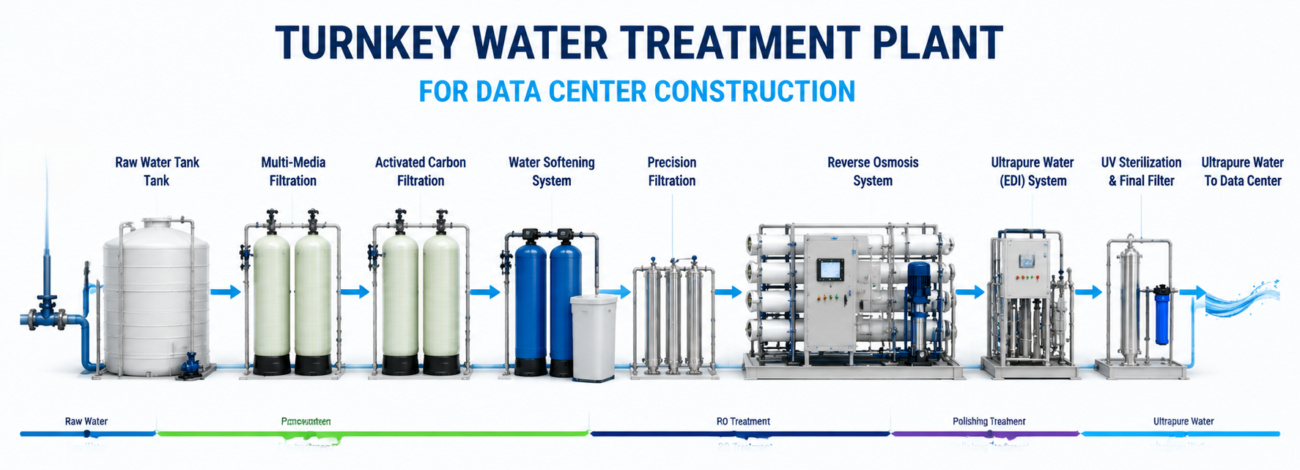
A properly scoped turnkey water treatment plant for data center construction covers the full pretreatment-to-polish train as one engineered system, typically built around:
- Multi-media and UF pretreatment — sized to the actual feed water, not a generic assumption, ahead of the RO pass.
- Industrial reverse osmosis systems — single- or two-pass, sized in GPD output to the pretreated water the RO membranes will actually see, with high-pressure pumps rated to the operating PSI the design calls for.
- EDI or mixed-bed polishing — where the cooling loop or makeup spec calls for it.
- Automated chemical dosing — antiscalant and, where applicable, biocide, dosed against the train’s actual operating parameters.
- Auto CIP (clean-in-place) — integrated for membrane cleaning without disassembling the skid.
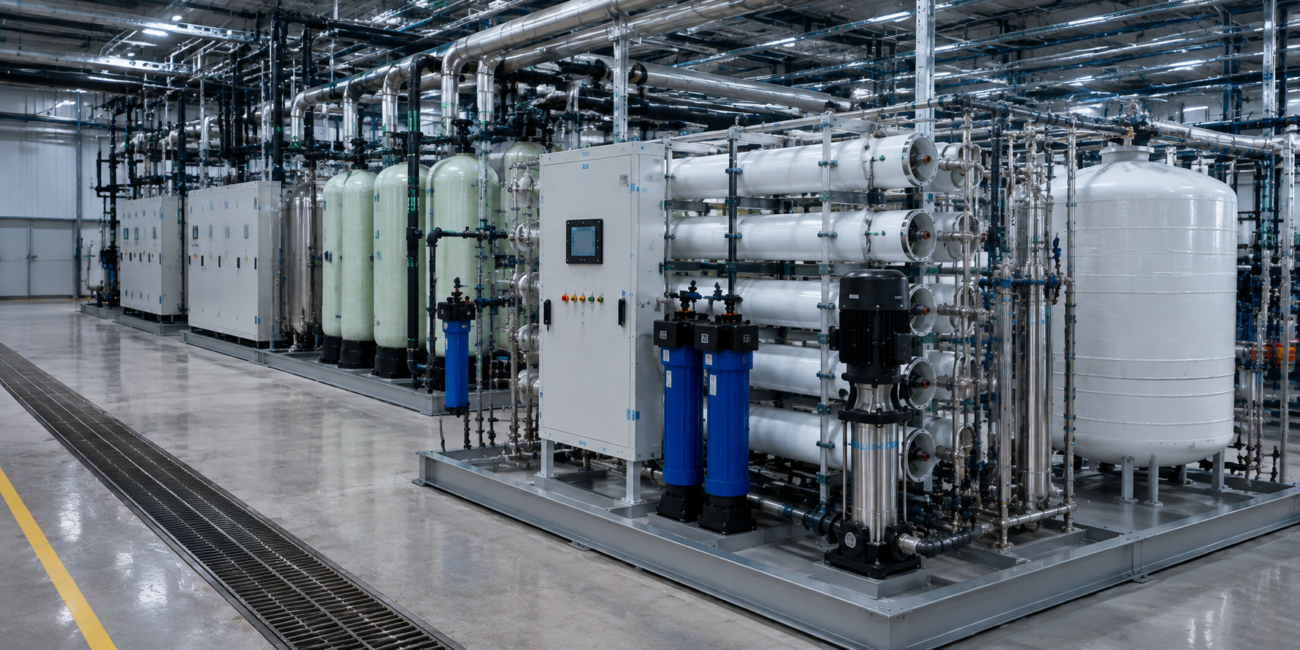
- Skid-mounted delivery — pretreatment and RO trains built as pre-piped, pre-wired units for a single rigging and connection event.
- PLC integration — Siemens or Allen-Bradley platforms, with BMS connectivity (Modbus TCP, BACnet IP, or SNMP) specified once for the whole plant, not per component.
This is where the single-guarantee structure pays back downstream, not just on the schedule. When one party owns finished water quality end to end, that consistency is what protects the assets on the other side of the plant:
- Lower infrastructure OPEX — a train tuned as one system needs fewer emergency heat-exchanger cleanings, less mechanical cooling-tower descaling, and fewer unplanned cartridge or membrane change-outs than a plant assembled from mismatched components.
- Longer capital asset life — consistent, in-spec water protects cold plates, CDU heat exchangers, high-pressure pumps, and other server-side heat-exchange components from the scaling and fouling that inconsistent water quality accelerates.
- Fewer hot spots, less throttling risk — water quality that drifts out of spec at a vendor interface is what eventually shows up as a localized hot spot, forcing a cluster into thermal throttling rather than holding 24/7/365 operation.
Request a Data Center Water Sizing Consultation — send your project’s water analysis, target flow, and commissioning date, and we will configure a single-scope treatment train sized to it. Talk to us.
Municipal vs. Deep Well Feed: Why the Whole Train Has to Be Engineered Together
Feed water source changes the pretreatment design fundamentally — and on a turnkey scope, that decision has to be made once, for the whole train, not negotiated separately between two vendors.
Municipal potable feed:
- Moderate, predictable chemistry. Pretreatment centers on carbon filtration for chlorine/chloramine and chloride control to protect 316L stainless components downstream.
- Lighter multimedia stage, single- or two-pass RO sized against a known, stable influent.
Deep well feed:
- Higher variability, and often higher raw TDS (ppm). Pretreatment has to manage hardness, iron and manganese, and silica — each requiring a different removal step (softening, oxidation/filtration, or antiscalant dosing) before the water ever reaches the RO membranes.
- Well chemistry can shift seasonally, so the pretreatment design margin has to account for that swing, not just the water quality on the day of the sample.
A pretreatment package engineered in isolation from the RO design tends to be sized to the wrong risk. A turnkey scope forces the pretreatment and RO decisions to be made together, against the same water analysis — consistent with ASHRAE TC 9.9 water quality expectations and the EPA Water Quality Framework governing discharge and makeup water handling.
Standard Pre-Engineered Skids vs. Fully Customized Turnkey Systems
Not every “packaged” water system is engineered as one scope. The distinction below is what separates a standard skid quote from a true turnkey plant.
| Engineering Parameter | Standard Pre-Engineered Skids | Fully Customized Turnkey Systems |
|---|---|---|
| Scope of supply | Component-by-component, separately bid | Pretreatment through polish, one engineered scope |
| Flow capacity (GPM) | 10–50 GPM, single train | 100–1,000+ GPM, multi-train |
| CAPEX structure | Multiple line-item quotes | One consolidated system price |
| Lead time | Staggered by vendor, coordination overhead | Coordinated fabrication on one schedule |
| PLC / BMS integration | Per-component, reconciled on site | Pre-integrated, single control philosophy |
| Redundancy | Applied to individual units, inconsistently | Engineered across the full train (N+1 / 2N) |
| Performance guarantee | Per component datasheet | Against finished water quality at point of use |
| Factory testing | Isolated component tests | Whole-train FAT on actual site water |
The FAT and scope-of-supply rows are what actually separate these two categories. A skid on a frame does not make a system turnkey — the engineering behind the whole train does.
To pressure-test a vendor’s turnkey claim, ask a direct question: has the pretreatment and RO train ever been factory-tested together, on your water, or only tested as separate units?
Field Engineering Insight: Isolated FAT Passes, Whole-Train FAT Catches the Real Problem
Here is the detail that separates a genuine turnkey plant from a bundle of components shipped together: a pretreatment system tested alone, on clean or generic water, can pass its factory test and still foul an RO membrane it was never actually run against.
Component-level FAT verifies that a unit performs to its own datasheet. It does not verify that the unit’s actual output — at your site’s real water chemistry and your design flow rate — matches what the downstream RO membrane needs to run without accelerated fouling.
This shows up most often with silica and hardness breakthrough: a softener or UF system can hold spec on a short, clean-water factory run and still allow intermittent breakthrough under the sustained flow and real turbidity of site water — a condition an isolated test at the pretreatment factory has no way to surface.
A whole-train FAT — pretreatment and RO run together, against water matched to your actual site analysis, before the system ships — catches this before it becomes a commissioning-phase RFI. It is also the difference a project only notices in hindsight: whichever plant caught the mismatch at the factory is the one that commissioned on schedule.
The defense, written into the RFP:
- Require FAT on the assembled train, not certificates from each component in isolation.
- Specify the FAT feed water to match your actual site analysis, not the factory’s default clean water.
- Require one performance guarantee covering finished water quality, so there is no vendor boundary for a failure to hide behind.
This is the detail that never appears on a component spec sheet, and it is exactly what a single-scope turnkey plant is engineered to prevent.
Turnkey Water Treatment Plant for Data Center Construction FAQs
What does “turnkey” mean for a data center water treatment plant? A single-vendor engineered, factory-tested treatment train covering pretreatment through RO and polishing, delivered under one P&ID, one control philosophy, and one performance guarantee — not a claim to perform the data center’s civil or electrical construction.
Is a turnkey water treatment plant the same as hiring an EPC for the whole facility? No. It covers the water treatment scope only — design, fabrication, factory testing, and documentation of the treatment train — as one package within the larger construction project, not general contracting of the building.
What’s included in a turnkey plant’s scope of supply? Typically multimedia/UF pretreatment, industrial RO, EDI or mixed-bed polishing, automated dosing, auto CIP, and PLC/BMS integration — engineered and documented as one system rather than separate line items.
How is a turnkey plant tested before it ships? Through a factory acceptance test (FAT) on the fully assembled train, ideally run against water matched to the project’s actual site analysis, rather than isolated tests of each component on generic water.
Does a turnkey plant cost more than sourcing components separately? The consolidated price can look higher than the sum of separate component quotes, but it removes the interface risk and RFI cycles that component-by-component sourcing typically pushes into commissioning — where a delay costs far more than the line-item difference.
How is redundancy handled in a turnkey data center water plant? Redundancy — N+1 or 2N — is engineered across the whole train, including pretreatment, rather than applied only to the RO pass while pretreatment remains a single point of failure.
Can a turnkey plant be engineered for both municipal and well water feed? Yes, provided the pretreatment and RO stages are designed together against the actual water analysis — municipal and deep well feed require different pretreatment trains, and a turnkey scope makes that a single design decision instead of two independently bid ones.
One Scope, One Train, One Guarantee
A turnkey water treatment plant for data center construction is not a bigger skid or a faster install — it is a different commercial structure: one engineering party accountable for how pretreatment, RO, and polishing perform together, verified by one factory test before the system ever reaches your site.
Whether you’re sourcing a single-train plant or a multi-train system for a larger build, YourWaterGood sources the right system through our manufacturing partner and a network of vetted factories — turnkey water treatment plant for data center construction configurations cover pretreatment, RO, EDI, dosing, and controls as one engineered scope, with quality inspection, logistics, and English-language support handled for you.
- Get an Infrastructure Engineering Quote: send your water analysis, flow requirement, and construction schedule for a single-scope treatment train proposal.
- Request Technical Data Sheets: P&ID, FAT scope, and PLC/BMS integration detail for your engineering submittal package.
- Get Competitive B2B Pricing: sourced through our supplier network, with QC and shipping managed end to end.