
Best Industrial Water Filtration Technologies for PFAS Removal: Engineering the GAC, Ion Exchange, and RO Decision

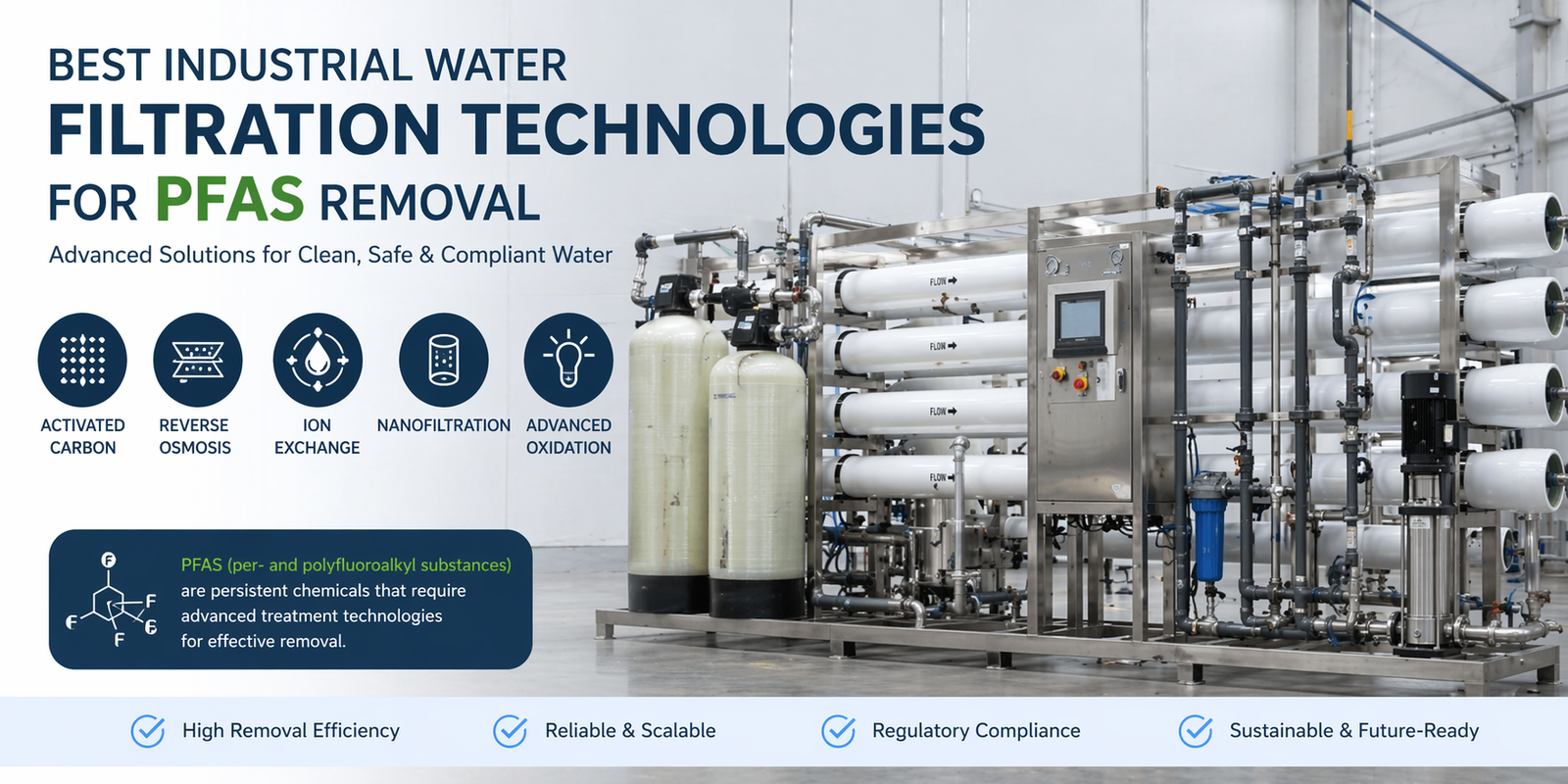
A PFAS exceedance doesn’t announce itself the way a TDS spike does — it shows up in a lab report, weeks after the water already ran through your process. For facilities with continuous production or discharge obligations, that lag is the real risk.
Before evaluating any vendor, lock these specs into the RFP:
- Which PFAS chain lengths are actually in your feed water — short-chain and long-chain compounds don’t respond the same way to the same media.
- Empty bed contact time (EBCT) or membrane rejection rate validated against your real flow, not a datasheet number from a different water matrix.
- A defined concentrate or spent-media disposal path before the system is sized, not after it’s fouled.
- Continuous duty-cycle rating at your actual peak GPM, with PLC-based monitoring for breakthrough or pressure drift.
- 316L stainless steel or high-grade UPVC wetted materials rated for continuous operation, regardless of which technology is selected.
Sourcing the right industrial water filtration technology for PFAS removal starts with knowing which of three EPA-recognized treatment pathways actually fits your water chemistry — not defaulting to whichever one a vendor happens to sell.
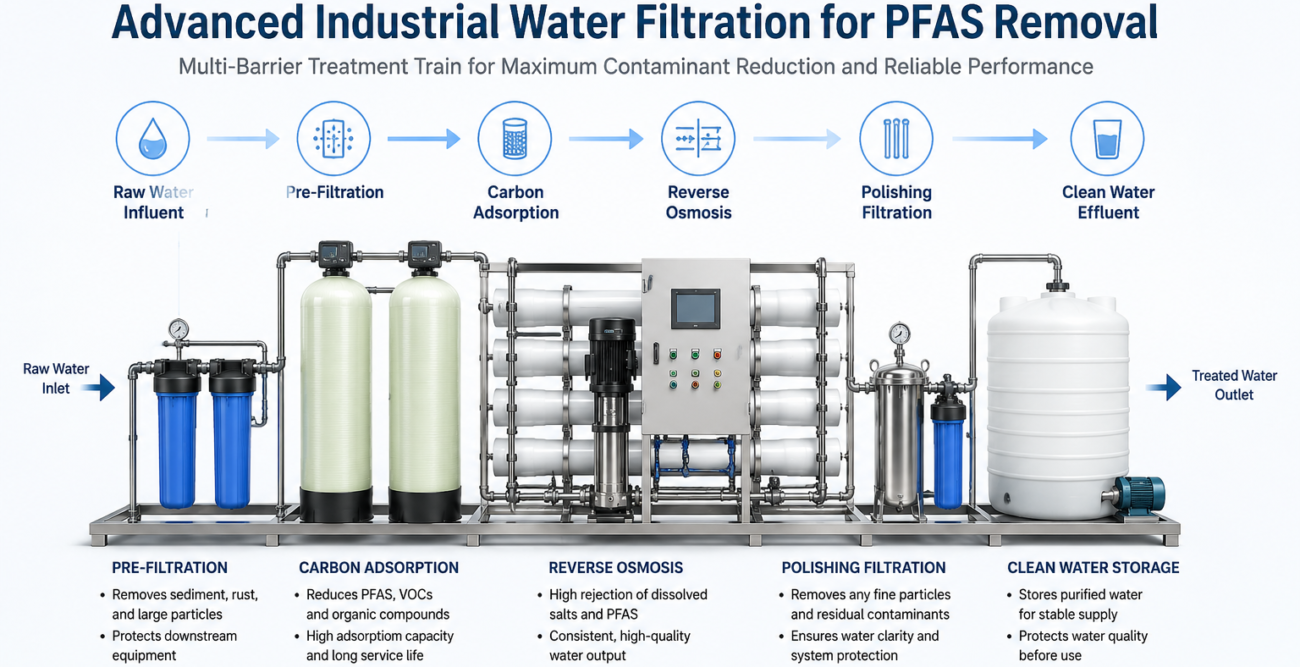
Fast Check Product: https://yourwatergood.com/product/industrial-reverse-osmosis-system/
Why PFAS Removal Is a Different Engineering Problem Than TDS Reduction
Standard industrial pretreatment — multimedia filtration, softening, carbon polishing — is built around bulk parameters: TDS (ppm), hardness, turbidity. PFAS removal is governed by a different mechanism entirely.
- Adsorption-based media (GAC, ion exchange) work by capacity — they bind PFAS molecules until the media is saturated, then breakthrough occurs. Performance is capacity-limited, not just flow-limited.
- Membrane rejection (RO/NF) works by physical size and charge exclusion — it doesn’t saturate the same way, but it concentrates whatever it rejects into a smaller waste stream that has to go somewhere.
- Chain length matters. Long-chain PFAS (like PFOA and PFOS) adsorb onto GAC more readily than short-chain compounds (like PFBS or GenX/HFPO-DA), which tend to break through GAC media faster and are generally better handled by ion exchange or membrane rejection.
Feed water source still shapes the pretreatment ahead of whichever PFAS-specific stage is selected. Municipal feed typically needs chlorine/chloramine management and a clear TDS baseline before the PFAS stage. Deep well feed typically carries hardness, iron, manganese, and silica that will foul GAC pores or scale an RO membrane faster if it isn’t stripped out first — the PFAS media only performs to spec if it isn’t also fighting fouling from upstream minerals.
GAC, Ion Exchange, and High-Pressure Membranes: Comparing the Three Treatment Pathways
Three technology classes account for the overwhelming majority of full-scale industrial PFAS treatment: granular activated carbon (GAC), PFAS-selective ion exchange (IX) resin, and high-pressure membranes (RO/NF).
| Technology | Removal Mechanism | Chain-Length Coverage | Primary OPEX Driver | Waste Stream |
|---|---|---|---|---|
| GAC | Physical adsorption | Strong on long-chain; weaker on short-chain | Media replacement (roughly every 6–18 months) | Spent carbon requiring disposal or off-site regeneration |
| PFAS-Selective IX Resin | Ion exchange | Strong across both long- and short-chain | Resin replacement, often single-use | Spent resin, typically sent to incineration |
| RO / NF Membranes | Size and charge rejection | Broad coverage across chain lengths | Energy, membrane cleaning, concentrate management | Concentrated reject stream carrying the rejected PFAS load |
No single technology wins on every criterion. GAC is the most field-proven and handles a broad spectrum of co-contaminants, but short-chain PFAS and background organics reduce its bed life. IX resin typically has a smaller equipment footprint than GAC for equivalent capacity and performs well across chain lengths, but resin costs more per unit and single-use systems mean no regeneration waste stream to manage. RO/NF rejects the broadest range of PFAS species and simultaneously reduces TDS, hardness, and most other dissolved contaminants in one pass — the trade-off is that it concentrates PFAS into a reject stream that itself becomes a disposal consideration.
For facilities that need PFAS control and low-TDS process water in the same train — semiconductor rinse water, food and beverage ingredient water, boiler feed — an industrial reverse osmosis system frequently ends up doing double duty that a media-only train can’t.
Request a Custom CAD Skid Diagram or Water Analysis Review before committing to a technology — the right answer depends on your actual PFAS speciation, not a generic recommendation.
Standard Pre-Engineered PFAS Treatment Skids vs. Fully Customized Turnkey Systems
Packaged PFAS treatment skids are not all engineered to the same standard. The table below is what separates a catalog unit from a system built for your actual water chemistry.
| Engineering Parameter | Standard Pre-Engineered Skid | Fully Customized Turnkey System |
|---|---|---|
| Flow capacity (GPM) | Fixed, single-media configuration | Custom-sized, multi-stage, expandable |
| CAPEX structure | Lower upfront, single-technology | Higher upfront, engineered around your PFAS profile |
| Lead time | Shorter — stock media vessel or skid | Longer — sized against your actual water analysis |
| PLC integration | Basic breakthrough alarm only | Siemens or Allen-Bradley platform, full SCADA integration |
| Redundancy | None — single train, single point of failure | N+1 engineered across the treatment train |
A standard skid fits a facility with a well-characterized, single-source PFAS profile and modest continuity requirements. A fully customized turnkey system is the right call when a discharge exceedance or a production stoppage costs more than the CAPEX premium — which, for most continuous manufacturing lines, it does.
Concentrate and Spent Media Management: The OPEX Line Most RFPs Miss
This is where PFAS treatment economics diverge sharply from standard RO sizing, and it’s the detail most vendor quotes leave out.
- GAC and IX media don’t destroy PFAS — they concentrate it onto the media itself. Spent carbon or resin typically requires hazardous-waste-grade disposal or incineration, not standard landfill handling.
- RO/NF concentrate carries the rejected PFAS load in a smaller volume of water. That reject stream needs a defined disposal or further-treatment path before the system is ever commissioned, not worked out afterward.
- Regeneration versus single-use IX resin changes the OPEX profile entirely — regenerable systems create a smaller, more concentrated waste stream to manage; single-use resin eliminates on-site regeneration but shifts cost to more frequent media replacement.
Sizing the treatment train without a defined answer to “where does the concentrate or spent media go” is how a PFAS project blows its OPEX budget in year one, even when the CAPEX number looked competitive on paper.
Field Engineering Insight: Cold-Water Flux Decay Still Applies to PFAS-Rated RO Trains
Where a project selects RO or NF membranes for PFAS rejection, the same cold-water physics that governs standard industrial RO sizing still applies — and it’s easy to overlook when the design focus is on PFAS rejection rate instead of flux.
When well feed temperature drops toward 50°F (10°C), water viscosity increases and membrane flux declines. If the system wasn’t sized with a temperature correction factor — typically 30%–40% additional membrane area — the train can’t hit its rated GPD output at that lower temperature.
The usual compensation is the wrong one: the high-pressure pump gets pushed to a higher PSI to force the same flow through less-efficient membranes. That raises energy draw and accelerates scaling and fouling, especially if the antiscalant dosing pump wasn’t calibrated to the feed water’s actual silica and calcium concentration. On a PFAS-rated train, fouling doesn’t just cut output — it also risks compromising the rejection rate the system was specified to hit in the first place.
GAC and IX beds have their own version of this problem: colder water slows adsorption kinetics and can shorten effective bed life at a given EBCT, which is why bed sizing should reflect winter-condition flow and temperature, not just the water report from the day of sampling.
Where PFAS Removal Becomes a Production Requirement
PFAS treatment at industrial scale shows up across a consistent set of high-standard sectors:
- Semiconductor and electronics manufacturing — ultrapure process and rinse water where PFAS and TDS both have to be controlled simultaneously.
- Food and beverage production — ingredient and process water where PFAS in the raw feed becomes a product-quality and brand-risk issue.
- Chemical and industrial processing — facilities managing both intake water quality and PFAS-related discharge obligations.
- Facilities with private well or groundwater supply — where PFAS contamination is more variable and less centrally monitored than a municipal system.
On the regulatory side, the EPA’s 2024 National Primary Drinking Water Regulation set enforceable limits of 4 ppt for PFOA and PFOS, with additional limits for several other PFAS compounds. The original compliance deadline of April 2029 is currently the subject of an EPA proposal (announced mid-2026, not yet finalized) to extend it to April 2031 for systems that request the extension, alongside a separate proposal to rescind portions of the rule covering certain other PFAS. That framework technically governs public water systems, but it’s increasingly the benchmark industrial facilities get held to through state discharge permits and downstream customer specifications — worth confirming against current EPA guidance before finalizing a compliance timeline.
Industrial PFAS Removal FAQs
What are the best industrial technologies for PFAS removal? Three technology classes cover the vast majority of full-scale applications: granular activated carbon (GAC), PFAS-selective ion exchange resin, and high-pressure membranes (RO/NF). The right choice depends on your PFAS chain-length profile and whether you also need broader contaminant control.
Does reverse osmosis remove PFAS? Yes. RO and NF membranes reject PFAS across both long- and short-chain species through size and charge exclusion, and simultaneously reduce TDS and most other dissolved contaminants — the trade-off is a concentrated reject stream that needs a defined disposal path.
Is GAC or ion exchange better for PFAS removal? GAC is more field-proven and handles a broader range of co-contaminants but has shorter bed life on short-chain PFAS. Ion exchange resin typically has a smaller footprint and stronger short-chain performance but costs more per unit of capacity.
What happens to the PFAS captured by GAC or ion exchange media? The PFAS stays bound to the spent media, which typically requires hazardous-waste-grade disposal or incineration rather than standard landfill handling.
What is the current EPA PFAS drinking water limit? The 2024 EPA rule set enforceable limits of 4 ppt for PFOA and PFOS. A 2026 EPA proposal would extend the 2029 compliance deadline to 2031 for systems requesting it; as of this writing, that proposal is not yet finalized.
Can one system remove PFAS and reduce TDS at the same time? Yes — an industrial RO or NF system does both in a single pass, which is why it’s often selected over media-only treatment for process water that also needs low-TDS output.
Does cold water affect PFAS treatment performance? Yes. RO/NF systems lose flux as viscosity increases below roughly 50°F (10°C) without a temperature correction factor; GAC and IX beds see slower adsorption kinetics and shorter effective bed life under the same conditions.
Get an Engineered PFAS Treatment Quote
Choosing between GAC, ion exchange, and membrane rejection isn’t a generic decision — it depends on your actual PFAS speciation, feed water chemistry, and disposal constraints.
- Get an Industrial Engineering Quote: send your water analysis and PFAS test results for a technology-matched proposal.
- Request Technical Data Sheets & P&ID Drawings: get the full engineering submittal package for your project file.
- Get B2B Wholesale / Factory-Direct Pricing: request competitive pricing sourced through our vetted manufacturing network.
Where membrane rejection is the right fit for your PFAS profile and process-water needs, the industrial reverse osmosis system architecture above is engineered to hold rejection rate, flux, and uptime together — not one at the expense of the others.