
Home Water Purifier PP Cotton Manufacture: Building Dependable Sediment Media For Safer Household Water

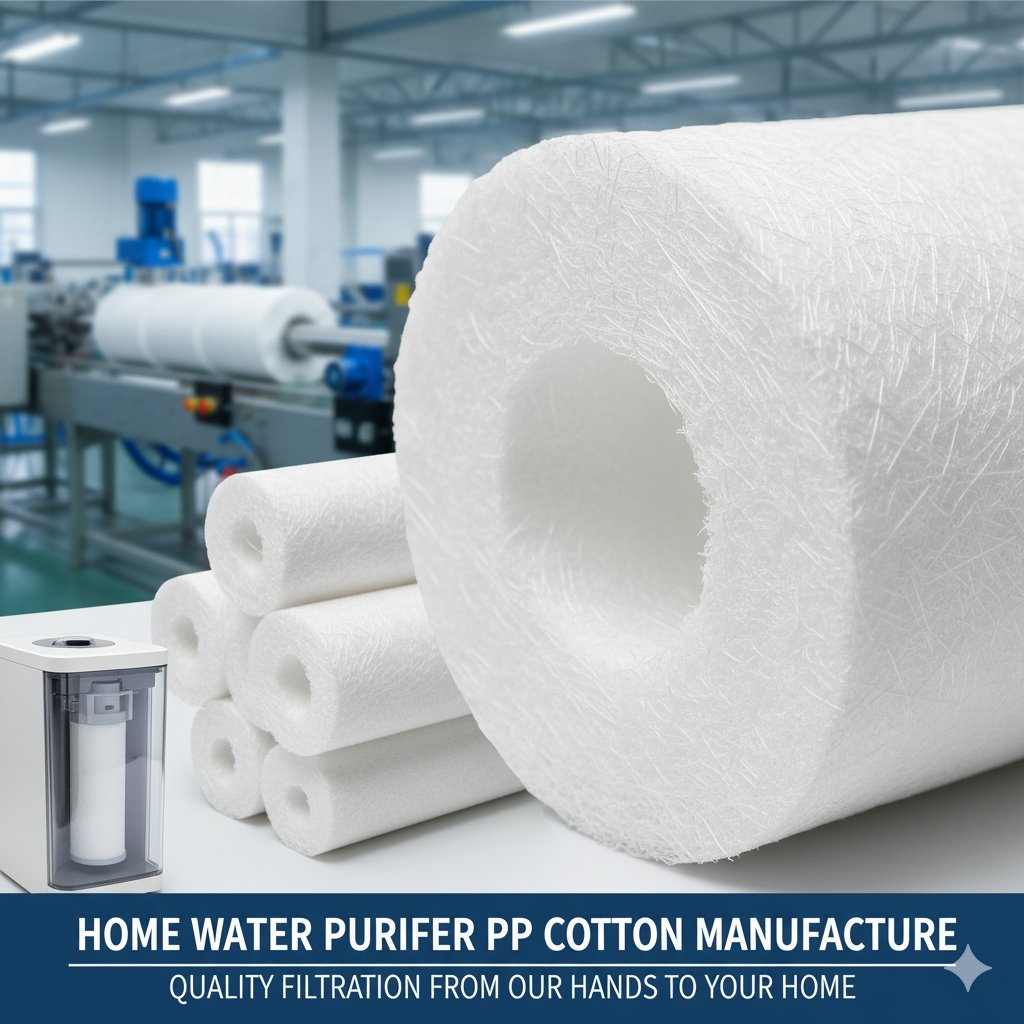
This topic is covered in full in our main guide: PP Cotton Household Water Purifier Factory: From Production to Performance.
Introduction
The phrase home water purifier pp cotton manufacture captures a specific but high-impact segment of the water-treatment value chain: producing polypropylene (PP) melt-blown sediment media for household water purifiers. These humble cartridges sit at the front line of almost every filtration train, protecting downstream carbon blocks, membranes, and appliances by capturing sand, rust, silt, and other particulates. When manufactured to consistent standards, PP cotton filters quietly reduce complaints, extend component life, and cut service costs. When manufactured poorly, they cause early clogging, first-use turbidity, and warranty headaches.
This article walks through the end-to-end process of designing, manufacturing, validating, and commercializing PP cotton cartridges for home water purifiers. It’s written for product managers, procurement teams, factory engineers, and founders who want to turn a commodity raw material into a reliable, differentiated product. Along the way we’ll cover resin selection, melt-blown process controls, graded-density design, cartridge conversion, mechanical and performance testing, packaging and logistics, regulatory and safety checkpoints, and commercial strategies that preserve margin while improving customer outcomes. For system-level context—how PP cotton pre-filters fit into whole-house strategies—consider comparing specs against representative whole-house units such as this example: 2-stage whole house water filter for homes.
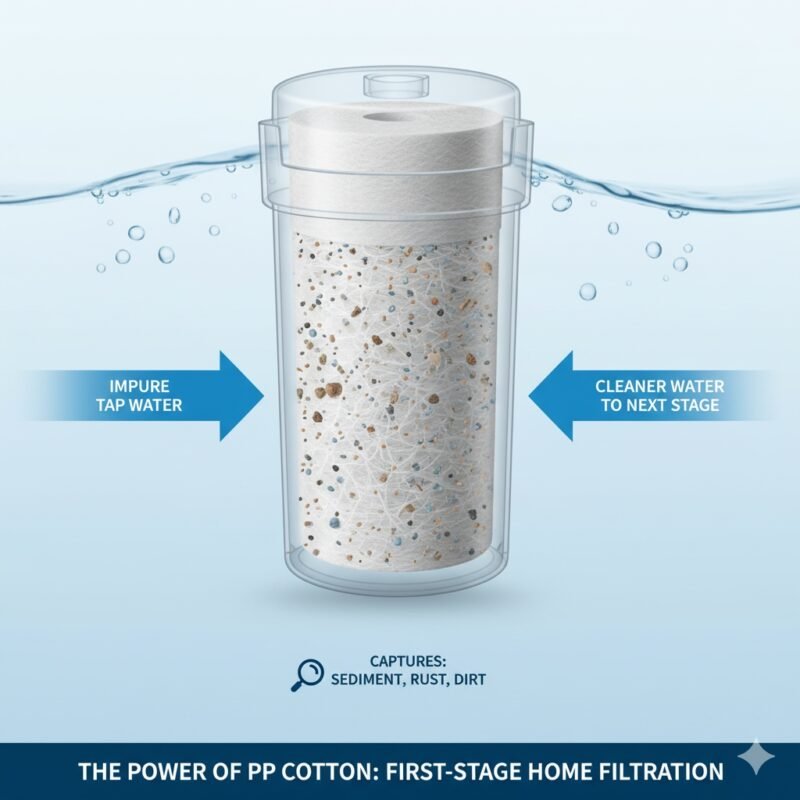
Why PP Cotton Matters for Home Water Purifiers
PP cotton (melt-blown polypropylene depth media) is the standard workhorse for sediment filtration because it offers a combination of low cost, graded-density capture, chemical inertness in potable water, and scalability. Its primary roles include:
- Particle protection: Intercepting particulate before they reach carbon, membranes, or appliances.
- Extend downstream life: Reducing fouling and premature exhaustion of higher-value media.
- Improve perceived quality: Less cloudy water, fewer deposits in kettles and coffee machines, and improved clarity in ice.
- Low cost and disposability: Cheap enough to be a replaceable component in regular maintenance plans.
These benefits translate into measurable value for homeowners and channel partners: fewer service calls, reduced appliance wear, and an easier path to recurring revenue through cartridge replacements.
Key Design Choices: Resin, Fiber, and Structure
Getting PP cotton right begins with resin selection and process design. The core technical choices influence capture efficiency, pressure drop (ΔP), initial fines, and longevity.
Resin Grade and Approval
Choose potable-water-grade polypropylene resin with stable melt flow index (MFI) and documented food-contact or potable-water compliance. Key parameters buyers or engineers should request from suppliers:
- Certificate of Analysis (CoA) showing resin grade and approval for potable water (FDA or equivalent).
- Melt Flow Index (MFI) range — tighter MFI yields more consistent fiber diameters.
- Additive profile — minimize slip agents or non-approved processing aids that could elevate extractables.
Consistency in resin batches reduces run-to-run variability in the finished cartridge.
Melt-Blown Web Structure
The melt-blown process creates a nonwoven web of microfibers whose pore structure determines performance:
- Fiber diameter distribution: Smaller fibers increase capture efficiency at a cost of higher ΔP; larger fibers reduce ΔP but capture coarser debris.
- Web basis weight: Higher basis weight increases dirt-holding capacity and life but can increase pressure drop.
- Graded-density (gradient) structure: A common design: coarser outer layers capture large particles and prevent rapid surface blinding; progressively finer inner layers capture smaller particulates. Graded density extends life while keeping ΔP manageable.
Designing a gradient web—where outside layers might nominally be 20–50 µm and inner layers 1–5 µm—gives excellent balance in many household scenarios.
Additive and Binder Choices
Melt-blown PP is typically self-binding due to entanglement of fibers, and thermal bonding is preferred. Avoid solvent-based binders or adhesives that might increase extractables. If stabilizers are needed, ensure they are potable-grade and documented.
Process Controls: Turning Resin into Reliable Media
Transforming resin into consistent melt-blown web requires tight control of many process variables. If you manufacture media in-house or qualify a media supplier, insist on documented process controls.
Die Temperature and Air Attenuation
Die temperature and air velocity during melt-blowing control fiber diameter. Small changes shift the fiber diameter distribution and influence retention and ΔP. A well-controlled line will log these parameters per roll and link them to roll IDs.
Throughput and Collector Speed
Polymer throughput and collector speed jointly set web thickness and basis weight. Use inline basis-weight gauges to reject off-spec rolls automatically. Aim for process capability metrics (Cp/Cpk) that indicate stable manufacturing.
Environmental Controls
Humidity and temperature in the production area affect cooling and web formation. Maintain stable environmental conditions or apply compensatory process settings to maintain consistency.
Filtration and Dust Control
Media production can generate fines. Good manufacturing includes dust control and post-processing wash/conditioning steps to minimize first-use fines in finished cartridges.
Cartridge Conversion: From Web to Usable Component
Once rolls of melt-blown web are produced, converting them into cartridges requires careful engineering to avoid bypass, collapse, or early failure.
Geometry and Form Factors
Standard household cartridges come in several form factors: 10″ and 20″ lengths for under-sink or inline modules, larger pleated cartridges for whole-house housings, and custom small capsules for fridge lines. Choose geometry that matches the intended housing and flow rates.
Core Strength and End-Cap Design
Cores must resist collapse under expected operating pressures and when wet. Use cores with verified collapsing pressure ratings and validate via mechanical testing. End-caps should provide robust sealing surfaces and be designed for the housing type (o-ring groove vs flat face). Thermal bonding of end-caps is preferred for food-safety reasons.
Pleating vs Wrapped Elements
Pleated elements increase surface area and are common in whole-house high-flow designs. Wrapped or rolled elements are typical in POUs. Pleating machines must produce consistent pleat spacing and maintain seam integrity.
Sealing and O-Rings
Specify gasket material (EPDM, silicone) based on chemical compatibility and compression set characteristics. Test o-ring aging to prevent leaks over prolonged service life.
Performance Testing: Proving the Cartridge Works
Performance testing is non-negotiable. Buyers and OEMs should insist on lot-level testing and certificates that document performance at representative conditions.
ΔP vs Flow Curves
Provide measured initial pressure drop across the cartridge at representative flows (0.5–2 GPM for POU; 8–15+ GPM for POE). Homeowners notice reduced pressure quickly; keeping ΔP low at normal flows avoids complaints.
Dirt-Holding Capacity
Run a standardized particulate challenge until ΔP reaches a predefined service endpoint (for example, 15 psi). Report grams retained. This predicts replacement intervals and helps size maintenance programs.
Particle Retention Efficiency
Report percent capture at relevant micron sizes—e.g., percent removal at 1 µm, 5 µm—while documenting test challenge specifics. Define whether ratings are nominal or absolute.
Initial-Fines and Extractables
Measure particulate and organic extractables during recommended first flush volumes. High initial fines generate immediate complaints and returns. Conditioning or factory rinse steps can mitigate this.
Mechanical and Burst Tests
Run end-cap pull tests, core collapse tests, and burst tests at >1.5× rated pressure. Mechanical failures are costly in the field; design with safety margins.
Quality Systems and Traceability
Repeatability depends on quality systems that link every finished cartridge to raw material lots and process logs.
Lot-Level CoAs and Retained Samples
Produce and ship a Certificate of Analysis (CoA) with each lot that lists resin lot numbers, carbon batch (if combined), measured ΔP at specified flows, and dirt-holding capacity. Retain samples from each lot for at least 6–12 months to enable RCA in the event of field failures.
Statistical Process Control (SPC)
Apply SPC to critical process variables—web basis-weight, die temp, collector speed—and monitor Cp/Cpk. Use automated rejection where feasible to prevent downstream conversion of off-spec material.
Incoming Material Inspection
Check resin MFI, carbon mass and particle distribution, and gasket hardness on receipt. Reject or quarantine any lot without a valid CoA.
Packaging and Logistics: Keeping Cartridges Healthy in Transit
Cartridges can deform, collect dust, or otherwise degrade during transit. Packaging must be specified and validated.
Individual Sealing and Master Cartons
Bag each cartridge in a food-grade polybag to prevent fines migration. Use master cartons with adequate inserts and padding for pleated elements. Print lot codes and CoA references on cartons for traceability.
Environmental Protection
If shipping membranes or sensitive components alongside cartridges, use desiccants and consider temperature-controlled containers for long transits in hot climates.
Storage Recommendations
Provide clear storage guidance: cool, dry, away from UV, and avoid heavy stacking that could deform pleated elements.
Regulatory and Safety Considerations
Ensure all wetted materials are potable-water compatible and that health claims are supported by appropriate certifications.
Material Declarations
Maintain MSDS and CoAs for resin, carbon, and adhesives. For imported resin, verify food-contact or potable-water certifications required in target markets.
Certification Strategy
If you plan to make health-effect claims (lead reduction, cyst removal), partner with NSF/ANSI labs and pursue model-level certification where needed. For sediment-only cartridges, certification needs are lower but still document material safety.
Commercial Strategies: Differentiation Beyond Price
The PP cotton market is crowded; manufacturers and brands win by making measurable improvements in user experience and supporting channel partners.
Low-Fines Conditioning
Offering cartridges that have been factory-conditioned or pre-flushed to remove fines reduces early complaints. This can be a clear differentiator versus commodity cartridges.
Graded-Density Optimization
Publish ΔP curves and dirt-holding data that show longer life for your graded-density designs versus single-density competitors. Contractors prefer longer-life cartridges even at slightly higher unit cost.
Easy Cross-Reference and Compatibility
Provide cross-reference charts to popular housings and clear fitment guides. Installers value parts that match.
Subscription and Consumables Strategy
Position cartridges within a subscription model: home delivery of replacement cartridges at predictable intervals reduces friction and locks in lifetime value.
Sustainability and End-of-Life
Responsible manufacturers consider end-of-life impacts and design for lower waste.
Durable Housings and Replaceable Media
Encourage or supply durable housings where consumers only replace the internal media. This reduces waste compared to fully disposable sealed modules.
Recycling Pilots
Investigate cartridge take-back or recycling partners. PP can be recycled but often requires separation from gaskets and adhesives—pilot programs can target high-volume regions.
Recycled Content Caution
If using recycled PP resin, validate extractables and leachables thoroughly. Potable-water safety must not be compromised for sustainability messaging.
Manufacturing Economics and Scale
Understanding cost drivers helps design a viable manufacturing and pricing strategy.
Primary Cost Drivers
- Resin cost and variability.
- Media production yield (roll rejections raise cost).
- Conversion labor and automation level (pleating adds cost but extends life).
- Testing and CoA generation (lab time).
- Packaging and logistics, especially for international distribution.
Scale and Automation
Automate conversion (slitting, end-cap placement, thermal bonding) where volumes justify capex. Increased automation reduces labor variability and improves yield, which in turn supports stable pricing for customers and wholesalers.
Field Support, RMA Handling, and Continuous Improvement
Even with rigorous controls some field failures happen. Fast, transparent RMA processes preserve relationships.
RMA Triage and Sample Comparison
Implement a rapid triage workflow: request lot code and install photos, collect failed cartridge, compare against retained production sample, run ΔP and extractables tests, and issue RCA with CAPA where needed.
Data-Driven Improvements
Use RMA data to identify upstream drift—resin batch changes, die temperature variance, bonding anomalies—and adjust SPC setpoints or supplier relationships accordingly.
Integrating PP Cotton into Whole-Home Solutions
PP cotton pre-filters are often the first line in multi-stage whole-house systems. Proper sizing and flow-matching are crucial.
- For whole-house installs, pleated high-capacity elements reduce ΔP at peak flows (8–20 GPM) and extend service intervals.
- Pair PP cotton pre-filters with appropriately sized carbon polishing modules or specialty media depending on local disinfectant (chlorine vs chloramine) and organics.
- When planning whole-home staging, compare cartridge ΔP curves with representative system capacities such as the whole-house product linked earlier: 2-stage whole house water filter for homes.
Selling to Channels: OEMs, Installers, and Retail
Different channels have distinct needs:
- OEMs: Require tight traceability, private-label options, and predictable lead times. Offer CoA and retained-sample policies as standard.
- Installers/Contractors: Require compatibility, strong mechanical integrity, spare part kits, and training materials. Provide bulk packs and starter kits.
- Retail/Consumer: Emphasize ease of replacement, clear instructions, and subscription options. Include visible change-date labels and QR-code videos.
Conclusion: Turning a Commodity into a Reliable Product
The phrase home water purifier pp cotton manufacture encapsulates a deceptively broad technical and commercial challenge. Done right, PP cotton cartridges are inexpensive, reliable first-line defenders in every home’s filtration train. Done poorly, they are an endless source of customer frustration and warranty cost.
The difference lies in discipline: select potable-grade resin with stable MFI; control melt-blown process variables and environmental conditions; design graded-density webs tailored to application; convert cartridges with robust cores and thermal bonds; run lot-level ΔP, dirt-holding, and extractables tests; package to protect media in transit; and back products with retained-sample traceability and a fast RMA process. Combine those capabilities with channel-appropriate commercial strategies—OEM support, installer enablement, subscription offerings—and PP cotton becomes more than a commodity: it becomes a dependable, profitable part of a home water solution.
If you’re sizing PP cotton pre-filters within a larger whole-house strategy, it helps to review representative whole-house products to align flow, ΔP, and replacement intervals: 2-stage whole house water filter for homes. Use measured data, not marketing claims, to engineer the right cartridge, and you’ll cut returns, extend downstream media life, and make maintenance predictable for everyone involved.