Industrial RO Systems for Manufacturing Plants: Engineering Around Your Existing Utility Infrastructure

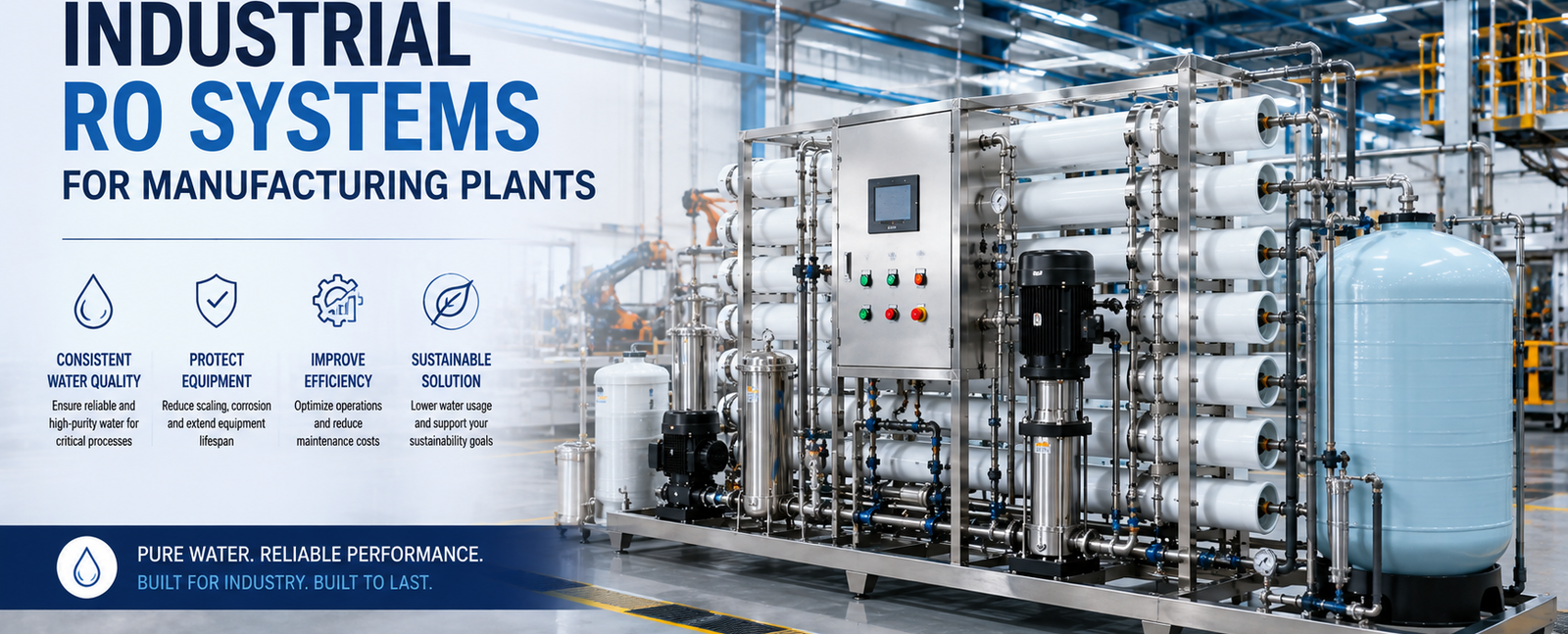
A TDS spike from a municipal main or a hardness swing from a well feed doesn’t evaluate itself against a spec sheet — it shows up as a rejected plating batch, a fouled heat exchanger, or a wafer rinse line out of tolerance. For a manufacturing plant, water-quality variation is a yield problem before it’s ever a maintenance ticket.
Before evaluating any vendor, lock these specs into the RFP:
- Which department’s water demand the system serves — process rinse, boiler feed, and cooling makeup carry different quality targets and can’t be sized off one blended average.
- How the new system ties into existing plant utilities — steam headers, cooling loops, and your existing wastewater treatment capacity, not a standalone install.
- Continuous duty-cycle rating at real peak GPM demand across shifts, with automated CIP integration that doesn’t interrupt production.
- 316L stainless steel or high-grade UPVC wetted materials rated for continuous high-PSI operation.
- A temperature-correction margin built into membrane sizing, hedging against seasonal flux decay.
Sourcing the right industrial RO system for a manufacturing plant starts with treating it as a utility integration project, not an isolated equipment purchase.
Fast Check Product:https://yourwatergood.com/water-filtration-food-beverage-industry/
Water Quality Requirements Across Manufacturing Verticals
A blanket water-quality spec is how a plant either over-engineers a simple rinse application or under-engineers a process that can’t tolerate variability. Requirements diverge sharply by vertical.
- Metal finishing and electroplating — rinse water purity directly affects drag-out contamination, plating adhesion, and reject rates. Low-TDS or deionized final-rinse water is standard practice, not an upgrade.
- Electronics and semiconductor manufacturing — wafer rinse water demands extend well beyond single-pass RO, often requiring resistivity approaching the theoretical maximum of 18.2 MΩ·cm. An industrial RO system typically serves as the primary desalination stage feeding a downstream EDI or mixed-bed polishing train, not a complete ultrapure water solution on its own.
- Chemical processing — process water consistency affects reaction chemistry and corrosion rates on process equipment, which is why 316L stainless steel wetted components matter as much for the water system as for the process vessels downstream.
- Automotive parts and e-coat paint lines — final rinse water quality affects paint adhesion and finish consistency; mineral spotting from hard or high-TDS rinse water shows up as a visible defect, not just a lab number.
Matching the technology to the vertical — not defaulting to a generic industrial spec — is what keeps a manufacturing plant from paying for capacity or purity it doesn’t need, or under-buying capacity it can’t operate without.
Municipal vs. Well Feed: Pretreatment Logic Ahead of the RO Stage
Feed water source still dictates the pretreatment architecture, regardless of which manufacturing vertical the plant serves.
Municipal potable feed:
- Chlorine and chloramine removal protects the RO membrane from oxidative damage.
- Soluble inorganic salts set the RO sizing baseline; carbon filtration protects the membrane, not the process.
Well feed:
- Hardness, dissolved iron and manganese, and silica each need a dedicated pretreatment step — softening, oxidation/filtration, or antiscalant dosing — before the RO stage.
- Well chemistry shifts seasonally, and a manufacturing line running to a fixed process tolerance needs that variability engineered out before it reaches the RO array, not compensated for downstream.
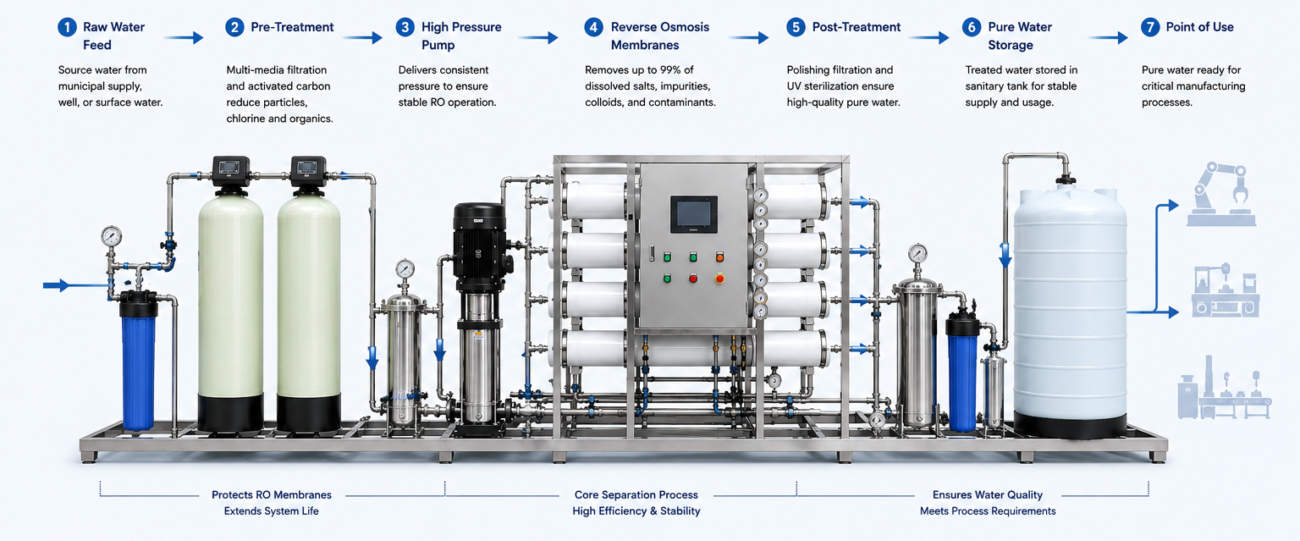
A resilient architecture runs a five-stage sequence: multimedia filtration, activated carbon for chlorine and organics, ion-exchange softening, a precision security filter, and the RO membrane array — each stage protecting the one after it, and ultimately protecting yield.
Standard Pre-Engineered Skids vs. Fully Customized Turnkey Systems
Not every packaged RO skid marketed to manufacturing plants is engineered to the same standard. The table below separates a catalog unit from a system built for continuous multi-shift operation.
| Engineering Parameter | Standard Pre-Engineered Skids | Fully Customized Turnkey Systems |
|---|---|---|
| Flow capacity (GPM) | Fixed, single-train sizing | Custom-sized, multi-train scalable |
| CAPEX structure | Lower upfront, component-based | Higher upfront, single consolidated price |
| Lead time | Shorter — built to stock configurations | Longer — engineered to site-specific water analysis and utility tie-in |
| PLC integration | Basic relay logic or standalone HMI | Siemens or Allen-Bradley platform, integrates with existing plant SCADA |
| Redundancy | Typically none — single point of failure | N+1 or 2N engineered across the train |
A standard skid fits a plant with a single, well-characterized water use and modest uptime requirements. A fully customized turnkey system fits a facility where a process line stoppage costs more in a single shift than the CAPEX premium — and where the new system has to integrate with utilities that already exist.
Request a Custom CAD Skid Diagram or Water Analysis Review to confirm tie-in points with your existing steam, cooling, and wastewater infrastructure before the skid is fabricated — not after it arrives on a truck sized for a doorway that doesn’t fit it.
Tying Into Existing Plant Infrastructure: Brownfield Retrofits and Capital Project Sequencing
Most manufacturing plant RO projects aren’t greenfield installs — they’re retrofits into a facility that’s already running.
- Brownfield retrofits need to work around existing piping runs, electrical capacity, and floor space that wasn’t planned around a water treatment skid. A pre-piped, factory-assembled unit reduces the number of field connection points compared to a component-by-component build.
- Utility tie-in — the new system’s reject stream and CIP discharge need a defined path into existing wastewater treatment capacity, not an assumption that current WWTP capacity has headroom.
- Capital project sequencing — for larger installs, the water system typically needs to be commissioned ahead of the process lines it feeds, which means lead time has to be built into the broader project schedule, not treated as a parallel workstream that can slip independently.
- Electrical and controls integration — a PLC-based system on a Siemens or Allen-Bradley platform should be specified to integrate with the plant’s existing SCADA architecture, not run as an isolated island system nobody on the plant floor can monitor.
Field Engineering Insight: Cold-Water Flux Decay in Multi-Shift Manufacturing Operations
This is the detail that catches plant engineers off guard when a system that performed fine in commissioning starts underperforming months later.
When well feed temperature drops toward 50°F (10°C) — common in winter or with deep well sources — water viscosity increases measurably. If the system wasn’t sized with a temperature correction factor — typically 30%–40% additional membrane area — it can’t hit rated GPD output at that lower temperature, right as a multi-shift plant’s total daily demand stays constant regardless of season.
The usual compensation is the wrong one: the high-pressure pump gets pushed to a higher PSI to force the same flow through less-efficient membranes. That drives energy costs up and accelerates scaling and fouling, especially if the antiscalant dosing pump wasn’t calibrated to the feed water’s actual silica and calcium concentration. On a plant running three shifts, that fouling curve compounds fast — there’s no idle period between shifts to absorb reduced output, which is exactly when an under-sized system turns into an unplanned production stoppage.
Industrial RO Systems for Manufacturing Plants FAQs
What flow capacity does a manufacturing plant need from an industrial RO system? Most modular skids cover 4–44 GPM (roughly 6,300–63,400 GPD) per train. Plants running multiple departments with overlapping water demand typically move to multi-train, custom-engineered configurations.
How does an industrial RO system integrate with existing plant utilities? The system’s reject stream and CIP discharge need a defined path into existing wastewater treatment capacity, and the PLC control platform should integrate with existing plant SCADA rather than running as an isolated system.
Does electronics manufacturing need more than standard industrial RO? Yes. Semiconductor and electronics rinse water typically requires resistivity approaching 18.2 MΩ·cm, which means industrial RO serves as the primary desalination stage feeding a downstream EDI or mixed-bed polishing train, not a standalone solution.
How much TDS can an industrial RO system remove? In documented field cases, raw feed TDS has been reduced from 1,300 ppm to under 20 ppm in a single pass, and under 10 ppm in a two-pass configuration. Actual rejection depends on raw water chemistry.
What’s the difference between a standard skid and a custom turnkey system for a manufacturing plant? A standard skid is fixed-capacity and built to stock; a turnkey system is sized to your actual water analysis and utility tie-in points, includes PLC/SCADA integration, and is engineered with redundancy (N+1 or 2N) across the train.
Does cold well water affect a manufacturing plant’s RO system in winter? Yes. Below 50°F (10°C), viscosity increases enough to reduce flux. Systems without a temperature correction factor (typically 30%–40% extra membrane area) tend to compensate with higher PSI, which accelerates scaling.
What inlet pressure does an industrial RO system require? A minimum of roughly 0.2 MPa (~29 PSI) at the booster pump inlet. Sites below that threshold need a pre-boost pump stage specified at design time.
Get an Engineered Quote for Your Manufacturing Plant
Sizing an industrial RO system against your actual water analysis and existing utility infrastructure — not a generic industrial estimate — is what keeps the project on schedule and the membrane warranty valid.
- Get an Industrial Engineering Quote: send your water analysis and utility tie-in details for a sized proposal.
- Request Technical Data Sheets & P&ID Drawings: get the full engineering submittal package for your project file.
- Get B2B Wholesale / Factory-Direct Pricing: request competitive pricing sourced through our vetted manufacturing network.
Whether the project is a brownfield retrofit or a new production line, the industrial reverse osmosis system architecture above is engineered to hold flux, hold pressure, and integrate with the plant you already have — not just the one on a clean-sheet drawing.