
Scaling Success with oem pp cotton filter: Design, Manufacture, and Sell High-Quality Sediment Cartridges

Introduction
The market for high-performance sediment cartridges is booming — from under-sink systems to whole-house housings and commercial ice machines. If your company wants to capture private-label and OEM volume without sacrificing product quality, mastering the production and commercialization of the oem pp cotton filter is essential. This article lays out everything you need: the technical basics of melt-blown polypropylene media, design and specification choices that win customers, manufacturing best practices, quality control and certification pathways, packaging and logistics, commercial models for OEM partnerships, pricing and margin mechanics, and after-sales strategies that protect your brand and your buyers’ reputation.
Throughout the piece you’ll find practical, actionable information you can apply whether you’re a factory launching a new SKU, a purchasing manager sourcing contract suppliers, or a brand team preparing a private-label lineup. For product discovery and retail presentation examples you can reference, check manufacturer product pages and shopping resources such as https://yourwatergood.com/ and https://yourwatergood.com/shop/.
Why focus on the oem pp cotton filter?
PP melt-blown (often called “PP cotton”) is the cornerstone sediment medium in water treatment. It’s low-cost, easy to manufacture at scale, chemically inert for potable water, and — when engineered correctly — provides excellent dirt-holding capacity with manageable pressure drop. For OEM customers the appeal is clear:
- predictable consumable demand (replacement cartridges);
- low SKU complexity for many housing platforms;
- high unit economics when you control media quality and conversion processes;
- broad compatibility with point-of-use (POU) and point-of-entry (POE) housings.
A well-engineered oem pp cotton filter becomes the recurring-revenue backbone of distributor and installer channels. But the difference between a commodity and a premium product lies in specification, testing, and reliability.
Understand the media: what “PP cotton” really is
Melt-blown polypropylene is a nonwoven depth filter. Unlike surface filters that block particles on the face, depth filters capture particles throughout the thickness of the media, which gives them high dirt-holding capacity and slower differential-pressure rise.
Key media attributes to control:
- Fiber diameter and distribution — determines capture efficiency for different particle sizes.
- Filtration gradation (graded density) — many premium cartridges use a coarse-to-fine density profile to trap large particles on the outer layers and fine particles deeper inside.
- Basis weight and web uniformity — affects dirt capacity and differential pressure (ΔP).
- Binder and thermal bonding parameters — ensure structural integrity and avoid media shedding.
- Initial fines — leftover fines from conversion can cloud first-use water; conditioning or washing protocols mitigate this risk.
For OEM customers, publish clear technical specs—micron rating (with test method), ΔP vs flow curves, dirt-holding capacity, and first-flush behavior—so resellers can confidently market and install.
Specify, don’t guess: creating commercial product specifications
OEM buyers make decisions based on measurable numbers. A plain “5µm” label is not enough. Your spec sheet for an oem pp cotton filter should include:
- Nominal vs absolute micron rating and the test standard used (e.g., ASTM, ISO).
- Initial ΔP at specific flows (e.g., 0.5 GPM, 1.0 GPM) and a ΔP vs GPM chart.
- Dirt-holding capacity expressed as grams retained to a defined service ΔP endpoint (e.g., 15 psi increase).
- Material declarations and CoA for PP resin (FDA/NSF potable material statements if available).
- Burst and collapse pressure and end-cap pull strength.
- Recommended first-flush volume and conditioning instructions.
- Shelf life and storage conditions (important for long supply chains).
These data points reduce RMA rates and help OEM partners calculate replacement cadence — a crucial metric in subscription and consumable models.
Design choices that matter
When designing a new oem pp cotton filter SKU, decisions fall into performance, compatibility, and user experience buckets.
Performance
- Micron gradation: pick graded densities for high dirt hold with low ΔP. A nominal 5 µm graded design will outperform a single-density 5 µm in both throughput and longevity.
- Length and diameter: 10″ and 20″ lengths are standard for housings; larger 2.5″×20″ pleated variants add capacity for POE use.
- End-cap materials and sealing: ensure O-ring compatibility (EPDM, Buna, silicone) and include color-coded end caps for quick SKU recognition.
Compatibility
- Standardized form factors: match common housing standards (e.g., 2.5″×10″, 2.5″×20″) to reduce confusion.
- Performance across flows: publish ΔP curves so installers can verify operation at the specific GPM their equipment needs.
User experience
- First-flush instructions printed on the package to prevent customer complaints about cloudy first use.
- Conditioned/washed option: offer preconditioned cartridges for premium channels to remove initial fines.
- Clear labeling with lot code and production date for traceability.
Manufacturing: process and scale
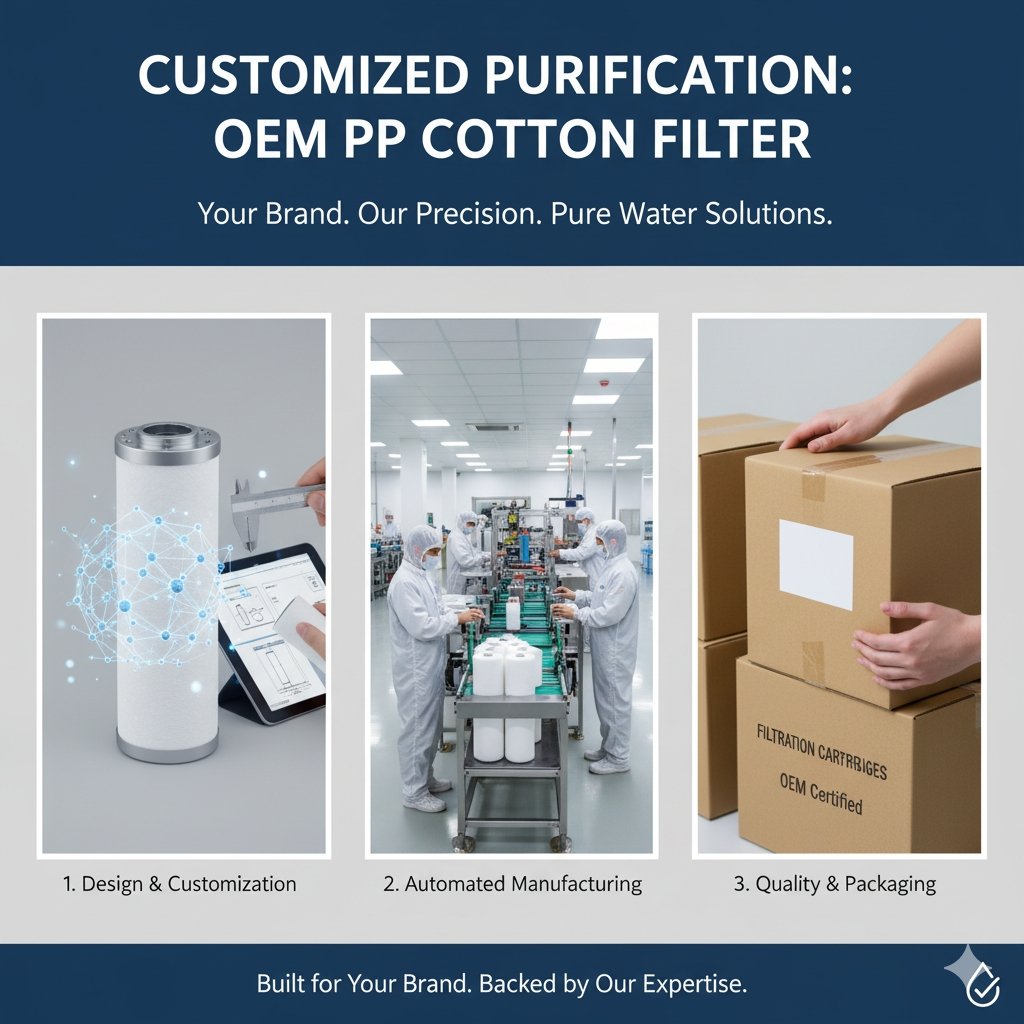
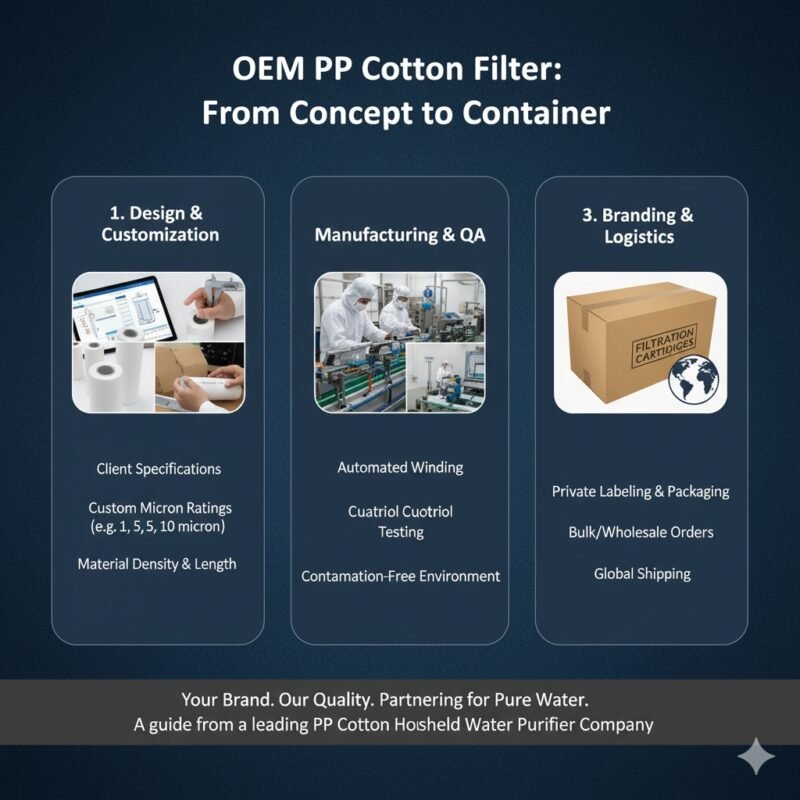
Producing reliable melt-blown cartridges at scale means controlling both media production and conversion (cutting, end-cap assembly, bagging).
Media production
- Melt-blown die and extruder control: run SPC on melt temperature, die pressure, air flow, and collector speed. Variations change fiber diameter and bonding.
- Basis weight mapping: measure across the web to ensure uniformity.
- Inline testing: measure pore size distribution and initial ΔP during R&D and periodically during production.
Conversion and assembly
- Dimensional accuracy: ensure cores, end caps, and media lengths meet housing tolerances.
- Sealing quality: ultrasonic or thermal welding methods must be validated to avoid leaks and particle shedding.
- Bagging and packaging: individually sealed in PE bags reduces contamination and initial-use fines; batch-coded master cartons help traceability.
Environmental and safety controls
- Clean assembly area: reduce particulate contamination—especially important for foodservice or medical markets.
- Employee training: standardized procedures reduce lot variations and RMAs.
Quality control and testing to reduce RMAs
The difference between a one-time order and repeat OEM contracts is low RMA rates. Implement these QC measures:
- Retained sample policy: keep a production sample from every lot for at least 6–12 months.
- Lot-level CoA: include measured ΔP, micron test method, and dirt-holding numbers on shipped CoAs.
- Incoming raw material checks: PP resin CoA, core material verification, O-ring hardness tests.
- Random lot testing: run a subset of cartridges for burst, pull, ΔP, and initial-fines tests.
- Field feedback loop: capture install data and any returns; perform RCA and CAPA when thresholds exceed targets.
Testing protocols to publish
- ΔP vs flow curve using standardized water viscosity and temperature conditions.
- Particulate capture tests with polystyrene latex (PSL) spheres or defined particulate slurries to demonstrate nominal/absolute capture.
- Initial-fines turbidity test after a standard first-flush volume to demonstrate readiness for immediate use.
- Microbial and extractables screening if selling into sensitive markets.
Certifications and regulatory requirements
Different markets require different documentation: NSF, FDA food contact statements, local potable approvals. For OEM success, consider:
- NSF/ANSI 42 for chlorine/taste/odor claims if using carbon combos.
- NSF/ANSI 61 for material safety where applicable.
- Food contact (FDA) statements for packaging and materials used in foodservice.
- ISO 9001 quality system certification to reassure larger brand partners.
Even when full certification is not required, having test reports and a documented quality system speeds procurement for large buyers and distributors.
Packaging, labeling, and documentation
Packaging is more than branding — it’s a performance and logistic enabler.
Essential packaging elements:
- Individual sealed bags to prevent shipping dust and protect media.
- Clear quick-start install label on each cartridge (first flush volume, orientation).
- Lot code and production date printed on both cartridge and master carton.
- Material declarations and CoA QR code so resellers can quickly verify claims.
- Retail vs installer packaging variants: consumer retail boxes need UPC and shelf appeal; trade packs focus on bulk economics and technical data.
Logistics and inventory planning
Consumables must be available when replacement cycles occur. Plan for:
- Forecasting by installed base: conversion of systems to recurring cartridge demand is a predictable revenue stream — model installed units × replacement cadence to set production and safety stock.
- Lead times and MOQs: offer pilot MOQs for new OEM partners (e.g., 250–1,000 units) and tiered pricing for larger volumes.
- Regional warehousing: position inventory near major markets to reduce shipping time and cost.
- Expiration policy: while PP is stable, some buyers prefer >1 year shelf life guarantees—document storage recommendations.
Commercial models for OEM partnerships
There are several go-to-market models to scale oem pp cotton filter sales:
- White-label / private label
- Manufacturer produces cartridges, buyer brands and retails. Provide flexible packaging and artwork services. Offer MOQ tiers and pilot runs.
- Co-branded supply
- Supply cartridges with joint branding for installers or retailers. Often used when the supplier’s credibility and the buyer’s channel strength combine.
- OEM contract manufacturing
- Long-term supply agreements with fixed pricing bands, JIT delivery, and quality audits. Favorable for stable, high-volume buyers.
- Direct replacement subscription
- Provide direct-to-consumer subscription services for cartridges. Requires fulfillment capability and marketing support but greatly increases LTV.
Pricing, margins, and unit economics
Understand the math. Key components of per-unit cost:
- Media cost (resin) — primary material cost.
- Core and end-cap components — plastic injection molded parts and adhesives.
- Labor and conversion — cutting, assembly, QC.
- Packaging and logistics — sealed bags, master cartons, freight.
- Warranty and RMA reserve — budget for replacements and testing.
- Overhead and factory amortization.
Pricing strategy:
- Trade channels often accept lower per-unit margins but higher volume.
- Retail and direct allow premium pricing for conditioned/premium SKUs.
- OEM contracts favor steady pricing with volume tiers and potential annual price indexation tied to resin costs.
Example pricing model (illustrative):
- COGS per 10″ cartridge: $2.50 (materials $1.50, labor/overhead $0.60, packaging $0.40)
- Wholesale price (distributor): $6.00–$9.00
- Retail price: $15.00–$25.00 (depending on brand and retail channel)
Margins scale as volume increases and production efficiencies improve.
Marketing and selling OEM cartridges
Selling oem pp cotton filter requires both technical trust and compelling commercial offers.
Sales collateral to develop:
- Technical spec sheets (with ΔP curves and dirt-holding data).
- Quick installation guides and troubleshooting for installers.
- Test reports and CoAs for procurement buyers.
- Marketing kit: high-res images, retail box art, SKU cross-reference tables.
Channels and tactics:
- Trade shows and installer demos — bring demo rigs to show ΔP and flow performance.
- Distributor sampling programs — provide sample packs to wholesalers and show them replacement cadence economics.
- Content marketing — publish data-driven posts explaining the benefits of graded media and conditioning, linking to product pages like those on https://yourwatergood.com/ and https://yourwatergood.com/shop/.
- Subscription offers — direct channels with auto-ship and discount incentives that lock in recurring revenue.
After-sales support and reducing friction
A strong RMA and support process reduces churn.
- Fast RMA triage: initial response within 48–72 hours, clear sample policy, and rapid replacement for verified defects.
- Field training and troubleshooting: video guides for installers; quick phone/WhatsApp support to address on-site issues.
- Performance warranties: limited performance guarantees (e.g., “meets published ΔP at stated flow”) build trust with large buyers.
Sustainability and lifecycle thinking
Environmental considerations increasingly influence procurement decisions.
- Recyclable cores and packaging: use recyclable plastic for cores and minimize mixed materials that hinder recycling.
- Reduced waste SKUs: design cartridges that maximize dirt capacity so replacements are less frequent.
- Transparency: publish material declarations and any recycled content percentages. Buyers appreciate data on carbon footprint, especially large chains.
Common pitfalls—and how to avoid them
- Underspecifying ΔP: pick standard flows and publish ΔP curves; avoid “it will be fine” answers.
- Skipping retained samples: without retained samples RCA is lengthy and costly.
- No first-flush guidance: first-use complaints are a major cause of RMAs; state the flush volume clearly on the package.
- Inconsistent lots: control melt-blown process variables and keep tight SPC to avoid lot-to-lot variation.
- Weak packaging: crushed cartridges or contamination during transit leads to immediate returns—invest in sealed bags and sturdy cartons.
A practical rollout checklist for launching an OEM SKU
- Define target form factors (10″, 20″, pleated) and graded micron targets.
- Produce R&D prototypes and generate ΔP vs flow, dirt-holding, and initial-fines test data.
- Finalize conversion specs (end caps, O-rings, adhesives).
- Create CoA template and QMS docs (ISO or internal).
- Run pilot batch and retain samples; send production samples to prospective OEM buyers.
- Build packaging and labeling (lot code, first-flush instructions, CoA QR code).
- Negotiate MOQs, lead times, and pricing tiers with launch partners.
- Plan logistics (safety stock, regional warehousing).
- Train customer support and RMA teams.
- Launch with bundled marketing (samples, spec sheets, demo rigs).
Conclusion
The oem pp cotton filter opportunity is straightforward but disciplined: high recurring demand, relatively low material costs, and broad channel reach. Success depends on turning a commodity material into a dependable product through rigorous specification, consistent manufacturing, transparent testing, and supportive commercial policies. Manufacturers who invest in measured performance data (ΔP curves, dirt-holding capacity, first-flush behavior), robust QC, and clear logistics win long-term OEM contracts and create durable revenue from consumable replacement cycles.
If you’re sourcing or evaluating product models, examine vendor spec sheets closely and compare real test data. For product inspiration, retail presentation examples, and accessory grouping ideas, explore resources and product pages at https://yourwatergood.com/ and https://yourwatergood.com/shop/. With the right technical rigor and commercial execution, your oem pp cotton filter can move from commodity SKU to cornerstone consumable for installers, retailers, and end customers alike.