
How to Choose the Best water purifier vendor for Your Business: Sourcing, Vetting, and Scaling Reliable Supply

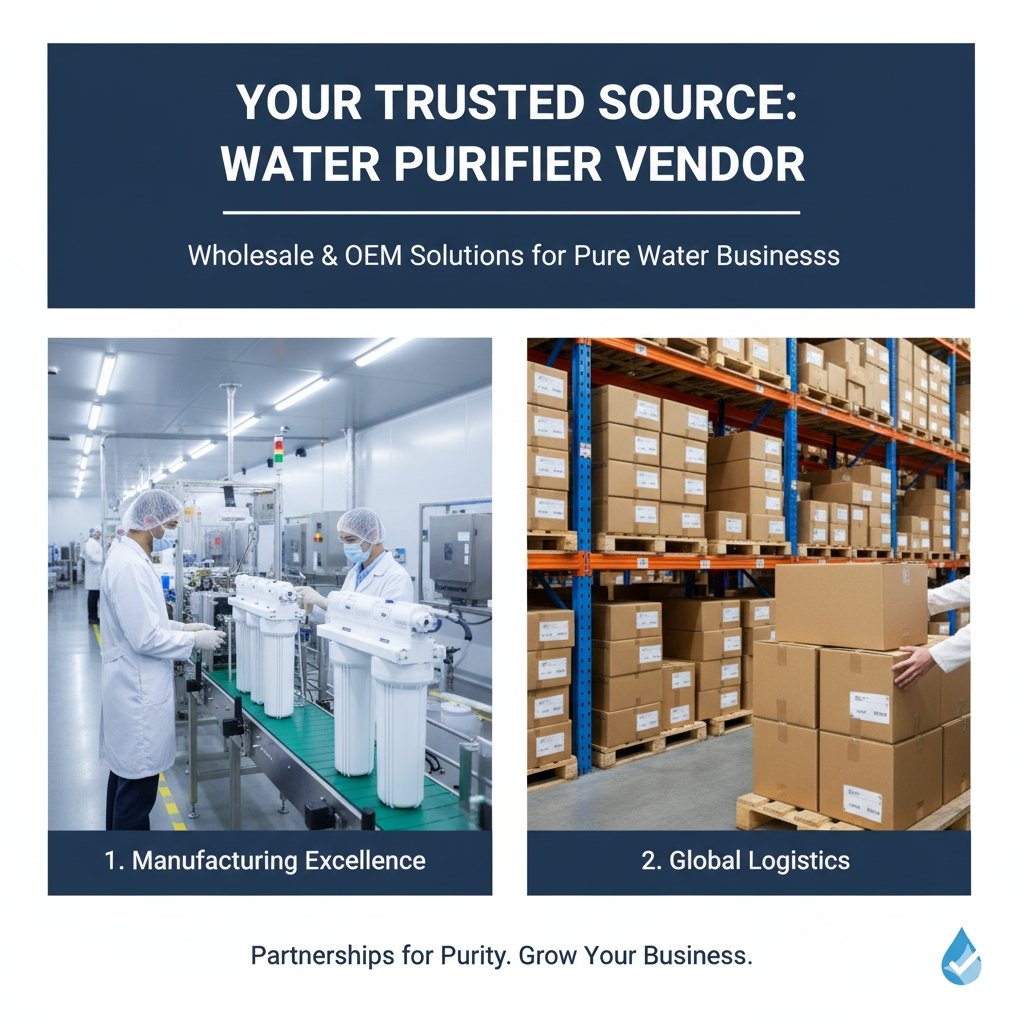
This topic is covered in full in our main guide: Water Filter Vendors: OEM Factories vs Wholesalers for B2B Buyers.
Introduction
Finding a dependable water purifier vendor is one of the most consequential procurement decisions for any company that sells water-treatment products, operates hospitality or healthcare facilities, or manages facilities with high water-quality requirements. The right vendor supplies consistent product quality, predictable lead times, clear compliance documentation, and the kind of technical support that prevents emergency downtime. The wrong one creates warranty headaches, unpredictable lead times, and reputational risk.
This article walks you, step by step, through everything a professional buyer needs to know: how to define requirements, evaluate vendors technically and commercially, check certifications and lab data, structure contracts and pricing, plan inventory and logistics, manage quality and traceability, onboard the vendor, and scale the relationship. Wherever relevant, I point you to product and shopping resources so you can review real examples and parts: YourWaterGood and our product range.
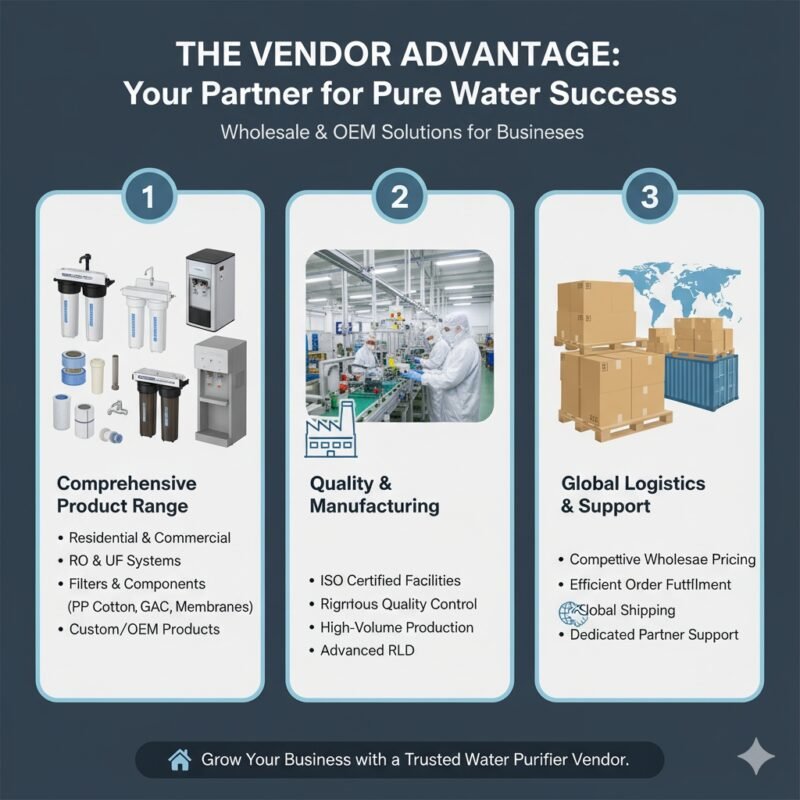
Why vendor choice matters
A water purifier vendor is not just a parts supplier — they are a partner in product reliability, brand reputation, and customer satisfaction. The most common downstream consequences of a weak vendor selection are: inconsistent product quality, high return and RMA rates, missed shipments that break subscription models, incomplete compliance documentation that blocks sales channels, and costly emergency service calls.
Good vendors decrease total cost of ownership (TCO) by supplying predictable consumables, providing performance data that reduces customer confusion, and offering proactive training and technical resources. They often become strategic allies when you need co-development, private labeling, or quick surges in capacity.
Start by defining the problem you need the vendor to solve
Before you begin sourcing, be precise about what you need. Vendors solve specific problems; if your requirements are vague you will get vague proposals.
Ask and document:
- What product categories do you need? (PP sediment cartridges, carbon blocks, RO membranes, complete POE systems, housings, UV units, pumps, etc.)
- What performance requirements must be met? (micron rating, ΔP at specified GPM, TDS rejection for RO, chlorine/chloramine reduction numbers, flow rates)
- What certifications are required to sell in your target markets? (NSF/ANSI 42/53/58, NSF 61, CE, WQA, local potable approvals)
- What commercial model do you need? (one-off purchases, consignment, private label/OEM, subscription consumables)
- What volume and forecast cadence are you expecting, including seasonal peaks?
- What lead times and logistics constraints are acceptable?
- What level of technical support and documentation will installers and customers require?
A clear requirements document prevents scope creep and ensures apples-to-apples vendor comparisons.
Where to find potential water purifier vendors
Start broad, then narrow. Typical places to find candidates:
- Industry trade shows and conferences (water-tech, plumbing, hospitality). Face-to-face inspections of booths and samples is invaluable.
- Manufacturer directories and trade associations (WQA, regional water associations).
- Online supplier platforms and B2B marketplaces — use them to shortlist but always verify independently.
- Recommendations from industry peers, installers, and distributors. A good local installer will often know which vendors ship reliable cartridges and which ones cause returns.
- Product pages and shop catalogs — review spec sheets and CoAs up front; examples include manufacturer sites and commerce pages such as YourWaterGood and our product range for inspiration on product presentation and technical detail.
Initial screening: ask the right questions early
A fast, disciplined initial screen saves time. Send a short RFQ/RFI email with these minimal asks:
- Can you supply the product SKU(s) I need? Provide datasheets.
- What are your typical MOQ and lead time? (Be explicit: e.g., 1,000 units, 6 weeks after PO).
- Do you have the certifications required for my market? Provide copies or test reports.
- Can you provide a production-run sample and lot CoA?
- What is your retained-sample policy and warranty terms?
- What are payment terms and standard incoterms? (EXW, FOB, DDP)
- What QC processes and traceability do you maintain? (ISO 9001, SPC, lot coding)
- Do you support private labeling or custom packaging? If yes, what are artwork and MOQ requirements?
If the vendor stalls on basic questions (e.g., can’t supply CoAs or refuses to discuss lead times), deprioritize them. A legitimate water purifier vendor will provide documentation quickly.
Technical evaluation: look beyond marketing claims
Marketing claims are cheap; test data is not. Your technical evaluation should focus on measurable, verifiable performance metrics.
Key technical documents and data to request:
- Product datasheet with test methods and units for each claim (e.g., “5 µm nominal” alone is not enough — ask for test method and ΔP at flow rates).
- ΔP vs flow curves and recommended maximum GPM at specified temperature.
- Dirt-holding capacity test results and the test method used (e.g., grams retained until 15 psi service ΔP).
- For carbon: iodine number, BET surface area, ash content, and regeneration method (steam activation vs chemical).
- For RO membranes: TDS rejection at specified pressure and temperature, GPD rating, membrane model/brand.
- For softeners: resin brand, grains capacity, regeneration salt usage (lbs/regen), and recommended service intervals.
- Third-party lab reports (e.g., NSF/ANSI model testing). Insist on full lab reports, not just a certificate.
- Initial-fines/first-flush particle testing to quantify the turbidity or particulate release on first use.
- Mechanical strength tests (burst pressure, end-cap pull, core collapse) for cartridges and housings.
If a vendor refuses to supply test data or gives vague answers, treat that as a significant red flag. When possible, have samples tested in an independent accredited lab using the methods you intend to reference in product marketing.
Regulatory compliance and certifications
Different markets require different approvals. Don’t assume a vendor’s “we are compliant” statement will be accepted by your procurement or regulatory team — request documentation.
Common certifications and why they matter:
- NSF/ANSI 42 — claims for chlorine, taste, and odor reduction.
- NSF/ANSI 53 — health-related contaminant reduction (lead, cysts). This requires model-level testing.
- NSF/ANSI 58 — reverse osmosis systems.
- NSF/ANSI 61 — material safety for drinking water system components.
- WQA Gold Seal — additional industry trust marker.
- CE / EMC / LVD — for electrical components intended for EU markets.
- Local potable approvals — some states/countries require local registrations or approvals for point-of-entry systems.
Verify certification authenticity by checking the certifier’s public directory or asking for the test report number. Match the model numbers and test conditions in the lab report to your intended SKU and marketing claims.
Quality systems and factory processes
A good water purifier vendor will have documented quality systems. Ask about and verify:
- ISO 9001 or equivalent QMS — not required everywhere but a strong indicator of process discipline.
- Incoming materials inspection — do they require CoAs for resin, carbon, membranes, and other wetted parts?
- Lot coding and retained sample policy — can they trace a shipped batch back to raw-material lots and keep a physical sample?
- SPC on key production variables — for melt-blown PP this means melt temperature and die speed; for injection molding, cavity temperature and cycle times matter.
- Finished-product testing — what percent of production receives ΔP verification, mechanical checks, or leak testing?
- RMA and CAPA process — how do they triage systemic issues and issue corrective actions?
If you are planning a strategic relationship, include the right to audit the factory in contracts or request a virtual/physical factory tour. Many vendors accept a supplier audit as part of due diligence.
Request samples — then test them
Never buy a production run sight-unseen. Ask for production-run samples (not pre-production prototypes) and run them through your test protocols.
Typical sample tests:
- Bench ΔP vs flow test at representative water temperature.
- Particulate challenge test to measure dirt-holding capacity.
- First-flush turbidity test.
- Mechanical strength tests: burst, end-cap pull.
- For RO membranes, measure TDS rejection and permeate flow under your feed-water conditions.
- Visual inspection for manufacturing defects (flash, uneven end caps, loose fibers).
- If possible, run an accelerated in-field pilot for 30–90 days at one or more representative customer sites.
A single disappointing sample can save you from a large bad order. Add a clause in your PO that permits batch rejection if samples fail pre-agreed acceptance criteria.
Commercial terms and pricing models
Price is important, but it is only one part of commercial viability. Consider total landed cost and the commercial model you need.
Common pricing and commercial models:
- EXW (factory), FOB (port), DDP (delivered) — be explicit. Many vendors quote EXW; you must budget freight, duty, and inland logistics.
- MOQ tiers — pilot MOQ, standard MOQ, and volume break pricing. Ask for unit prices at realistic volumes for your first-year forecast.
- Payment terms — typical is 30–60 days for established partnerships; first-time buyers often pay 30–50% deposit with balance on shipping. Negotiate letters of credit or escrow for high-value first orders if risk is a concern.
- Private label / OEM packaging fees — artwork, retooling, and prepress costs, plus MOQ for custom-labeled cartons.
- Warranty terms and RMA allowances — agree on warranty coverage, defective percentage thresholds for returns, and RMA handling logistics (who pays freight?).
- Consignment or vendor-managed inventory (VMI) for high-turn consumables — reduces stockouts for your marketplace or service network.
Get itemized quotes that separate materials, labor, packaging, and one-time setup costs so you can compare true cost. Don’t forget duty and import compliance when sourcing overseas.
Logistics, lead times, and inventory strategy
Long lead times kill subscription businesses and leave installers stranded. Build a logistics plan with your vendor before placing sizable orders.
Key logistics considerations:
- Realistic lead times by SKU and by season; if resin pricing or shipping tightness is likely, ask the vendor how they handle sudden demand spikes.
- Flexibility for expedited production runs and air-shipping options for emergency replenishment.
- Minimum and maximum production lot sizes and warehouse availability.
- Packaging suitability for long transport and retail shelving; inspect sample cartons and master cartons for protection against transit damage.
- Consolidation and distribution options: can the vendor ship to your regional fulfillment centers, or will they drop-ship to customers?
- Cold-chain or humidity-sensitive storage needs, if any, and shelf-life statements.
For consumables, design an inventory model around installed base × expected replacement cadence. For example: installed units × replacements/year × average lead time to replenish determines safety stock. Negotiate consignment or VMI if you want a lower working capital footprint.
Contracts, SLAs, and escalation paths
Good contracts define expectations and penalties for failure. Include:
- Detailed product specifications and acceptance criteria (attach datasheets and test methods).
- Delivery schedule and penalties or remedies for late delivery.
- Warranty terms, RMA flow and turnaround times, and defective-part thresholds that trigger corrective action or credits.
- Change-control process for formulation, artwork, or process changes — require vendor to notify you X days before implementing process changes that impact product performance.
- Quality metrics and KPIs (on-time in full, defect rate per million, first-30-day failure rate) with review cadence.
- Right to audit and inspection clauses and dispute resolution mechanisms.
Define an escalation path for problems: vendor account rep → factory QC manager → regional operations director → executive sponsor. Assign your own counterpart escalation roles to maintain speed when issues arise.
Onboarding: documentation, training, and go-to-market support
A vendor that helps you onboard your team and channel partners accelerates adoption.
Ask the vendor to provide:
- Full technical datasheets and CoAs for each SKU.
- Installation guides and quick-start sheets for installers.
- Troubleshooting guides and common failure modes with corrective actions.
- Marketing assets and high-res imagery for your e-commerce pages (if allowed).
- Training sessions (webinars or in-person) for your technical and sales teams.
- Spare-parts lists, cross-reference guides, and reorder SKUs.
If they can provide co-branded collateral for early adopters or distributor packs, you reduce friction for channel partners.
Operational quality management and continuous improvement
After go-live, measure and manage performance. Regular reviews should include:
- On-time in-full (OTIF) performance and lead-time adherence.
- RMA metrics: rate, categories, root causes, and time to resolution.
- Field feedback from installers and end customers.
- KPI trending and CAPA completion rates.
- Periodic re-audit of factory and processes, especially after major product changes.
Use quarterly business reviews (QBRs) to evaluate strategic issues — capacity changes, cost inputs (resin, carbon), and potential co-development opportunities.
Red flags to watch for
Avoid vendors who demonstrate any of the following:
- Inability or unwillingness to provide production-run CoAs, lab reports, or retain samples.
- Vague lead times and evasive answers about capacity during seasonal demand periods.
- Excessively high MOQ for basic SKUs without justification.
- Poor communication or unreliable point-of-contact changes.
- Lack of traceability or refusal to permit audits.
- Overpromising certification or using deceptive marketing language (e.g., citing certifications that don’t match SKU numbers).
These issues typically precede larger failures once production and scale ramp.
Negotiation tips for buyers
- Use sample testing outcomes as leverage to secure better warranties or price concessions.
- Request a short pilot MOQ with the option to scale into volume commitments after defined acceptance testing.
- Negotiate price bands tied to resin or commodity indexes for multi-quarter contracts.
- Ask for marketing and technical support included in the initial purchase price for the first year.
- If working with overseas vendors, secure favorable payment terms initially (partial deposit, balance on shipping) until trust is proven.
Scaling the relationship: from supplier to partner
When a vendor consistently delivers, consider deeper collaboration:
- Co-develop differentiated product SKUs with unique media blends or branding.
- Negotiate exclusivity in certain geographies in exchange for minimum purchase guarantees.
- Invite the vendor to collaborate on sustainability improvements (recyclable packaging, lower-carbon logistics).
- Invest in joint forecasts and shared inventory to lower total supply costs and reduce stockouts.
Conclusion: a disciplined process yields reliable supply
Selecting a water purifier vendor is a multidimensional decision that combines technical validation, quality systems, commercial acumen, and logistics planning. A disciplined process — define requirements, shortlist vendors, request production-run samples, independently test performance, verify certifications, negotiate clear commercial terms, and manage quality post-onboard — will substantially reduce your risk and improve margins and customer satisfaction.
If you want concrete product options and to review technical spec sheets while sourcing partners, a practical place to look for product examples and shopping resources is YourWaterGood and our product range. Use the checklist and evaluation steps above to convert the vendors you find into reliable partners who grow with your business.