
Restaurant Water Filtration Supplier: What to Check Before You Sign a PO


Picking a restaurant water filtration supplier comes down to five numbers, not a sales pitch. Before price ever comes up, get straight answers on:
- Peak-hour flow rate (GPM) — sized to your busiest 15 minutes, not your daily average
- Feed pressure window (PSI) — most compact commercial RO skids need roughly 29–58 psi to run without a booster
- Footprint against your actual utility space — measured in inches, not “should fit”
- Consumable change intervals — membrane and prefilter schedules that match your water quality, not a generic label
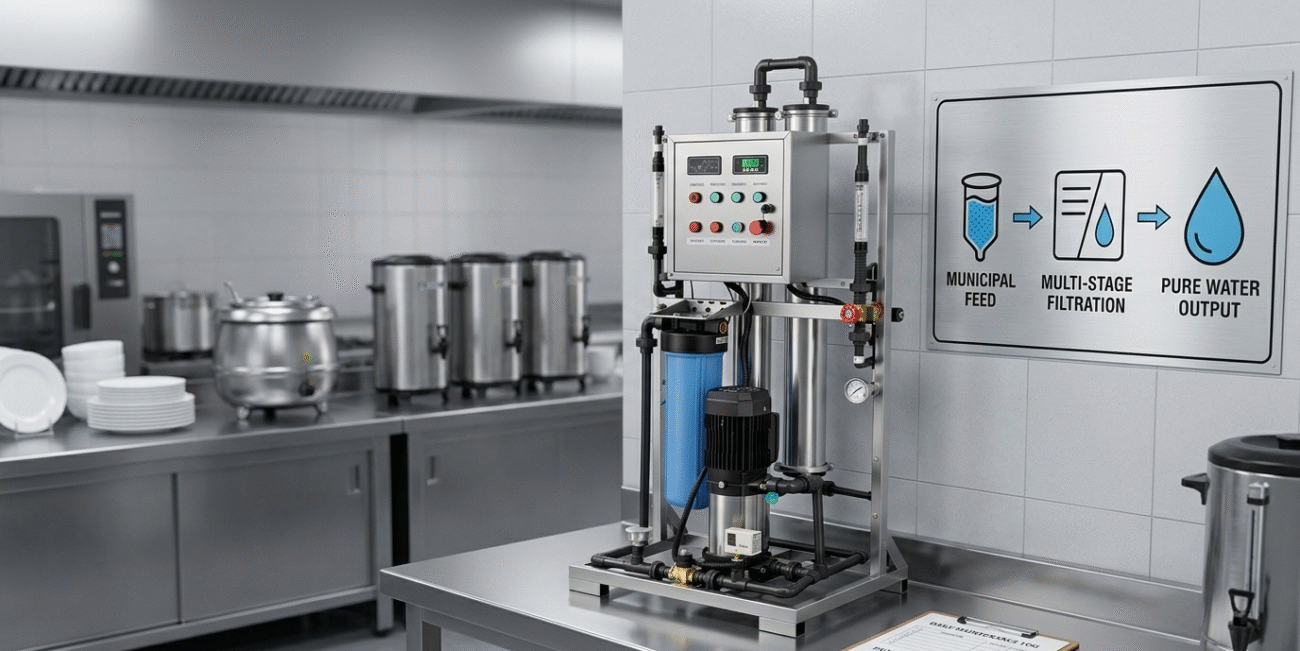
- What’s actually bolted to the frame — pump brand, membrane housing material, whether flow and pressure are monitored or just assumed
Get those five wrong and you’re not buying a filtration system — you’re buying a service call.
Fast Check Product: https://yourwatergood.com/product/commercial-reverse-osmosis-system/
Sizing to Peak-Hour Draw, Not Daily Averages
Commercial RO membranes produce continuously, not on demand. A compact 0.25 T/H frame-mounted skid rated at 250 L/h (roughly 1.1 GPM, ~66 gal/h) doesn’t spike to cover a rush — it just keeps producing at that steady rate.
That matters for two reasons:
- Daily volume is a function of run hours, not a fixed number. Run that unit 10–16 hours during service and you’re looking at roughly 660–1,050 gallons per operating day. Run it around the clock against a storage tank and theoretical output climbs toward ~1,580 GPD.
- Peak draw needs a buffer. If your busiest 15 minutes pulls more than the membrane produces in that window, you need a break tank sized to the gap — not a bigger membrane.
Undersizing here is the single most common reason a “filtered” espresso bar still tastes flat during a Saturday rush: the system simply can’t keep the storage tank full.
Municipal Supply vs. Well Water: Different Problems, Different Builds
Municipal tap water brings chlorine or chloramine taste and odor, disinfection byproducts, and — in older buildings — trace metals picked up from aging service lines.
Commercial well water brings a different fight: hardness, iron and manganese staining, sulfur odor, and conductivity that swings with the season.
Most compact commercial RO skids carry a feed-water ceiling — commonly around 800 µS/cm conductivity (roughly 400–550 ppm TDS equivalent) — above which membrane performance and lifespan drop fast. A well running hotter than that needs pretreatment (typically a softener or scale-inhibitor stage) ahead of the membrane, not a bigger RO unit.
Where does the EPA framework actually fit in? The EPA sets the national drinking-water standards municipal utilities already have to meet before water reaches your building — that’s the baseline, not a piece of equipment certification. Individual commercial filtration units are certified through a separate, voluntary process manufacturers can opt into. When a supplier can’t point to that certification, the fair follow-up question is what they can point to — sourced component brands, in-house test data, or a service history you can call and verify.
POE vs. POU: Where a Compact Skid Actually Belongs
“Whole-building” and “one machine” are not interchangeable decisions, and suppliers rarely spell out the cost difference until the quote lands.
| Factor | POE (Point-of-Entry / Whole-Facility) | POU (Point-of-Use / Point-of-Application) |
|---|---|---|
| Initial CAPEX | Higher — sized for total simultaneous draw | Lower — sized to one or two critical stations |
| Ongoing consumables (OPEX) | Higher volume, shared across every station | Lower volume, isolated to what actually needs treated water |
| Plumbing/install cost | Significant — feeds the whole building | Minimal — a dedicated line to one station |
| Footprint | Larger skid, dedicated mechanical space | Compact — fits a utility closet or under-counter |
| Best fit | Multi-station kitchens with simultaneous wash-down, steam, ice, and beverage draw | Espresso bars, single ice machines, beverage stations, small kitchens |
A compact 60 × 60 × 140 cm frame-mounted unit producing ~1.1 GPM is, realistically, a POU/POA build — a dedicated feed for an espresso machine plus an ice maker, or a single beverage station. It isn’t sized to run wash-down, steam equipment, and ice simultaneously across a full-service kitchen. That’s a larger, custom-built skid — and a different conversation.
Not sure which one your layout actually needs? Request a Commercial Kitchen Water Layout Design and we’ll size it against your real station count instead of guessing from a floor plan.
What’s Actually Bolted to the Frame
Skip the certification-sticker question for a second and look at the bill of materials instead — it tells you more about reliability than a badge does:
- High-pressure pump: Leo-brand pump, cast construction
- Membrane housing: 4040 stainless steel housing paired with a 4040 RO membrane
- Control panel: Delixi low-voltage electricals, 220V circuit, housed in a stainless cabinet
- Monitoring: integrated online conductivity/TDS meter, plus separate glass-tube flow meters on both the permeate and concentrate lines
- Protection: high/low pressure switches on the pump, gauges on both the low- and high-pressure sides
That last point is the one most buyers skip past. Dual flow meters on permeate and concentrate mean kitchen staff can watch the recovery ratio in real time. If permeate flow starts dropping while concentrate flow holds steady, that’s an early fouling signal — weeks before it shows up as flat espresso or cloudy ice.
This unit doesn’t carry a formal certification badge. What it does carry is a fully disclosed component list built from sourceable, verifiable brands — a more useful due-diligence trail for a wholesale buyer than a sticker you can’t call and confirm.
Power and Footprint: The Spec Buyers Actually Miss
The frame itself is compact — 60 × 60 × 140 cm — built to sit in a utility closet or tight back-of-house corner rather than needing dedicated mechanical space.
The control panel draws 1.1 kW and is built around a 220V / 50Hz circuit. If you’re sourcing for U.S. service, confirm with your supplier whether a 60Hz-rated motor and control build is available before you order — a 50Hz-rated pump run on 60Hz mains (or the reverse) mismatches motor speed and throws off the rated flow and pressure specs on the sheet. It’s a five-minute question before the PO, and a much longer one after the unit arrives.
Total Cost: What the Consumables Actually Protect
On this build, the RO membrane runs roughly one year, depending on feed water quality, and the prefilter cartridge is on a 2–4 month swap schedule.
That consumable cost is small next to what it’s protecting:
- Espresso boilers — scale buildup on copper boilers is a recurring, expensive repair, driven directly by feed water hardness and TDS
- Ice machines — scale on evaporator plates cuts output and shortens compressor life
- Combi ovens and steam equipment — mineral buildup is one of the most common causes of unscheduled downtime in commercial kitchens
None of those repairs happen on your schedule. A scaled boiler doesn’t wait for a slow Tuesday — it fails during service, which turns a routine descale into an emergency call, a comped ticket, and a machine down during your busiest hours. The filtration OPEX is the predictable line item; the alternative is the unpredictable one.
A missed prefilter swap doesn’t just cost a filter cartridge — it shortens membrane life, which shortens equipment life downstream. Get the full technical parameter sheet — membrane spec, consumable schedule, and warranty terms — before you budget the year.
FAQ
What flow rate does a small commercial restaurant need from a water filtration system? Size to your busiest 15-minute stretch, not your daily average. A compact unit producing around 1.1 GPM (250 L/h) covers a dedicated espresso and ice line in most small operations; multi-station kitchens with simultaneous draw need a larger, custom-sized build.
What’s the difference between POE and POU commercial water filtration? POE (point-of-entry) treats water for the entire building at higher CAPEX and install cost. POU (point-of-use) treats water for one or two critical stations — like an espresso machine or ice maker — at lower cost and a smaller footprint.
How often do commercial RO membranes and prefilters need replacement? On a compact commercial RO skid, expect roughly one year on the RO membrane and a 2–4 month swap schedule on the sediment prefilter, both depending on feed water quality.
Does a restaurant water filtration supplier need NSF certification to be a valid commercial system? No — certification is one signal among several. Component-level transparency (named pump, membrane, and electrical brands you can independently verify) is a legitimate due-diligence path, especially for direct-from-manufacturer wholesale sourcing.
What water pressure does a commercial RO system need to operate? Most compact commercial RO skids need a feed pressure between roughly 29–58 psi (0.2–0.4 MPa). Pressure below that range typically requires adding a booster pump ahead of the unit.
Can the same commercial RO unit run on well water and municipal water? Yes, within a feed-water ceiling — commonly around 800 µS/cm conductivity. Municipal supply mainly needs chlorine/odor and byproduct treatment; well water above that conductivity ceiling needs pretreatment (softening or scale inhibition) ahead of the membrane.
How much space does a compact commercial RO system need? A frame-mounted unit in this class runs about 60 × 60 × 140 cm — small enough for a utility closet or under-counter installation rather than a dedicated mechanical room.
Get Real Numbers Before You Budget
A restaurant water filtration supplier should hand you a spec sheet, not a sales deck. If you’re ready to move past ballpark numbers, we can put together:
- A custom commercial quote sized to your actual station count and peak draw
- A detailed technical parameter sheet — flow, pressure, power, and consumable schedule
- B2B wholesale pricing for direct and multi-unit orders
Send your kitchen layout and current water report (or well test, if applicable) and we’ll size it — not guess at it.