
Pretreatment System for Data Center RO Cooling Water: Why Multimedia Alone Can’t Hold SDI

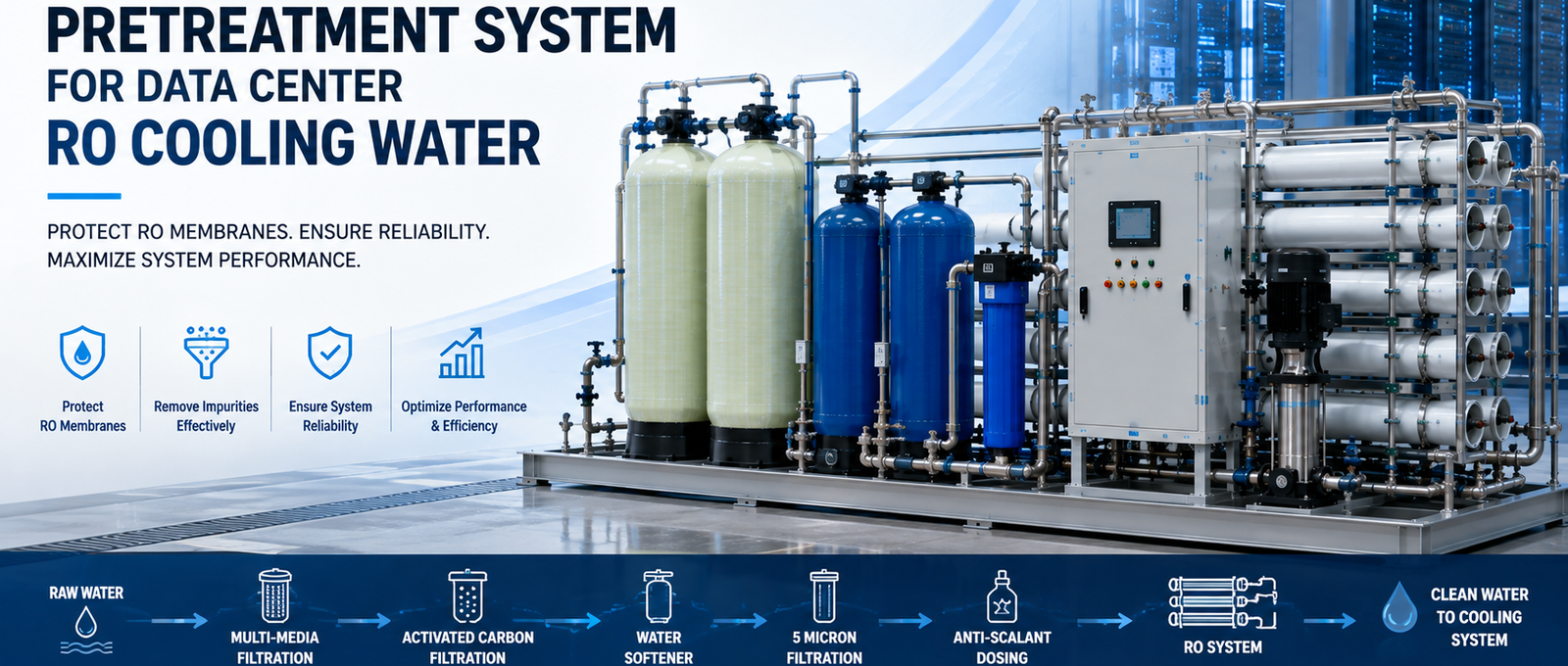
An RO membrane warranty is written against a number most facilities teams never test for: SDI, the Silt Density Index. Feed water can look clear, pass a turbidity check, and still carry enough colloidal fouling potential to void that warranty inside a year.
Multimedia filtration was never designed to guarantee SDI. It is a depth-media process — performance drifts with influent turbidity, bed condition, and flow rate — which is exactly why membrane manufacturers keep seeing “properly filtered” feed water foul their elements early.
A correctly engineered pretreatment system for data center RO cooling water is built around holding SDI inside the membrane manufacturer’s limit, continuously — not around passing a single grab sample.
Before sourcing, lock these pretreatment specifications first:
- Design to SDI₁₅ < 3, not to turbidity or a generic “clean water” assumption — most spiral-wound RO elements are warrantied against this number specifically.
- UF (ultrafiltration) as the pretreatment stage where feed water turbidity or particulate load varies — an absolute membrane barrier, not a depth-media guess.
- Automated CEB (chemically enhanced backwash) on a fixed cycle, not manual intervention triggered by falling flux.
- Transmembrane pressure (TMP) trending, not just inlet PSI — rising TMP at constant flux is the earliest fouling signal.
- Periodic membrane integrity testing — SDI and turbidity alone cannot catch a compromised UF fiber.
The sections below cover why multimedia alone struggles to hold SDI, where UF earns its place, and the failure mode that slips past both.
Fast Check Product: https://yourwatergood.com/product/industrial-reverse-osmosis-system/
SDI Is the Number That Actually Matters — And Multimedia Wasn’t Built to Guarantee It
The defining gap in most pretreatment system for data center RO cooling water specifications is designing to turbidity instead of SDI (Silt Density Index), the metric RO membrane warranties are actually written against.
SDI measures fouling potential, not clarity:
- SDI₁₅ < 3 is the target most spiral-wound RO manufacturers require to honor a membrane warranty.
- SDI₁₅ < 5 is treated as a bare minimum by some — above it, accelerated fouling and shortened membrane life are expected, not exceptional.
- Turbidity and SDI do not track together. Water can read low NTU and still carry colloidal silica, fine iron, or organic matter that drives SDI well above the RO-safe range.
Multimedia (depth) filtration removes particulate by trapping it within a graded bed — a process whose capture efficiency shifts with bed condition, loading rate, and how consistent the raw water is. On stable, low-turbidity municipal feed, a well-run multimedia bed can hold SDI in range. On variable feed water, it cannot be guaranteed to.
The practical rule: specify pretreatment performance against SDI, and verify it — don’t infer it from a turbidity reading.
Why Multimedia Alone Fails on Variable Feed Water
Multimedia filtration is not obsolete — it remains correct pretreatment for stable, low-turbidity municipal supply. The failure mode shows up specifically where feed water varies, which is common ground for data center sourcing.
Feed conditions where multimedia alone is the wrong call:
- Deep well water — seasonal turbidity swings, iron and manganese fouling, and silica loads multimedia beds were not sized to absorb consistently.
- Reclaimed / recycled water — increasingly required for WUE targets in Ashburn, VA and Phoenix, AZ, carrying variable organics and suspended solids multimedia struggles to capture to an absolute standard.
- Surface water intakes — turbidity spikes after rain events that can overwhelm a depth-media bed’s capture rate within hours.
Multimedia’s fundamental limitation is that it is not an absolute barrier — capture efficiency is a function of conditions, not a fixed pore size. A bed performing well today on a stable feed can pass fouling colloids tomorrow on the same feed at a different turbidity spike, with no local alarm to flag it.
This is the gap UF pretreatment exists to close.
UF Membrane Pretreatment: An Absolute Barrier Instead of a Depth-Media Guess
Ultrafiltration replaces depth filtration’s variable capture rate with a fixed, absolute pore size — the mechanism that lets it hold SDI regardless of feed water swings that would defeat a multimedia bed.
How UF pretreatment holds the line multimedia cannot:
- Hollow-fiber membrane barrier, typically 0.01–0.1 µm pore size — particulate, colloids, and most bacteria are physically excluded, not statistically captured.
- Consistent permeate quality independent of feed turbidity — a UF system fed a turbidity spike still delivers filtrate at its design pore size; a multimedia bed under the same spike does not hold its capture rate.
- Automated CEB (chemically enhanced backwash) restores flux on a fixed cycle, rather than depending on an operator to notice falling performance.
- Design flux in GFD (gallons per square foot per day), monitored against TMP (transmembrane pressure, in PSI) — rising TMP at constant flux is the direct signal of fouling, well before SDI on the RO feed would show it.
Request a Data Center Water Sizing Consultation — send your feed-water source and turbidity range, and we will confirm whether multimedia is sufficient or UF pretreatment is required to hold your RO membrane warranty’s SDI limit. Talk to us.
Sizing the Pretreatment Train: GPM, Flux, and Where It Sits in the Plant
A pretreatment system is sized to the RO train it protects, not to a standalone flow figure — undersizing flux or skipping redundancy shows up as fouling long before it shows up as a capacity shortfall.
What the sizing decision actually covers:
- Flow capacity (GPM) matched to the downstream RO’s design feed rate, with margin for CEB cycles that take a train briefly offline.
- Parallel UF trains for redundancy — an N+1 configuration lets one train run CEB or a fiber repair without interrupting RO feed.
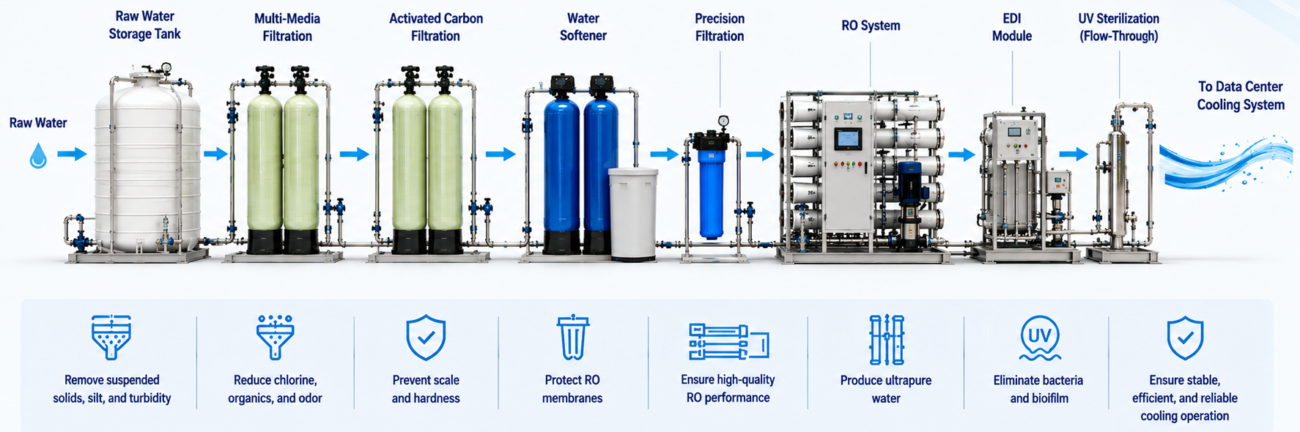
- Cartridge polishing (typically 1–5 µm) immediately ahead of the RO high-pressure pump, as a final guard downstream of UF or multimedia.
- Antiscalant dosing, sized to the RO feed’s hardness and silica, injected after pretreatment and ahead of the RO pump — a chemistry decision, not a filtration one, and outside this pretreatment scope.
Getting this sizing right protects more than the membranes. Consistent pretreatment output holds RO performance steady, which lowers membrane replacement OPEX, protects downstream cold plates, CDU heat exchangers, and high-pressure pumps from the fouling and scaling that inconsistent water quality accelerates, and keeps the loop clear of the localized hot spots that force a cluster into thermal throttling.
Multimedia vs UF Pretreatment for RO Feed Water
Not every RO feed water needs UF. The table below is the decision framework — matched to feed water behavior, not to budget alone.
| Engineering Parameter | Multimedia-Only Pretreatment | UF Membrane Pretreatment |
|---|---|---|
| Barrier type | Depth media (variable capture) | Absolute pore size (0.01–0.1 µm) |
| SDI performance on stable feed | Can hold SDI₁₅ < 3 | Holds SDI₁₅ < 3 consistently |
| SDI performance on variable feed | Not reliable | Unaffected by turbidity swings |
| Correct for | Stable, low-turbidity municipal | Well, reclaimed, or variable surface water |
| Cleaning method | Manual/timed backwash | Automated CEB |
| Fouling signal | ΔP rise (lagging) | TMP trend (leading indicator) |
| Flow capacity (GPM) | 10–50 GPM, single train | 100–1,000+ GPM, parallel trains |
| Redundancy | Single train typical | N+1 / N+2 parallel trains |
| RO warranty protection | Feed-water dependent | Consistent regardless of source variability |
The barrier-type row is the decisive one: a depth bed’s capture rate depends on conditions holding steady, while a membrane’s pore size does not change with the water. On variable feed, that difference is the entire case for UF.
To pressure-test a vendor’s pretreatment proposal, ask what SDI they are designing to guarantee, and how — not just what media they are quoting.
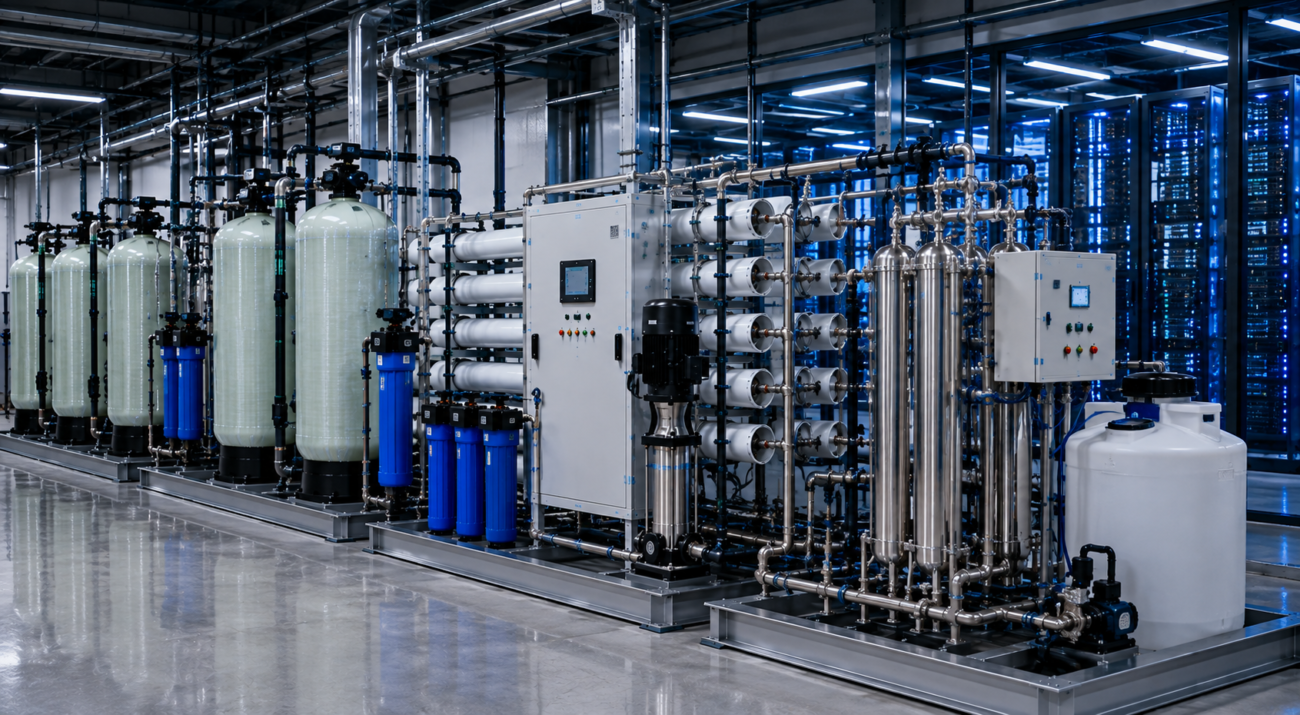
Field Engineering Insight: A Broken UF Fiber Doesn’t Show Up on an SDI Test
Here is the failure that catches even a correctly specified UF system: a single broken hollow fiber can pass particulate straight through to the RO, and neither an SDI grab sample nor a turbidity reading will reliably catch it.
UF pretreatment holds SDI because the membrane’s pore size is fixed — but that logic depends on every fiber being intact. A fiber breach from mechanical stress, a pressure spike, or normal service wear creates a direct bypass path at the pore-size-bypassing scale, while the bulk permeate stream still tests clean.
An SDI test samples the combined permeate stream. A small number of compromised fibers can be diluted enough in that stream that the SDI result still passes, while enough particulate slips through to accelerate fouling on the RO membranes downstream — discovered weeks later as unexplained RO fouling, not as a pretreatment alarm.
The only reliable catch is a pressure decay integrity test: the UF module is isolated, pressurized on the air side, and the pressure decay rate is measured directly against a fiber-integrity threshold — a test built to detect exactly this failure, which SDI and turbidity were never designed to catch.
The engineering defense:
- Run pressure decay integrity tests on a fixed schedule, not only when RO performance already looks wrong.
- Log CEB and backwash history — a fiber failure often follows a documented mechanical or chemical stress event.
- Treat unexplained RO fouling as a UF integrity question first, before assuming a pretreatment or dosing failure elsewhere in the train.
This is the detail that never appears on a UF flow-rated quote, and it is exactly what separates a pretreatment system that protects the RO membrane warranty from one that only looks like it does.
Pretreatment System for Data Center RO Cooling Water FAQs
What is SDI and why does it matter for RO pretreatment? Silt Density Index measures a feed water’s fouling potential. Most spiral-wound RO manufacturers require SDI₁₅ < 3 to honor a membrane warranty — a target multimedia filtration alone cannot always guarantee on variable feed water.
Is multimedia filtration enough pretreatment for RO? On stable, low-turbidity municipal feed, often yes. On well water, reclaimed water, or variable surface water, multimedia’s capture rate is not consistent enough to reliably hold SDI, and UF pretreatment is the safer specification.
What does UF pretreatment do differently from multimedia? UF uses a fixed membrane pore size (0.01–0.1 µm) as an absolute barrier, so filtrate quality does not depend on feed turbidity staying stable — unlike depth-media filtration, whose capture rate varies with conditions.
How is a UF pretreatment system cleaned? Through automated CEB (chemically enhanced backwash) on a fixed cycle, restoring flux without waiting for an operator to notice performance decline.
How do I know if my UF pretreatment system has a problem? Monitor TMP (transmembrane pressure) trend at constant flux — a leading indicator — and run scheduled pressure decay integrity tests, since SDI and turbidity readings can miss a single compromised fiber.
Does pretreatment replace the RO system? No. Pretreatment (multimedia or UF) removes particulate and colloidal fouling potential ahead of the membranes. RO removes the dissolved solids that pretreatment does not address.
What flow capacity does a data center pretreatment system need? Sized to the downstream RO’s design feed rate in GPM, typically with N+1 parallel trains so a CEB cycle or fiber repair on one train doesn’t interrupt RO feed.
Engineer the Pretreatment That Actually Holds Your SDI Target
A pretreatment system for data center RO cooling water is only as good as the SDI it holds under real, variable feed conditions — not the SDI it happens to show on a single clean-water sample. Multimedia earns its place on stable municipal supply; UF earns its place everywhere that supply isn’t stable.
Whether your source is municipal, well, or reclaimed water, YourWaterGood sources the right system through our manufacturing partner and a network of vetted factories — pretreatment system for data center RO cooling water configurations cover multimedia, UF, cartridge polishing, and antiscalant dosing sized to your feed water and your RO train, with quality inspection, logistics, and English-language support handled for you.
- Get an Infrastructure Engineering Quote: send your feed-water source and turbidity range for a pretreatment train sized to your SDI target.
- Request Technical Data Sheets: UF flux, CEB cycle, and TMP monitoring detail for your engineering review.
- Get Competitive B2B Pricing: sourced through our supplier network, with QC and shipping managed end to end.