Data Center Water Treatment System: Instrumentation and Control That Holds the Loop Spec

A data center water treatment system can carry the right reverse osmosis, the right softening, and the right dosing — and still let a cooling loop drift out of spec. The usual cause is not a failed component. It is a control system trusting a sensor that quietly went blind.
The treatment hardware removes contaminants. The instrumentation decides whether it keeps doing so, around the clock, without an operator standing at the skid. On a mission-critical floor, that sensing-and-control layer is the system.
Specifying a data center water treatment system for 99.999% uptime therefore means engineering the analyzers, control loops, and alarm logic as rigorously as the membranes — because a blind controller fails silently.
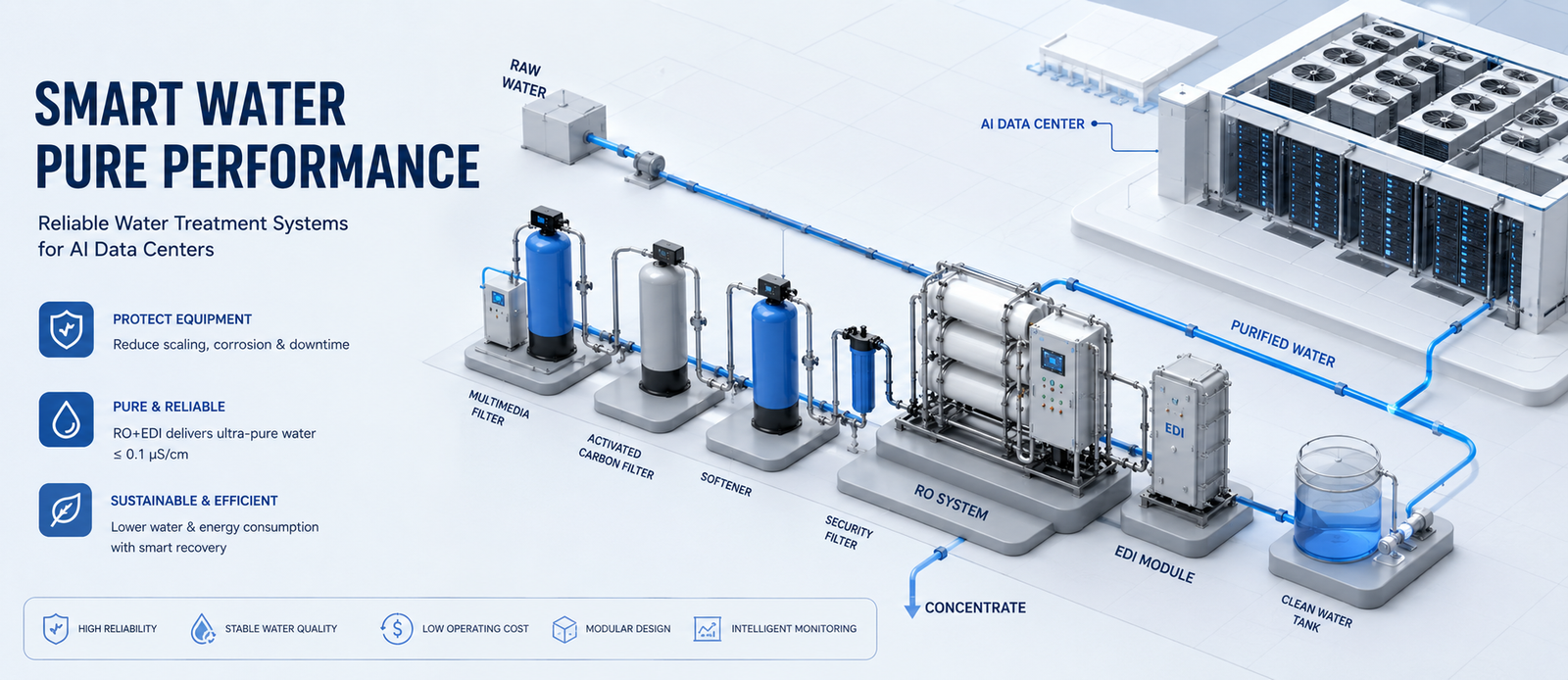
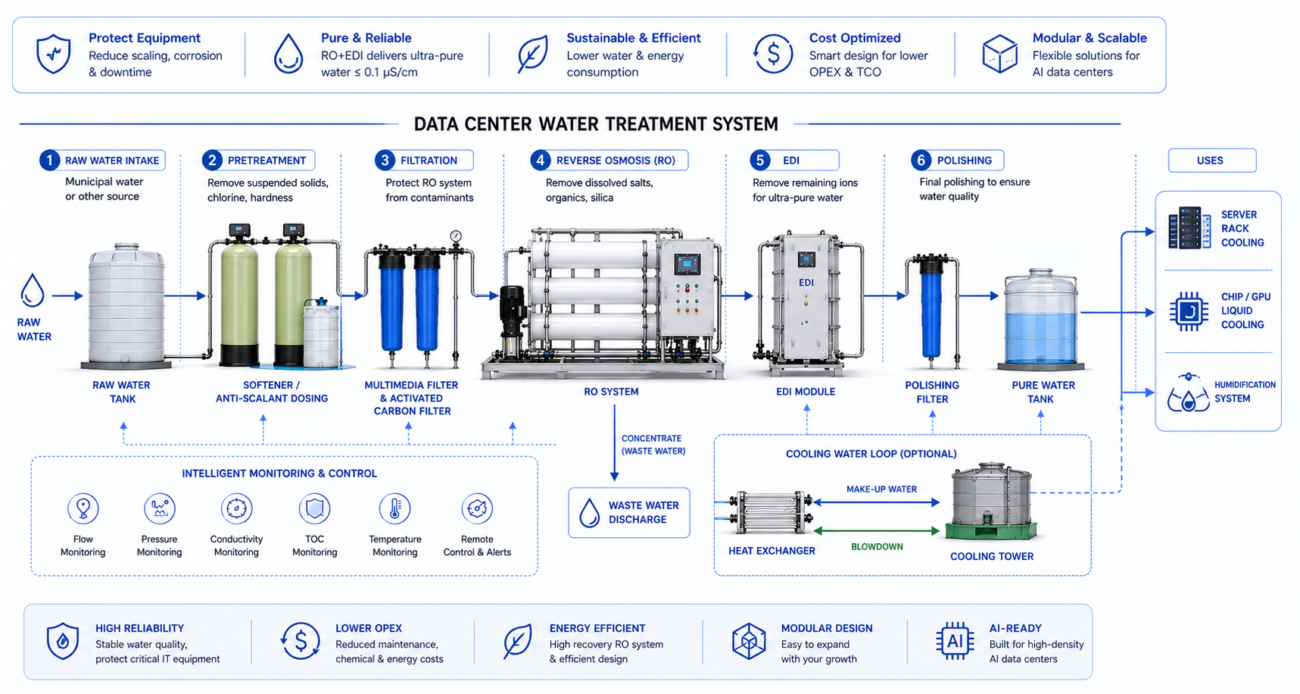
To meet the high-volume, zero-downtime demands of enterprise facilities across the United States and Europe, YourWaterGood delivers robust, skid-mounted industrial purification trains. Moving away from low-capacity alternatives, our engineering architecture utilizes a highly resilient multi-stage pre-treatment and desalination framework designed to stabilize water quality and maximize infrastructure longevity:
1、Multi-Media & Particle Interception: Utilizes high-efficiency media and precision security filters to catch large-scale suspended solids, rust, and microscopic particulates down to fine micron levels before the water reaches the membrane stages.
2、Deep Chemical Adsorption: Employs active carbon filtration modules to deeply adsorb residual chlorine and volatile organic compounds, protecting sensitive downstream membranes from oxidative degradation.
3、Ion-Exchange Hardness Control: Integrates dedicated softening arrays to selectively extract calcium and magnesium ions, entirely eliminating scale formation risks inside critical heat exchangers.
4、Double-Pass Industrial Reverse Osmosis (RO): A heavy-duty desalination core featuring thickened membrane shells and high-grade stainless steel or UPVC piping to withstand continuous high-pressure operations. Our industrial RO arrays are documented to reduce raw water TDS from a challenging 1300 mg/L down to less than 20 mg/L (and below 10 mg/L in two-stage setups).
5、Continuous Electrodeionization (EDI) Polishing: Combines electrodialysis and ion-exchange technology to strip away trace weak ions (such as silica and boron) without requiring harsh chemical regeneration. This chemical-free electrical polishing stabilizes loop conductivity below 0.1 μs/cm and delivers ultrapure water with a resistivity of up to 18.2 MΩ⋅cm.
Fast Check Product: https://yourwatergood.com/product/industrial-reverse-osmosis-system/
Before sourcing, lock these instrumentation and control specifications first:
- Redundant online analyzers on critical points — conductivity/resistivity, pH, and ORP, not a single probe whose drift no one catches.
- Automated control loops with alarmed setpoints — conductivity-driven blowdown, makeup control, and dosing control, each with a high/low trip.
- Scheduled calibration and temperature compensation built into the control philosophy, not left to chance.
- Full BMS / SCADA integration — Modbus TCP, BACnet IP, or SNMP, with trip points wired into the building alarm tier.
- Continuous data logging and trending for predictive maintenance, so a slow excursion is caught before it becomes a hot spot.
The sections below break down each control decision and where it fails on the floor.
The System Is Only as Good as Its Sensors
Every automated action a data center water treatment system takes — blowing down a tower, dosing a chemical, switching a train — is triggered by a measurement. If the measurement is wrong, the automation does the wrong thing with full confidence.
The core online analyzers that govern a data center loop:
- Conductivity / resistivity — the primary purity guardrail. Cooling-tower control watches µS/cm; ultrapure direct-to-chip loops watch resistivity toward 18.2 MΩ·cm.
- pH — held in the 7.0–9.0 band to prevent copper cold-plate corrosion and steel scaling.
- ORP (oxidation-reduction potential) — the real-time signal for oxidizer and biocide control, far faster than lab sampling.
- Flow (GPM) and differential pressure (PSI) — flux stability and filter loading across every train.
On a Technology Cooling System (TCS), critical points should carry redundant sensing. A single conductivity probe is a single point of failure for the entire purity guarantee — when it drifts, nothing downstream knows the loop has left spec until a cold plate is already scaling.
The specification discipline: define which measurements are safety-critical, then make those redundant and alarmed — not just logged.
Automated Control Loops: Conductivity-Driven Blowdown, Makeup, and Dosing
A data-center-grade system does not wait for a technician to act. It closes the loop automatically, and the quality of that control logic is what separates stable operation from a slow drift into scaling.
Conductivity-controlled blowdown (FWS / cooling towers):
- A conductivity controller opens the blowdown valve when tower water reaches the Cycles of Concentration (CoC) setpoint.
- Tuned correctly, it holds the highest safe CoC — minimizing blowdown, cutting makeup, and improving WUE — without crossing into scaling.
Makeup and level control:
- Automated makeup replaces evaporated and blown-down volume, holding basin level and loop pressure stable so the thermal load never sees a flow transient.
Automated chemical dosing:
- ORP-controlled oxidant or biocide dosing responds to real demand instead of a fixed clock, avoiding both under-treatment and chemical waste.
- Antiscalant and corrosion-inhibitor dosing is paced to makeup flow (GPM), keeping residuals inside the program target.
These loops only work if their setpoints are alarmed and their sensors trusted. A control loop acting on a drifted reading does not stop — it confidently drives the system in the wrong direction, which is exactly the failure mode the field insight below addresses.
BMS / SCADA Integration: Turning a Reading Into Action Before a Hot Spot Forms
A measurement that stays inside the water skid is a missed opportunity. The value of a data center water treatment system is realized when its data crosses into the building management layer and drives a response.
Native integration should expose, at minimum:
- Conductivity / resistivity, pH, ORP — live, with high/low alarm flags.
- Flow (GPM) and differential pressure (PSI) across trains and filters.
- Pump and valve status, train online/standby state, and dosing-pump health.
- Aggregated fault and alarm states mapped to the facility’s alarm hierarchy.
Protocols are Modbus TCP, BACnet IP, or SNMP — the same languages the electrical and mechanical plant already speak. A high-conductivity excursion on the TCS should not just light a local HMI; it should raise a facility alarm and, where the architecture supports it, trigger a switch to a standby train before the loop drifts far enough to throttle a rack.
The integration test for a vendor: ask for the full register map and the alarm list. A supplier who can only offer dry-contact outputs is delivering a skid that runs in isolation, not a system that participates in mission-critical operations.
Municipal vs Reclaimed Feed: Why the Control Strategy Changes With the Source
The same analyzer suite is tuned differently — and watched differently — depending on whether the system runs on municipal or reclaimed feed, because the two sources fail in different ways.
Municipal potable feed demands control focused on oxidizer breakthrough:
- ORP and chlorine monitoring ahead of the membranes to catch chlorine/chloramine before it oxidizes thin-film RO.
- Chloride trending, since chlorides above low thresholds drive pitting corrosion on 316L under high-velocity flow.
Reclaimed and recycled feed demands a heavier monitoring and control regime:
- Tighter ORP and biocide control, because organic and nutrient load drives faster biological activity.
- More frequent calibration and fouling monitoring, since high TDS, silica above ~150 ppm, and organics load both sensors and membranes faster.
- Antiscalant residual control paced to a more variable feed chemistry.
A control strategy calibrated for stable municipal feed will under-react on reclaimed water and let excursions develop. The monitoring regime is matched to the source, not copied between sites.
Standard Skids vs Data-Center-Grade Instrumented Systems
A commercial skid ships with basic gauges and manual control. A data-center-grade data center water treatment system is instrumented, automated, and integrated to run 24/7/365 without an operator at the panel.
| Engineering Parameter | Standard Pre-Engineered Skids | Data Center Grade High-Redundancy Systems |
|---|---|---|
| Instrumentation | Basic gauges, single probes | Redundant online analyzers on critical points |
| Control logic | Manual / timer-based | Automated closed loops with alarmed setpoints |
| Flow capacity (GPM) | 10–50 GPM | 100–1,000+ GPM, parallel trains |
| Redundancy | Single train | N+1 / N+2 / 2N with alarm-driven failover |
| BMS integration | Dry contact / 4–20 mA | Modbus TCP / BACnet IP / SNMP, full register map |
| Filtration / purity | 10–20 µm nominal | Absolute guard + RO to 0.0001 µm, EDI to 18.2 MΩ·cm |
| Data & diagnostics | Local readout only | Trending and logging for predictive maintenance |
| Lead time & support | Stock unit, generic spares | Engineered build, documented P&ID, standardized spares |
Alarm-driven control is what underwrites uptime: a high-conductivity or high-ΔP event raises a facility alarm and can initiate failover before loop quality degrades. That is the difference between a skid that measures and a system that protects.
To pressure-test a vendor, ask which measurements are redundant and how each alarm is actioned. A flow rating without a control narrative is a generic skid wearing a data-center label.
Field Engineering Insight: The Drifting Probe That Breaks Automated Control
Here is a failure mode that catches teams who trust the HMI over the sensor: a fouled or drifted conductivity probe makes a fully automated system fail silently, with every screen showing green.
A conductivity or resistivity probe slowly scales, fouls, or drifts out of calibration. It begins reading low. The control system — doing exactly what it was told — sees “good” water and stops blowing down the tower, or eases makeup, or trims dosing.
Cycles of Concentration then climb past the safe limit while the HMI displays a comfortable number. By the time temperature or pressure alarms reveal the problem, scale is already forming on heat-transfer surfaces, and the root cause is not the treatment hardware — it is an instrument the controller trusted too long.
The engineering defense is procedural and architectural, not a bigger skid:
- Scheduled calibration of every control-critical analyzer on a fixed interval, with documented verification against a reference standard.
- Temperature compensation enabled and verified, since uncompensated conductivity and resistivity readings swing with water temperature and produce false “in-spec” values.
- Redundant sensing on safety-critical points, with a deviation alarm that fires when two probes disagree — the earliest possible warning that one has drifted.
This is the kind of detail that never appears on a flow-rated quote but decides whether automated control protects the loop or quietly betrays it. It is also where instrumentation pays back: catching excursions early lowers cleaning OPEX, prevents scaling and biofouling on cold plates and CDUs, holds high-pressure pumps in their efficient curve, and extends the capital life of the entire thermal chain.
Data Center Water Treatment System FAQs
What online analyzers does a data center water treatment system need? At minimum conductivity/resistivity (µS/cm or MΩ·cm), pH, and ORP, plus flow (GPM) and differential pressure (PSI). Critical direct-to-chip points should carry redundant sensing with deviation alarms.
How is cooling-tower blowdown automated? A conductivity controller opens the blowdown valve when tower water reaches the target Cycles of Concentration setpoint, using temperature-compensated probes to hold the highest safe CoC and minimize makeup.
What conductivity setpoint protects a direct-to-chip loop? Alarm the TCS at ≤ 10 µS/cm, with EDI-polished resistivity trending toward 18.2 MΩ·cm. The high-conductivity trip should be wired into the BMS, not just the local panel.
Why do conductivity probes need scheduled calibration? Scaling, fouling, and drift cause probes to read low, so automated blowdown and makeup act on bad data and let CoC climb into scaling. Calibrate on a fixed interval with temperature compensation and verify against a reference.
What protocols integrate the system with the BMS? Modbus TCP, BACnet IP, and SNMP. Map conductivity, pH, ORP, flow, differential pressure, pump and valve status, and aggregated alarms into the facility hierarchy.
Does municipal vs reclaimed feed change the control strategy? Yes. Municipal control centers on chlorine/chloramine breakthrough and chloride trending; reclaimed demands tighter ORP and biocide control, fouling monitoring, and more frequent calibration — consistent with ASHRAE TC 9.9 and EPA frameworks.
How does monitoring lower OPEX and protect uptime? Early detection of excursions prevents scaling and biofouling before they insulate heat-transfer surfaces, cutting cleaning frequency, extending cold-plate, CDU, and pump life, and protecting 99.999% uptime.
Specify a System That Controls Itself — and Tells You When It Can’t
A data center water treatment system earns its uptime in the control layer. The facilities that avoid silent excursions are the ones whose analyzers are redundant, whose loops are alarmed, and whose data reaches the BMS — not the ones that trusted a single probe and a comfortable screen.
Whether you are equipping a single high-density server room or sourcing instrumented trains into a larger buildout, YourWaterGood manufactures and ships the equipment factory-direct — a data center water treatment system built on industrial RO, EDI, skid-mounted softening, automated dosing, and BMS-ready instrumentation, configured to your loop targets.
- Get an Infrastructure Engineering Quote: itemized pricing on 1 t/h–10 t/h systems with the analyzer suite and control logic defined for your loop.
- Request Technical Data Sheets: analyzer specs, control narratives, register maps, and alarm lists for your engineering review.
- Secure B2B Wholesale / Factory-Direct Pricing: source instrumented equipment straight from our manufacturing facility.