
Choosing the Right Water Filtration Systems for Businesses — Practical Buying, Installation & Lifecycle Playbook

If you searched water filtration systems for businesses, you’re probably tasked with solving a real operational problem: protect equipment, comply with health rules, provide great-tasting water to customers or employees, or secure process water for manufacturing. Businesses face different constraints than homeowners — higher volumes, liability exposure, continuous uptime requirements, and strict cost-accounting. This article gives an actionable, vendor-ready playbook for facility managers, purchasing teams, café owners, property managers, and engineers who must select, size, purchase, install, and operate water filtration systems for businesses with confidence.
You’ll find step-by-step selection logic, practical sizing rules, technology pros and cons, procurement and QA checklists, cost/ROI examples, maintenance plans, and sustainability considerations. When you’re ready to compare models or order parts and consumables, check supplier catalogs and accessories at https://yourwatergood.com/ and https://yourwatergood.com/shop/.
1. Start with outcomes — define what the business needs
Before you talk to vendors, write a one-paragraph problem statement that answers these questions:
- Who are the stakeholders (operations, health & safety, procurement, customers)?
- What endpoints must be protected or served (drinking fountains, espresso machines, boilers, lab processes, manufacturing lines)?
- Which contaminants or issues must be addressed first (taste/odor, chlorine, hardness, iron, TDS, lead, PFAS, microbes)?
- What are the uptime and redundancy requirements (can you tolerate service downtime)?
- Are there regulatory or contractual water-quality standards to meet?
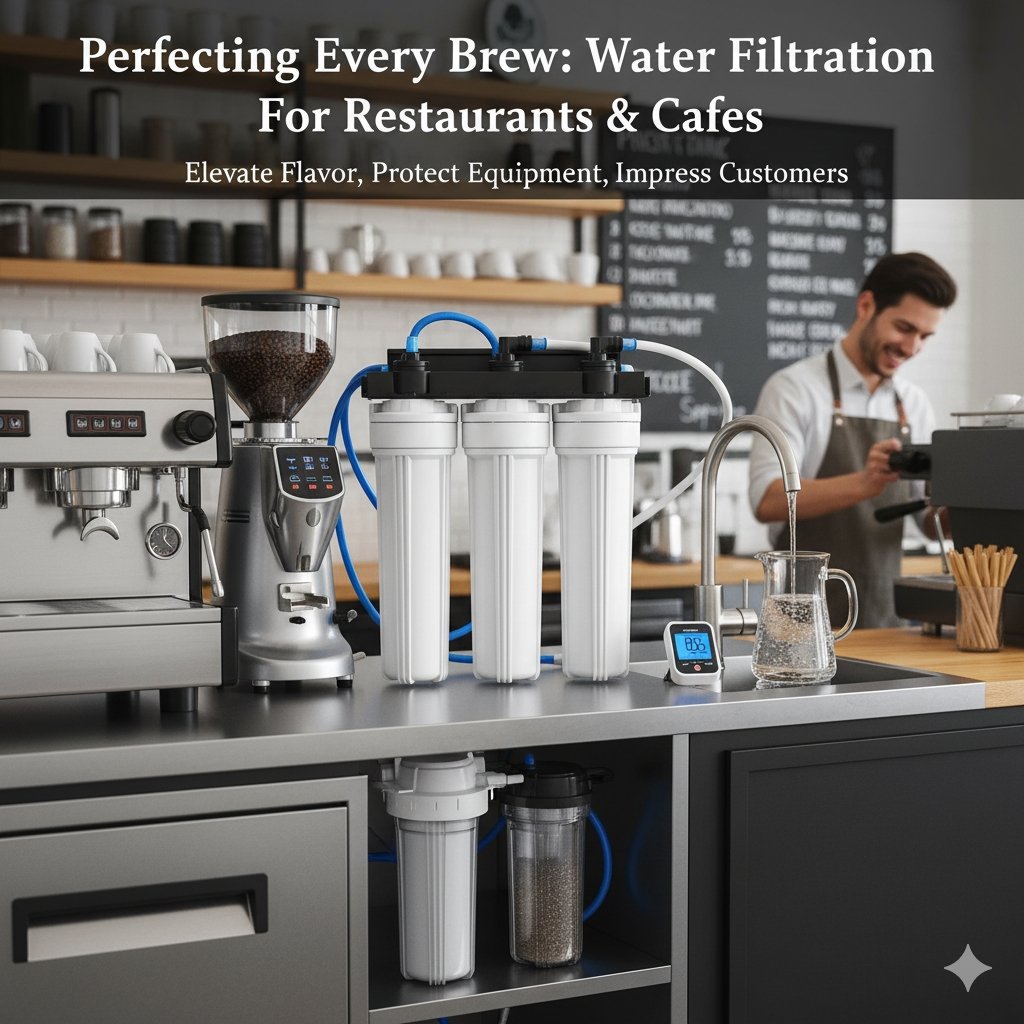
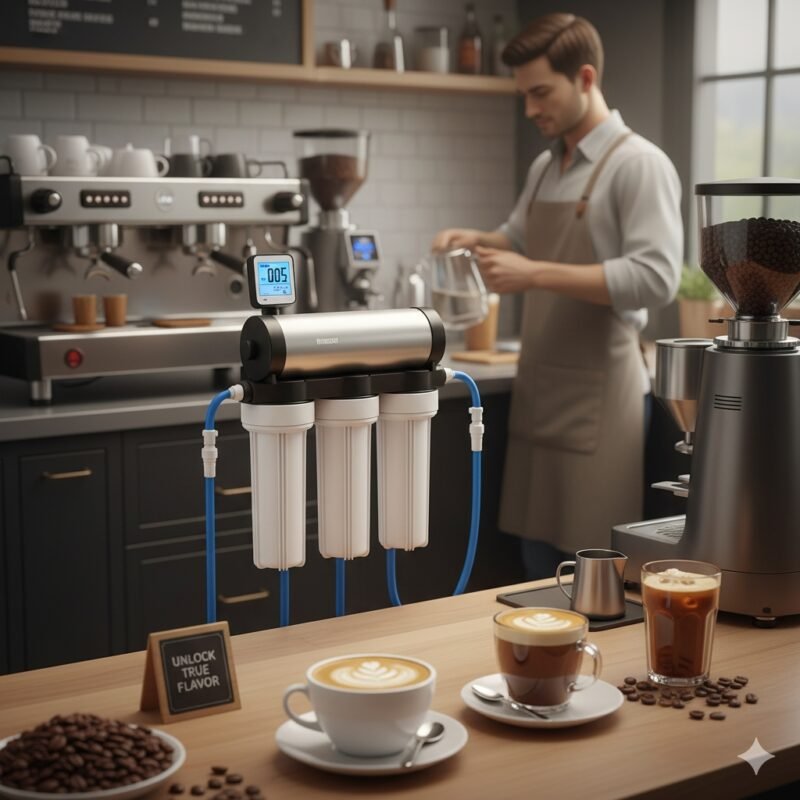
Example: “We are a 3-location café chain. We need water filtration systems for businesses that protect espresso machines from scale, remove chlorine for taste across all brew stations, and ensure consistent water for specialty drinks with minimal downtime. Preferred: local service partner, consumable autofill program, and RO only at specialty counters.”
Define measurable acceptance criteria you can hand to bidders (e.g., “post-treatment free chlorine <0.05 mg/L; softener design hardness ≤1 gpg at espresso machines; 80% recovery POU RO where RO is used; 99.99% UV inactivation for microbiological risks”).
2. Test the water properly — data beats assumptions
Never buy a system without a recent test (or two). For businesses, perform both source and endpoint sampling: building inlet, kitchen/service points, and any problematic taps.
Minimum lab panel for businesses:
- TDS, hardness (Ca/Mg), pH, alkalinity, chloride, sulfate, iron, manganese, nitrate/nitrite.
- Metals: lead, copper, arsenic as relevant (older pipe networks).
- Microbial: total coliforms / E. coli for wells or suspected contamination.
- Organics: VOC screen and PFAS if local risk exists (industrial areas, firefighting foam use nearby).
- Turbidity and TSS for process-sensitive sites.
For coffee & beverage businesses, also test for chlorine and chloramine levels, silica, and alkalinity since they affect taste and extraction. Keep results in the RFQ and make them part of the contract.
3. Map business problems to technologies (quick cheat sheet)
Use this short mapping when crafting solutions:
- Chlorine / taste/odor → Activated carbon (GAC or carbon block)
- Chloramine → Catalytic carbon (or combined catalytic + GAC)
- Sediment / turbidity → Depth sediment cartridges, pleated filters, or backwashing systems
- Hardness (scale) → Ion-exchange softener or TAC (salt-free) where salt discharge is restricted
- Iron / manganese → Oxidation + filtration (greensand, catalytic media, or oxidation vessels)
- Microbial risk → Ultrafiltration (UF) or UV disinfection with prefiltration
- Dissolved salts / PFAS / nitrates → Reverse osmosis (RO) or targeted adsorptive media (anion exchange, PFAS-specific adsorbents)
- High-volume continuous service → Industrial cartridge banks, multi-vessel staged treatment, or skid-mounted RO
Most business systems are hybrid — staged solutions deliver reliability and protect expensive downstream components.
4. Point-of-entry (POE) vs point-of-use (POU) — choose strategically
Decide whether the facility needs whole-building treatment (POE) or targeted POU installations.
POE is appropriate when:
- Problem affects all water uses (e.g., scale damaging boilers or building-wide chlorine taste).
- You must protect multiple downstream systems and appliances.
- You want central maintenance and fewer POU units to manage.
POU is appropriate when:
- Only drinking/cooking/espresso quality matters (POU under-counter RO or carbon at beverage points).
- Whole-house RO is impractical due to cost, waste, or space.
- You want to selectively treat premium outlets (e.g., chef’s station, tasting bar).
For many businesses the best pattern is POE pretreatment (sediment + carbon + softener if needed) plus POU RO or polishing at high-value endpoints.
5. Sizing rules and practical capacity planning
Businesses need flow-based sizing and a clear view of peak demand.
Steps to size:
- Create a peak flow profile: count simultaneous fixtures and processes (espresso group heads, dishwashers, showers, autoclaves). Use fixture flow rates to estimate peak GPM.
- For continuous processes (labs, manufacturing), calculate daily volume in liters/day or GPD.
- Select components with service flow ratings exceeding peak by 25–30% to avoid pressure drop issues.
- For carbon vessels, size bed volume to maintain required contact time at peak flow (bed contact time = bed volume / flow).
- For RO, pick membrane count and high-pressure pump rating to meet daily permeate demand and peak rate if direct-feed is required (add storage tank for buffered supply).
- Include backwash capacity and drainage for media vessels; specify pump sizes and valves.
Practical example: a small café with two espresso machines (each 2 GPM when in use), 1 sink (1.5 GPM), and ice maker (0.5 GPM) has a peak simultaneous flow of ~6 GPM. Design POE pretreatment and POU polishing to supply 6–8 GPM without >15% pressure drop.
6. Procurement: RFQ must be precise
Your RFQ should include:
- Water test reports and measured peak/continuous flows.
- Required contaminant reduction targets and acceptable outlet specs.
- Operating conditions — inlet pressure, temperature, available electrical supply.
- Preferred brands for critical components (membranes, pumps) or allow equivalents.
- Consumables replacement interval expectations and spare-part lead times.
- Installation constraints — space, bypass requirements, drainage capacity.
- Acceptance testing: required lab verification post-install and criteria.
- Warranty, SLA for emergency support, and training deliverables.
Ask bidders for line-item pricing (equipment, installation, consumables, annual service contract). Require pre-production samples or factory test certificates for novel media (e.g., PFAS adsorbents).
7. Certifications, standards and documentation to require
Businesses must insist on documentation:
- Material safety declarations for wetted parts (food-grade plastics, stainless steel SS316L where required).
- NSF/ANSI certifications for health claims (NSF 42/53/58 where relevant).
- UV systems — electrical safety listings (UL/CE) and lamp replacement schedules.
- Vendor-provided performance data that matches your water matrix (don’t accept only generic numbers).
- Commissioning report including pre/post lab test results, measured flows, pressure drops, and instrument calibration certificates.
For regulated facilities (medical, food production), ensure the system meets local health authority requirements and that test reports are traceable.
8. Installation realities — what contractors must plan for
Typical installation tasks:
- Mechanical: piping, isolation valves, bypass loops, mounting, and structural support for tanks/vessels.
- Electrical: wiring for pumps, controls, UV — GFCI and local code compliance.
- Drainage: RO reject, softener brine, backwash waste — ensure legal discharge or plan for on-site reuse/storage.
- Instrumentation: flow meters, pressure gauges, TDS/ conductivity sensors, and sample taps.
- Commissioning tests: leak tests, TDS/product checks, microbiological/chemical sampling.
Insist on bypass valves for critical processes to ensure operations continue during service. For mission-critical applications, require dual trains or hot-swappable vessels to allow servicing without downtime.
9. Maintenance and service — plan it like an operating expense
Maintenance schedule should be explicit in purchase contract and include:
- Consumable replacement intervals (prefilters, carbon, softener resin regeneration).
- Membrane maintenance: cleaning schedule, expected life, and fouling indicators (differential pressure, flux decline).
- UV lamp and sleeve maintenance: annual lamp replacement and sleeve cleaning.
- Media replacement and backwash frequency.
- Instrument calibration and sensor replacement cadence.
- Emergency response time and on-site support SLA.
For predictable budgeting, negotiate a service contract that covers preventative maintenance, emergency callouts, and a minimum spare-parts pool on-site (O-rings, prefilter sets, a spare membrane).
10. Cost and ROI — realistic numbers and what to watch
Costs vary widely. High-level guidance:
- Small POE carbon + cartridge bank: equipment $2k–$6k; annual consumables $200–$800.
- Softener + carbon for a mid-size facility: equipment $3k–$8k; salt & servicing $200–$800/year.
- Commercial RO skid (small business, 500–2000 GPD): $6k–$25k equipment; membranes and maintenance add to annual cost.
- Large industrial systems: project-based costing with significant engineering and civil works.
ROI drivers:
- Reduced equipment downtime and maintenance (less scale on boilers, espresso machines).
- Lower bottled water purchases and improved product consistency (coffee, beverages).
- Regulatory compliance avoidance of fines and customer health incidents.
- Energy savings where improved water chemistry reduces appliance inefficiency.
Calculate TCO over 3–5 years: equipment + installation + consumables + water waste + service + downtime risk. Present these figures to procurement and finance — a cheap upfront system that fails or causes downtime can cost far more.
11. Quality assurance: inspect before acceptance
Before release of final payment, require:
- Photographic documentation of installation and serial numbers of major components.
- Pre/post installation lab tests (third-party) with acceptance criteria in the contract.
- Performance demonstration under peak flow conditions.
- Handover documents: O&M manuals, spare-parts list, service schedule, and as-built P&ID.
- Training session for on-site staff and a 30–90 day operational support period.
Include a 30–90 day performance warranty where the vendor must correct performance issues discovered after the system has seen real load.
12. Common pitfalls and how to avoid them
- Undersizing leading to pressure loss. Avoid by designing for peak + margin.
- Omitting pretreatment. Skipping sediment or softening before RO or UV leads to early failures.
- Ignoring discharge rules. Softener brine and RO reject can create environmental/compliance headaches; plan from the start.
- Buying by price only. Verify component brands, lab data, and local support capability.
- No spare parts or consumable plan. Leads to extended downtime when membranes or lamps are needed urgently.
Mitigate by using checklists, independent inspections, and insisting on performance guarantees.
13. Sustainability & water stewardship
Businesses increasingly expect sustainable choices:
- Choose high-recovery RO membranes and permeate pumps to reduce water waste.
- Reuse RO reject water for non-potable uses (toilets, irrigation) where safe and legal — consider a small holding tank and dosing as needed.
- Select softeners with efficient regeneration cycles and consider salt-free alternatives if local regulations or discharge limits force it.
- Implement cartridge recycling or take-back programs with vendors to minimize plastic waste.
- Monitor water use and set targets for reductions tied to ESG or cost-saving goals.
Sustainability choices can be both cost-saving (less freshwater purchase, reduced wastewater fees) and brand-enhancing.
14. Case studies — practical examples
Short case study 1 — Café chain (3 stores):
Problem: espresso machines scaling and inconsistent espresso flavor.
Solution: POE softening + POU RO at specialty counters for high-end drinks + carbon at all brew stations.
Outcome: Less machine downtime, reduced descaling, consistent cup quality, and a payback in reduced maintenance costs in under 18 months.
Short case study 2 — Small manufacturing plant:
Problem: cooling tower fouling and boiler scale.
Solution: POE sediment + chemical dosing + side-stream RO for concentrated recycling.
Outcome: Increased equipment uptime, lower chemical dosing over time, measurable extension in equipment life.
These examples show how tailored systems deliver quick operational returns when matched properly to the problem.
15. Vendor selection criteria — beyond price
When evaluating suppliers, score them on:
- Technical competence and references in your industry.
- Local support network and spare-parts availability.
- Transparency of test reports and certifications.
- Willingness to include acceptance testing, training, and short-term support at no extra cost.
- Clear, itemized proposals and reasonable lead times.
Prefer vendors who offer subscription consumable programs and local stocking to shorten downtime.
16. Contractual clauses to include
Protect the business with contract language:
- Acceptance tests and measurable performance KPIs.
- Penalties or credits for missed SLAs or failure to meet agreed water quality.
- Spare-parts lead-time commitments.
- Clear warranty terms and what voids the warranty (e.g., unauthorized modifications).
- Escalation and dispute resolution process.
Legal and procurement teams should review service-level clauses carefully before signing.
17. Practical checklist — ready-to-use
Pre-procurement:
- Document stakeholders and desired outcomes.
- Order a certified water test for inlet and endpoints.
- Create RFQ with flows, contaminant targets, and acceptance tests.
Procurement:
- Get ≥3 itemized bids.
- Verify references & site-specific experience.
- Insist on DUPRO/PSI inspections for manufacturing when relevant.
Installation & commissioning:
- Confirm permit and drainage planning.
- Require as-built drawings, instrument calibration, and lab test results.
- Train staff and schedule first preventative maintenance.
Operations:
- Maintain spare parts on-site (prefilters, O-rings, a spare membrane).
- Log consumable replacements and test results.
- Review SLA performance quarterly.
18. Where to shop and how to source parts
For model comparisons, spare parts, and consumables, reputable vendor catalogs save time. Start your product and spare-part comparison at https://yourwatergood.com/ and order replacement cartridges, membranes, and accessories at https://yourwatergood.com/shop/. Use vendor subscription services where available to lock supply and simplify maintenance.
19. Final recommendations — a pragmatic roadmap
- Diagnose first: test water and document problems precisely.
- Design layered solutions: POE pretreatment + targeted POU polishing for high-value endpoints.
- Size for peak demand and include redundancy for critical processes.
- Procure with clear acceptance tests and require vendor-provided lab data matching your feed water.
- Budget for maintenance and include a service contract for the first year.
- Measure and optimize: instrument TDS, flow, and service intervals; optimize recovery and reuse to cut waste.
- Plan ESG and compliance in the design — efficient RO membranes, recycling programs, and legal discharge strategy.
Water filtration systems for businesses are an investment in reliability, quality, and compliance. With the right specification, vendor controls, and maintenance regime, a well-designed system reduces risk, improves product consistency, and ultimately saves money.
When you’re ready to compare models, check specs and consumables at https://yourwatergood.com/ and stock the filters and parts you’ll need at https://yourwatergood.com/shop/.