
Industrial Water Filtration for Data Centers: Engineering the Media and Carbon Beds That Protect RO

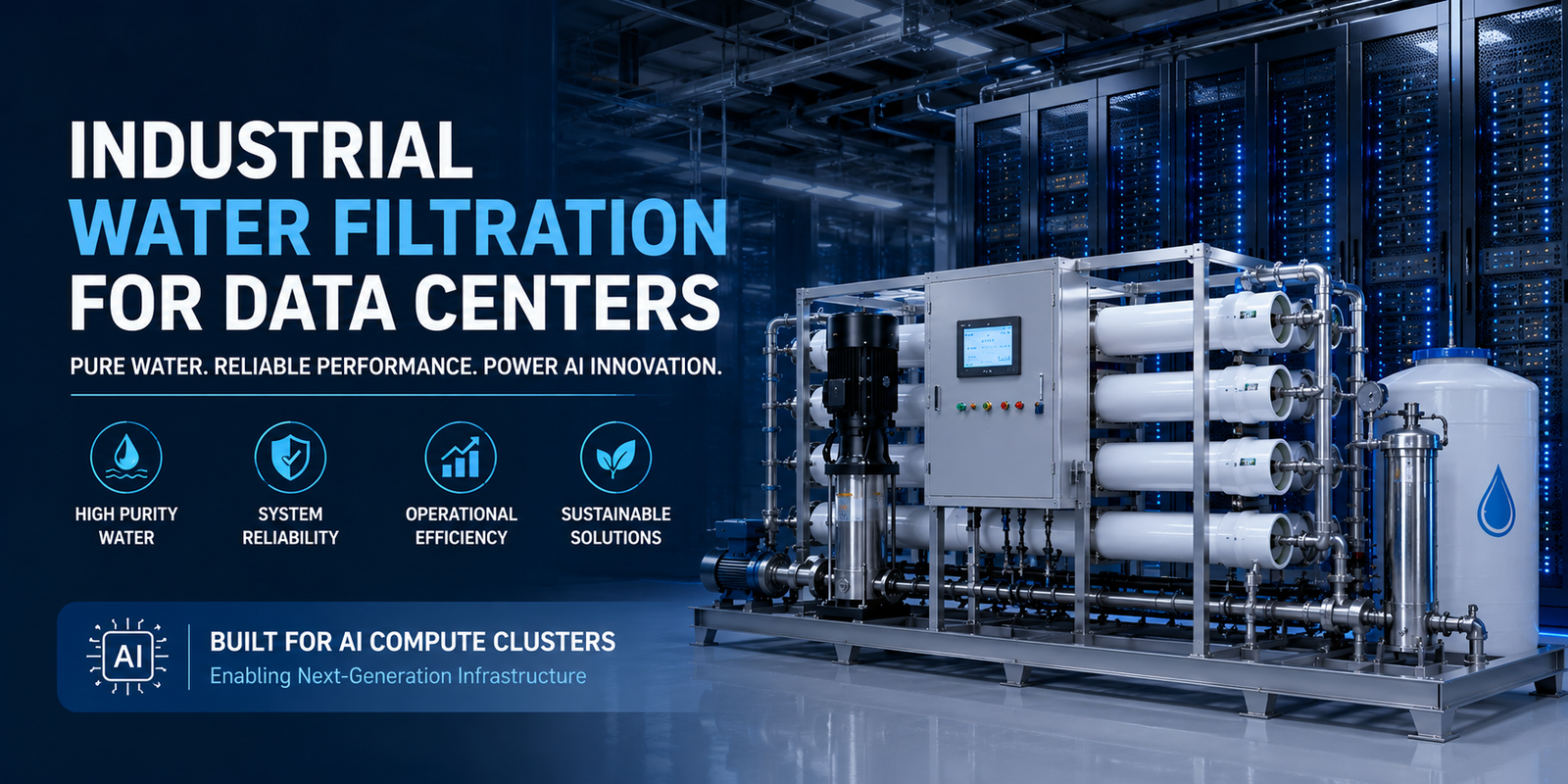
The most expensive reverse osmosis failures in a data center rarely start at the membrane. They start two vessels upstream, in a multimedia or carbon bed that was sized on nameplate flow instead of on loading rate and contact time.
Industrial filtration is the pre-treatment that decides whether the RO behind it survives. Get the media vessels wrong and the membranes foul, oxidize, or scale — and the cost surfaces downstream as repeat membrane replacement and lost capacity.
Engineering industrial water filtration for data centers correctly means designing the deep-bed media and carbon stages to a service rate and a contact time, not just bolting a pair of tanks ahead of the skid.
Before sourcing, lock these specifications first:
- Service (loading) rate, not nameplate flow — multimedia sized to GPM per ft² of bed area, the parameter that actually sets filtration quality.
- Adequate freeboard for backwash — roughly 50% bed expansion of headspace, or the bed channels and mudballs.
- Carbon sized on EBCT — empty bed contact time, with catalytic carbon where the residual is chloramine.
- Correct backwash flow — enough to fluidize and expand the bed without washing media to drain.
- Continuous-duty vessels and automated valves — ASME or FRP construction with backwash sequencing reported to the BMS.
The sections below break down each media-stage decision and where it fails on the floor.
Fast Check Product:https://yourwatergood.com/product/industrial-reverse-osmosis-system/
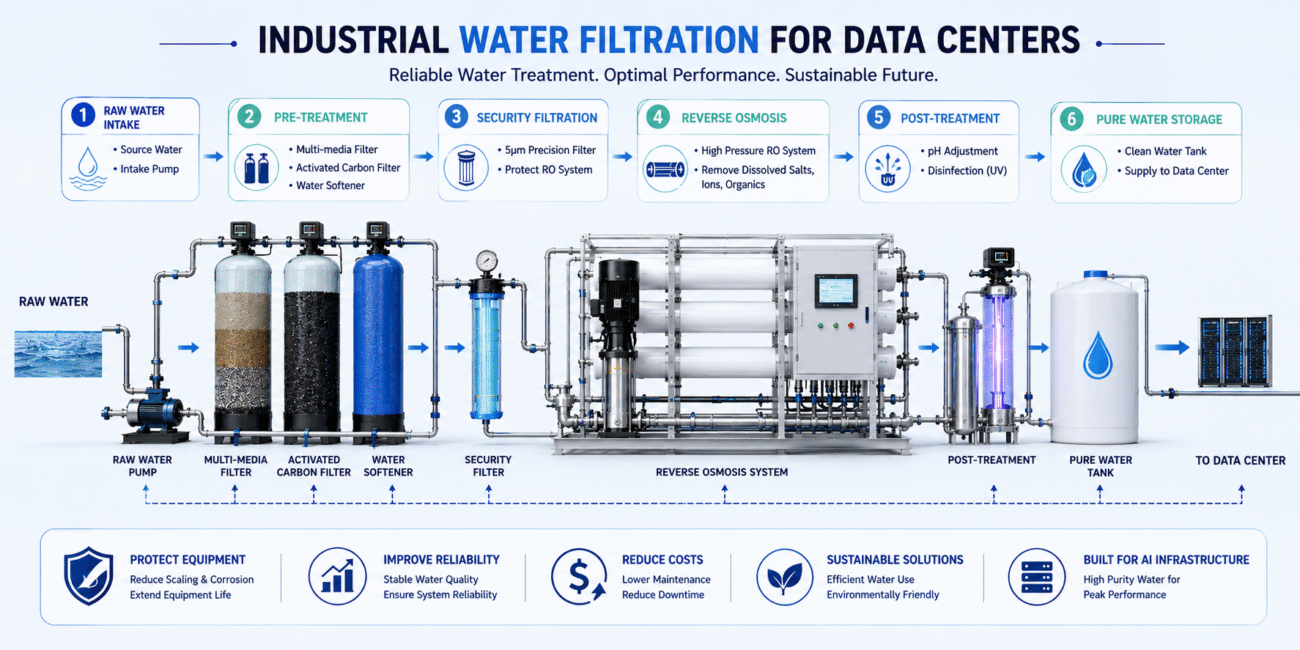
Next-generation AI data centers running high-density server racks require hyper-efficient thermal management, pushing the industry to closely track Water Usage Effectiveness (WUE). Companies like YourWaterGood provide critical industrial water filtration for data centers by supplying high-output 5-stage industrial RO systems and heavy-duty pre-filtration nodes. This hardware drops incoming Total Dissolved Solids (TDS) and filters out suspended solids down to sub-micron levels, preventing scale buildup in cooling towers and protecting the ultra-fine microchannels inside direct-to-chip cold plates from catastrophic thermal blockages.
As a leading choice for hyperscale facility managers across the United States and Europe, YourWaterGood streamlines the B2B supply chain with flexible trade terms, including EXW and FOB, backed by reliable global carrier routing through FedEx and UPS. Our product ecosystem avoids complex, non-standard consumer hardware, focusing instead on heavy-duty, scalable modular filtration nodes. We provide standardized replacement assets—including precision-rated PP cotton sediment pre-filters and high-flow carbon block arrays—engineered to protect delicate direct-to-chip microchannels and coolant distribution units (CDUs) from microscopic particulate fouling.
The Pre-Treatment Decides the RO: Why Filtration Failures Surface Downstream
The defining error in industrial water filtration for data centers is judging the pre-treatment by its own gauges while the consequences play out one stage later, at the membranes.
Deep-bed filtration exists to protect the most sensitive components downstream:
- Multimedia (depth) filtration removes suspended solids and turbidity that would otherwise foul RO membrane surfaces and raise feed pressure.
- Activated carbon removes the chlorine and chloramine that oxidatively destroy thin-film RO membranes.
- Softening strips the hardness that scales membranes and, downstream, cold-plate microchannels under 100 µm.
When any of these stages under-performs, the failure does not show up locally — it shows up as collapsing RO rejection, rising clean-in-place frequency, or scaled cold plates weeks later. The operator then troubleshoots the membranes or the loop, while the actual fault sits in an upstream vessel that still reads an acceptable pressure drop.
The discipline: commission and monitor each filtration stage against what it is protecting, not just its own ΔP. Pre-treatment is judged by the condition of the RO and the loop, because that is where its failures land.
Sizing Media Filters by Loading Rate, Not Nameplate Flow
A multimedia filter is not specified by the GPM on its label — it is specified by how fast water moves through the bed cross-section, and getting that loading rate wrong quietly destroys filtration quality.
The parameters that actually govern a media vessel:
- Service / loading rate — expressed as GPM per ft² of bed surface area. Run a vessel above its design loading rate and particulate drives straight through the bed instead of being captured.
- Bed depth and media layering — graded layers (anthracite over sand over support gravel) capture across a range of particle sizes and extend run time between backwashes.
- Freeboard — the headspace above the bed, sized for roughly 50% expansion during backwash. Too little freeboard and the bed cannot fluidize to clean itself.
Backwash hydraulics are where media beds silently fail:
- Too low a backwash flow leaves the bed under-cleaned; trapped solids cement into mudballs and the bed channels, letting raw water bypass the media.
- Too high a backwash flow fluidizes the bed past expansion and washes media out to drain, thinning the bed permanently.
- A channeled or mudballed bed often still shows an acceptable pressure drop, which is exactly why the degradation goes unnoticed until particulate reaches the RO.
The engineering rule: size on loading rate, provide real freeboard, and set backwash flow to the media — not to a generic default. A bed that cannot backwash correctly is a filter in name only.
Activated Carbon: Contact Time, Not Just a Carbon Tank
Activated carbon is the membrane’s protection against oxidizers, and its performance is governed by contact time — not by how much carbon is in the vessel. Undersize the contact time and the oxidant breaks through to the RO.
The controlling parameter is EBCT (empty bed contact time) — how long water dwells in the carbon bed:
- Free chlorine is removed quickly and needs a relatively short EBCT.
- Chloramine is far more stable and needs a significantly longer EBCT, or catalytic carbon, to break down.
- A carbon vessel sized for chlorine’s short EBCT will pass chloramine straight to the membranes — the failure mode detailed in the field insight below.
Designing the carbon stage correctly:
- Confirm the municipal residual — free chlorine or chloramine — before sizing, because most US utilities have shifted to chloramine.
- Size EBCT to the actual oxidant, using catalytic carbon for chloramine.
- Monitor for breakthrough with ORP ahead of the membranes, and consider a reducing-agent polish such as sodium metabisulfite (SMBS) as a backup barrier.
Carbon is not a commodity tank to be sized by flow. It is a contact-time device, and the contact time has to match the chemistry the utility actually delivers.
Municipal vs Reclaimed Feed: Two Different Pre-Treatment Trains
The filtration train is not interchangeable between source types. Municipal and reclaimed feeds load the media and carbon stages differently and demand different designs.
Municipal potable feed:
- Centers on activated carbon sized for the residual disinfectant (often chloramine) and chloride control to prevent pitting corrosion on 316L.
- Multimedia loading is moderate, with predictable turbidity.
Reclaimed and recycled feed — increasingly mandated for WUE targets in Ashburn, VA and Phoenix, AZ:
- Demands heavier multimedia filtration for higher, more variable suspended solids.
- Requires skid-mounted softening and antiscalant dosing because of high TDS and silica above ~150 ppm.
- Needs finer downstream guard filtration and stronger microbiological control for elevated organic and nutrient load.
- Loads every stage faster, shortening backwash and regeneration intervals.
A filtration train sized for municipal feed will foul and break through early on reclaimed water. The source water sets the bed sizing, the media selection, and the backwash frequency before any vessel is quoted.
Standard Skids vs Data-Center-Grade Filtration Trains
A commercial filter set is sized by flow and runs on timers. A data-center-grade filtration train is sized by loading rate and contact time, built for continuous duty, and integrated to the BMS.
| Engineering Parameter | Standard Pre-Engineered Skids | Data Center Grade High-Redundancy Trains |
|---|---|---|
| Media sizing basis | Nameplate GPM | Loading rate (GPM/ft²) and EBCT |
| Carbon design | Generic carbon tank | EBCT-sized, catalytic for chloramine |
| Flow capacity (GPM) | 10–50 GPM | 100–1,000+ GPM, parallel trains |
| Redundancy | Single train | N+1 / N+2 / 2N parallel architecture |
| Backwash control | Timer-based | Automated, ΔP- and volume-triggered to BMS |
| Vessels | Light-duty | ASME / FRP continuous-duty construction |
| Downstream protection | Minimal | Protects RO, EDI, cold plates, CDUs |
| Lead time & support | Stock unit, generic spares | Engineered build, documented P&ID, standardized spares |
The sizing-basis and carbon rows are decisive: a train sized on nameplate flow with a generic carbon tank passes both particulate and oxidants to the membranes. The cheaper filtration train is paid for in RO membranes.
To pressure-test a vendor, ask for the media loading rate and the carbon EBCT they have designed to. A supplier who quotes vessels by flow alone has not engineered the pre-treatment.
Field Engineering Insight: Chloramine Breakthrough That Destroys the RO
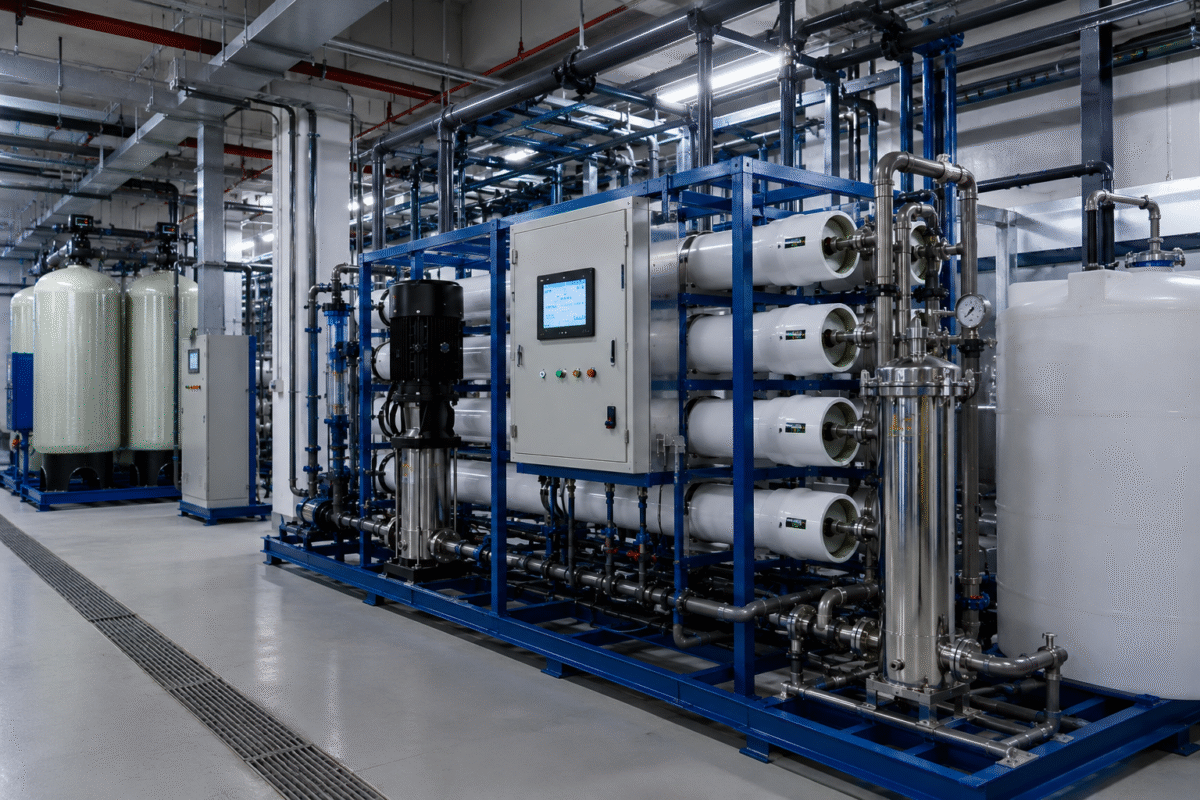
Here is the failure that catches teams whose carbon was sized a generation ago: a carbon bed designed to remove free chlorine will pass chloramine — and chloramine quietly destroys the RO membranes behind it.
Most US municipalities have shifted from free chlorine to chloramine (chlorine combined with ammonia) as the distribution-system residual, because it is more stable. That stability is the problem: chloramine needs a much longer EBCT, or catalytic carbon, to break down than free chlorine does.
A carbon vessel sized for chlorine’s short contact time lets chloramine slip through to the thin-film membranes, where it oxidatively degrades the membrane surface. RO rejection collapses over weeks to months, conductivity downstream climbs, and the technology loop drifts out of spec.
The trap is the troubleshooting path: the operator sees failing RO performance and replaces the membranes — and the new membranes degrade on the same timeline, because the root cause, insufficient carbon contact time for chloramine, was never addressed.
The engineering defense is sizing and verification, not another membrane order:
- Confirm whether the utility uses chlorine or chloramine before sizing the carbon — do not assume free chlorine.
- Size EBCT for chloramine and specify catalytic carbon, which breaks chloramine down far faster than standard carbon.
- Monitor oxidant breakthrough with an ORP sensor ahead of the membranes, alarmed into the BMS.
- Add a reducing-agent polish (SMBS) where a guaranteed barrier is required.
This is the kind of detail that never appears on a flow-rated quote but decides whether the RO lasts years or months. It is also where correct pre-treatment compounds: protecting the membranes lowers replacement OPEX, keeps the technology loop in spec, prevents downstream scaling of cold plates and CDUs, and holds 99.999% uptime.
Industrial Water Filtration for Data Centers FAQs
How are industrial media filters sized for a data center? By service / loading rate — GPM per ft² of bed area — not nameplate GPM, with bed depth and roughly 50% freeboard for backwash expansion. Running above the design loading rate pushes particulate through the bed.
What is EBCT and why does it matter for carbon? Empty Bed Contact Time is how long water dwells in the carbon bed. Chloramine needs a longer EBCT (or catalytic carbon) than free chlorine; too short an EBCT passes oxidants that destroy RO membranes.
What is the difference between chlorine and chloramine removal? Chloramine is more stable and requires more contact time or catalytic carbon to remove. A carbon bed sized for free chlorine will pass chloramine to the membranes.
What backwash flow does a media filter need? Enough to fluidize and expand the bed (media-dependent) with adequate freeboard. Too little causes mudballing and channeling; too much washes media to drain and thins the bed.
Does industrial filtration replace reverse osmosis? No. Media and carbon filtration are pre-treatment that protect RO by removing suspended solids and oxidizers. RO removes the dissolved solids that filtration cannot.
How does pre-treatment differ for reclaimed water? Reclaimed feed needs heavier multimedia, softening, antiscalant, finer guard filtration, and faster backwash and regeneration intervals than municipal feed, due to higher TDS, silica above ~150 ppm, and organics.
What filtration protects cold plates from particulate? Pre-treatment plus RO/EDI for dissolved solids, with absolute sub-5 µm guard filtration on the technology loop, consistent with ASHRAE TC 9.9 water-quality guidance.
Engineer the Pre-Treatment That Keeps Your RO Alive
Industrial water filtration for a data center is a pre-treatment engineering decision that determines membrane life and loop stability. The facilities that avoid repeat RO failures are the ones whose media and carbon beds were sized on loading rate and contact time — not on a nameplate flow figure.
Whether you are equipping a single high-density server room or sourcing trains into a larger buildout, YourWaterGood manufactures and ships the equipment factory-direct — industrial water filtration for data centers built on multimedia and catalytic-carbon vessels, skid-mounted softening, industrial RO and EDI, and automated dosing, sized to your feed water.
- Get an Infrastructure Engineering Quote: itemized pricing on media, carbon, and 1 t/h–10 t/h RO/EDI trains sized to your loading rate and EBCT.
- Request Technical Data Sheets: media specs, backwash rates, carbon EBCT, and BMS integration detail for your review.
- Secure B2B Wholesale / Factory-Direct Pricing: source filtration equipment straight from our manufacturing facility.