Data Center Cooling Tower Water Treatment: Running High Cycles of Concentration Without Scale or Corrosion

An open cooling tower is the one place in a data center where water is concentrated on purpose. Evaporation rejects heat and leaves dissolved minerals behind, so every cycle of concentration that improves water efficiency pushes the water closer to scaling and corroding the system.
The treatment program is what holds that line. Run too few cycles and the facility wastes water and fails its WUE target; run too many without chemistry control and the tower scales, corrodes, or grows biology that insulates the heat-transfer surface.
Engineering data center cooling tower water treatment is the discipline of holding the highest safe Cycles of Concentration (CoC) while a dosing program keeps scale, corrosion, and microbial growth in check.
Before sourcing, lock these specifications first:
- Automated CoC control — conductivity-controlled blowdown holding the highest safe cycles, not a fixed manual guess.
- A three-part dosing program — antiscalant, corrosion inhibitor, and biocide, each paced to load.
- Metered makeup and blowdown — balanced and trended for WUE reporting.
- Galvanized-tower passivation before high-pH operation, to prevent white rust on new towers.
- Microbiological and Legionella control under an ASHRAE 188 water management plan.
The sections below break down each element of a tower chemistry program and where it fails on the floor.
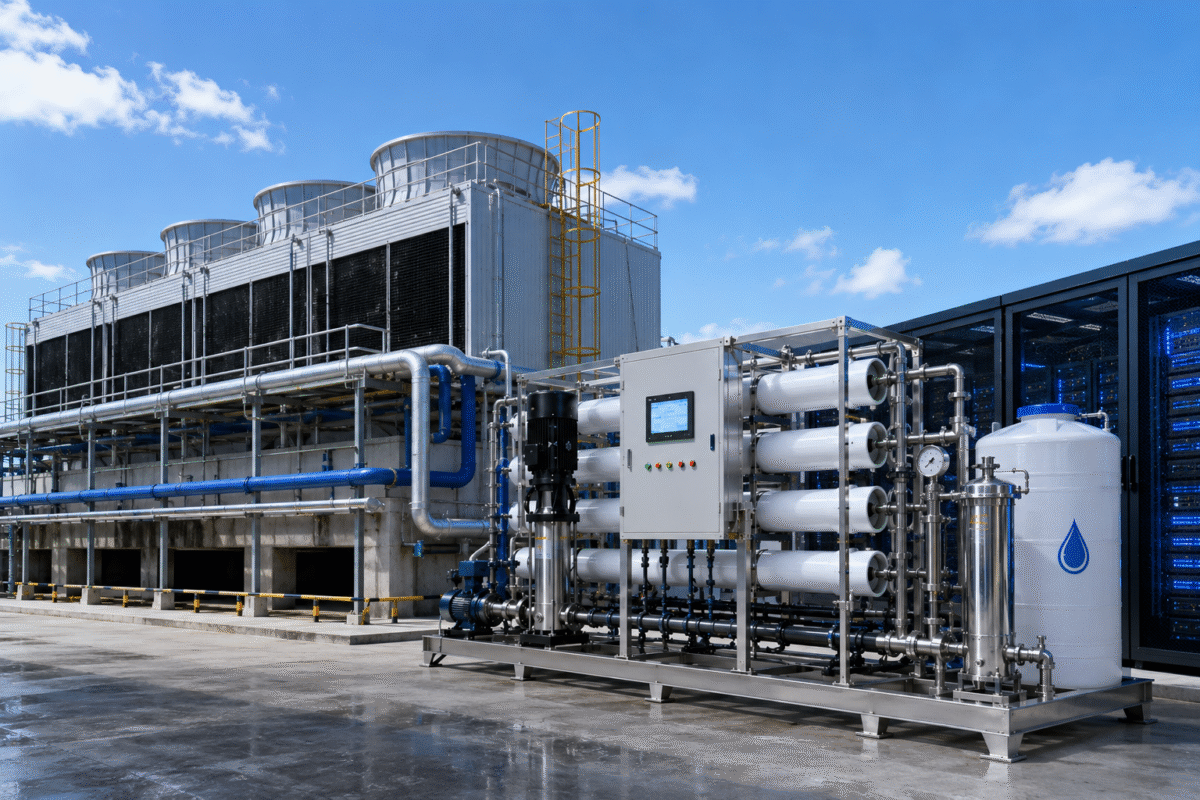
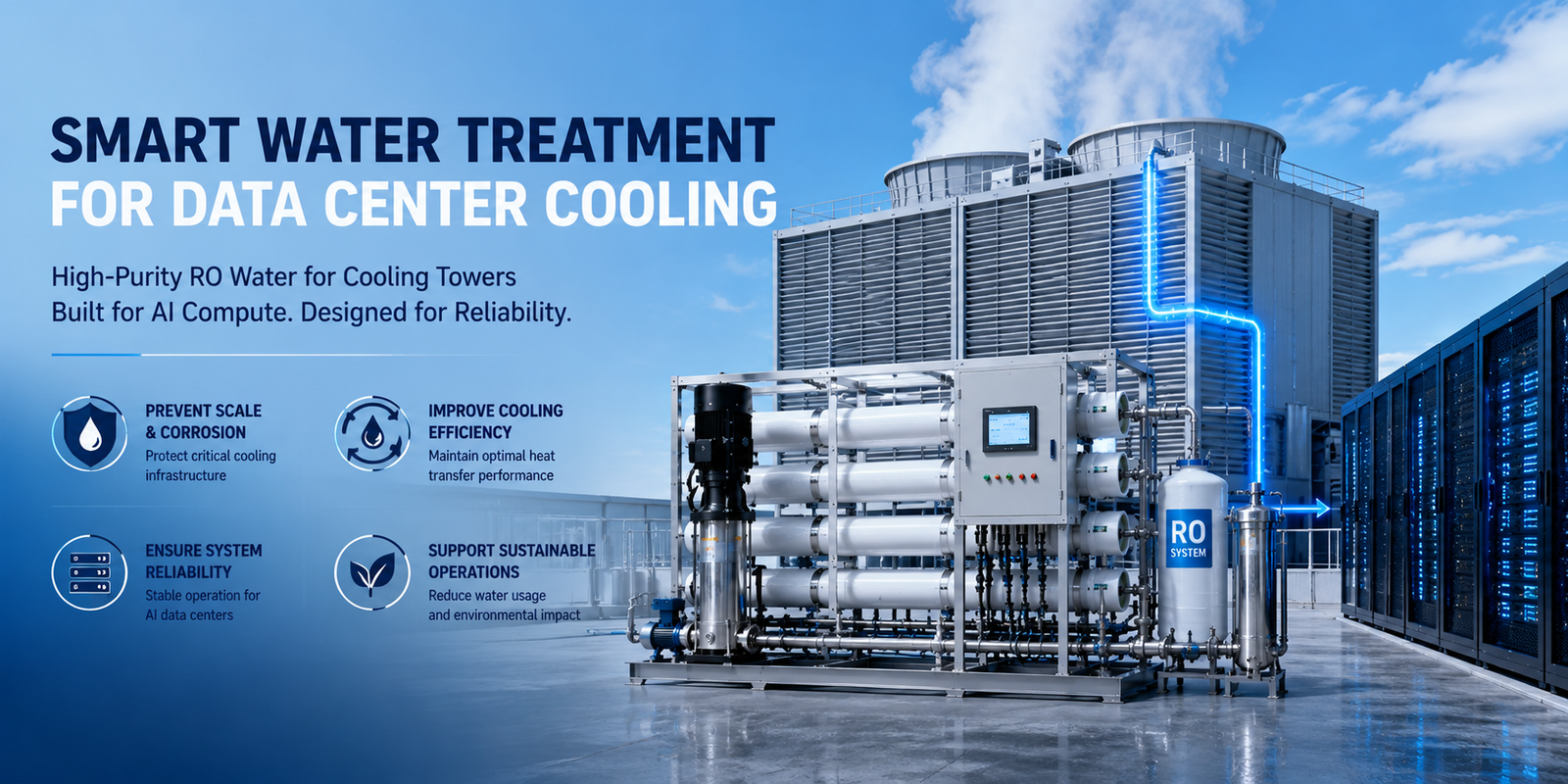
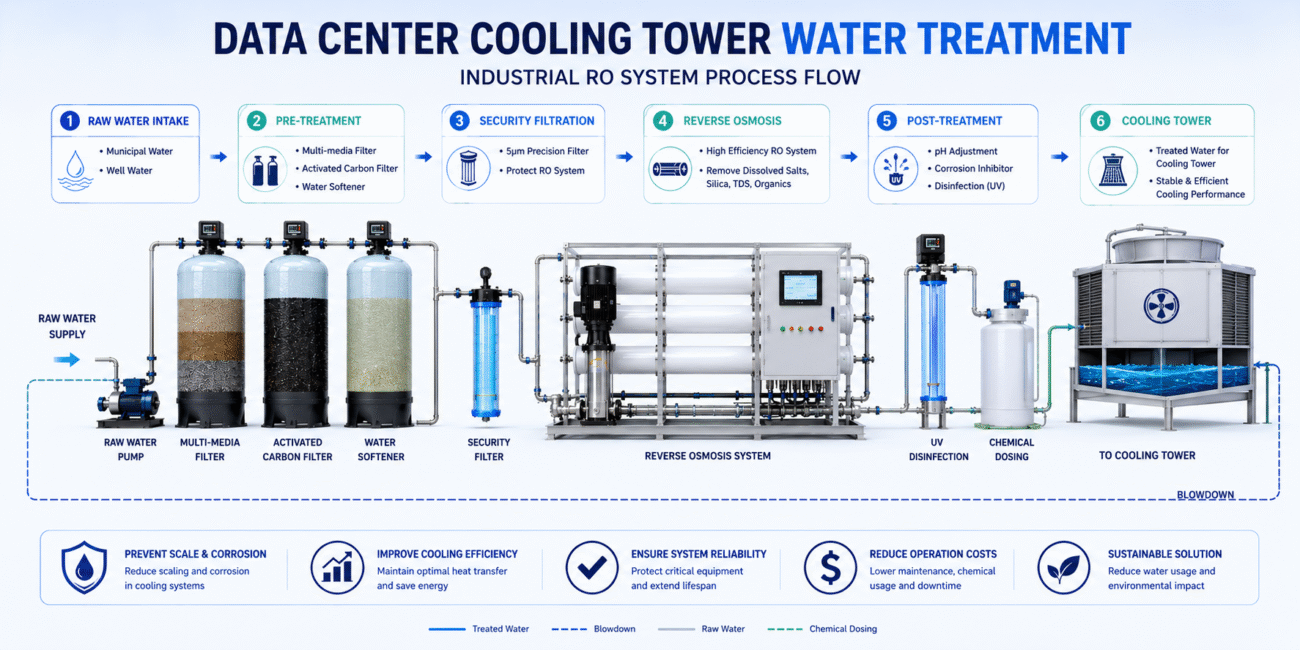
Commercial 5-stage Reverse Osmosis (RO) systems from suppliers like YourWaterGood transform incoming municipal or raw water into high-purity makeup feeds by removing up to 99% of scale-causing minerals and dissolved ions. In high-density AI data center applications, this ultra-pure water feed allows cooling towers to safely operate at significantly higher Cycles of Concentration (CoC) without risking efficiency-killing scale deposits on heat-exchanger surfaces, effectively lowering both blowdown waste and total facility Water Usage Effectiveness (WUE).
Fast Check Product: https://yourwatergood.com/product/industrial-reverse-osmosis-system/
Heavy-duty pre-filtration utilizing multi-stage high-density PP cotton and advanced carbon block arrays serves as the primary line of defense against suspended solids, sediment, and macro-particulates. For AI cluster infrastructure, deploying these modules upstream ensures that incoming physical contaminants are intercepted before they can foul sensitive downstream RO membranes, choke cooling tower spray nozzles, or cause localized micro-channel plugging within liquid-to-chip heat transfer loops.
The Cooling Tower Concentrates on Purpose: Why CoC Is the Master Variable
The defining parameter in data center cooling tower water treatment is Cycles of Concentration — the ratio of dissolved solids in the recirculating water to the makeup water. Every other decision flows from where CoC is held.
CoC is a direct trade between water efficiency and scaling risk:
- Higher CoC concentrates the recirculating water, cutting makeup and blowdown — the single largest lever for WUE in an evaporative system.
- Too high a CoC drives calcium, silica, and alkalinity past their solubility limits, depositing scale on fill and heat exchangers.
- Too low a CoC wastes water and chemicals through excess blowdown.
Data center towers commonly target 4–8+ cycles with a proper treatment program, where an untreated tower would scale at far fewer. Holding that range depends on:
- Conductivity-controlled blowdown that opens automatically at the CoC setpoint.
- Antiscalant chemistry that holds minerals in solution above their normal saturation point.
- Makeup water quality, which sets the ceiling on achievable cycles (covered below).
The discipline: CoC is held by chemistry and control, not chosen on a spreadsheet. A tower pushed to a high cycle count without the dosing to match trades a better WUE number for scaled fill and lost heat-rejection capacity.
The Three-Part Chemistry Program: Scale, Corrosion, and Biological Control
A cooling tower treatment program manages three threats at once, and a gap in any one undermines the others. The dosing system exists to hold all three in balance continuously.
Scale control:
- Antiscalant and dispersant chemistry keeps calcium carbonate, silica, and other minerals in solution as CoC rises.
- Pairing with softened makeup removes the hardness that drives scale at the source, allowing higher CoC.
Corrosion control:
- Corrosion inhibitors protect the mixed metallurgy of the tower, piping, and exchangers, forming protective films on steel and yellow metals.
- pH control holds the water in a band that protects metal without promoting scale.
Biological control:
- Biocide dosing controls bacteria, algae, and the biofilm that insulates heat-transfer surfaces and harbors pathogens.
- Microbiological monitoring verifies the program is working, since biological fouling is the hardest of the three to see until capacity is already lost.
These three programs interact: pushing CoC for water savings raises both scaling and corrosion potential, and warm tower water accelerates biological growth. A tower chemistry program is balanced, not a single additive — and automated dosing paced to load is what holds the balance that manual top-ups miss.
Makeup Water Sets the Ceiling: Municipal vs Reclaimed Feed
The achievable CoC — and the entire dosing program — is set by the makeup water, and municipal versus reclaimed feed move that ceiling in opposite directions.
Municipal potable makeup:
- Relatively stable chemistry, allowing a predictable CoC with standard antiscalant.
- Softening the makeup removes hardness and lets the tower run higher CoC with less scaling risk.
- Chloride control protects 316L components from pitting corrosion.
Reclaimed and recycled makeup — increasingly mandated for WUE targets in Ashburn, VA and Phoenix, AZ:
- Higher TDS, silica above ~150 ppm, phosphate, and ammonia lower the achievable CoC before scaling begins.
- Demands heavier antiscalant and dispersant dosing and stronger biocide programs for the elevated nutrient load.
- Often justifies RO treatment of the makeup to restore the CoC headroom that reclaimed chemistry removes.
A program tuned for municipal makeup will scale or foul on reclaimed water at the same cycle count. The makeup analysis sets the CoC ceiling, and the CoC ceiling sets the program — which is why the water analysis comes before any chemical is selected.
Legionella and Compliance: The Public-Health Dimension of Tower Treatment
A data center cooling tower is not only an asset-protection problem — it is a public-health one. Open towers are a primary source of Legionella transmission, which makes microbiological control a compliance obligation, not just an efficiency measure.
A defensible compliance posture includes:
- An ASHRAE 188 water management plan documenting control measures, monitoring, and corrective actions.
- A biocide program with both oxidizing and non-oxidizing chemistry to prevent resistance.
- Routine microbiological monitoring to verify control and document due diligence.
- Control of stagnant zones and drift, since low-flow areas and aerosol drift are where risk concentrates.
The same biofilm that harbors Legionella also insulates the heat-transfer surface and accelerates under-deposit corrosion, so the public-health program and the performance program reinforce each other. Microbiological control protects both the building occupants and the heat-rejection capacity — and on a mission-critical site, neither is optional.
Standard Skids vs Data-Center-Grade Tower Treatment
A commercial dosing package controls a tower loosely on timers. A data-center-grade program controls CoC and chemistry automatically, with monitoring and redundancy built for 24/7/365 operation.
| Engineering Parameter | Standard Pre-Engineered Skids | Data Center Grade High-Redundancy Systems |
|---|---|---|
| CoC control | Manual / timer blowdown | Automated conductivity-controlled blowdown |
| Dosing | Single inhibitor, manual | Antiscalant + inhibitor + biocide, paced to load |
| Flow capacity (GPM) | 10–50 GPM | 100–1,000+ GPM, parallel trains |
| Redundancy | Single train | N+1 / N+2 / 2N parallel architecture |
| Makeup treatment | Raw or softened | Softening or RO to lift CoC ceiling |
| Monitoring | Spot checks | Online conductivity, ORP, microbiological to BMS |
| Compliance | None | ASHRAE 188 plan, metered WUE reporting |
| Lead time & support | Stock unit, generic spares | Engineered build, documented P&ID, standardized spares |
The control and compliance rows decide outcomes: a tower run on timer-based blowdown and a single inhibitor scales, corrodes, or fails a Legionella audit, while an automated program holds CoC, protects the fill, and documents compliance. The cheaper package carries the scaling, corrosion, and public-health risk.
To pressure-test a vendor, ask how the program holds CoC and controls Legionella on your specific makeup water. A supplier offering a single inhibitor and a timer has not engineered a tower program.
Field Engineering Insight: White Rust on New Galvanized Towers
Here is the detail that destroys brand-new cooling towers: a new galvanized steel tower must be passivated before normal chemical operation — and a high-pH scale-control program run from day one prevents that passivation, causing white rust.
A new galvanized tower needs a passivation window — the first weeks of operation run at controlled pH (~6.5–7.0) with adequate calcium hardness, so the zinc surface forms a stable, protective zinc carbonate layer.
Scale-control programs, though, favor higher pH and alkalinity to allow high CoC. Apply that program to a new galvanized tower immediately and the zinc never passivates. Instead it forms white rust — a voluminous, chalky white zinc corrosion product that consumes the galvanized coating and sharply shortens the tower’s life.
The operator optimizing for scale on a new tower destroys it by corrosion, and the cause is invisible unless the startup was staged correctly.
The engineering defense is sequencing, not a different chemical:
- Passivate new galvanized towers per the manufacturer’s protocol, holding controlled pH and hardness through the passivation window before high-pH operation.
- Stage the chemistry — passivation chemistry first, then transition to the high-CoC scale program.
- Specify stainless or coated towers where high-pH operation is required from day one and a passivation window is not feasible.
This is the kind of detail that never appears on a flow-rated quote but decides whether a new tower lasts decades. It is also where the program compounds: holding correct chemistry lowers descaling and fill-replacement OPEX, prevents the scale and biofilm that rob heat-rejection capacity, protects downstream cold plates and CDUs, and holds 99.999% uptime.
Data Center Cooling Tower Water Treatment FAQs
What is Cycles of Concentration (CoC) in a cooling tower? CoC is the ratio of dissolved solids in the recirculating water to the makeup water. Higher cycles cut makeup and blowdown but raise scaling and corrosion risk; data center towers commonly run 4–8+ cycles with a proper treatment program.
What does a cooling tower treatment program include? A three-part dosing program — antiscalant, corrosion inhibitor, and biocide — plus automated conductivity-controlled blowdown, pH control, and microbiological monitoring.
How is cooling tower blowdown controlled? An automated conductivity controller opens the blowdown valve at the CoC setpoint, using temperature-compensated probes to hold the highest safe cycle count and minimize makeup.
What is white rust and how is it prevented? White rust is a voluminous white zinc corrosion product on galvanized towers. It is prevented by passivating a new tower at controlled pH (~6.5–7.0) and adequate hardness before transitioning to high-pH scale-control operation.
Does makeup water quality limit achievable CoC? Yes. Hard or high-TDS makeup limits the cycles before scaling, while softening or RO makeup raises the achievable CoC and the resulting water savings.
How is Legionella controlled in data center cooling towers? Through a biocide program with oxidizing and non-oxidizing chemistry, routine microbiological monitoring, and an ASHRAE 188 water management plan, since open towers are a primary Legionella risk.
Does reclaimed makeup change the tower program? Yes. Higher TDS, silica above ~150 ppm, and nutrients lower the achievable CoC and demand heavier antiscalant and biocide — often justifying RO treatment of the makeup — consistent with ASHRAE TC 9.9 and EPA frameworks.
Engineer a Tower Program That Holds the Line
Cooling tower water treatment for a data center is the discipline of holding high cycles without crossing into scale, corrosion, or biological failure. The towers that protect heat-rejection capacity and pass compliance are the ones with an automated, balanced program — not a timer and a single inhibitor.
Whether you are commissioning a single high-density facility or sourcing trains into a larger buildout, YourWaterGood manufactures and ships the equipment factory-direct — data center cooling tower water treatment systems built on skid-mounted softening, RO makeup and blowdown treatment, automated antiscalant/inhibitor/biocide dosing, and BMS-integrated CoC control.
- Get an Infrastructure Engineering Quote: itemized pricing on softening, dosing, and 1 t/h–10 t/h RO makeup systems sized to your tower and makeup water.
- Request Technical Data Sheets: dosing specs, CoC control logic, and BMS integration detail for your engineering review.
- Secure B2B Wholesale / Factory-Direct Pricing: source tower treatment equipment straight from our manufacturing facility.