
Water Treatment for Data Centers: Meeting WUE Targets, Reclaimed-Water Mandates, and Discharge Limits

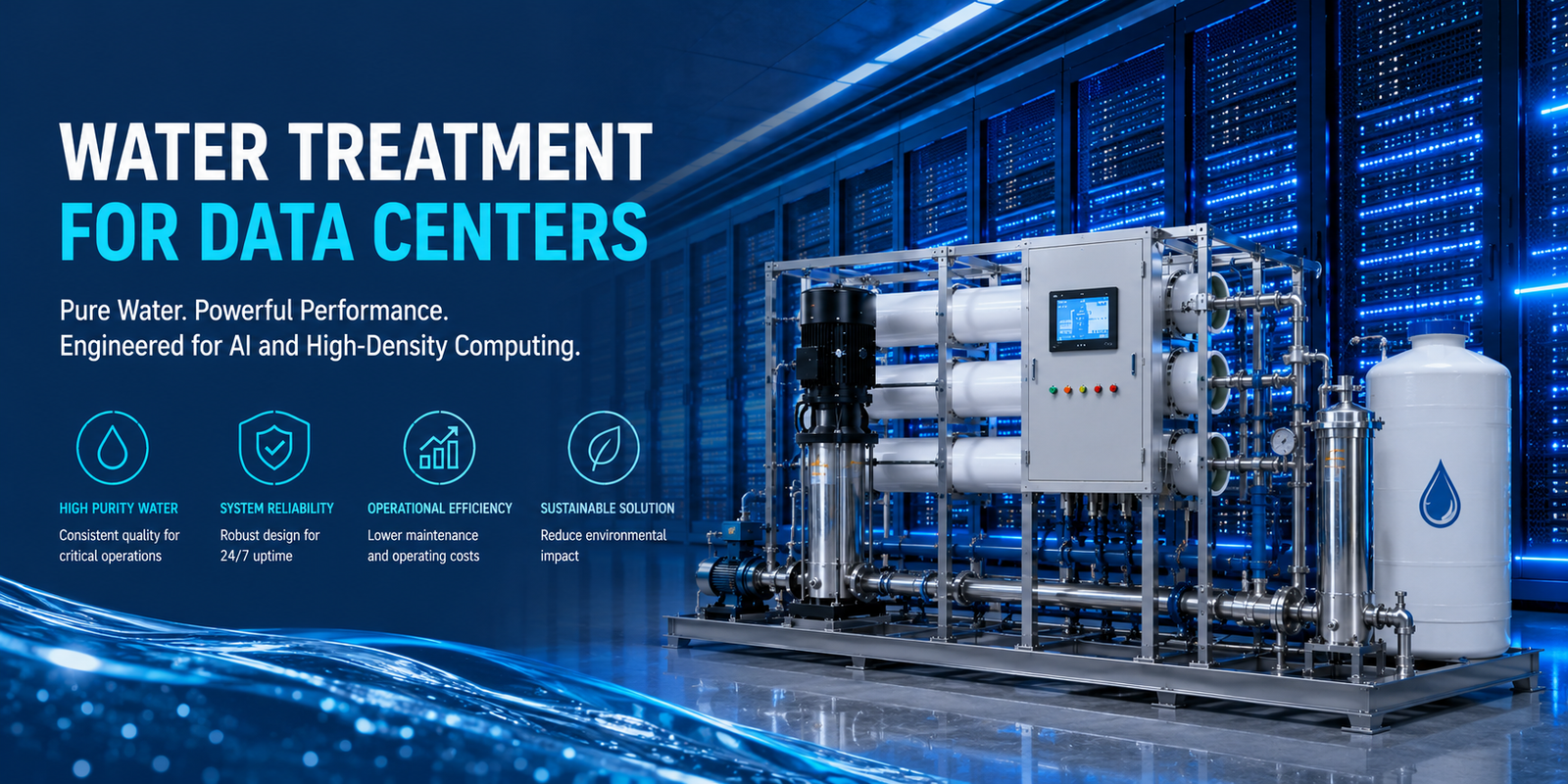
For a new AI data center, the constraint that stalls the project is increasingly not power or land — it is water. Whether a site can secure a withdrawal permit, hit a Water Usage Effectiveness (WUE) target, and stay inside a discharge limit now decides whether it gets built at all.
Treatment is what converts a water-constrained site into a permittable one. The same equipment that protects the cooling loop also cuts withdrawal, enables reclaimed reuse, and keeps discharge inside legal caps — turning a regulatory obstacle into an operating license.
Engineering water treatment for data centers at this level means designing for the permit and the sustainability target as hard inputs, not just for water quality at the cold plate.
Before sourcing, lock these specifications first:
- High Cycles of Concentration (CoC) capability — cuts both withdrawal and discharge volume to fit permit limits.
- Reclaimed and recycled water treatment — the front-end capability to meet reuse mandates on a harder feed.
- Blowdown recovery and ZLD readiness — to stay inside discharge caps where permits restrict volume or strength.
- WUE-aware instrumentation — metered makeup and blowdown, trended into the BMS for reporting.
- Compliance by design — ASHRAE TC 9.9 for quality and EPA / state frameworks for withdrawal and discharge.
The sections below break down water as a siting constraint and the treatment that resolves it.
Fast Check Product: https://yourwatergood.com/product/industrial-reverse-osmosis-system/
As artificial intelligence clusters advance toward ultra-high-density architectures—including hardware platforms with a Thermal Design Power (TDP) exceeding 1000W—traditional HVAC systems have reached their physical limitations. Modern facilities are forced to pivot toward liquid-based heat rejection models, such as direct-to-chip (DTC) cold plates and closed-loop evaporative chillers. This massive infrastructure shift has elevated Water Usage Effectiveness (WUE) to a mission-critical metric alongside standard PUE.
Without rigorous, high-volume water treatment for data centers, incoming supply water poses a catastrophic risk to server uptime. Total Dissolved Solids (TDS), calcium hardness, silica, and microscopic suspended matter rapidly form crystalline scale insulation or biological biofilms across heat-exchange boundaries. This degradation chokes micro-channel cooling pathways, triggers severe thermal throttling, and threatens multi-million dollar GPU deployments.
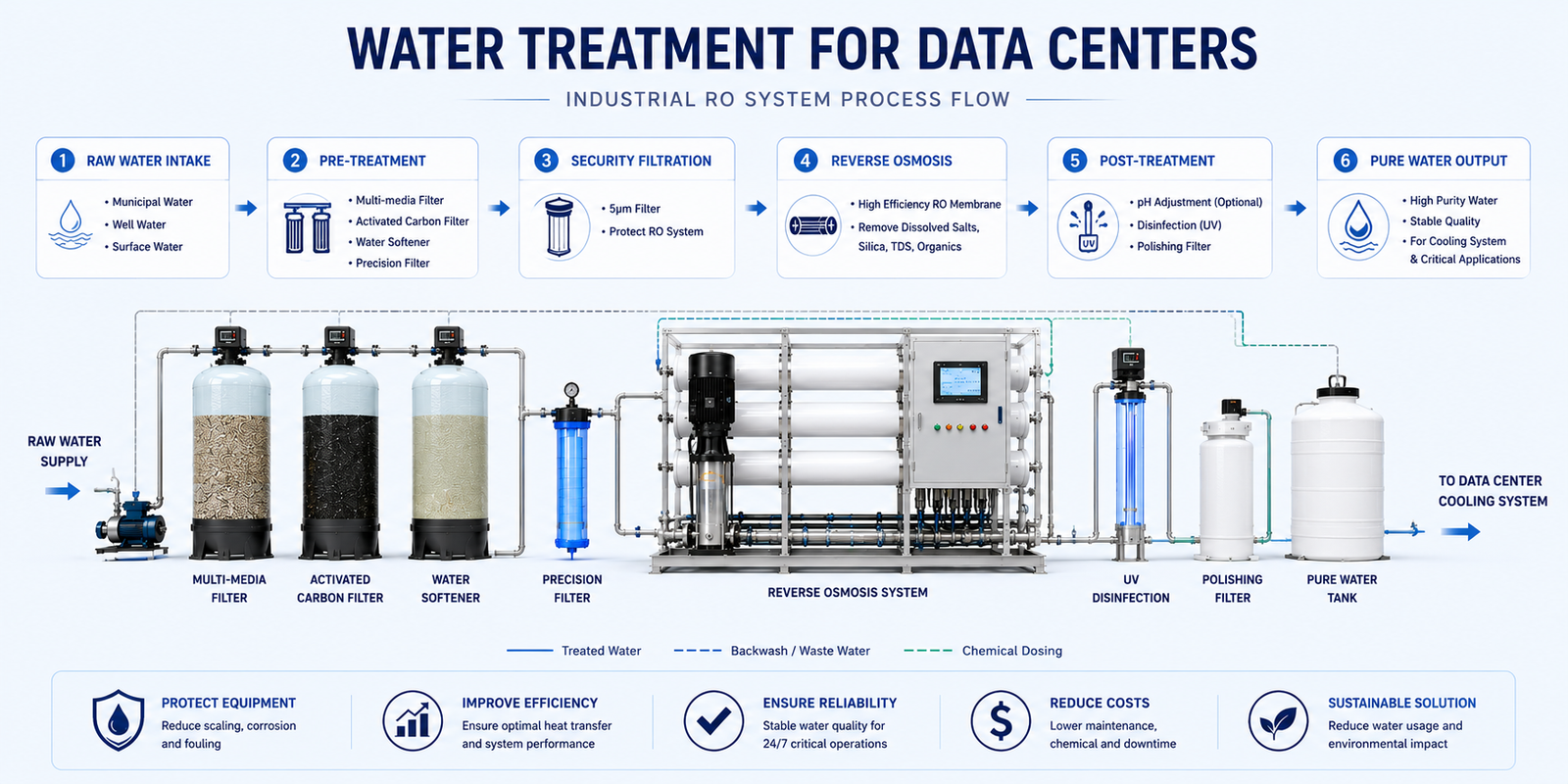
To meet the continuous water demands of modern hyperscale and edge facilities across the United States and Europe, YourWaterGood delivers adaptable, high-efficiency commercial and traditional 5-stage industrial Reverse Osmosis (RO) infrastructure arrays.
By steering clear of unscalable desktop consumer alternatives, our commercial architecture focuses entirely on ruggedized, modular purification components designed for decentralized edge deployments and primary cooling tower makeup loops:
- Multi-Stage Sediment Interception: Utilizing robust, high-density PP cotton media and extruded carbon block systems to extract suspended particulates and chemical oxidizers prior to primary membrane filtration.
- Industrial 5-Stage Reverse Osmosis Plants: Removing up to 99% of dissolved ionic contaminants, silica, and mineral salts to stabilize water chemistry and allow cooling towers to safely operate at elevated Cycles of Concentration (CoC).
- Micro-Channel Protection Protocols: Deploying fine-micron inline pre-filtration modules to guarantee that fluid moving through direct-to-chip cooling loops remains entirely free of abrasive silt or particulate debris.
For infrastructure management teams managing fast-tracked data center builds in major North American and European technology corridors, procurement agility is as vital as hardware reliability. YourWaterGood simplifies supply chain logistics by offering flexible international shipping terms, including EXW and FOB, with direct, trackable dispatch via major global networks
By standardizing core filtration elements—such as our high-capacity carbon block modules, industrial-grade RO membranes, and heavy-duty pre-filter housings—we eliminate the maintenance complexity associated with custom, proprietary systems. This allows facility engineers to implement predictable, simplified preventive maintenance routines, keeping cooling loops functioning at peak thermodynamic efficiency.
High-density AI computing nodes generate severe concentrated thermal loads that require liquid-to-chip or evaporative cooling loops to run efficiently. Implementing specialized water treatment for data centers using high-output 5-stage industrial RO plants and high-density pre-filtration from providers like YourWaterGood is essential to strip out dissolved minerals, silica, and particulates. This targeted purification prevents scale accumulation and micro-channel blockages, ensuring optimal heat transfer rates and protecting the facility’s baseline Water Usage Effectiveness (WUE).
Traditional municipal or well water contains high levels of magnesium and calcium ions that naturally precipitate out as water evaporates, forming a dense mineral crust on condenser tubes. By implementing a high-capacity 5-stage industrial Reverse Osmosis (RO) system as a makeup water feed, the water is stripped of up to 99% of these scaling ions beforehand. This enables the cooling tower to safely recirculate the same water through significantly higher Cycles of Concentration (CoC), drastically cutting down on wastewater blowdown and protecting cooling efficiency.
Water Is the New Siting Constraint: Why Treatment Decides Permittability
The defining shift in water treatment for data centers is that water has moved from an operating detail to a siting gate. In water-stressed core markets, a project can secure power and still be blocked on water.
Three regulatory pressures now converge on every large buildout:
- Withdrawal limits — state and local authorities cap how much water a facility may draw, and in drought-prone regions new large withdrawals face moratoria or heavy scrutiny.
- WUE targets — operators increasingly report and commit to a WUE figure, and local approvals can hinge on it.
- Discharge limits — EPA NPDES permits and local sewer authorities restrict both the volume and the strength of what a facility may discharge.
Treatment is the lever that satisfies all three at once:
- Higher CoC and reclaimed reuse cut withdrawal.
- Efficient operation and recovery lower the WUE number.
- Blowdown recovery and ZLD keep discharge compliant.
The takeaway for site selection: the water treatment strategy is part of the permitting strategy. A facility that treats water as an afterthought discovers the regulator does not.
WUE Is Now a Reported Metric: Engineering the Number Down
Water Usage Effectiveness measures the water a facility consumes per unit of IT energy — and as it becomes a reported, committed figure, the treatment system is what moves it.
The engineering levers that lower WUE:
- Maximized CoC — running cooling towers at the highest safe Cycles of Concentration cuts makeup water and blowdown together, the single largest WUE lever for an evaporative system.
- Blowdown recovery — treating and reusing tower blowdown with industrial reverse osmosis returns water to the loop instead of discharging it.
- Reclaimed substitution — replacing potable makeup with treated reclaimed water lowers freshwater withdrawal even when total water use is unchanged.
- Leak-tight closed loops — direct-to-chip and immersion heat-rejection loops that recirculate rather than evaporate consume far less water per kWh.
These levers depend on holding water quality while pushing efficiency. Running high CoC without proper softening and antiscalant trades a better WUE number for scaling — which is why the WUE strategy and the scale-control strategy are the same project. A lower WUE is engineered, not declared.
Reclaimed-Water Mandates: Inheriting a Harder Feed
A growing number of jurisdictions require or incentivize reclaimed and recycled water for data center cooling. That mandate solves a withdrawal problem and creates a treatment one — the facility inherits a much more difficult feed.
Municipal potable feed is the lighter case:
- Activated carbon to remove chlorine and chloramine that attack RO membranes.
- Chloride control to prevent pitting corrosion on 316L.
Reclaimed and recycled feed is far more aggressive:
- High TDS, silica above ~150 ppm, phosphate, ammonia, and organic load.
- Requires multimedia filtration, skid-mounted softening, and antiscalant dosing ahead of RO.
- Carries higher biofouling potential, demanding stronger microbiological control.
- Polymerized silica scale is effectively unremovable by acid wash once formed, so prevention is the only option.
The strategic point for environmental and procurement managers: a reclaimed-water mandate transfers the treatment burden onto the facility. The water may be cheaper or required, but the pre-treatment train to use it safely is a real CAPEX and OPEX line that must be budgeted at siting, not discovered at commissioning.
Discharge Limits and ZLD: Staying Inside the Permit
Discharge is where many water plans break. A facility may hold ample intake, then find it cannot legally release the concentrated blowdown its cooling system produces.
Discharge constraints take several forms:
- EPA NPDES limits on surface-water discharge, capping volume and specific pollutants.
- Local sewer / POTW limits, often surcharged on both discharge volume and strength (TDS or conductivity).
- Outright prohibition in some jurisdictions, where no compliant discharge path exists.
The treatment responses scale with the limit:
- Maximize CoC to shrink blowdown volume at the source.
- Recover blowdown with RO, returning permeate to the loop and reducing discharge.
- Zero Liquid Discharge (ZLD) where the permit caps or prohibits discharge — concentrating the reject to a solid and eliminating liquid effluent entirely.
ZLD is capital-intensive, so it is engineered to the permit rather than applied by default. Where a discharge limit is the binding constraint, though, it is the difference between an operating facility and a stranded one. The discharge permit sets the recovery target, and the recovery target sets the equipment.
Standard Skids vs Data-Center-Grade Systems
A commercial skid treats water for the loop and ignores the permit. A data-center-grade system is engineered around withdrawal, WUE, and discharge compliance to run 24/7/365.
| Engineering Parameter | Standard Pre-Engineered Skids | Data Center Grade High-Redundancy Systems |
|---|---|---|
| Compliance scope | Loop quality only | Withdrawal, WUE, and discharge by design |
| Reclaimed-water capability | Limited | Full pre-treatment for reclaimed feed |
| Recovery / ZLD | None | Blowdown recovery and ZLD readiness |
| Flow capacity (GPM) | 10–50 GPM | 100–1,000+ GPM, parallel trains |
| Redundancy | Single train | N+1 / N+2 / 2N parallel architecture |
| Metering / reporting | Basic | Metered makeup and blowdown to BMS for WUE |
| Purity | 10–20 µm nominal | RO to 0.0001 µm, EDI to 18.2 MΩ·cm |
| Lead time & support | Stock unit, generic spares | Engineered build, documented P&ID, standardized spares |
The compliance and recovery rows are what matter at siting: a system that cannot run reclaimed feed or recover blowdown leaves the facility exposed to the exact limits that block permits. The cheaper skid carries the permitting risk.
To pressure-test a vendor, ask how their system meets your specific withdrawal and discharge limits. A supplier who only discusses loop quality has not engineered for your license to operate.
Field Engineering Insight: The Discharge Permit Is the Hidden Constraint
Here is the reality that catches teams planning a new build: a facility can run out of permitted discharge capacity before it runs out of water — and almost no one plans for that direction.
Project teams secure the water supply first and treat discharge as a downstream formality. But discharge permits restrict both volume and strength — concentrated cooling-tower blowdown is high-volume and high-TDS, which is exactly what NPDES and sewer limits cap.
When the discharge ceiling is reached, the facility can no longer blow down enough to control CoC the conventional way. The site has water coming in and nowhere compliant to put the concentrate — and the only paths out are high-recovery treatment, reclaimed reuse, or ZLD.
The teams who discover this mid-buildout face an expensive retrofit; the teams who plan for it design the recovery in from the start.
The engineering defense is to treat the discharge permit as a primary design input:
- Model the discharge limit (volume and strength) before sizing the cooling and treatment plant.
- Maximize CoC and recover blowdown to shrink the discharge stream at the source.
- Build toward ZLD where the permit caps or prohibits discharge, sizing the concentration train to the legal limit.
- Meter and trend discharge into the BMS so the facility proves compliance continuously, not just at audit.
This is the kind of detail that never appears on a flow-rated quote but decides whether a site is permittable. It is also where treatment compounds: recovering water lowers withdrawal and discharge cost, improves WUE, and — by keeping the loop clean while running high CoC — protects cold plates and CDUs and holds 99.999% uptime.
Water Treatment for Data Centers FAQs
What is WUE for a data center? Water Usage Effectiveness is the water a facility consumes per unit of IT energy (commonly liters per kWh). A lower number is better, and it is increasingly a reported and committed sustainability metric tied to local approvals.
How does water treatment lower WUE? By running the highest safe Cycles of Concentration to cut makeup and blowdown, recovering blowdown with RO, and substituting treated reclaimed water for potable makeup to reduce freshwater withdrawal.
Are data centers required to use reclaimed water? In some water-stressed jurisdictions, yes — reclaimed or recycled water is mandated or incentivized for cooling. This shifts the treatment burden onsite, since reclaimed feed carries higher TDS, silica, and organics.
What is ZLD and when is it required? Zero Liquid Discharge eliminates liquid effluent by concentrating reject to a solid. It is engineered where discharge permits cap volume or strength, or prohibit discharge entirely.
Which water permits apply to a data center? EPA NPDES permits for surface-water discharge, local sewer/POTW limits (often surcharged on volume and TDS/strength), and state withdrawal permits for intake. All three can constrain a site.
Does reclaimed water raise treatment cost? Yes. Higher TDS, silica, and organics require heavier pre-treatment (multimedia, softening, antiscalant), raising CAPEX and OPEX — but it secures compliance and reduces withdrawal, consistent with ASHRAE TC 9.9 and EPA frameworks.
How does treatment support a data center’s license to operate? It keeps withdrawal and discharge inside permitted limits and meets WUE commitments, de-risking siting and protecting continuous operation against drought and regulatory tightening.
Engineer Water Compliance Into the Build
Water treatment for a data center is now a permitting decision as much as an engineering one. The sites that get built and stay running are the ones whose treatment strategy was designed around withdrawal, WUE, and discharge limits — not bolted on after the regulator pushed back.
Whether you are permitting a single high-density facility or sourcing trains into a larger buildout, YourWaterGood manufactures and ships the equipment factory-direct — water treatment for data centers built on industrial RO, EDI, skid-mounted softening, blowdown-recovery and ZLD-ready trains, and automated dosing, engineered to your permits and WUE targets.
- Get an Infrastructure Engineering Quote: itemized pricing on 1 t/h–10 t/h systems sized to your withdrawal, discharge, and WUE constraints.
- Request Technical Data Sheets: recovery rates, reclaimed-feed specs, and metering detail for your environmental review.
- Secure B2B Wholesale / Factory-Direct Pricing: source compliance-ready equipment straight from our manufacturing facility.