
Ultrapure Water System for Liquid Cooling: Why Direct-to-Chip Loops Demand 18.2 MΩ·cm Resistivity

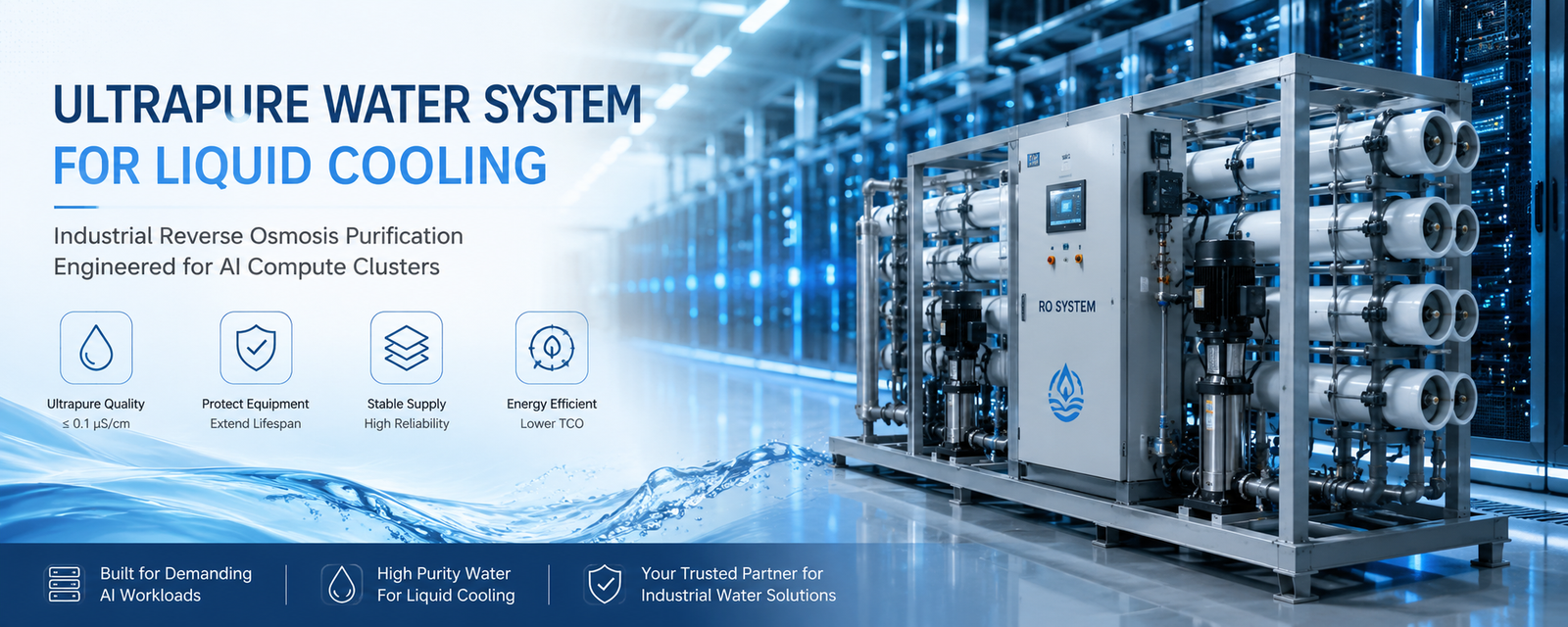
That single fact is why liquid cooling demands ultrapure water, not merely “treated” water. Conductivity in the loop is a dielectric safety parameter before it is a fouling parameter, and the target sits at the physical limit of water purity.
Engineering an ultrapure water system for liquid cooling means designing for resistivity at the 18.2 MΩ·cm ceiling, controlling organics that conductivity cannot detect, and holding that purity in a fluid that actively resists staying pure.
Before sourcing, lock these specifications first:
- Resistivity target — drive toward 18.2 MΩ·cm (≤ 0.1 µS/cm) for direct-to-chip loops; this is the dielectric guardrail, not a nicety.
- TOC control — UV oxidation plus polishing, because total organic carbon evades conductivity measurement and feeds biofilm.
- Inert wetted materials — PVDF, PP, or electropolished 316L; ultrapure water leaches ions and plasticizers from the wrong material.
- Continuous recirculation through polishing — ultrapure water degrades the moment it sits stagnant.
- Bacteria and endotoxin control — UV at 185/254 nm and ultrafiltration, with a fully sanitizable design.
The sections below break down the purity grade, why liquid cooling needs it, and how to hold it.
Fast Check Product: https://yourwatergood.com/product/industrial-reverse-osmosis-system/
To support hyperscale deployments and edge computing facilities throughout the United States and Europe, YourWaterGood manufactures robust, scalable commercial and industrial-grade water purification platforms.
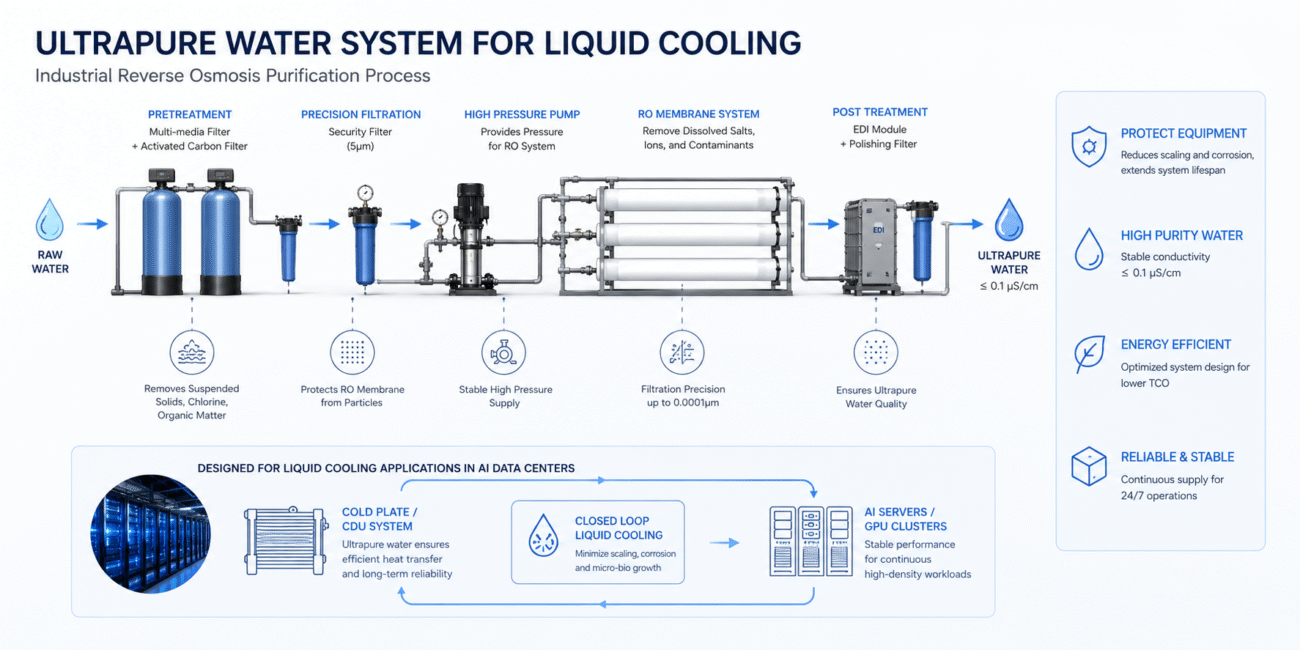
Moving far beyond low-capacity, high-maintenance desktop filtration, our industrial process train combines primary multi-stage filtration with high-recovery membrane separation to deliver continuous, high-volume fluid stabilization:
- Advanced Particle Isolation Nodes: Deploying heavy-duty, high-density PP cotton sediment modules alongside premium extruded carbon blocks to remove suspended silt, colloids, and chlorine prior to membrane processing.
- Double-Pass Industrial RO Units: Stripping out up to 99% of bulk Total Dissolved Solids (TDS), silica, and hard mineral ions to establish a low-conductivity baseline feed.
- Deionization and Polishing Loops: Integrating modular continuous electrodeionization (EDI) and mixed-bed polishing steps to lift fluid resistivity toward absolute purity, protecting delicate direct-to-chip cooling loops from chemical degradation.
Maintaining uninterrupted operation across these mission-critical compute clusters requires deploying a dedicated ultrapure water system for liquid cooling that locks in tight physical and chemical parameters:
- Sub-Micro West Conductivity Profiles: Maintaining continuous electrical conductivity below 0.1 uS/cm to eliminate macro-galvanic tracking and structural corrosion risks.
- Absolute Micro-Particulate Interception: Implementing continuous multi-stage filtration down to 0.05 microns to prevent the accumulation of debris in high-density cold plates.
- Continuous Electrodeionization (EDI) Polish: Utilizing chemical-free electrical regeneration to steadily strip out weak ions, including silica and boron, without flow interruptions.
- Integrated BMS Telemetry Interoperability: Providing native communication via Modbus TCP/IP or BACnet protocols to deliver real-time data on resistivity, flow rates, and trans-membrane differential pressures.
Purity Is an Electrical Spec, Not Just a Scaling Spec
The defining insight behind an ultrapure water system for liquid cooling is that the conductivity target is set by electrical safety, not only by scale prevention.
In a direct-to-chip architecture, coolant circulates through cold plates bonded to processors operating at full power. Two failure modes drive the purity requirement:
- Leakage current — if a micro-leak puts coolant in contact with an energized board, the water’s conductivity determines how much current flows. High-resistivity water carries far less, turning a potential short circuit into a containable event.
- Galvanic and scaling activity — ionic content drives both corrosion of copper cold plates and mineral deposition in microchannels under 100 µm; ultrapure water removes the ions that feed both.
This is why the spec is so much tighter than an open cooling tower’s. A tower tolerates hundreds of µS/cm; a direct-to-chip loop targets ≤ 0.1 µS/cm, because the water is an electrical medium wrapped around live silicon.
The discipline: specify loop conductivity as a safety parameter. Treating it as a scaling number alone under-specifies the system for the electrical risk it actually carries.
The Resistivity Ladder: From RO Permeate to 18.2 MΩ·cm
Reaching ultrapure grade is a staged process, and each stage exists because the one before it cannot reach the next purity tier alone.
The purity ladder for a liquid cooling UPW system:
- Reverse osmosis — bulk demineralization, taking feed water down to roughly 1–20 µS/cm by rejecting ~99% of dissolved solids.
- Continuous electrodeionization (EDI) — polishes RO permeate to approximately 0.1 µS/cm, equivalent to 1–15 MΩ·cm, regenerating electrically with no chemicals.
- Polishing mixed-bed — a final ion-exchange stage that lifts resistivity toward the theoretical maximum of 18.2 MΩ·cm.
Supporting stages handle what ion removal does not:
- UV oxidation (185 nm) breaks down organics to control TOC.
- Ultrafiltration provides a final barrier against bacteria and particulate at the point of use.
Each stage is sized to the loop’s makeup demand (GPD) and the recirculation rate that holds resistivity stable. A UPW system is a polishing chain, not a single skid — and the polishing never stops, for the reason covered in the field insight below.
TOC and Bacteria: The Contaminants Conductivity Cannot See
A resistivity meter reading 18.2 MΩ·cm can still sit on water that is contaminated — because two of the most important UPW contaminants are invisible to conductivity.
Total Organic Carbon (TOC):
- Organics carry little or no ionic charge, so they do not move the resistivity reading.
- They feed biological growth and can deposit on hot surfaces, so they must be controlled independently.
- UV oxidation at 185 nm breaks organics into ionized fragments that polishing resin then removes, driving TOC toward the low-ppb range.
Bacteria and endotoxin:
- Ultrapure water supports specific low-nutrient bacteria that colonize stagnant zones and resin beds.
- Control requires UV at 254 nm for disinfection, ultrafiltration as a final barrier, and a sanitizable system design with minimal dead-legs.
A UPW specification written only around conductivity is incomplete. Resistivity proves ion removal; it says nothing about organics or biology — both of which require their own barriers. This is the gap that separates a real ultrapure system from a high-resistivity skid.
Make-Up and Source Water: Municipal vs Reclaimed Feed to a UPW Train
Every ultrapure system starts from a raw source, and the pre-treatment ahead of the RO/EDI chain changes with that source even though the polishing end stays the same.
Municipal potable feed:
- Needs activated carbon to remove chlorine and chloramine that destroy RO membranes and shorten resin life.
- Needs chloride control to prevent pitting corrosion on 316L in the high-purity train.
Reclaimed and recycled feed — increasingly mandated for WUE targets in Ashburn, VA and Phoenix, AZ:
- Needs multimedia filtration, skid-mounted softening, and antiscalant dosing ahead of RO, because higher TDS and silica above ~150 ppm otherwise foul the membranes.
- Needs upstream TOC reduction, since the heavier organic load of reclaimed water burdens the downstream UV and polishing stages.
The polishing chain that produces 18.2 MΩ·cm is the same; the front end that protects it is not. Source water sets the pre-treatment, and under-building it starves the polishing stages that hold the loop spec.
Standard Skids vs Data-Center-Grade UPW Systems
A commercial deionization skid produces purified water and stops there. A data-center-grade ultrapure system produces, polishes, monitors, and continuously recirculates UPW to hold resistivity 24/7/365.
| Engineering Parameter | Standard Pre-Engineered Skids | Data Center Grade High-Redundancy UPW Systems |
|---|---|---|
| Output purity | ~1–20 µS/cm (RO grade) | 18.2 MΩ·cm (≤ 0.1 µS/cm) |
| Polishing chain | RO only | RO + EDI + polishing mixed-bed + UV |
| TOC / bacteria control | None | UV 185/254 nm + ultrafiltration |
| Flow capacity (GPM) | 10–50 GPM | 100–1,000+ GPM, parallel trains |
| Redundancy | Single train | N+1 / N+2 / 2N parallel architecture |
| Wetted materials | PVC / standard | PVDF / PP / electropolished 316L |
| Monitoring | Spot conductivity | Online resistivity + TOC to BMS |
| BMS integration | Analog (4–20 mA) | Modbus TCP / BACnet IP / SNMP |
The purity and materials rows are decisive: an RO-grade skid in PVC cannot reach or hold ultrapure resistivity, and its materials would re-contaminate the water if it did. Ultrapure grade is a system property, not an upgrade sticker.
To pressure-test a vendor, ask for the resistivity and TOC they guarantee at the point of use, and the wetted materials. A supplier quoting conductivity from an RO skid is not offering an ultrapure system.
Field Engineering Insight: Ultrapure Water Is “Hungry”
Here is the detail that catches teams new to ultrapure systems: water at 18.2 MΩ·cm is chemically aggressive and thermodynamically unstable — it does not stay pure on its own, and it degrades the moment it stops moving.
Ultrapure water is so depleted of ions that it aggressively pulls contamination from everything it touches:
- It absorbs atmospheric CO₂ on contact with air, forming carbonic acid that drops resistivity sharply within minutes.
- It leaches ions and plasticizers out of the wrong piping — PVC, brass, and ordinary steel re-contaminate it and add TOC.
- It picks up ions from stagnant resin and dead-legs, so any non-circulating volume loses grade quickly.
The trap is treating UPW like RO water — making a batch and storing it in a poly tank. Do that, and resistivity at the point of use collapses, while the operator blames the polishing system instead of the storage and stagnation that actually caused it.
The engineering defense is architectural:
- Continuously recirculate the loop through polishing; never rely on dead storage to hold grade.
- Specify inert wetted materials — PVDF, PP, or electropolished 316L — end to end, with no PVC or yellow metals.
- Nitrogen-blanket storage tanks to exclude CO₂ and oxygen.
- Monitor resistivity at the point of use, not just at the skid outlet, and minimize dead-legs in design.
This is the kind of detail that never appears on a flow-rated quote but decides whether a loop holds 18.2 MΩ·cm at the cold plate or only at the skid. It is also where the system pays back: stable ultrapure water lowers resin and membrane OPEX, prevents galvanic and organic fouling of cold-plate microchannels, protects CDUs and high-pressure pumps, and holds 99.999% uptime.
Ultrapure Water System for Liquid Cooling FAQs
What water purity does a liquid cooling loop need? For direct-to-chip cooling, drive resistivity toward 18.2 MΩ·cm (≤ 0.1 µS/cm). The rationale is dielectric and electrical safety near energized silicon, not only scale prevention.
Why does liquid cooling need ultrapure water instead of RO water? Because the coolant runs millimeters from live boards. High-resistivity water minimizes leakage current if a leak contacts energized electronics, and removes the ions that drive corrosion and scaling in microchannels under 100 µm.
What is the resistivity ladder for ultrapure water? RO permeate at roughly 1–20 µS/cm, polished by EDI to about 0.1 µS/cm (1–15 MΩ·cm), then a mixed-bed stage lifting it toward 18.2 MΩ·cm.
What is TOC and why is it controlled? Total Organic Carbon is organic contamination that conductivity cannot detect. It feeds biofilm and deposits on hot surfaces, so it is controlled with UV oxidation at 185 nm plus polishing, targeting the low-ppb range.
Why does ultrapure water lose purity in storage? It absorbs CO₂ from air and leaches ions from piping, so resistivity collapses when it sits stagnant. UPW must recirculate continuously through polishing and use inert wetted materials.
What materials are required for an ultrapure water system? PVDF, PP, or electropolished 316L. PVC, brass, and ordinary steel leach ions and plasticizers that re-contaminate the water and raise TOC.
Does source water affect ultrapure system design? Yes. Both municipal and reclaimed feeds need the full RO + EDI + polishing chain, but reclaimed requires heavier pre-treatment — multimedia, softening, antiscalant, and TOC reduction — consistent with ASHRAE TC 9.9 and EPA frameworks.
Hold Ultrapure Grade From the Skid to the Cold Plate
An ultrapure water system for liquid cooling is judged at the point of use, not the skid outlet. The loops that hold 18.2 MΩ·cm at the cold plate are the ones built on a full polishing chain, inert materials, and continuous recirculation — not a high-resistivity skid feeding a storage tank.
Whether you are commissioning a single high-density server room or sourcing trains into a larger buildout, YourWaterGood manufactures and ships the equipment factory-direct — an ultrapure water system for liquid cooling built on industrial RO, EDI, polishing, UV, and BMS-ready resistivity and TOC monitoring.
- Get an Infrastructure Engineering Quote: itemized pricing on 1 t/h–10 t/h RO/EDI/polishing chains sized to your loop and resistivity target.
- Request Technical Data Sheets: guaranteed resistivity and TOC, wetted materials, and BMS integration detail.
- Secure B2B Wholesale / Factory-Direct Pricing: source ultrapure equipment straight from our manufacturing facility.