
High-Purity Water Systems for AI Data Center Cooling: Engineering Specs for High-Density Rack Uptime

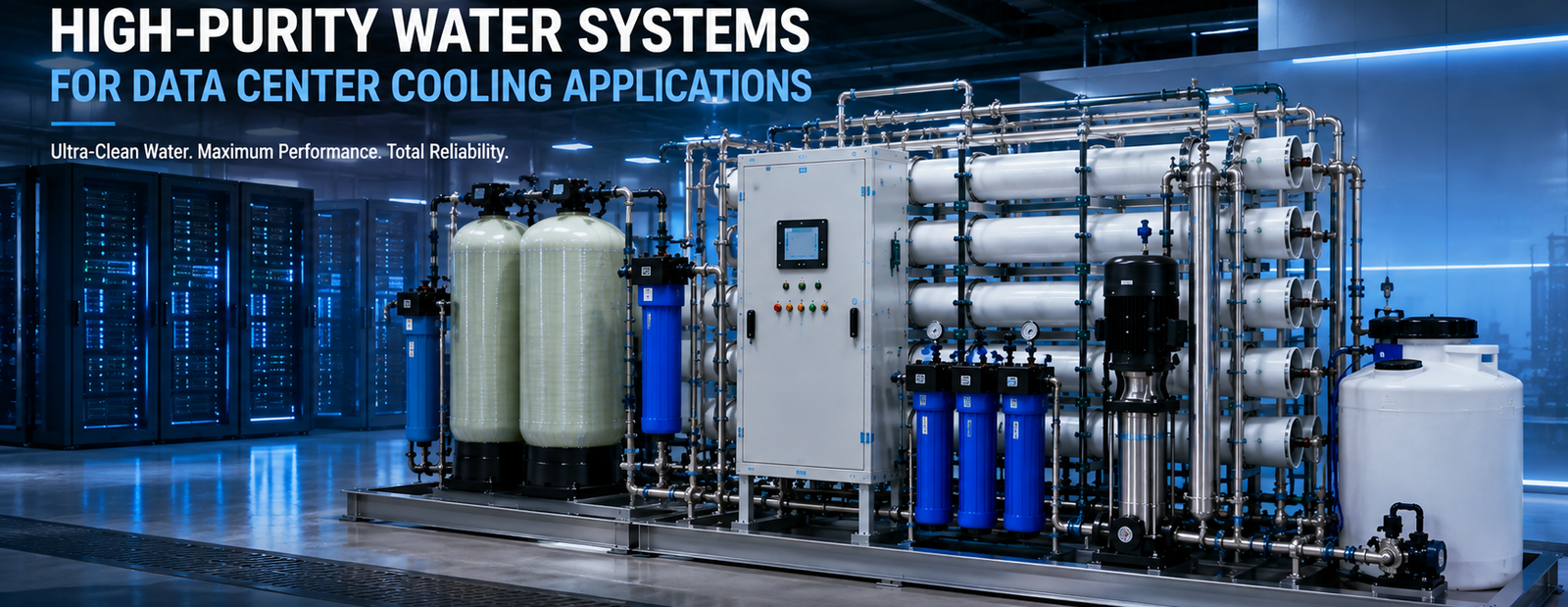
Before evaluating any vendor, lock these five specifications into your RFP. Nothing else in this article matters if these aren’t non-negotiable line items:
- Continuous online conductivity monitoring with automated high-limit alarm escalation to BMS, not periodic grab-sample testing
- Documented TDS rejection performance under real feed conditions — for example, raw water reduced from 1,300 mg/L to under 20 mg/L in a single-pass build, and under 10 mg/L in a two-stage configuration — not a bare percentage claim on a spec sheet
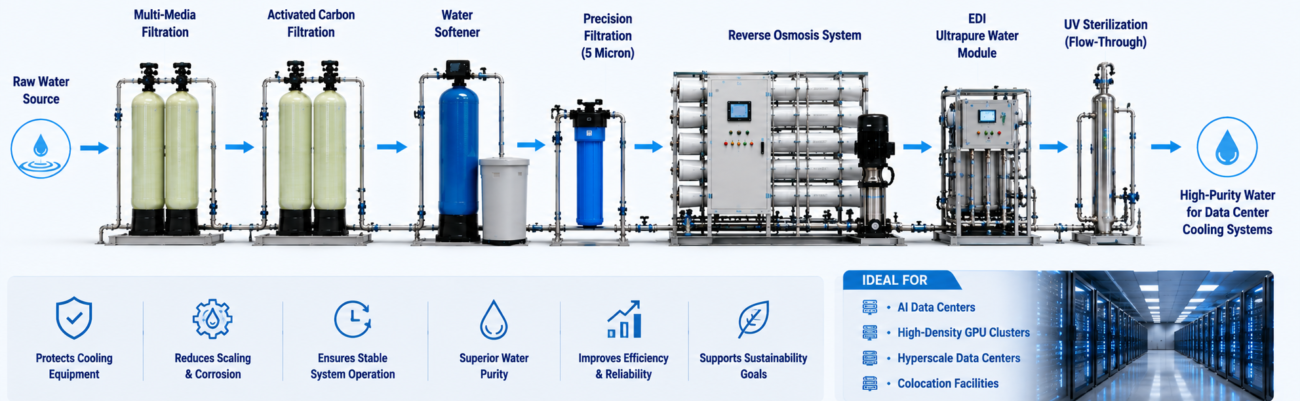
- RO-plus-polishing architecture (EDI or mixed-bed) capable of holding conductivity in the near-DI range your CDU/cold plate OEM actually specifies, not a generic baseline number
- N+1 or 2N skid redundancy engineered for zero-downtime maintenance windows, not single-train systems with a spare parts kit
- PLC-integrated automated backwash, blowdown, and biocide dosing with real-time PSI differential and flow-rate monitoring, tied into facility BMS for exception reporting
If a proposal is missing any of these, it was written for a chiller plant, not a 40kW+ GPU rack.
Fast Check Product: https://yourwatergood.com/product/industrial-reverse-osmosis-system/
Why Water Chemistry Failures Become GPU Cluster Failures
A scaled heat exchanger in a commercial building is a maintenance ticket. In a liquid-cooled AI cluster, the same failure mode is a thermal event.
Cold plate micro-channels on modern GPU liquid-cooling loops run below 100 microns in width. Hardness scale and silica deposition that would be invisible in a conventional chilled water loop is enough to constrict flow at that geometry.
The result isn’t a gradual efficiency loss. It’s localized hot spots, automatic thermal throttling on affected nodes, and in clusters running distributed training jobs, throttling on one node degrades throughput across the entire job.
Biological fouling carries a second failure mode: microbiologically influenced corrosion (MIC) inside CDU heat exchangers and copper cold plate manifolds. Left unchecked, MIC leads to pinhole leaks — and a coolant leak inside a rack with energized busbars is a different category of incident than a slow drip in a mechanical room.
This is the engineering case for high-purity water systems for data center cooling applications: the water treatment train isn’t a utility afterthought sized off a rule-of-thumb GPM figure. It’s a protection layer for capital assets that individually cost more than the water system protecting them.
Municipal Makeup vs. Reclaimed Water: Two Different Pretreatment Problems
Facilities teams sourcing new sites in Ashburn, Phoenix, or other high-density corridors are increasingly pulling makeup water from two very different sources, and treating them identically is where designs fail.
Municipal potable water feeds bring chloramine and free chlorine residuals that attack polyamide RO membranes and elastomers over a multi-year duty cycle. Pretreatment needs activated carbon dechlorination sized for peak GPM draw, not average daily flow — undersized carbon beds are the single most common cause of premature membrane oxidation failure.
Recycled or reclaimed water — increasingly mandated or incentivized in water-stressed markets like Phoenix — arrives with a different threat profile: elevated TDS, higher silica, and variable organic loading. RO systems fed from reclaimed sources need higher anti-scalant dosing precision and, frequently, a lower recovery target to hold silica below its solubility limit in the concentrate stream.
Specifying a single pretreatment skid architecture across both source types is a design shortcut that shows up eighteen months later as membrane replacement costs nobody budgeted for.
Request a Data Center Water Sizing Consultation before your RFP goes out if your site has both municipal backup and reclaimed primary supply — the pretreatment train needs to be engineered for the worse of the two, not the average.
Sizing RO, EDI, and Softening Capacity for Liquid Cooling Loops
Rack density drives makeup water demand indirectly, through evaporation loss on the condenser water side and through CDU fluid replacement volume on the technology cooling system (TCS) side.
A facility running 40–100 kW+ racks at scale needs a treatment train sized against three numbers, not one:
- Peak GPM demand during simultaneous cooling tower blowdown and CDU makeup events
- Continuous duty-cycle capacity — RO systems sized for 8-hour commercial duty cycles fail early when run 24/7/365 against a mission-critical load
- GPD production capacity with margin for planned redundancy testing without dropping below minimum reservoir level
Feed pressure matters as much as feed volume. Reclaimed water feeds commonly push RO feed pressure requirements to 200–250 PSI to hold target flux against elevated TDS, which changes high-pressure pump selection and energy draw relative to a municipal-fed system typically running 150–180 PSI.
One detail that gets missed in vendor sizing worksheets: RO membrane flux drops meaningfully as feed water temperature falls, particularly in shoulder-season months when cooling tower makeup water runs colder. Systems sized only against summer design-day feed temperature are undersized by a material margin every winter — a temperature correction factor needs to be built into the array sizing, not treated as a footnote.
Skid-mounted RO and softening systems, when spec’d correctly, let facilities stage capacity in parallel trains rather than committing to one oversized monolithic system upfront — a meaningful CAPEX advantage on phased data center builds.
For clusters requiring EDI-polished water directly at the CDU makeup point, resistivity stability matters more than peak resistivity — a system that swings from 18 MΩ·cm to 12 MΩ·cm under feed-water variability is a bigger operational risk than one that holds steady at 15 MΩ·cm.
Cooling Tower Cycles of Concentration and ASHRAE TC 9.9 Alignment
Every cycle of concentration you push on a cooling tower reduces blowdown volume and utility water spend — and every cycle raises TDS, hardness, and silica concentration in the recirculating loop.
Data centers pursuing aggressive WUE targets by running towers at 8+ cycles of concentration need automated conductivity-controlled blowdown, not timer-based bleed valves. A timer doesn’t know that ambient wet-bulb conditions just shifted the evaporation rate — an online conductivity controller does, and it’s the difference between staying inside ASHRAE TC 9.9 water quality guidance and precipitating silica scale on condenser tubes mid-summer.
ASHRAE TC 9.9 guidance for data center water systems sets tight bands for hardness, conductivity, and pH specifically because these loops feed equipment with far less thermal margin than a comfort-cooling chiller plant. Designing toward that guidance — rather than toward generic industrial cooling tower water quality targets — is the difference between a system that runs clean for a decade and one that needs mechanical descaling within 24 months.
Blowdown discharge volume and chemistry also need to track against local and EPA water discharge framework requirements, particularly as cycle-of-concentration increases push blowdown TDS higher and change the disposal or reuse pathway available on site.
Automated anti-scalant and biocide dosing systems, PLC-controlled and integrated with facility BMS, close the loop: dosing rates adjust to actual cycle-of-concentration conditions in real time rather than a fixed daily schedule that over- or under-doses as ambient conditions shift.
Standard Pre-Engineered Skids vs. Data Center-Grade High-Redundancy Systems
Not every water treatment skid built for industrial service is built for mission-critical service. The differences show up in the specification sheet, not the sales pitch.
| Specification | Standard Industrial Skid | Data Center-Grade High-Redundancy System |
|---|---|---|
| Flow Rate Control | Fixed GPM, manual valve adjustment | Variable GPM with automated PLC flow control |
| Redundancy Architecture | Single train, spare parts on hand | N+1 or 2N parallel trains, zero-downtime swap |
| BMS Integration | Local gauge readout only | Full BMS/SCADA tie-in with remote alarm escalation |
| Filtration Precision | 5–20 micron pre-filtration | Sub-micron staged filtration matched to cold plate channel tolerance |
| Delivery Lead Time | Standard catalog lead time | Engineered-to-order with expedited mission-critical scheduling |
| Construction | Carbon steel or standard alloy frame | 316L stainless steel, cleanroom-grade skid assembly |
The gap that matters most operationally is redundancy architecture. A single-train system with a maintenance window is acceptable in a warehouse. It is not acceptable upstream of a cluster with a 99.999% uptime commitment written into the facility’s SLA.
This is where high-purity water systems for data center cooling applications, purpose-built for continuous mission-critical duty, diverge from catalog RO skids — the pressure vessel arrangement, instrumentation package, and control logic are built around uninterrupted operation, not lowest first cost.
Request Technical Data Sheets for a side-by-side comparison against your current vendor’s proposal before signing off on a system spec.
Protecting Capital Assets: Cold Plates, CDUs, Pumps, and Heat Exchangers
The economic case for correct water treatment isn’t utility savings. It’s capital asset protection.
Cold plates and CDU heat exchangers represent a disproportionate share of liquid cooling CAPEX relative to their physical size — and they’re the components most exposed to scale and biofouling damage at the micro-channel level. Replacing a cold plate array across a rack fleet costs materially more than the water treatment system that would have prevented the failure.
High-pressure circulation pumps see accelerated wear from suspended solids and scale nucleation sites. Properly filtered, softened, or RO-polished makeup water extends pump seal and bearing life measurably against unconditioned feed water.
On the OPEX side, correctly cycled cooling towers with automated dosing cut mechanical descaling frequency, reduce chemical consumption per gallon treated, and lower filter cartridge replacement intervals — line items that compound across a multi-building campus.
None of this shows up as a line item on a PUE dashboard. It shows up eighteen to thirty-six months later, in a maintenance budget that either tracked to plan or didn’t.
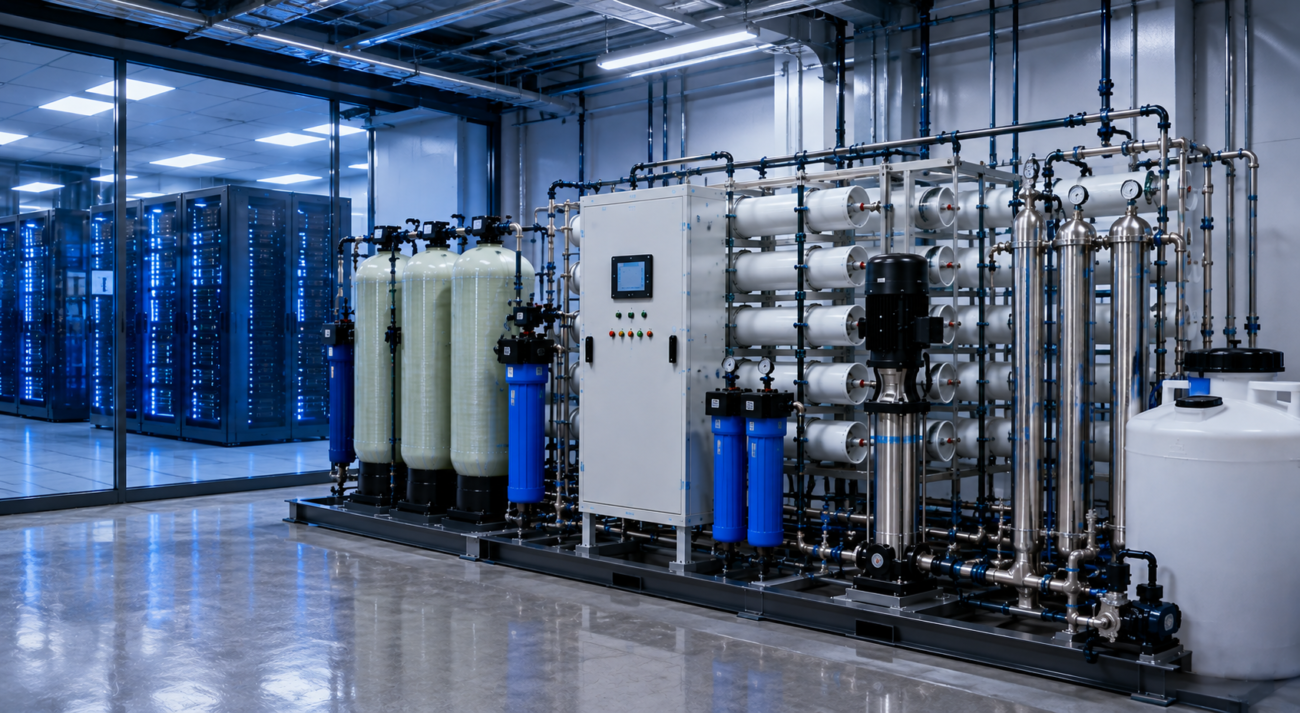
Get an Infrastructure Engineering Quote built around your actual site water report, target rack density, and redundancy requirement — not a generic system sized off square footage.
Frequently Asked Questions
What TDS level is acceptable for data center cooling tower makeup water? Most ASHRAE TC 9.9-aligned designs target makeup water TDS low enough to sustain 6–8 cycles of concentration without exceeding roughly 1,500–2,000 ppm TDS in the recirculating loop, though the ceiling depends on site-specific silica and hardness levels.
What resistivity is required for direct-to-CDU makeup water? EDI-polished makeup water for CDU loops typically targets 16–18 MΩ·cm at point of use, with stability across seasonal feed-water variation weighted more heavily than peak resistivity.
How does reclaimed water change RO system design for data centers? Reclaimed water feeds generally require higher anti-scalant dosing precision and a lower target recovery rate — often 70–75% instead of 80–85% — to keep silica below its solubility threshold in the RO concentrate.
What GPM sizing margin should a data center RO system carry? Systems should be sized against peak simultaneous demand from cooling tower blowdown replacement and CDU fluid makeup, with continuous 24/7/365 duty-cycle capacity rather than commercial 8-hour duty-cycle ratings, plus margin for redundancy testing.
Why does cold water reduce RO system output in winter months? RO membrane flux declines as feed water temperature drops, so systems sized only against summer design-day temperature underproduce in colder months unless a temperature correction factor is built into the original array sizing.
What redundancy level should a mission-critical water treatment system carry? Facilities targeting 99.999% uptime commitments generally specify N+1 at minimum, with 2N architecture common on flagship or multi-tenant campuses where a treatment train outage cannot coincide with any maintenance window.
Does recycled cooling tower water require different biocide dosing than municipal water? Yes — reclaimed water typically carries higher organic loading, requiring more frequent or higher-concentration biocide dosing cycles, ideally automated and BMS-integrated rather than manually scheduled.
Get a Custom Engineering Quote for Your Data Center Water System
Generic water treatment sizing doesn’t hold up against a 40kW+ rack, a reclaimed water feed, or a 99.999% uptime SLA. If your next build — or your next capacity expansion — needs a water system engineered around actual site water chemistry, redundancy requirements, and BMS integration specs, the sizing conversation should start with your site’s water report, not a catalog page.
Get an Infrastructure Engineering Quote, request full Technical Data Sheets for RO, EDI, and skid-mounted system options, or ask about B2B factory-direct pricing for multi-site or campus-scale procurement.