
Outdoor Whole House Water Filter: How to Install One That Survives the Weather

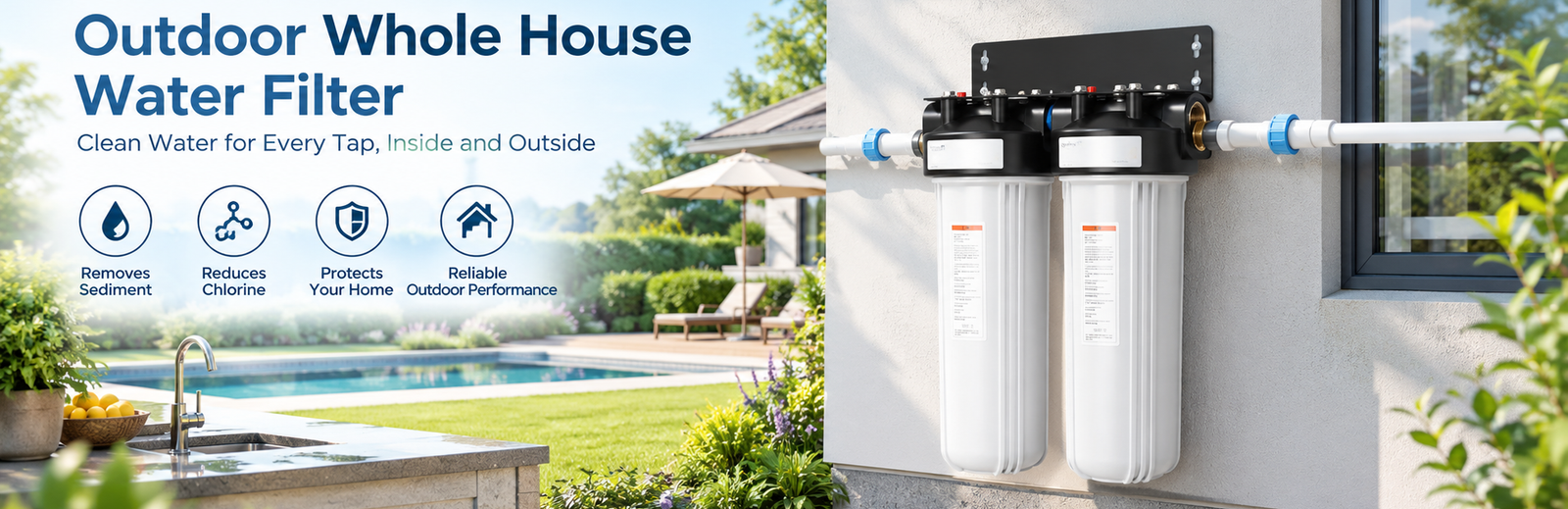
Yes, an outdoor whole house water filter works well if you protect it from freezing and direct sun. Most outdoor installs go where the main line rises out of the ground near the house, inside an insulated, shaded enclosure. In mild climates that is simple. In places with hard freezes, it needs heat or a below-frost location.
Check these five things before you commit to an outdoor location:
- Lowest winter temperature where the filter will sit
- Sun exposure on the housings during the day
- Where irrigation branches off the main line
- Access for changing cartridges in bad weather
- The filter’s rated temperature range, usually printed on the spec sheet
Can You Install a Whole House Water Filter Outside?
You can, and in many Sun Belt homes it is the normal location. Slab foundations, no basement, and water heaters in the garage or attic often leave the outside wall as the only spot where the main line is accessible.
The trade-off is exposure. Indoors, a filter sits at room temperature in the dark. Outdoors, it faces freezing nights, summer heat, and UV light. Each of those has a simple fix, covered below. If you only want the short answer and pros and cons, see can a whole house water filter be installed outside.
Where to Tap the Main Line Outdoors
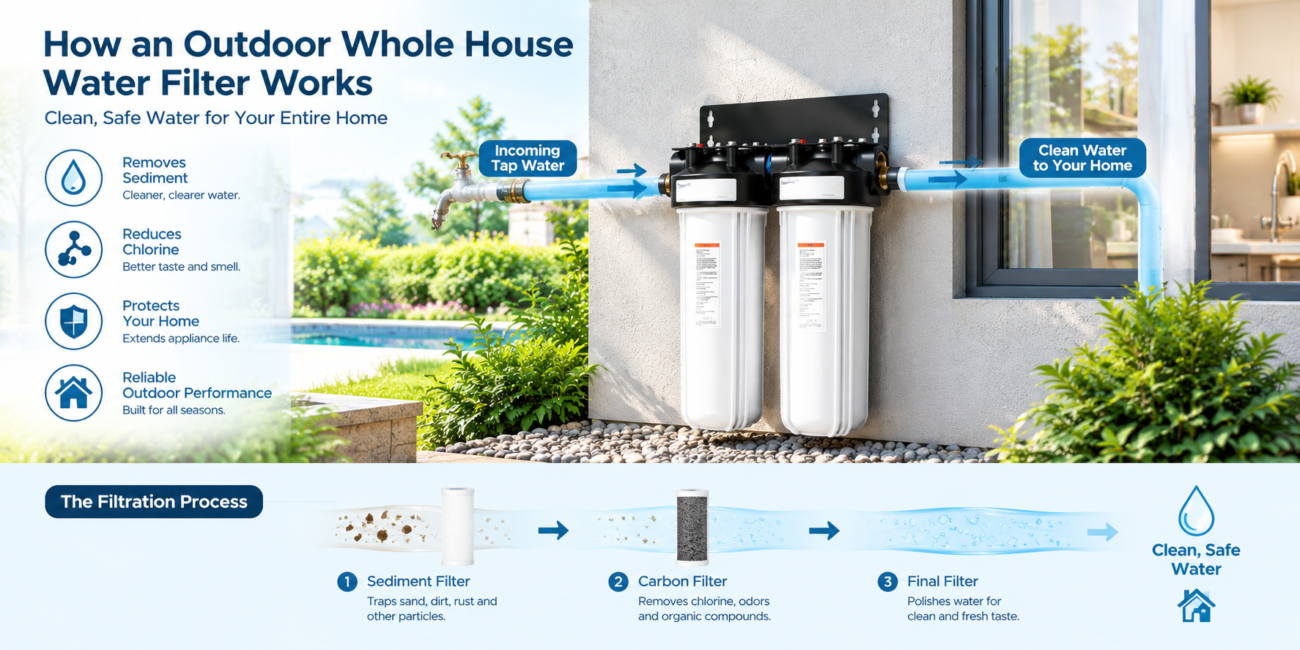
Most homes have the main entering near a hose bib or at the point where it comes up from the meter. Three placement rules matter:
- After the main shutoff, so you can isolate the filter.
- After the irrigation branch. Watering the lawn with filtered water uses up cartridge capacity for no benefit. Put the filter on the line that feeds the house, downstream of the irrigation tee.
- Close to the wall, so the enclosure can share the house’s warmth and the pipe run stays short.
If the hose bibs are on the filtered side, expect sediment cartridges to load faster when you use them heavily.
Freeze Protection: The Part That Decides Success
A filter housing full of water that freezes will crack. So will the fittings around it.
Your options, from mild to cold climates:
- Insulated enclosure. A box or cabinet lined with rigid foam board, sealed against wind. Enough in areas with only occasional light frost.
- Heat source inside the enclosure. Self-regulating heat cable rated for the pipe material, or a small thermostatically controlled heater in the box. Needed where nights regularly drop below freezing.
- Below-frost installation. Some homes place the filter in a meter pit or vault below the frost line. Check with your utility, since meter boxes often belong to them.
- Seasonal drain-down. For vacation homes, isolate the filter, drain the housings, and remove cartridges for winter.
Insulate exposed pipe on both sides of the filter, not just the housings. Fittings and short pipe runs freeze first.

Sun and Heat: Protect the Housings
UV light breaks down many plastics over time, making housings brittle. Sunlight through a clear housing also grows algae on the cartridge and inside the sump.
- Use opaque housings, or cover clear ones.
- Mount the system on the shaded side of the house where possible.
- Keep it inside an enclosure that blocks direct sun.
- Watch the upper temperature limit. A dark box in full summer sun can get much hotter than the air around it, so vent the enclosure or shade it.
Plumbing Details for an Outdoor Install
Outdoor installs follow the same steps as indoor ones, with a few additions:
- Bypass loop with three valves, so you can service the filter without shutting off the house
- Pressure gauges before and after the housings, mounted where you can read them without opening the enclosure if possible
- Unions on both sides, so the filter can be removed for winter or replacement
- Bonding jumper if you cut metal pipe that is part of the electrical ground
- Pipe supports. Do not let the housings hang on the pipe alone, especially where ground movement or frost heave is possible.
For the full procedure, see our step-by-step guide to install a whole house water filtration system.
Maintenance Outdoors
Outdoor filters need the same cartridge schedule as indoor ones, plus a few seasonal checks:
- Before winter: confirm the heat source works, check insulation, and replace a cartridge that is close to its interval so you are not changing it in freezing weather.
- After heavy rain or flooding: check that the enclosure stayed dry.
- In summer: look for algae in clear sumps, and check that housings are not discolored or chalky, which is a sign of UV damage.
- At every change: inspect and lubricate the O-ring with food-grade silicone. Temperature swings are hard on seals.
Sediment cartridges commonly need changing every 3 to 6 months on city water. See how often to change a whole house water filter for intervals by water type.
Which Filter Configuration for Outdoor Use?
The water treatment choice is the same as indoors. Pick the stages for your water, then plan the enclosure around them.
| Water situation | Configuration | Outdoor note |
|---|---|---|
| City water, chlorine taste | Sediment + carbon block | Simple two-housing enclosure |
| City water, chloramine | Sediment + two carbon stages | Wider enclosure for three housings |
| Moderately hard water | Sediment + scale inhibitor | Same footprint as sediment + carbon |
| Hard water | Filter outdoors, softener indoors or in garage | Softeners need a drain and power and are harder to protect outdoors |
| Well water | Sediment outdoors near the wellhead, other stages indoors | Keep complex equipment where it is easier to service |
Not sure what your water needs? Our whole house water filter overview walks through the options.
Common Outdoor Installation Mistakes
Most outdoor failures we see trace back to one of these:
- Insulating the housings but not the pipe. The short exposed copper or PEX runs between the wall and the filter freeze first.
- A heat source with no power backup plan. A heat cable does nothing during a winter power cut. In freeze-prone areas, know how to isolate and drain the filter quickly.
- Clear housings in full sun. Algae grows on the cartridge within weeks, and the plastic ages faster.
- No unions. Without them, replacing a cracked housing means cutting pipe again, often in bad weather.
- Filtering the irrigation line. Sediment cartridges load up in a single watering season.
- An enclosure that traps water. Leave a drain hole at the bottom so a leak or rain does not pool around the housings and freeze.
How YourWaterGood’s Systems Fit an Outdoor Install
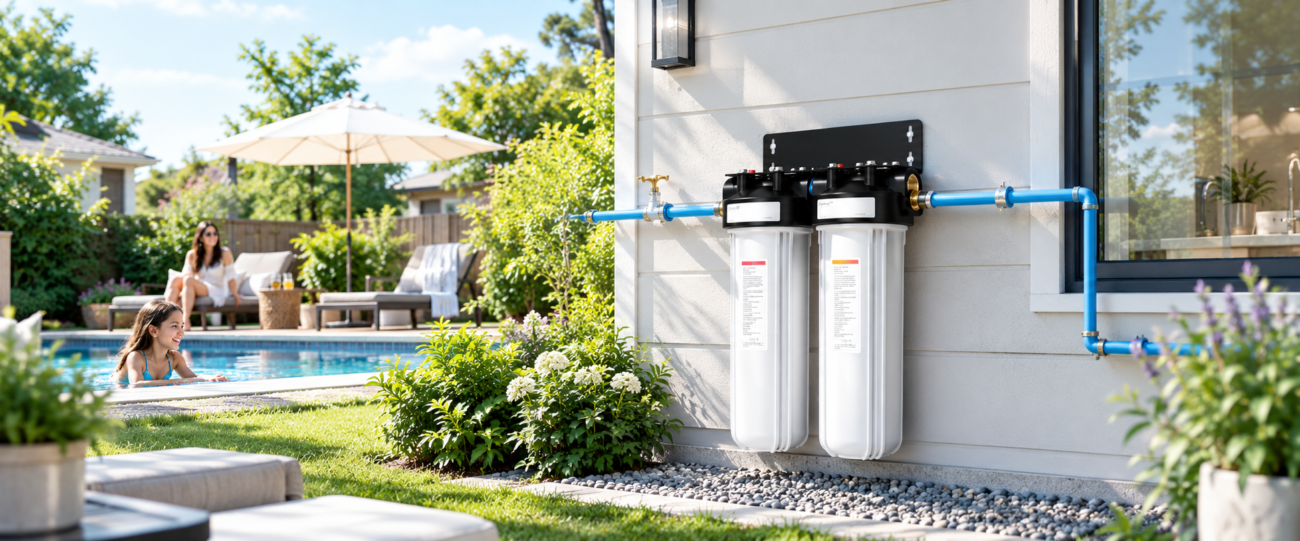
Both of our cartridge systems are compact and need no electricity, which keeps an outdoor enclosure simple.
- Our 2-stage whole house water filter comes as PP cotton + CTO carbon block for city water taste and odor, or PP cotton + polyphosphate scale inhibitor to slow scale without salt.
- Our 3-stage system runs 1-micron PP cotton, UDF granular carbon, and a CTO carbon block. It is rated for 14.5 to 58 PSI and an operating range of 41 to 100°F (5 to 38°C).
That temperature range matters outdoors. Below 41°F the housings must be kept warm, so plan heat or insulation in any climate with cold nights. Above 100°F, shade and ventilate the enclosure.
For Installers, Property Managers and Brands
Outdoor installs are common in warm-climate tract housing, where one enclosure design fits many homes. We supply whole house systems and replacement cartridges in volume, with spec sheets and wholesale pricing on request.
FAQ
Can a whole house water filter be installed outside?
Yes. Use an insulated, shaded enclosure, add heat where nights drop below freezing, and keep the filter on the house side of the irrigation branch.
How do I keep an outdoor water filter from freezing?
Insulate the enclosure and the exposed pipe on both sides of the filter. In colder climates, add a self-regulating heat cable or a thermostatically controlled heater in the box, or install below the frost line.
Does sunlight damage water filter housings?
Yes. UV light can make many plastics brittle over time, and sunlight through clear housings encourages algae. Use opaque housings or keep the system in a shaded enclosure.
Should outdoor hose bibs be filtered?
Usually not. Filtering irrigation water uses up cartridge capacity quickly. Place the filter after the branch that feeds irrigation, unless you specifically want filtered water outdoors.
Is an outdoor filter harder to maintain?
Slightly. Cartridge changes are the same, but you add seasonal checks: heat and insulation before winter, and UV and algae checks in summer.
Can I put a water softener outside too?
It is possible but harder. Softeners need power, a drain, and protection for the brine tank and control valve. Many homes put the filter outside and the softener in the garage.
Plan Your Outdoor Installation
Tell us your climate, water source, and where your main line is accessible. We will recommend a configuration and the enclosure considerations for your outdoor whole house water filter, and send the spec sheet. Installers can request wholesale pricing from YourWaterGood.